
EDK2, formally EDK II, is TianoCore’s open-source firmware development environment for implementing the UEFI and Platform Initialization specifications. It supplies code and build infrastructure from which platform firmware can be assembled. It is not a universal BIOS update that an operator can install on any computer. TianoCore’s project overview is the authoritative starting point for that distinction.
For a security engineer, the important relationship runs from source code through build choices to the firmware that actually executes. Finding a vulnerable module in the upstream repository does not establish that an organization’s laptop, server, or virtual machine includes it. Finding an upstream repair does not establish that a supported downstream image contains the repair either.
A useful EDK2 assessment preserves both sides of that relationship: what the project provides and what the platform ships. That approach makes a vulnerability report actionable without treating the entire UEFI ecosystem as one product.
UEFI, TianoCore, EDK II, and OVMF describe different things
| Plazo | Papel | Useful evidence for an assessment |
|---|---|---|
| UEFI | Firmware interface specification | Relevant interfaces and platform behavior |
| Platform Initialization, or PI | Specification for firmware initialization architecture | Execution phase and component contracts |
| TianoCore | Community supporting open-source firmware development | Project documentation and upstream notices |
| EDK II | Implementation code, libraries, tools, and build environment | Revision, selected modules, configuration, and patches |
| OVMF | EDK II-based virtual-machine firmware project | Selected firmware artifact and guest configuration |
| OEM firmware image | Platform-specific delivered firmware | Manufacturer, model, image revision, and update mapping |
These relationships are documented in TianoCore’s introduction and its OVMF project description. OVMF provides UEFI firmware for virtual-machine environments, with QEMU and KVM as documented examples. That does not make every virtual machine an OVMF deployment, or every UEFI implementation an EDK II build.
These distinctions answer different operational questions. A device inventory can establish the platform manufacturer and current firmware revision. A source repository establishes available code. A virtualization definition identifies the guest’s selected firmware. Joining those records requires a maintained mapping; their names alone do not provide it.
Start with the package tree, then follow selection
En upstream EDK II repository contains packages including MdePkg, MdeModulePkg, NetworkPkg, SecurityPkg, OvmfPkg, and UnitTestFrameworkPkg. The package layout is a navigation aid: it helps locate declarations, implementation modules, platform code, and tests. It is not a bill of materials for every output image.
Ask a sequence of progressively stronger questions. Is the relevant code in the maintained source tree? Is the module selected by this platform’s build? Which library implementation does it use? Does the generated image contain it? Does the platform’s configuration cause it to execute on the path being assessed?
Each answer narrows the next investigation. A component omitted from the deployed image requires different treatment from an included component whose feature is temporarily disabled. The latter can become relevant after a recovery action or configuration change. Record the reason for the disposition, rather than only an affected or unaffected label.
Suppose a hypothetical platform tree contains two network implementations, but a particular product builds only one. Searching both trees for a function name proves availability of source, not selection. Conversely, removing a component from one build configuration says nothing about another platform configuration maintained in the same repository. The build target is part of the security evidence.
The build files explain how code becomes a firmware image
TianoCore’s build-description documentation distinguishes module information in INF files, package declarations in DEC files, and platform build choices in DSC files. Library resolution is particularly important: a module names a library class, while the platform configuration selects an implementation. Reading the module alone can therefore leave a material dependency unresolved.
| File or setting | What to inspect | Security question |
|---|---|---|
| INF | Module sources, dependencies, type, and entry information | Which implementation and interfaces belong to this component? |
| DEC | Package declarations and configurable interfaces | Which declarations and configuration tokens are being consumed? |
| DSC | Selected components and library instances | Which implementation is selected for this platform? |
| FDF | Firmware-image contents and layout | Which selected components enter the delivered artifact? |
| PCD values | Relevant configuration values and overrides | Which behavior does this build enable? |
The FDF role is described in the EDK II specification catalog: it describes binary-image content and layout. A source correction, a successful module build, and inclusion in the final image are distinct milestones.
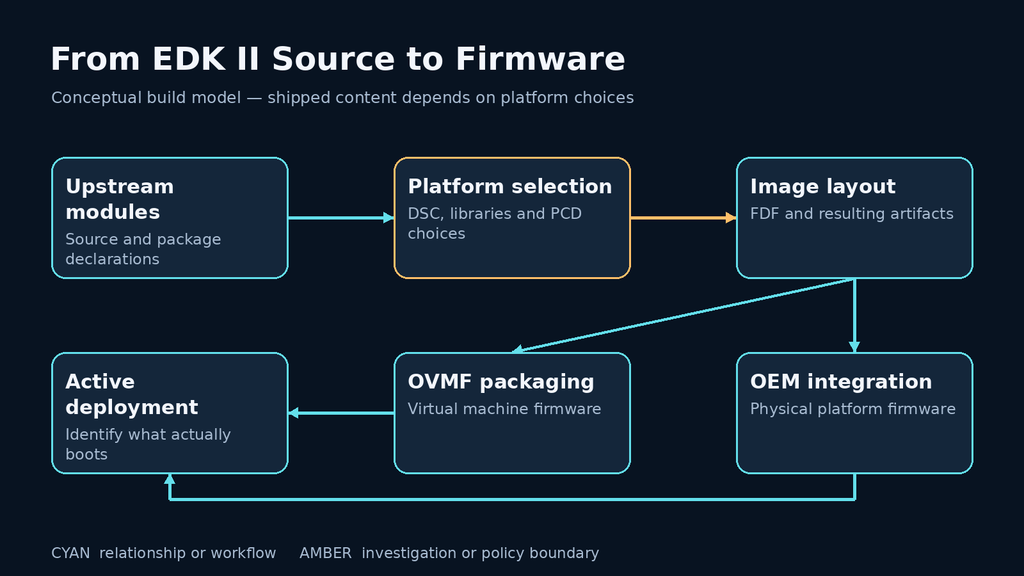
A careful review follows the specific component through these decisions. Retain the build target, architecture, configuration inputs, source revision, and any downstream changes. If a conclusion depends on a feature being excluded, preserve the evidence establishing exclusion and identify what change would invalidate it.
Do not infer a selected value from an upstream default when the platform can override it. Equally, do not assume that a configuration knob has a security effect simply because its name sounds relevant. Trace the value into the implementation and identify the operation it changes. This is a source-review task, not a reason to modify production firmware settings during inventory.
Execution context changes the trust boundary
En PI specification’s DXE Foundation chapter describes a dispatcher that discovers and executes DXE drivers, along with the services and protocols those components use. This explains why firmware review needs more than a familiar application threat model: the component may run before the operating system and its normal monitoring tools are active.
Still, “before the OS” is an execution context, not an exploit proof. Identify the input consumed by the component, who controls that input, when the component receives it, and which outcome the public evidence establishes. Keep a memory-corruption finding separate from a demonstrated durable firmware modification or a proven boot-policy bypass.
This prevents two common errors. The first is assuming that Secure Boot repairs arbitrary input-handling defects. The second is assuming that any pre-OS execution claim proves persistent compromise. Both conclusions require evidence beyond a component’s location in the boot process.
For an implementation review, write the boundary as a concrete sentence: a named component accepts a named class of input under specified platform conditions. Then identify the check that should constrain that input. If the mechanism is not public, keep the diagram and review plan conceptual instead of inventing an internal function or packet format.
Inspect an owned source checkout without changing it
The following commands are for an existing, authorized EDK II checkout. They record provenance and locate build-description files; they do not build, execute, flash, or download firmware.
git rev-parse HEAD
git status --short
git submodule status
rg --files -g '*.inf' -g '*.dec' -g '*.dsc' -g '*.fdf'
rg -n '^\[Components|^\[LibraryClasses' --glob '*.dsc' .
Record the output alongside the platform target being reviewed. A clean worktree is useful, but it does not establish that a revision is secure. A dirty worktree needs explanation because local changes may alter the implementation under investigation. Submodule information helps retain dependency identity without assuming that the top-level commit fully describes the tree.
After locating the relevant module, inspect its selected libraries and configuration in the target platform. Prefer focused searches to a repository-wide conclusion based on a single match. When a maintained fork uses an equivalent backport, compare the repaired behavior and tests rather than requiring the upstream commit identifier to appear unchanged.
OVMF introduces a second delivery chain
For a physical server, the supported delivery path generally comes from its platform supplier. For an OVMF guest, the assessment also needs the hypervisor’s selected firmware artifact. The guest operating system’s package list cannot, by itself, identify the firmware supplied by the host.
En libvirt domain format reference documents firmware loader selection and variable storage. In deployments using that model, collect the loader path, associated package or artifact identity, and guest-specific variable-store information through approved tooling. Distribution paths and formats vary; do not hard-code an example filename into a universal detection rule.
Consider a host whose firmware package has been updated while an older VM template refers to a private copy elsewhere. The package update is relevant evidence for its managed files. It does not establish the identity of the copied artifact. The remediation plan must inventory the path actually selected by each affected guest group.
Secure Boot adds another state question. libvirt’s Secure Boot guidance distinguishes capable firmware from firmware with enrolled keys, and explains that changing an existing VM involves its persistent variable state. A capability label or a new XML preference is insufficient evidence of the guest’s effective trust policy. Follow supported platform procedures; do not casually reset a production guest’s variable store.
An evidence model preserves unresolved component states
This original, offline Python example models assessment status. It does not inspect firmware and is not a vulnerability detector. Its purpose is to make the difference between an unknown component, an excluded component, a mitigation, and a verified repair explicit.
def disposition(component_present, path_enabled, fix_verified):
    if component_present is False:
        return "excluded-by-component-evidence"
    if component_present is not True:
        return "unresolved-component"
    if fix_verified is True:
        return "verified-repair"
    if path_enabled is False:
        return "mitigated-pending-repair"
    return "requires-remediation-review"


assert disposition(None, False, False) == "unresolved-component"
assert disposition(False, None, False) == "excluded-by-component-evidence"
assert disposition(True, False, False) == "mitigated-pending-repair"
assert disposition(True, True, True) == "verified-repair"
print("Synthetic evidence-state checks passed")
The ordering is deliberate. A disabled path cannot establish which component is installed. Once the component is established, a disabled feature can support a mitigation decision while leaving the repair unfinished. In a real record, every input to this function needs a source, collection time, and owner; a Boolean without provenance is only another assumption.
Trace a fix to an active artifact
A useful repair record connects the upstream advisory or correction to downstream integration, an approved firmware artifact, deployment, and activation. Firmware developers may have build manifests and regression results. Operators using supported OEM releases may instead rely on a vendor’s platform-specific mapping. Those are different evidence routes to a specific disposition.
A version string alone is often too weak a join. Preserve the vendor’s exact model scope and release mapping. If the supplier says a repair was backported, retain that statement with its applicable revisions. If the supplier has not determined applicability, keep the affected assets unresolved and assign the next deliverable.
For source-maintained deployments, test the changed contract and relevant legitimate behavior. A bounds repair, for example, calls for evidence about the accepted input range, chosen copy length, output contents, and boundary conditions. Merely showing that one input no longer crashes is a weaker result. This is a general review method, not a claim about an undisclosed EDK II flaw.
For deployment acceptance, read the active revision or selected artifact after the required activation sequence and exercise normal startup and recovery. A source commit merged upstream, an image downloaded locally, and a firmware update scheduled for the next restart should retain their own statuses until the corresponding transitions are complete.
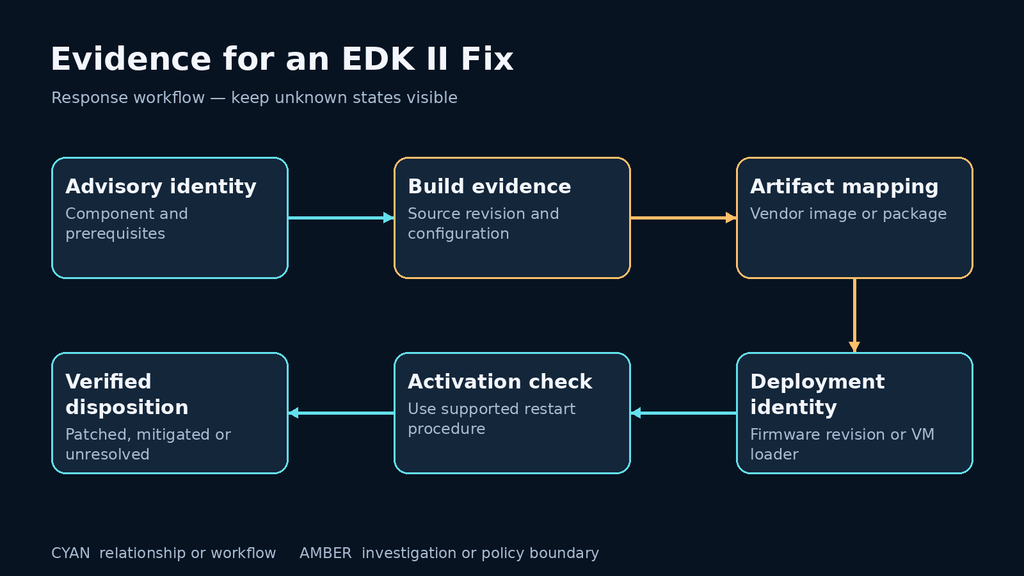
Plan lifecycle events as revalidation triggers. A board replacement, VM migration, template restore, or recovery workflow can alter which firmware runs or which features become reachable. An assessment remains useful when its conditions are explicit enough that the next engineer can recognize such a change.
Frequently asked questions
Is EDK2 the same as UEFI?
- No. UEFI describes interfaces; EDK II supplies an implementation environment. Evaluate the platform’s actual implementation rather than inferring it from the specification label.
Does every EDK II package enter every firmware image?
- No. Follow the target’s component selection, library resolution, configuration, and image layout. Source presence alone is insufficient.
Is OVMF an operating system?
- No. It supplies virtual-machine firmware. Its delivery and selection belong in the host and VM configuration review.
Can I flash a generic EDK II build onto a production motherboard?
- Use the platform supplier’s supported process. A generic development output does not establish compatibility, recovery support, or approval for that board.
Does Secure Boot mean an EDK II vulnerability is irrelevant?
- No. Identify which control addresses the reported input and behavior. Image authorization and implementation memory safety answer different questions.
What evidence closes an EDK2-related finding?
- Retain component applicability, the supported fix mapping, the deployed and active artifact identity, required functional checks, and any conditions that require reassessment.
EDK II becomes manageable when a team can connect a component-level claim to a selected build and a specific active platform. The missing connection is usually the next engineering task: a library choice, vendor mapping, loader identity, or activation result. Name it, collect it, and keep the final disposition no broader than the evidence.
 Spanish
 English
 German
 French
 Portuguese
 Japanese
 Korean
 Hindi
 Arabic
 Turkish
 Hebrew