
Last updated: November 4, 2026.
Internal network penetration testing measures what an attacker or compromised user could reach after crossing the perimeter. The engagement should test identity controls, endpoint and server exposure, network segmentation, credential paths and access to sensitive systems without turning the exercise into uncontrolled lateral movement.
A useful scope starts with explicit assumptions: an ordinary employee account, a managed workstation, an unmanaged device on a guest segment, or a foothold in a defined subnet. Different starting conditions answer different risk questions, so the report must keep them separate.
For the assessment framework, consult NIST SP 800-115 and map the relevant guidance to the actual environment and authorized scope.
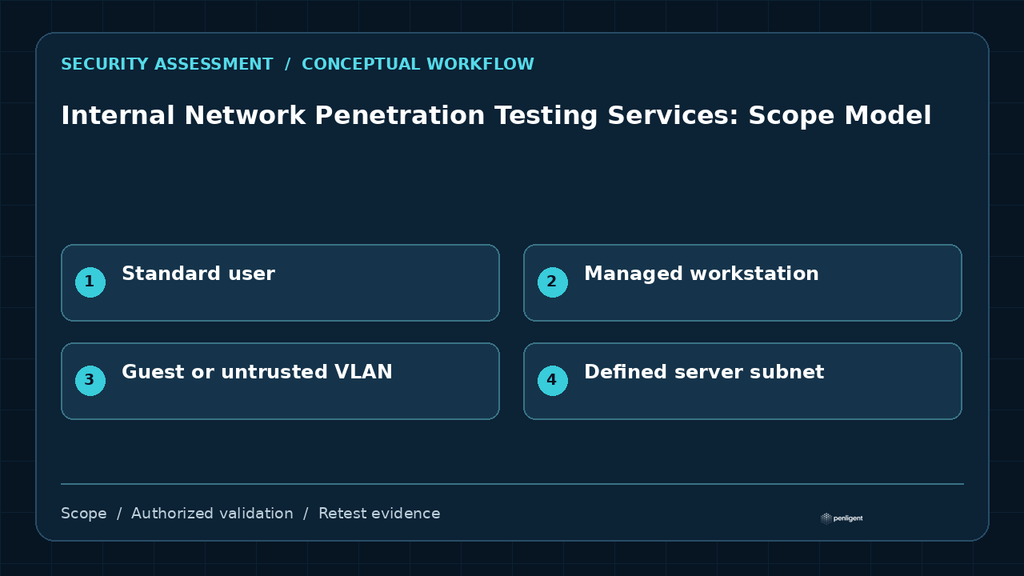
Build a starting-position matrix
The rules of engagement should define each initial identity and network position, approved targets, prohibited systems and actions that require real-time approval.
| Starting point | Question answered | Typical evidence |
|---|---|---|
| Standard user | Can ordinary access be escalated or reused? | Group memberships, reachable services and privilege transitions |
| Managed workstation | Can local compromise expose credentials or management paths? | Local controls, service configuration and authenticated connections |
| Guest or untrusted VLAN | Does segmentation prevent access to internal services? | Permitted routes, blocked routes and unexpected listeners |
| Defined server subnet | Can one workload reach higher-trust systems? | Service accounts, east-west access and administrative paths |
Turn the scope into testable evidence
Define an authorized target, validate meaningful attack paths, and keep the evidence connected to remediation and retesting.
Test identity and segmentation as one system
Directory security and network segmentation interact. A network rule may block one route while an over-privileged service account, management interface or shared credential creates another. Testing should therefore combine identity enumeration, privilege relationships, service exposure and allowed communication paths.
- Active Directory or equivalent identity relationships, delegation and privileged groups.
- Credential storage and reuse without collecting unnecessary sensitive material.
- Administrative protocols, remote management and legacy authentication.
- Segmentation between users, servers, management, backups and regulated environments.
- Paths from ordinary access to business-critical systems, with approval before disruptive validation.
Control operational risk
Internal tests can affect authentication systems, monitoring platforms and fragile services. Rate limits, maintenance windows, excluded hosts, account lockout thresholds and emergency contacts belong in the rules of engagement. Proof should stop when the agreed control failure is demonstrated; dumping data or expanding access rarely adds decision value.
Define closure evidence
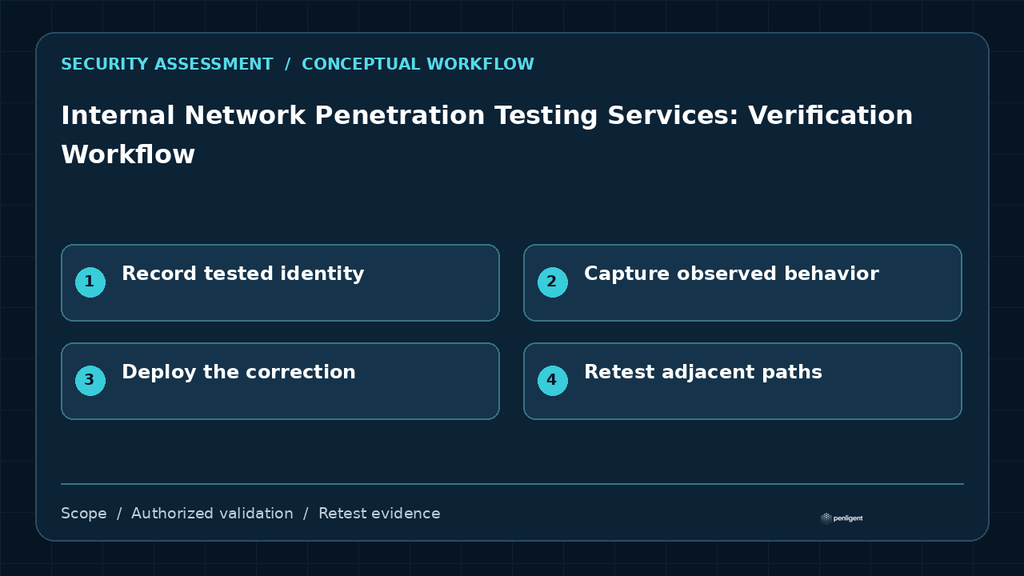
The report should show the original starting point, the control that failed, the minimum path needed to demonstrate impact and the asset reached. Retesting should validate both the direct fix and the surrounding regression risk, such as alternative groups, protocols or routes.
Turn the scope into testable evidence
Define an authorized target, validate meaningful attack paths, and keep the evidence connected to remediation and retesting.
Questions buyers should ask
- Which starting identities and network locations are included?
- Are Active Directory, cloud identity and endpoint management relationships in scope?
- How are account lockouts, fragile systems and production safety handled?
- Will the retest verify segmentation and identity changes together?
Conclusión
An internal pentest should produce a defensible map from initial access to material impact. The value is not the number of hosts touched; it is evidence that identity, segmentation and administrative controls either stop or permit a realistic path.
 Spanish
 English
 German
 French
 Portuguese
 Japanese
 Korean
 Hindi
 Arabic
 Turkish
 Hebrew