
LiteLLM versions 1.82.7 and 1.82.8 published on PyPI on March 24, 2026 were publicly identified as malicious. The most important technical detail is not merely that a package was poisoned, but that version 1.82.8 introduced a litellm_init.pth file. In Python, executable lines in a .pth file are processed by the site module at interpreter startup, so this changed the incident from an import-triggered compromise into something that could fire on ordinary Python startup. Public incident tracking also states that 1.82.7 carried its payload in litellm/proxy/proxy_server.py, while 1.82.8 carried both that payload and the new .pth launcher. (GitHub)
That distinction matters because LiteLLM is not a cosmetic helper. Its own documentation and PyPI description position it as both a Python SDK and an AI gateway that provides a unified interface to more than 100 model providers, with features such as routing, logging, cost tracking, auth, virtual keys, and MCP gateway support. In many teams it sits close to the highest-value secrets in the stack: cloud credentials, model provider keys, tenant keys, gateway config, prompt logs, and integration tokens. A compromise here is not “just a dependency problem.” It is a control plane problem for AI infrastructure. (PyPI)
Public incident threads on the LiteLLM repository describe the malicious package behavior as credential theft and exfiltration to https://models.litellm.cloud/. The detailed issue text says the payload collected environment variables and sensitive files, encrypted the bundle using hybrid encryption, and sent it out over HTTP POST. A related issue tracking the broader incident says the compromised PyPI releases were published by an attacker through the maintainer’s release path rather than through the project’s normal public release flow, and the project page on PyPI currently shows 1.82.6 as the latest visible release, not 1.82.7 or 1.82.8. (GitHub)
The result is a supply chain incident with a shape that security teams should recognize immediately. The attacker did not need to exploit LiteLLM users directly through an exposed web endpoint. They only needed to get a trusted release into a trusted package channel. Once that happens, developer machines, CI runners, shared gateways, and agent hosts all become collection points. That pattern is familiar from earlier ecosystem compromises, but the AI stack makes it worse because the same machine often holds keys for several LLM vendors, cloud APIs, vector stores, observability backends, and tool integrations at once. (GitHub)
What LiteLLM Is and Why This Package Matters
It is easy to underestimate the impact of a poisoned Python package when the package name sounds like a normal application dependency. LiteLLM is closer to a multiplexing layer for AI applications than to a single-purpose helper library. Its public docs describe two main usage patterns. One is the Python SDK, which lets application code call many model providers through one interface. The other is the proxy and gateway layer, which centralizes policy and traffic for multiple models, users, and teams. The same docs expose routing, budget controls, logging, prompt management, secret manager integration, and MCP gateway features. That is exactly the kind of software that ends up running near privileged secrets and shared infrastructure. (PyPI)
The package’s PyPI page reinforces that architecture. It explicitly markets LiteLLM as a way to access 100-plus LLMs through either a proxy server or a Python SDK, and it documents integration with MCP-style tooling. That means the same component can exist on a local developer laptop, inside a service mesh, in a central inference gateway, in an IDE plugin workflow, or inside automation that talks to remote tools. An attacker does not need every deployment mode to be compromised for the incident to be severe. Any one of those positions can already be enough. (PyPI)
That architecture also changes how defenders should think about blast radius. A compromised logging library may expose tokens that sit in process memory. A compromised web framework package may expose a subset of services built with it. A compromised AI gateway package can expose a matrix of dependencies: OpenAI keys, Anthropic keys, Azure OpenAI credentials, Bedrock config, Vertex settings, Redis or Postgres connection strings, tool gateway secrets, and whatever else the surrounding environment uses to operate the gateway. Public issue text for the LiteLLM incident explicitly lists many of those target categories. (GitHub)
A useful way to frame the incident is to map LiteLLM’s deployment position to likely secrets at risk.
| Environment | Why LiteLLM appears there | High value secrets likely nearby | Por qué es importante ahora |
|---|---|---|---|
| Developer laptop | Local SDK use, IDE tools, agent experiments | SSH keys, cloud CLIs, .env files, Git credentials | Public incident writeups say those categories were targeted. (GitHub) |
| CI runner | Test installs, packaging, release validation | PyPI publish tokens, cloud deploy keys, GitHub tokens | The maintainer said the exposed release path involved a PyPI publish token in CI, in the context of the Trivy compromise. (Hacker News) |
| Shared AI gateway | Proxy mode, budgets, auth, logging, multi-tenant routing | Provider API keys, tenant virtual keys, logs | LiteLLM’s docs and PyPI page describe exactly those gateway functions. (PyPI) |
| Agent host | MCP gateway and tool execution | Tool credentials, callback secrets, policy config | LiteLLM docs expose MCP usage and gateway integration. (PyPI) |
| Kubernetes workload | Self-hosted gateway or AI app deployment | kubeconfig, service account tokens, mounted secrets | The public malware description explicitly includes Kubernetes-related credentials among collection targets. (GitHub) |
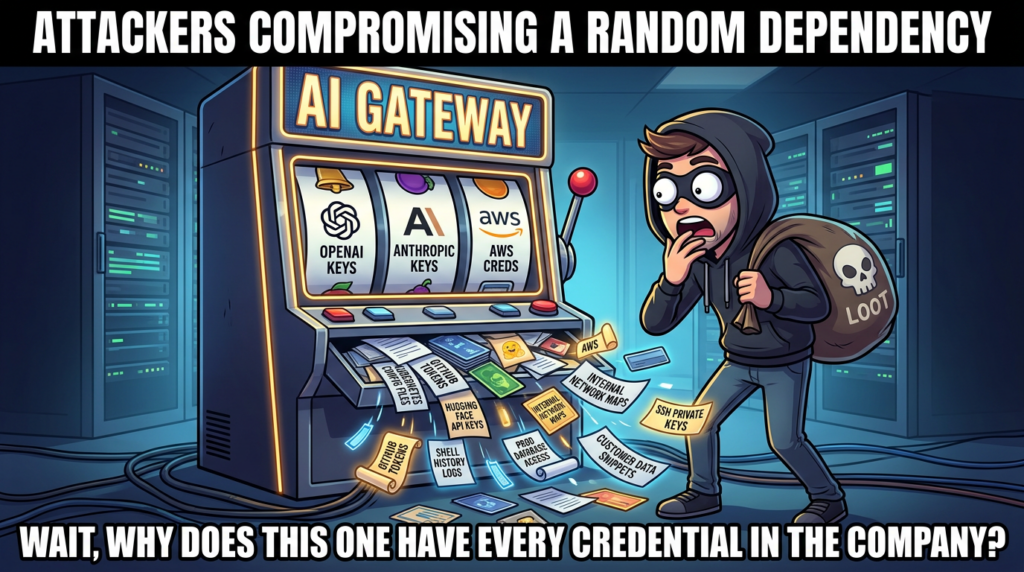
Most shallow reporting stops at “this package had a credential stealer.” That is true, but incomplete. The more important conclusion is that a gateway package aggregates the exact kinds of secrets an attacker wants to steal at once. That is why teams evaluating exposure should rank environments by privilege concentration, not by package importance alone. A small shared gateway node may deserve more urgent attention than ten ordinary developer laptops if it concentrates tenant keys and model-provider credentials. That ranking is a judgment call, but it follows directly from what LiteLLM is designed to do. (PyPI)
What Is Confirmed as of March 25, 2026
The most reliable public facts currently come from the LiteLLM GitHub issues, the Python documentation, the PyPI project page, and follow-on reporting that points back to the same technical artifacts. The issue titled “litellm PyPI package compromised — full timeline and status” states that malicious versions 1.82.7 and 1.82.8 were published, that 1.82.7 embedded a payload in litellm/proxy/proxy_server.py, and that 1.82.8 added litellm_init.pth, making execution possible on any normal Python startup. Another issue, focused specifically on the .pth file, describes the data collection and exfiltration logic and names the exfiltration endpoint as https://models.litellm.cloud/. (GitHub)
The PyPI project page currently shows litellm 1.82.6 as the latest visible version, released on March 22, 2026. The project page does not list 1.82.7 or 1.82.8 as current downloadable versions. Users on the LiteLLM issue tracker reported that PyPI had quarantined the package, and the LiteLLM maintainer wrote on Hacker News that the package was in quarantine and later said the impacted versions had been deleted from PyPI. That combination strongly supports the operational assumption that the malicious uploads were removed quickly, but it does not reduce the urgency for anyone who installed them during the exposure window. (PyPI)
One point that deserves precision is the question of release provenance. The incident-tracking issue says the malicious PyPI uploads were not part of the project’s normal public GitHub release flow. That matches the visible state of the public GitHub release history and the PyPI project page: the current public project page shows 1.82.6 on PyPI, while incident tracking points to 1.82.7 and 1.82.8 as attacker-published malicious versions. Teams should not treat this as a subtle packaging discrepancy. It means the attacker achieved something more serious than a code change on the default branch: they reached the release channel trusted by consumers. (GitHub)
The public description of the exfiltration path is also quite specific. The issue text says the .pth file launched a base64-obfuscated Python payload through subprocess.Popen, collected files and environment data, encrypted them with AES-256-CBC plus RSA, and sent the result to models.litellm.cloud with an X-Filename: tpcp.tar.gz header. That is more than enough detail to drive IOC-based hunting even if a full vendor postmortem has not yet been published. You do not need to wait for a polished incident report to start looking for that domain, that file name, and that file path. (GitHub)
The maintainer also posted an important attribution clue on Hacker News. In that discussion, he said the issue appeared to originate from the recent Trivy compromise and that the exposed secret was a PYPI_PUBLISH token stored as an environment variable in the project’s CI. That is not a formal postmortem, and it should be treated as an evolving statement, but it fits the broader public timeline around the Trivy incident and the known risk of long-lived release credentials in CI. (Hacker News)
A compact version-by-version summary helps separate what is urgent from what is merely interesting.
| Version | Where the malicious logic lived | What triggered it | Operational meaning |
|---|---|---|---|
| 1.82.7 | litellm/proxy/proxy_server.py | Import path involving the proxy code | Still serious, but not every Python startup would trigger it. (GitHub) |
| 1.82.8 | litellm_init.pth plus proxy_server.py | Normal Python startup through site processing | Far broader trigger surface, because .pth executable lines run at Python startup. (GitHub) |
The difference between those two rows is the difference between “dangerous package” and “interpreter startup trap.” That is why 1.82.8 deserves separate treatment in both incident response and public communication. (GitHub)
Why the .pth File Changes the Incident from Bad to Urgent
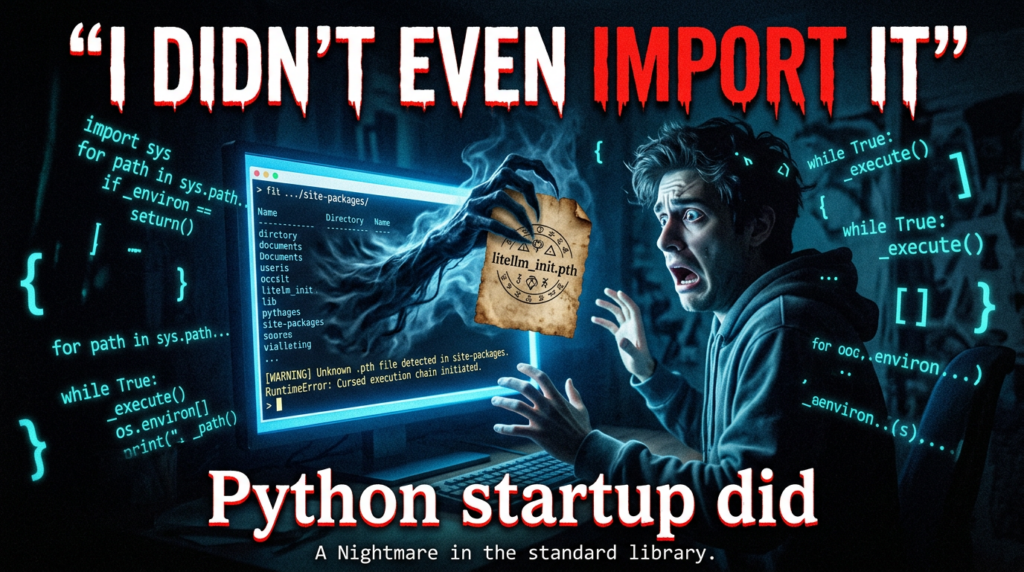
Python’s own documentation is unusually clear on this point. The site module is imported automatically during initialization unless Python is started with -S. Path configuration files ending in .pth inside site directories can contain executable lines, and lines beginning with import are executed. The docs go further and warn that an executable line in a .pth file runs at every Python startup, whether or not the corresponding module is actually intended to be used. (Python documentation)
That behavior is older and more obscure than many engineers realize. In day-to-day packaging work, people mostly think of .pth files as a path-extension mechanism. They are that, but they are also an interpreter-startup execution primitive. Legitimate tooling has used that behavior for years, which is exactly why it is dangerous when abused. The LiteLLM incident did not invent a new Python trick. It abused a little-understood but officially supported startup behavior. (Python documentation)
The practical implication is simple: if 1.82.8 landed in an environment’s site-packages, then many normal forms of “checking whether we are affected” could themselves retrigger the payload. Opening a Python REPL, launching a script, running an IDE-integrated Python process, or invoking package tools that rely on normal interpreter startup could all be unsafe in a contaminated environment. That is why defenders need a triage flow that uses filesystem inspection first and ordinary Python startup second, if at all. The presence of python -S as an official option is not a trivia point here; it is part of the safe handling pattern. (Python documentation)
This startup behavior also explains why “we never imported LiteLLM in production” is not a sufficient defense for 1.82.8. That line might matter for 1.82.7, where the incident tracker says the payload lived in proxy_server.py and required an import path into proxy code. It does not solve the 1.82.8 case, because the .pth launcher was designed to run before ordinary application logic even got a chance to decide what it needed. (GitHub)
There is also a second-order lesson here for security reviewers. Packaging and interpreter initialization are not separate threat domains. If your secure coding review model treats “dependency installation” as one step and “application execution” as another, .pth abuse breaks that neat separation. Installation becomes latent execution, and future interpreter starts become activation events. That is a different mental model from classic vulnerable-library CVEs where a flaw only matters when code reaches a bad function with attacker-controlled input. The LiteLLM 1.82.8 case is closer to startup persistence than to ordinary library misuse. (Python documentation)
What the Publicly Reported Payload Targeted
The most detailed public description currently available is the LiteLLM issue describing litellm_init.pth as data-exfiltration malware. That issue says the payload collected environment variables and files likely to contain credentials, encrypted the data, and posted it to the attacker-controlled endpoint. The broader timeline issue summarizes the targeted categories as SSH keys, environment variables, AWS, GCP, Azure, Kubernetes credentials, crypto wallets, database passwords, SSL private keys, shell history, and CI or CD configs. Simon Willison’s write-up, which points back to the same technical issue, highlights a long list of affected filesystem targets including ~/.ssh/, ~/.git-credentials, ~/.aws/, ~/.kube/, ~/.azure/, ~/.docker/, and multiple shell history files. (GitHub)
That target set is not random. It is optimized for developer and platform-administrator environments. SSH material enables repository and infrastructure access. Cloud CLI directories expose long-lived or refreshable cloud credentials. Kubernetes files can turn one compromised workload into broader cluster visibility. Shell history can reveal one-off admin commands, ad hoc tokens, internal hostnames, and database access patterns. Git credentials can open private repository access or release processes. In other words, the malware was not built to steal one API key from one application. It was built to raid the general-purpose trust store of a modern engineering workstation or runner. (GitHub)
The exfiltration details are also operationally useful. The issue says the payload used hybrid encryption and sent the archive by POST to https://models.litellm.cloud/ with an X-Filename: tpcp.tar.gz header. That makes the IOC set unusually concrete for a fast-moving package compromise. Even if DNS logs are incomplete, proxy logs, egress gateways, or outbound TLS metadata may still help confirm whether the domain was contacted. The header name may or may not be visible in every control plane, but it is valuable anywhere full HTTP metadata is retained. (GitHub)
One public analysis from FutureSearch also reported that the malware attempted lateral movement and persistence when Kubernetes service account material was available, and that the discoverers first noticed the issue because the .pth behavior created a fork-bomb-like side effect. Those details are interesting and may turn out to be important, but they currently rely on a more limited source base than the core facts above. Defenders should know about them, but should separate “confirmed by the project issues and Python docs” from “reported in third-party analysis and worth checking for.” That distinction is not pedantry. It keeps incident response honest when facts are still settling. (FutureSearch)
For most teams, the safest operational assumption is this: any credential that was reachable from environment variables or standard engineering credential locations on a host where the malicious versions were installed may have been exposed. That is already enough to drive remediation, even without resolving every unanswered detail about persistence, lateral movement, or downstream staging behavior. (GitHub)
Why AI Infrastructure Is a Particularly Attractive Victim
The same package compromise would be serious in a normal web stack. It becomes worse in the AI stack because AI gateway hosts often accumulate more kinds of trust than traditional application tiers. LiteLLM’s own docs show why. The gateway centralizes model-provider access, routing, budgets, auth, logging, guardrails, and MCP-style integrations. That means one process can hold keys for multiple vendors, visibility into traffic, and permission to invoke external tools or internal services on behalf of users or agents. (PyPI)
AI teams also tend to operate with a different risk shape from classic service teams. A web application often has one main cloud account, one database, and a predictable request surface. An AI platform team may have OpenAI and Anthropic keys side by side, Azure or Vertex credentials for enterprise routing, Redis and Postgres connections for caching and logging, callback integrations for observability, IDE plugin traffic, MCP servers, and internal admin APIs for budget and team management. A compromise of the gateway host can therefore expose not just credentials, but the operational topology of the AI system. LiteLLM’s public docs explicitly mention several of these functions. (PyPI)
That matters even after you rotate secrets. Once an attacker sees the environment, they learn names, providers, paths, budget boundaries, deployment conventions, and sometimes the shape of your internal control plane. Credential rotation repairs identity, but it does not erase attacker knowledge. This is why post-incident work has to include environment revalidation, not just key replacement. Did old callbacks still accept rotated credentials? Are dormant admin surfaces reachable? Does the gateway expose MCP or passthrough endpoints more broadly than intended? Those are architectural questions, not package-management questions. The incident just forced them into the open. (PyPI)
This is also the place where post-remediation verification tools become more useful than more theory. After secret rotation and config cleanup, teams still need to test what is actually exposed on the running system: web surfaces, API behavior, callback flows, auth mistakes, stale endpoints, and policy gaps introduced during emergency change windows. That is the kind of workflow where an automated adversarial validation platform can be useful as a verification layer rather than as a replacement for incident response. Penligent’s public materials and Hacking Labs content focus on AI security testing, execution boundaries, and continuous validation in modern agent and gateway deployments, which is exactly the kind of follow-up many teams will need after an event like this. (Penligente)
The important point is not the product name. The important point is the category of work: after a gateway compromise, the organization needs proof that the environment is now safe, not just optimism that the bad package is gone. Proof comes from retesting exposed paths, validating that unsafe actions are blocked, and producing a clean evidentiary record of what changed and what no longer reproduces. (Penligente)
Who Should Assume Exposure
If your team installed or upgraded LiteLLM on March 24, 2026, exposure is an obvious concern. But many real environments reach the same state indirectly. The FutureSearch analysis says they encountered the package as a transitive dependency pulled in by an MCP plugin inside Cursor, and the issue threads show the discovery path involved a separate package installation flow. That means you should not limit your search to repositories where engineers consciously added litellm a requirements.txt. It may have arrived through an IDE workflow, tool install path, ephemeral agent environment, or a transitive dependency chain. (FutureSearch)
Three groups should move first. The first is any team that allows dynamic dependency installation on startup, during uv run, or inside ephemeral build and test jobs. The second is any team that uses LiteLLM in proxy or gateway mode on shared infrastructure. The third is any maintainer or CI owner whose pipelines carried long-lived release secrets or cloud deployment credentials. Those are the environments with the best combination of likelihood and consequence. (Hacker News)
You should also assume that “we uninstalled it afterward” is not a reliable boundary. The question is whether the malicious package ever made it into a site directory and whether the interpreter ever started in that environment afterward. In the 1.82.8 case, the public issue describes a .pth launcher precisely because it gives the attacker a broad startup trigger. Once that event happens, uninstalling later does not rewind any credential exposure that may already have occurred. (GitHub)
Finally, environments with cached packages deserve more scrutiny than many teams give them. The third-party discoverers explicitly recommended checking uv caches and virtual environments, and pip’s own secure-install guidance notes that the locally built wheel cache is used in hash-checking mode as well. Caches are useful and normal, but they also mean package presence can outlive the moment of installation. A team that “never deployed the bad version” can still have contaminated caches on developer systems or runners if the package was resolved during the relevant window. (FutureSearch)
What to Do in the First Hour
The first response goal is to stop additional exposure, not to satisfy curiosity. If there is any chance that a host, runner, or image pulled 1.82.7 or 1.82.8, isolate that environment from normal release and credential flows. Pause automated publishing. Disable or isolate runners that may have executed affected jobs. Snapshot logs and filesystem state before aggressive cleanup, but do not keep compromised environments on a network path that can continue to reach sensitive destinations. That advice follows directly from the publicly reported exfiltration behavior and from the maintainer’s statement that release credentials were implicated in the chain. (GitHub)
The second goal is to avoid re-triggering the payload while you investigate. With 1.82.8, casual use of Python is part of the risk model. The Python docs say the site module is auto-imported during initialization unless -S is used, and that .pth executable lines run at every startup. That makes python -S a valuable first-line inspection tool for contaminated environments. It does not make the machine safe. It simply reduces the chance that your inspection step itself will execute the .pth file through normal startup flow. (Python documentation)
The third goal is to prioritize credential rotation in the right order. Start with anything that could let an attacker publish code, deploy code, or move laterally: PyPI publishing tokens, GitHub tokens, cloud IAM keys, kubeconfig and cluster credentials, and SSH material used for privileged infrastructure access. After that, rotate model-provider keys and application secrets. The payload target list from the public issue is broad enough that trying to decide which single secret “really mattered” is usually a waste of time. Prioritize by privilege and blast radius, not by guesswork. (GitHub)
A short, conservative triage sequence looks like this:
- Identify hosts and runners that may have installed 1.82.7 or 1.82.8.
- Stop release automation and isolate suspected build agents.
- Inspect filesystems and caches without normal Python startup where possible.
- Remove malicious artifacts and purge caches.
- Rotate high-privilege credentials first.
- Review logs for egress to the IOC domain and for suspicious downstream access.
- Rebuild clean artifacts from a verified source of dependencies.
- Retest the repaired environment before resuming normal delivery.
Every step in that sequence maps to the public facts: startup-triggered execution, credential theft, CI-related release-secret exposure, and rapid package removal from PyPI. (GitHub)
Safe Triage Without Re-Triggering the .pth Archivo
The safest initial move on a suspected host is to inspect the filesystem rather than “just run Python and see.” The code below is deliberately boring. That is the point.
# Print Python site paths without importing site customizations
python -S - <<'PY'
import sys
print("executable:", sys.executable)
print("sys.path:")
for p in sys.path:
    print("  ", p)
PY

# Search common site-packages locations for the known launcher
find / -type f -name 'litellm_init.pth' 2>/dev/null

# Search for the IOC domain in installed files and caches
grep -R "models\.litellm\.cloud" \
  ~/.cache ~/.local /usr/local/lib /opt /venv /srv 2>/dev/null
The reason python -S appears here is not superstition. The Python docs say that site is imported automatically during initialization unless -S is used, and that .pth executable lines are processed by site. If you are examining a host where litellm_init.pth may exist, suppressing site during your first look is a sensible defensive habit. (Python documentation)
If you need to inspect a virtual environment directly, go to the site-packages directory as a directory, not as an import target. Look for litellm_init.pth, inspect its contents as a file, and compare the installed LiteLLM files against a known-good artifact source. Public incident text says the first line of the .pth file launched a base64-obfuscated Python payload via subprocess.Popen, so a plain-text read of the file is usually enough to confirm that the environment is affected. (GitHub)
# Example path pattern, adjust to your environment
SITEPKG="/path/to/venv/lib/python3.12/site-packages"

ls -la "$SITEPKG" | grep -E 'litellm|\.pth'
sed -n '1,5p' "$SITEPKG/litellm_init.pth" 2>/dev/null
find "$SITEPKG/litellm" -type f | sort | sed -n '1,40p'
For CI and containerized environments, the same principle applies. Do not limit yourself to the live filesystem. Inspect the build workspace, dependency cache, and, if relevant, image layers or artifact storage. A package that was installed during build but not present in the final runtime container may still have exposed secrets during the build step. That distinction matters more in this incident than in many runtime-only compromises because the reported payload was built to target developer and pipeline secrets. (GitHub)
Hunt for Affected Environments and Caches
Most teams will underestimate how many places a poisoned package can land. There are at least four common paths: local virtual environments, global site-packages, pip caches, and alternate tool caches such as uv. The public FutureSearch analysis explicitly recommends checking uv caches and virtual environments after March 24 installations, and pip’s secure-install documentation explains that caching remains part of real installation behavior even when stricter integrity controls are used. A serious hunt therefore needs to include both “where the package ran” and “where the package was stored.” (FutureSearch)
A practical cache hunt on workstations and runners looks like this:
# pip metadata and cache
pip show litellm 2>/dev/null || true
pip cache dir 2>/dev/null || true
pip cache purge 2>/dev/null || true

# uv cache examples
find ~/.cache/uv -iname '*litellm*' 2>/dev/null
find ~/.cache/uv -name 'litellm_init.pth' 2>/dev/null

# virtualenv and local project search
find ~ -type d -path '*/site-packages' 2>/dev/null | while read d; do
  test -f "$d/litellm_init.pth" && echo "FOUND $d/litellm_init.pth"
done
For container images, search both the final image and the build system that produced it. A multistage Docker build can hide the package from the final runtime image while still exposing the build host or build runner during dependency resolution. That is why the first response should pause release automation and inspect runners, not just application pods. The Trivy incident, which the LiteLLM maintainer linked as the apparent upstream compromise path, is a strong reminder that pipeline environments are themselves high-value assets and not just temporary scaffolding. (Hacker News)
Once you confirm package presence, inventory the secrets that were reachable on that machine, not just the secrets that belonged to the application repository. On a developer machine, that includes SSH material, cloud CLI state, Git credential stores, shell history, and database helpers. On a runner, it includes release secrets, cloud deployment identities, artifact registries, and secrets loaded at job time. On a shared AI gateway, it includes model-provider keys, admin keys, logging endpoints, and MCP or tool-integration credentials. Those categories are not hypothetical. They line up with the publicly reported target list. (GitHub)
Remove the Package, but Do Not Stop There
Deleting the malicious package is necessary and insufficient. It removes the trigger, but it does not answer the question that matters most: what left the machine before removal. The public issue text says the payload used silent subprocess execution, gathered sensitive files and environment variables, encrypted the output, and sent it out. If the malicious code ran at least once, assume that secrets reachable from that environment may already have been exposed. (GitHub)
Cleanup should therefore happen in a deliberate order. First, remove the malicious package and purge any caches that could reinstall it accidentally. Second, rotate exposed credentials. Third, audit the logs of the systems behind those credentials for suspicious use after the likely exposure time. Fourth, rebuild artifacts from a clean dependency source. Fifth, retest the repaired environment. Teams often reverse that order and focus on “getting the package out” as though package removal ends the incident. It does not. Package removal ends one attacker foothold. It says nothing about what the stolen credentials can do next. (GitHub)
A cleanup example for a Python virtual environment is below:
# inside an isolated shell, after collecting evidence
pip uninstall -y litellm

# remove suspicious launcher if it still exists
find /path/to/venv/lib -name 'litellm_init.pth' -delete 2>/dev/null

# clear caches to avoid re-use of cached artifacts
pip cache purge 2>/dev/null || true
rm -rf ~/.cache/uv 2>/dev/null || true
Do not confuse “package no longer installed” with “environment now trustworthy.” If the system was a runner, rebuild it or replace it. If it was a developer laptop with privileged infrastructure access, rotate those credentials and review recent activity. If it was a shared AI gateway, verify not only that the gateway binary is clean, but also that old provider keys, admin keys, and callback paths no longer work. Gateway incidents require infrastructure-level hygiene, not only package-level hygiene. (GitHub)
Rotate Secrets in the Right Order
Not all secrets have equal value, and not all need the same response window. The incident’s public target list strongly suggests a rotation order that starts with release and infrastructure control, then moves to platform access, then to application-specific credentials. Release and CI tokens should go first because they can let an attacker republish code or alter delivery. Cloud IAM and cluster access should go next because they can expand the incident beyond the original host. SSH material used for administration or production deployment should be rotated alongside those. Only then should teams move through provider API keys, app secrets, and lower-privilege tokens. (Hacker News)
For AI teams, model-provider credentials deserve special handling. Rotating an OpenAI or Anthropic key is not enough if internal proxies, budget services, or usage loggers still trust stale secondary credentials derived from the original secret. Similarly, rotating Azure or Vertex access may require changes in service principals, workload identities, or proxy configuration rather than a one-line environment variable swap. This is one reason the AI stack is harder to clean after supply chain compromise than a simple single-vendor integration. The visible credential is often just one layer in a larger operational graph. (PyPI)
Shell history and local configuration files also deserve more respect than they usually get. The public target list includes shell history, Git config, database helpers, and local credential stores. Those artifacts can leak credentials directly, but they can also reveal incidentally privileged operational knowledge: internal hostnames, admin scripts, backup locations, release naming conventions, and one-off tokens pasted during troubleshooting. Even if you do not find evidence of successful login using a stolen key, you may still need to assume the attacker learned enough to make future phishing or lateral movement easier. (GitHub)
Validate the Environment After Cleanup
After secret rotation, the next mistake is assuming you are done because no obvious indicators remain. In practice, emergency cleanup introduces its own failure modes: partial rotation, forgotten sidecar configs, stale container images, ignored mirrors, and invisible trust relationships between tools. Aqua’s official Trivy advisory is instructive here. It explicitly says the March 19 incident was a continuation of an earlier attack and that credential rotation had not been atomic, allowing the attacker to retain access. That lesson transfers directly to LiteLLM. A hurried, partial fix is not the same thing as closure. (GitHub)
Validation should answer concrete yes-or-no questions. Are old release credentials dead? Do old provider keys fail everywhere, including proxies and sidecars? Are build agents recreated from clean base images? Is the package source now internal and pinned? Do outbound controls block the IOC domain and similar unexpected egress from build or gateway networks? Can you prove that the repaired environment no longer exposes the previously reachable web, API, or tool surfaces in unsafe ways? These are the questions that matter after the package is gone. (GitHub)
This is the second place where post-incident validation tooling matters. Once credentials are rotated and packages are rebuilt, teams still need to verify the external behavior of the live environment. That usually means scanning reachable assets, validating auth boundaries, replaying important requests, checking that old tokens truly fail, and collecting evidence for internal stakeholders. Penligent’s public docs and research material are relevant here not because this incident is “about Penligent,” but because the post-cleanup task is fundamentally adversarial validation of an AI-connected system with web, API, and tool boundaries. (Penligente)
If you delete the product name from that paragraph, the guidance still stands. Supply chain cleanup needs verification. Verification needs evidence. Evidence usually comes from automation plus careful review, not from a single reassuring screenshot that the bad package no longer imports. (Penligente)
Detection Ideas for Hosts, Networks, CI, and Package Hygiene
Start with host-level telemetry. The public issue gives you useful anchors: the file name litellm_init.pth, the exfiltration domain models.litellm.cloud, and the reported use of silent subprocess execution plus rizo or related tooling in the broader payload structure. A sensible host hunt therefore includes new .pth creation under site-packages, Python spawning unexpected shell utilities during startup, and command lines or files containing the IOC domain. Python startup activity is noisy, so precise IOC hunting is better than vague “alert on Python.” (GitHub)
A simple filesystem and IOC sweep is often more valuable in the first day than an overengineered detection rule:
# IOC hunt for files and domain references
find / -type f \( -name 'litellm_init.pth' -o -name '*.pth' \) 2>/dev/null | sed -n '1,200p'
grep -R "models\.litellm\.cloud" /etc /opt /srv /usr /var ~/.cache ~/.local 2>/dev/null

# Review whether Python startup files exist in user-site directories
python -S -m site --user-site 2>/dev/null
For network defenders, outbound connections to models.litellm.cloud should be treated as high-confidence indicators in the context of suspected LiteLLM exposure. If you capture HTTP metadata, look for POST traffic and the X-Filename: tpcp.tar.gz header described in the issue. If you only capture DNS or TLS metadata, start there anyway. IOC-based network hunting rarely tells the whole story, but it can help establish which machines need the deepest review. (GitHub)
CI defenders should read the LiteLLM incident through the lens of the official Trivy advisory. Aqua’s GHSA explains that the Trivy incident involved compromised credentials, mutable GitHub Action tags, and malicious release artifacts. It also recommends pinning actions to immutable SHAs and treating any pipeline that executed affected components as compromised. The LiteLLM maintainer’s HN comment about a PYPI_PUBLISH token in CI makes that guidance immediately relevant to Python package projects. Your release workflow is part of your attack surface. Your security scanner invocation is part of your attack surface. Your “temporary” runner secrets are part of your attack surface. (GitHub)
Package hygiene controls also matter on the consuming side. pip’s secure-install documentation states that hash-checking mode is all-or-nothing, that hashes are required for all requirements and dependencies, and that requirements must be pinned. The same docs also warn that remote hashes supplied by the index are not enough to satisfy --require-hashes, because those hashes themselves come from the remote server and are not a defense against a tampered index. That distinction is critical. Merely pinning litellm==1.82.8 would not have helped if 1.82.8 itself was the compromised release. Local, verified hashes and known-good internal artifacts are what change the trust model. (pip)
A hardened requirements fragment looks like this:
litellm==1.82.6 \
  --hash=sha256:REPLACE_WITH_VERIFIED_GOOD_HASH
And the install path should enforce those hashes:
pip install --require-hashes -r requirements.txt
That will not solve maintainer compromise across the ecosystem, but it does change one important fact: your environment stops trusting the index as the sole authority for what a package file should be. pip documents that requirement clearly, and teams that consume high-value infrastructure packages should treat it as a baseline, not an optional hardening step. (pip)
Why This Looks Like a Release Pipeline Problem, Not Just a Bad Upload
The public state of the incident points toward release-path compromise rather than a conventional source-repo code review failure. The LiteLLM timeline issue says the malicious packages were published by an attacker through the project’s PyPI channel, and the maintainer said on Hacker News that the exposed secret was a PyPI publishing token present in CI. The same HN comment links the origin to the recent Trivy incident, while Aqua’s official advisory for Trivy explains that the Trivy ecosystem compromise involved abused credentials, mutable action tags, and incomplete token rotation after the earlier incident. Put together, that is the anatomy of a release-security failure: an attacker reaches the path that turns code into trusted artifacts. (GitHub)
That distinction matters because it changes the remediation target. If your lesson from this event is “review code harder,” you learned the wrong lesson. The right question is how release credentials are held, minted, scoped, and revoked, and how much other infrastructure is allowed to touch them. The PyPI Trusted Publishing documentation exists for exactly this reason. PyPI says traditional API tokens are long-lived and remain usable until manually revoked, while Trusted Publishing uses CI-issued OIDC identity and returns a short-lived token valid for 15 minutes. That is not a silver bullet, but it materially narrows the replay window for stolen release credentials. (PyPI Docs)
PyPI’s documentation also shows the operational pattern teams should move toward. With Trusted Publishing, a GitHub Actions workflow can publish without carrying a long-lived PYPI_TOKEN secret at all. Instead, the job receives id-token: write, presents its OIDC identity to PyPI, and receives a short-lived upload credential. That is exactly the kind of control that reduces the value of one leaked CI environment variable. (PyPI Docs)
A minimal GitHub Actions publishing job using Trusted Publishing looks like this:
jobs:
  pypi-publish:
    name: upload release to PyPI
    runs-on: ubuntu-latest
    environment: pypi
    permissions:
      id-token: write
    steps:
      - name: Publish package distributions to PyPI
        uses: pypa/gh-action-pypi-publish@release/v1
That example comes almost directly from PyPI’s official docs. Notice what is missing: no nombre de usuario, no contraseña, no PYPI_TOKEN secret, and no long-lived credential sitting around for unrelated steps to inherit accidentally. PyPI’s docs explicitly say the id-token: write permission is mandatory for Trusted Publishing and that using permission at the job level is strongly encouraged because it reduces unnecessary credential exposure. (PyPI Docs)
The release-path lesson also extends beyond PyPI. If your build job can publish to PyPI, push a container image, deploy to cloud infrastructure, and run third-party actions or scanners with the same ambient secret set, then you have built a very attractive target. The LiteLLM incident is a Python package story, but the root lesson is broader: publishing pipelines should be treated as privileged systems with their own trust boundaries, not as normal CI. (Hacker News)
What Maintainers Should Change Now
Maintainers need to treat this incident as a design review of the release process. The first change is to eliminate long-lived package publication secrets where the registry supports a better model. For PyPI, that means Trusted Publishing through OIDC rather than static API tokens. PyPI’s own docs spell out the security advantage plainly: traditional tokens are long-lived, while Trusted Publishing mints short-lived tokens that expire automatically. If an attacker steals a job-scoped OIDC-derived token, the replay window is radically smaller than with a copied secret from a repository or runner environment. (PyPI Docs)
The second change is release-job isolation. A scan job should not inherit publish credentials. A documentation job should not inherit publish credentials. A test matrix should not inherit publish credentials. Even within a release workflow, permissions should be granted at the narrowest job boundary possible. PyPI’s docs specifically recommend job-level id-token: write instead of broader workflow-level permissions. That advice is not just about elegance. It is about not letting one compromised step become a publishing event. (PyPI Docs)
The third change is immutable provenance for consumers. The Python packaging ecosystem is improving here, and the Simple Repository API specification now includes support for per-file hashes and provenance-related attributes. Even before teams adopt every new provenance feature, maintainers can make practical improvements by publishing clear hashes, encouraging internal mirrors, and making official release provenance easy to verify. None of that would have saved consumers who blindly trusted a bad artifact in the moment, but it shortens the path to trustworthy recovery afterward. (Python Packaging)
The fourth change is incident-mode documentation. Consumers need a fast answer to three questions: which versions are affected, how do I check whether I pulled them, and what exact IOC and cleanup steps should I follow. The LiteLLM issue tracker already contains much of that information in raw form. The maintainers, or any maintainers facing a similar event, should convert it into a canonical advisory page as quickly as possible. In fast-moving supply chain events, public clarity is a security control. (GitHub)
What Consuming Teams Should Change Even If They Never Used LiteLLM
The easiest way to waste this incident is to treat it as “their package problem.” The controls that would have reduced damage here are general-purpose controls that many teams still have not implemented. The first is simple: do not install dependencies dynamically at production startup. The more you rely on uv run, ad hoc installs, or unresolved dependency fetching in runtime paths, the more you turn the package ecosystem itself into part of your production availability and security boundary. Even the HN discussion around this incident quickly converged on the point that deployable artifacts are safer and more auditable than live dependency fetches at launch time. (Hacker News)
The second is exact pinning plus local hashes for high-value environments. pip’s secure-install guidance could not be clearer: hash-checking mode requires all requirements and dependencies to be hashed and pinned, and remotely supplied index hashes are not enough to satisfy that trust model. Teams do not need to deploy that rigor uniformly across every throwaway notebook and experiment, but they should absolutely apply it to CI, production builds, shared AI gateways, and internal packages that sit near secrets. (pip)
The third is artifact and mirror strategy. The package index should not be the only place your critical environments can fetch from. Internal mirrors, curated artifact repositories, and build-time promotion of known-good dependencies are not glamorous controls, but they pay off when the public registry has to quarantine a project or when you need to prove what exact file you installed before an incident. This is not specific to Python or LiteLLM. It is one of the oldest and most durable supply chain lessons in modern software delivery. (PyPI)
The fourth is outbound network discipline for build and gateway hosts. If your build nodes and AI gateways can make arbitrary outbound connections, then credential-stealing malware has a straightforward path home. Restrictive egress is not always easy, but it turns many supply chain compromises from “silent exfiltration” into “detected blocked attempt.” Even when the initial compromise is not prevented, outbound friction can change the incident from invisible theft into noisy failure. The Trivy guidance’s emphasis on blocking known exfiltration infrastructure is part of that broader lesson. (GitHub)
A final control mapping makes the lesson more concrete.
| Weak practice | Why it failed in incidents like this | Better control |
|---|---|---|
| Long-lived release secret in CI | One exposed token can publish malicious artifacts | Trusted Publishing with short-lived OIDC-minted tokens. (PyPI Docs) |
| Dynamic install at runtime | Production trusts the registry on every launch | Build once, promote artifacts, run from known-good images. (Hacker News) |
| Pin version only | A malicious published version still satisfies the pin | Pin exact versions and enforce local hashes. (pip) |
| Mutable GitHub Action tags | Attackers can repoint a trusted tag to malicious code | Pin actions to immutable commit SHAs. (GitHub) |
| Broad job permissions | One compromised step sees every secret | Job-level least privilege and separate release jobs. (PyPI Docs) |
The Supply Chain Lesson from CVE-2024-3094
Not every supply chain incident gets captured neatly as a package-level “vulnerability” in the way engineers are used to reading CVE advisories, but CVE-2024-3094 remains the right comparison point because it shows how serious the problem becomes when a trusted distribution path carries malicious content. NVD describes CVE-2024-3094 as malicious code in the upstream tarballs of xz beginning with versions 5.6.0 and 5.6.1, where the build process extracted a hidden object file and modified library behavior during build. The core lesson was not “xz had a bug.” The lesson was that the artifact supply chain itself had been compromised. (NVD)
That is why CVE-2024-3094 is relevant here. In both cases, the attacker abused trust in a software distribution path rather than exploiting a normal application bug from the outside. In the xz case, the malicious logic rode inside upstream release material and affected how downstream software was built and linked. In the LiteLLM case, the malicious logic rode inside package registry releases and targeted the environments that installed them. Different mechanics, same strategic truth: trusted distribution channels are privileged attack surfaces. (NVD)
The exploitation conditions also help explain the difference. CVE-2024-3094 depended on affected xz release material and specific downstream build and runtime circumstances. The LiteLLM incident depended on consumers pulling specific malicious package versions from PyPI and then, in the 1.82.8 case, performing ordinary Python startup. In a sense, LiteLLM’s 1.82.8 startup condition is operationally simpler for many victims: the interpreter behavior that makes .pth execution possible is normal, documented Python behavior. That makes the compromise easier to trigger accidentally once installed. (NVD)
The mitigation lesson is also shared. In xz, defenders were told to move to known-safe versions and treat the supply chain path itself as suspect. In the LiteLLM case, defenders should remove the affected artifacts, rotate secrets, verify the release path, and strengthen artifact trust with controls such as Trusted Publishing, exact pinning, and hash enforcement. The package name changed. The discipline required did not. (NVD)
That is exactly why this incident deserves attention even from teams that do not use LiteLLM. It is a current, AI-adjacent example of a much older truth that CVE-2024-3094 made impossible to ignore: if you trust your release chain more than you verify it, attackers will eventually notice. (NVD)
Further reading
LiteLLM incident status and version-specific tracking on the project issue tracker. (GitHub)
LiteLLM public package page and product documentation, useful for understanding why the package sits so close to high-value AI control-plane functions. (PyPI)
Python documentation for the site module and .pth execution behavior, which is the key technical reason version 1.82.8 was more dangerous than 1.82.7. (Python documentation)
PyPI documentation on Trusted Publishing and pip documentation on secure installs and --require-hashes, which are directly relevant to release hardening and consumer-side artifact trust. (PyPI Docs)
Aqua’s Trivy advisory and discussion thread, which matter here because the LiteLLM maintainer publicly linked the apparent origin to the recent Trivy compromise and the advisory documents the broader credential-compromise and release-chain context. (GitHub)
NVD’s record for CVE-2024-3094, the xz supply chain backdoor, which remains the most useful CVE-level comparison for understanding what it means when a trusted distribution path becomes the attack vector. (NVD)
Penligent resources that are naturally relevant to the post-incident verification and AI supply chain boundary discussion include the product homepage, the docs page, and Hacking Labs pieces on AI execution boundaries and supply chain risk. (Penligente)
 Spanish
  English
  German
  French
  Portuguese
  Japanese
  Korean
  Hindi
Hindi  Arabic
  Turkish
  Hebrew