
Two AWS advisories describe different security failures in mcp-gateway-registry. CVE-2026-125926 concerns server-side request forgery through registered upstream addresses. CVE-2026-100307 concerns missing authorization in the external management API. Their fixes are not interchangeable, and neither upgrade automatically establishes that previously stored configuration is trustworthy. Start with the separate AWS SSRF bulletin y AWS management-authorization bulletin.
The practical response is to track three decisions: whether each running deployment contains both corrections, whether its retained grants and upstream registrations are intended, and whether its credentials or connected assets need recovery. Combining those questions into a single “patched” checkbox loses the distinction between corrected code and the state that code inherited. This analysis turns the published facts into a defensible review and verification process without supplying a production exploit.
Keep the two version decisions separate
| Issue | AWS affected range | Stated correction | Remaining state to review |
|---|---|---|---|
| CVE-2026-125926 | 1.0.3 through 1.34.0 | 1.35.0 | Previously stored upstream addresses |
| CVE-2026-100307 | 1.0.9 through 1.24.7 | 1.25.0 | Previously written privileged grants and potentially exposed credentials |
AWS explicitly distinguishes the version sequence: carrying the management-authorization correction does not imply that the SSRF issue is corrected. Match your actual artifact against the SSRF bulletin’s version guidance. For a fork, retain evidence that the relevant changes are present rather than inferring its state from an inherited upstream version string.
A deployment inventory should identify the component, instance, artifact, and owner. A registry service, an authentication component, a background task, and a standby environment can have different upgrade or restart paths. The inventory must reflect the organization’s actual topology. Do not assume that every deployment uses the same database, cloud runtime, or provisioning method simply because those options exist in the upstream project.
Record the time a corrected artifact became active, not only the time a package was downloaded. An image can be updated in a registry while an older container continues serving requests. A source checkout can move while the service manager launches a different directory. Use the environment’s normal deployment evidence to connect the reviewed build to the running component.
Maintain exceptions explicitly. If an instance is offline, unreachable, or owned by another team, record why its state remains unknown and who must resolve it before it returns to service. A report that says all reachable instances were updated may be accurate but incomplete. The response owner needs to know whether an unverified standby can later reintroduce the affected behavior.
The version table is a starting point for a security decision, not a universal downgrade or pinning instruction. Prefer the current supported release and the applicable upstream guidance. A historical first-fixed version establishes where a correction appeared; it does not prove that the same release is an appropriate maintenance baseline for every deployment today.
Understand the management and request boundaries
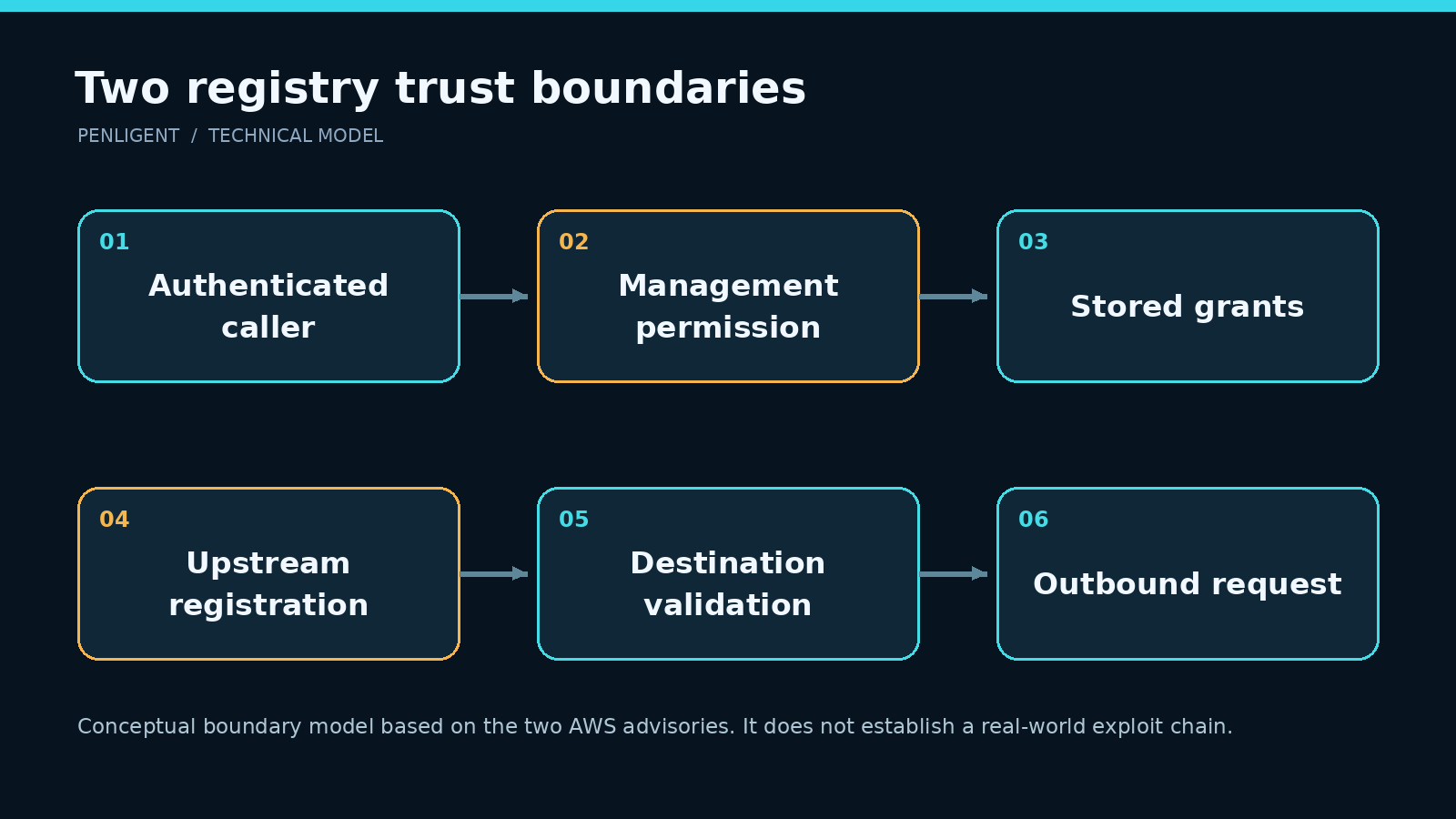
A registry combines decisions that can look similar in a user interface while carrying different authority. Authentication identifies the caller. Management authorization decides whether that caller may create or change a registry asset or group definition. Destination policy decides which upstream service a registered asset may contact. A successful sign-in establishes only the first of those decisions.
For the SSRF issue, AWS says an authenticated user with server-registration or modification permission could select an upstream address that caused requests to internal services, with responses returned in some cases. The bulletin states that the correction validates new or modified upstream addresses while leaving older stored entries unchanged. Those facts define the specific trust boundary described by the AWS SSRF advisory.
The management issue concerns authenticated callers reaching write operations without the required role or permission enforcement. AWS describes a low-privileged user creating a group mapping that granted registry administrator scope, and explains that such a stored grant can survive the code upgrade. Use the management-authorization advisory for the exact product behavior and review locations.
The two defects can be studied together because they affect the same registry’s authority. That does not establish that they were chained in a real incident, that either was exploited in your environment, or that every deployment exposed the relevant prerequisite. Keep the analysis at the level supported by the advisories and by your own deployment evidence.
Think of a registered upstream as a continuing permission to make a class of network requests. A registration is not harmless metadata if other components later trust it as a destination. The review should therefore follow the value from creation, through storage and modification, to the point where it influences an outbound request. That is an architectural review question, not a claim that every component in the project uses an identical implementation.
A group mapping has a similar lifecycle. A write creates a grant that future requests may consume. Correcting the write-time authorization prevents some new unauthorized changes, but it does not independently prove that the current grant set was created legitimately. This is why configuration history matters even when the running binary is corrected.
Build an exposure record before changing retained state
Begin with an interval for each deployment: when the affected artifact was active, when the relevant interface was reachable, and when the correction became effective. Historical evidence may be incomplete. A configuration snapshot can prove a state on one date without proving that it remained unchanged throughout the interval. Preserve that uncertainty instead of replacing it with a precise but unsupported timeline.
Identify the identities that could reach the management surface during that interval. An organization’s current group list may not capture former members, service principals, or temporary access. Use the identity provider and application records available to the authorized response team. The objective is to establish the relevant population, not to collect unrelated account information.
For each identity class, record the rights it was intended to hold. A group named “developers” can be administrative in one environment and read-only in another. Names are labels, not evidence of effective permission. Compare the stored grant, the approved policy, and the behavior expected by the owner. Where the approved policy is missing, first obtain a decision about intended access.
Map the registry’s outbound context separately. Which networks can its components reach? Which credentials or cloud roles are attached? Which upstream servers store their own authentication material in the registry? Those details affect the consequence of an unintended destination or administrative grant. The review should use actual configuration and supported management records, not infer the answer from an architectural diagram drawn for a different deployment.
Keep the asset inventory stable while collecting evidence. A registry entry may have a display name, internal identifier, upstream address, and environment association. If the display name changes, preserve the identifier relationship so earlier logs still map to the correct asset. Reused names and addresses can otherwise make unrelated changes appear connected.
Preserve a controlled export or snapshot of the relevant state before removing unexpected grants or registrations, when doing so is consistent with the response plan. The snapshot can contain sensitive configuration, so its access and retention need an owner. The public report should reference the evidence without exposing secrets or unnecessary internal addresses.
Review group mappings as permissions with provenance
A useful grant review asks who approved a permission, what identity relationship it applies to, which operations it enables, and whether it is still needed. Compare the current state with the organization’s intended access model. A mapping is not legitimate merely because it exists in a production database, nor is it malicious merely because the reviewer does not recognize its name.
Start with privileged grants and broad mutation permissions because they affect the authority to change other assets. Trace each to an approved owner or change record. If the evidence is unavailable, record the grant as unresolved and have the authorized owner decide how to restrict or remove it. Avoid using an improvised bulk database edit as the default response to an unfamiliar configuration.
Consider identity-provider group lifecycle. A renamed, deleted, or repurposed group can leave a mapping whose meaning differs from its original purpose. A group reused by another team can inherit authority accidentally. The registry review and the identity review should agree on the stable identity reference and its current membership, not only on a human-readable label.
Check whether a correction to one mapping leaves another route to the same authority. An identity may hold an administrative group membership, a service credential, or a separate direct permission. Removing the first observed grant does not establish that all effective access was revoked. The reviewer needs an effective-permission view supported by the deployment’s actual mechanisms.
Record the intended post-review state before testing it. For example, a read-only identity may inspect an approved asset but must not alter its destination or group permissions. A registry administrator may perform a controlled change within the agreed scope. Writing those expectations makes the behavioral test meaningful and gives another reviewer a basis for checking the result.
Changes to grants can affect availability. An automation identity may depend on a permission that was historically too broad but still necessary for a legitimate workflow. Coordinate a narrower replacement with the owner rather than silently breaking the workflow and declaring the security task complete. The response record should distinguish immediate containment from the final access design.
Review upstream addresses as continuing network authority
For each retained upstream, establish its owner, intended service, approved destination, and authentication requirements. A familiar hostname is not enough if no one can explain what service should answer there. The registry entry should map to an asset record or accountable team. Entries without an owner deserve a deliberate retirement or restriction decision.
Compare the address currently stored with its approved history. A change to scheme, host, port, or path can change where requests go or what authority they carry. Review redirects and intermediary proxies in the context of the actual request path. A registration that begins at an approved host may still depend on how later hops are handled.
The destination policy should match the service’s real purpose. A registry that needs to call a defined set of internal tools can often be governed differently from a service that intentionally proxies arbitrary user-selected internet sites. The OWASP SSRF prevention guidance distinguishes destination-validation approaches and network controls. Use it as a design reference, not as proof that a particular deployment has implemented those controls.
Investigate stale entries even after the new validation path is active. A registration created before the correction may remain usable until it is reviewed or changed. A disabled entry may also become relevant if another workflow can re-enable it. Include lifecycle states and activation paths in the review so that an old configuration does not quietly return during a later maintenance event.
Separate intended internal services from unintended internal reachability. Some MCP deployments legitimately connect to private tools. The security objective is not a blanket claim that every internal request is wrong; it is that requests follow the approved destination and authority model. Document the approved set and the mechanism that enforces it.
Do not probe an unknown destination merely to determine whether it is sensitive. A stored address can be evaluated through ownership records, configuration review, and an authorized controlled test. If a live request is necessary, the destination owner and response lead should define the permitted observation. The review should not turn an uncertain registration into an unapproved internal scan.
A network-free model for destination policy
The following example checks a small synthetic destination policy without making requests or resolving names. It is not the mcp-gateway-registry patch and is not a complete SSRF defense. It demonstrates that a destination is a structured value with several decisions, rather than a string that becomes trusted because its caller signed in.
from urllib.parse import urlsplit

APPROVED_HOSTS = {"tools.example.invalid"}

def inspect_destination(value):
    parsed = urlsplit(value)
    if parsed.scheme != "https":
        return "deny: scheme"
    if parsed.username is not None or parsed.password is not None:
        return "deny: embedded credentials"
    if parsed.hostname not in APPROVED_HOSTS:
        return "deny: host"
    if parsed.port not in (None, 443):
        return "deny: port"
    if parsed.fragment:
        return "deny: fragment"
    return "eligible for further deployment checks"

samples = [
    "https://tools.example.invalid/mcp",
    "http://tools.example.invalid/mcp",
    "https://unapproved.example.invalid/mcp",
]
for sample in samples:
    print(inspect_destination(sample))
The final result deliberately says “eligible for further deployment checks,” not “safe.” Real enforcement must account for the request implementation, resolution behavior, proxies, redirects, and network policy that apply to the deployment. A parser-only function cannot prove those properties. The example’s value is in making its limited decision explicit.
Use a controlled test destination owned by the assessment team when verifying an actual deployment. Decide which identity may register it, which identity may modify it, and what normal response proves that the approved path works. A denied unapproved configuration should not require contacting a real internal service. The test can demonstrate rejection at the relevant configuration boundary.
Keep policy tests and product tests separate. A passing result from this toy function says nothing about the registry’s implementation or the application’s deployed patch. A product regression must exercise the corrected product in the authorized environment and preserve its own evidence. Confusing the two would turn an educational illustration into an unsupported verification claim.
Correlate management changes with later use
A management request is part of a sequence. A useful investigation joins the identity that made a change, the configuration object affected, the previous and new values when available, and the later operations that used the resulting authority. A single request log can identify a lead while remaining insufficient to explain its consequence.
Start with the review interval established for the affected deployment. Search the application and supported audit records for relevant configuration changes, then correlate the result with the identity and asset inventory. Preserve the query or filtering method used so another responder can understand the scope of the search. An empty result is meaningful only within the available log coverage.
AWS identifies review of group mappings, application requests, credentials, and modified assets as post-upgrade work for the management issue. Treat the vendor’s post-upgrade guidance as the product-specific starting point. The correlation method here is a proposed way to organize the organization’s evidence around those questions; it is not a claim that every deployment emits every desired field.
Distinguish caller identity from an apparent source address. A proxy can cause many users to share an address, and a service identity can be used from more than one host. The log field that carries the authenticated principal may answer a different question from the network field. Keep both where available and explain which supports each conclusion.
Configuration history is especially useful when access is derived from current stored state. A later request may show an identity acting with administrator authority without recording how that grant was created. The earlier grant change and the later action need to be joined through stable identifiers. A report that shows only the final administrator action can miss the source of the privilege.
Account for automated legitimate changes. Provisioning jobs, imports, and administrative synchronization can produce a burst of modifications that resembles suspicious activity when viewed without context. Obtain the owner’s change record and expected behavior. Legitimate automation should be explained by evidence, not exempted merely because the principal has a familiar name.
Keep a distinction between a suspicious event and a confirmed unauthorized change. A request to a management operation can fail, be rejected by another control, or be part of an authorized test. The response status, effective state, and approved policy determine the outcome. Avoid converting every matching log line into a compromise count.
Decide which credentials need recovery
Credential review should follow the authority that an unintended administrator or destination could have reached. Inventory registry-managed upstream credentials, component service credentials, and attached platform identities according to the actual deployment. Do not assume that all secrets share the same exposure path or rotation procedure.
For the management issue, AWS warns that upgrading does not invalidate credentials read earlier and recommends rotation when unintended access cannot be excluded. For the SSRF issue, the bulletin calls for reviewing an attached cloud role’s activity and rotating credentials when the log review cannot rule out unexpected activity. Keep these vendor statements connected to their respective autorización y SSRF review conditions.
A rotation record should identify the credential’s owner, permitted use, dependent services, replacement state, and revocation evidence. Generating a new credential does not by itself establish that the old one stopped working. A dependent application may also continue using the old value until it is updated or restarted. The recovery decision needs both the replacement and the invalidation steps.
Sequence rotations with service owners. A credential used by several upstream registrations can create a wider operational change than its name suggests. Determine which consumers need the replacement and how to verify their normal behavior afterward. If temporary overlap is required, document its duration and the control that limits the old credential during that interval.
Platform-issued temporary credentials require their own handling. The relevant response may involve the platform’s session, role, or identity controls rather than editing a static secret in a configuration file. Follow the provider’s supported process for the actual identity type. Do not treat a generic password-rotation checklist as sufficient for every cloud role.
Investigate use as well as possession. A potentially exposed credential may have been used against its source system after the registry was patched. The source system’s records can therefore matter to the response. Keep that review within the authorized incident scope and use stable principal identifiers to avoid confusing a renamed credential with a different identity.
Where the available evidence cannot establish exposure, make the uncertainty part of the decision. The owner may choose rotation because the cost is acceptable and the visibility is insufficient. That is a defensible precaution when documented honestly. It is different from claiming that the credential was definitely stolen.
Use network and cloud controls for the boundary they enforce
A destination-validation fix and an outbound network policy operate at different layers. The first decides whether an application accepts or uses a destination value under its rules. The second limits what a component can contact even if an application decision is wrong. Review both, but do not use the existence of one as evidence that the other is correct.
For an actual deployment, list the outbound destinations required by each component and compare them with the effective policy. Include name-resolution services, proxies, identity endpoints, registered upstream tools, and operational services only when the component needs them. A policy written for a broad node or shared network can be much wider than the authority the registry itself requires.
AWS recommends limiting registration changes, restricting outbound access, using IMDSv2 on EC2, and limiting attached role permissions as interim risk reductions. Those measures appear in the SSRF bulletin’s workaround section. Their relevance depends on the deployment; an environment that is not running on EC2 should not be described as protected by an EC2-specific setting.
Review how requests leave the process. An explicit proxy, service mesh, or gateway can affect name resolution and destination enforcement. A host-level rule may see only the proxy destination while the proxy makes the ultimate connection. The owner needs to know which layer makes the effective decision and where a controlled test should be observed.
Network restrictions should have a functional control. Verify that the approved upstream still works under the intended identity and route. A policy that blocks every request has reduced one risk while also removing the service’s function. Whether that is acceptable temporary containment or an unacceptable final state is a business decision that should be visible in the record.
Cloud role review should be based on required operations, not merely on the role’s attachment to a known component. A narrow application function can still inherit a broad platform role from a shared deployment template. Have the platform owner identify the intended permissions and review effective access. This analysis does not claim that the advisories establish misuse of any particular cloud API.
Verify the corrected behavior with a role and state matrix
Design the verification in an owned test deployment or a specifically authorized controlled scope. Use synthetic registry assets and dedicated identities. The objective is to prove that normal approved operations work and prohibited operations are denied without creating persistent unauthorized access in a production registry.
| Identity and state | Controlled operation | Expected result to define |
|---|---|---|
| Read-only identity | Inspect an approved synthetic asset | Only intended metadata is visible |
| Read-only identity | Attempt a synthetic configuration change | Denied without changing retained state |
| Approved administrator | Change the designated test asset | Allowed and attributable in the review record |
| Authorized registrar | Use an approved controlled upstream | Normal registration and request behavior |
| Authorized registrar | Submit an unapproved synthetic destination | Rejected at the intended boundary |
| Previously stored test entry | Review and remediate its retained value | Final state matches approved configuration |
Define expected behavior before running the matrix. Different deployments may grant different rights to a registrar or operator role. A test is meaningful only when the intended policy is known. If the owner cannot explain whether a role may modify an asset, resolve that policy question instead of inferring the answer from whatever the application currently does.
Verify the resulting state as well as the response. A denied request should not have changed a group mapping, upstream address, or enabled status. An allowed request should affect only the designated synthetic object. Where the product’s supported interface exposes an audit record, preserve it with the operation’s identity and time.
Run a post-change normal-use test through the same route that legitimate callers use. An administrator-only test path can work while ordinary users fail because an identity or scope mapping was altered during remediation. The security matrix and functional matrix should therefore include the relevant production-like role separation without using real customer data.
A missing field or unavailable observation should produce a bounded limitation. If the team cannot inspect the underlying state safely, record which supported observation was used and what it cannot establish. Avoid escalating privileges solely to improve a report screenshot. The goal is sufficient authorized evidence, not unrestricted access for the assessor.
Keep the matrix versioned with the deployment. When a new transport, upstream type, or management workflow is introduced, review whether the existing cases still represent the security boundary. A passing old test may remain useful while failing to cover the new path. Coverage should be updated deliberately rather than inherited from a shared product name.
Handle mixed versions and shared infrastructure explicitly
A registry upgrade can span more than one instance or environment. The response record should identify which members can serve management requests, which issue outbound requests, and which share retained configuration. If two versions consume the same store during rollout, determine whether the older member can still write or use state that the newer one assumes has been validated.
This is a deployment review question, not an assertion about a specific clustering implementation. Use the actual topology and supported upgrade guidance. Some organizations may have one process on a host; others may have multiple services with independently deployed images. The relevant unit is the component that makes the security decision.
Shared stores create an evidence problem as well as an operational one. A configuration export from one environment may accidentally include entries used by another. A cleanup intended for a test registry can affect a production consumer if the store or credential set is shared. Confirm environment identity and ownership before applying changes.
Proxies and identity services can also be shared. A corrected registry may depend on a group claim whose meaning changed centrally, or a proxy policy may permit destinations beyond those needed by a particular instance. Coordinate those dependencies with their owners. The registry team should not silently change organization-wide identity or network policy while treating the action as a local patch task.
For disaster recovery and templates, verify the source of a future instance. An old machine image, deployment chart, or environment snapshot can reintroduce a vulnerable artifact or an unreviewed mapping after the active service is corrected. Update the recovery recipe and record the check required before activation. Otherwise the response may close only the current running population.
Measure rollout progress against the complete intended population, including unresolved exceptions. A percentage without the denominator can conceal a forgotten environment. Prefer a list of verified components, their evidence, and the remaining owner actions. That record remains useful when the service changes hands during a later incident or maintenance window.
Distinguish patch validation from incident recovery
Patch validation asks whether the intended correction is present and effective. Incident recovery asks what unauthorized activity may have happened earlier and whether its consequences remain. The two activities can share evidence without producing the same conclusion. A successful configuration rejection after upgrade does not establish that no credential was read before the upgrade.
If an unexpected privileged grant or upstream modification is found, preserve the relevant evidence and involve the organization’s response owner. That owner can decide whether to restrict access, rotate credentials, inspect connected assets, or take other recovery actions under the incident plan. The assessment should not improvise a broad cleanup that destroys the evidence needed to understand the event.
A registry entry alone may not establish who made a change. Correlate it with application records, identity events, deployment history, and approved administrative work. Keep alternative explanations where the evidence supports them. An unexplained value is a reason to investigate; it is not automatically attribution to a particular actor or campaign.
Connected assets may require their own review. A registry administrator’s potential access to upstream credentials raises questions about those upstream systems, while an unintended network destination raises a different set of questions about requests made from the gateway. Size the follow-up according to the authority and evidence actually present.
Document the recovery standard chosen by the owner. Some environments may be able to verify and repair retained state using a trusted baseline. Others may require rebuilding components or re-establishing credentials because the earlier state cannot be trusted. The advisories do not supply a universal answer for every incident, and this article does not claim to perform that investigation.
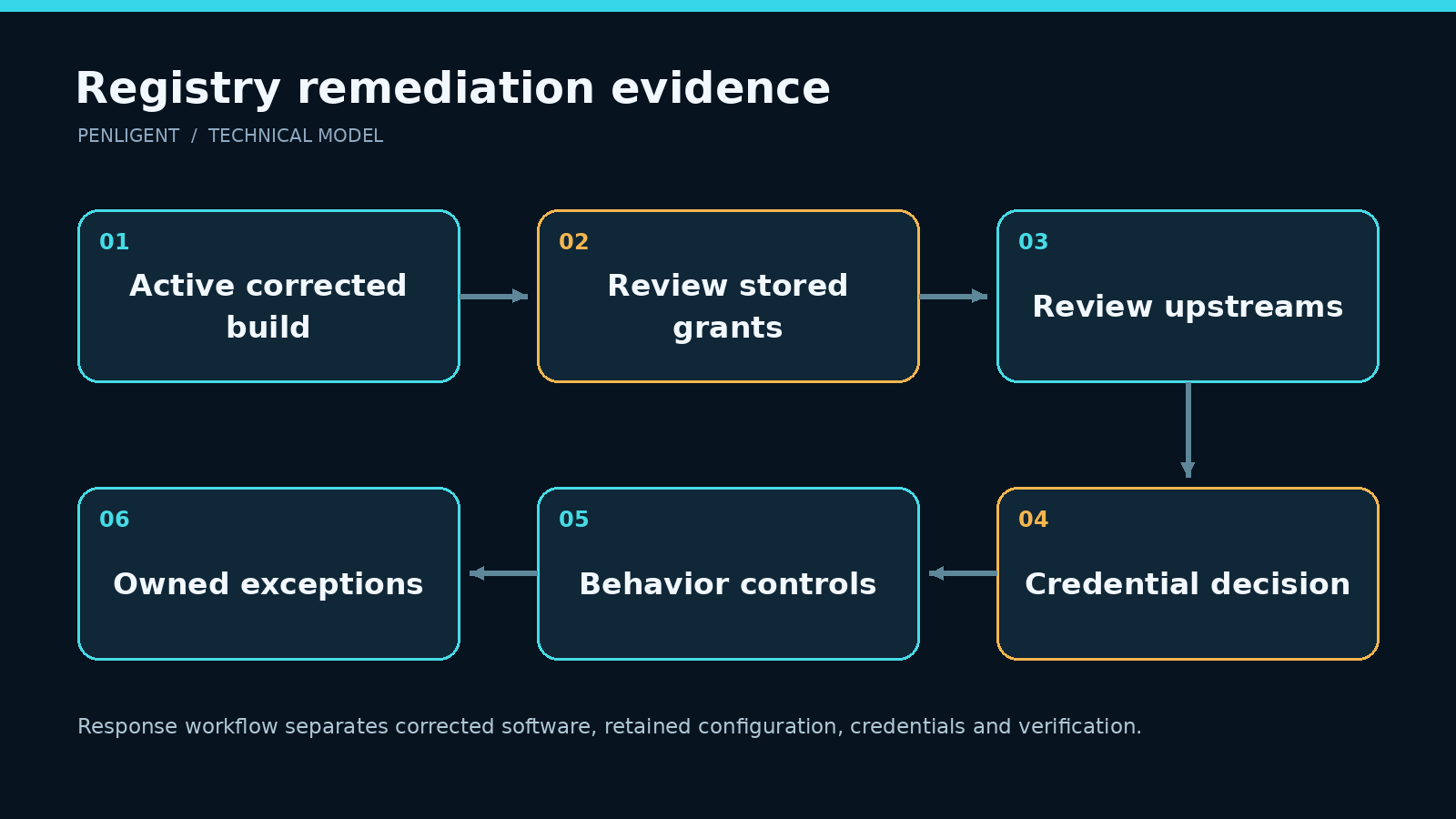
The closure record can contain separate conclusions: code corrected, configuration reviewed, credential decision completed, functional behavior verified, and incident questions resolved or retained. This format prevents a single successful deployment from hiding an unfinished recovery task. It also allows an organization to resume a controlled service while keeping a clearly owned investigation open.
Use counterexamples to test the verification method
A verification plan can fail even when every listed case appears to pass. Before relying on its results, identify an observation that would expose a weak test. The following counterexamples describe possible assessment mistakes in a fictional owned registry environment. They are not additional claims about the upstream vulnerabilities or evidence that these behaviors occur in the product.
A denied response with an unintended state change
Suppose a controlled configuration mutation returns a denial message. The tester records a pass because the response looks correct. A later supported state inspection, however, shows that the synthetic object changed before the denial was produced. The response test examined presentation, while the intended property concerned authority over retained state. The negative case should therefore verify both rejection and the absence of the prohibited change.
Design the fixture so that this distinction is observable without creating a harmful production grant. A designated test object can contain a harmless marker whose expected value is known before the operation. The owner can inspect it through the normal supported interface afterward. If the platform exposes no safe state observation, record the limitation and choose a different authorized verification method. Do not manufacture certainty from a response code alone.
An approved destination that resolves through a different route
A registration can pass a string-level policy while the actual request travels through a deployment-specific intermediary. For example, the application may use a configured proxy whose destination rules differ from the registry’s rules. A successful registration test establishes that the input was accepted. It does not independently establish which service received the resulting request.
Use a controlled upstream that can identify the expected test action without receiving secrets. Correlate its observation with the registry’s request record and the relevant proxy evidence. If the approved workflow requires redirects, define which transitions are intended and where they are enforced. The analysis should follow the actual request path instead of treating the first parsed URL as the complete network decision.
A permission change that affects only a fresh session
Imagine that the owner narrows a synthetic group’s rights and confirms the restriction using a newly signed-in account. An existing session then behaves differently. The result may reflect the application’s designed claim-refresh or cache behavior, a deployment inconsistency, or a defect. Without an expected revocation contract, the reviewer cannot distinguish those explanations.
Define the required behavior and observation times with the owner before testing. Keep the identity stable and record whether the session was existing, refreshed, or newly created. The test should answer a real operational question: when does a changed grant stop authorizing the relevant action? A report that says “revocation passed” without that context hides an important condition.
A normal operation performed with the wrong authority
A positive control can be misleading if it uses an administrator account for an operation ordinary users are supposed to perform. The administrator’s success proves that the service is functioning under that identity. It does not prove that the intended registrar or reader role still works after remediation. The matrix needs the actual role separation that the deployment relies on.
Keep separate test identities instead of repeatedly broadening one account until the operation succeeds. Record which permission is required for each positive control. If a newly restricted automation identity fails a legitimate task, have the owner identify the missing narrow permission rather than restoring a broad administrator grant without analysis. This produces evidence about both access reduction and functional compatibility.
A clean audit query that excludes the relevant events
An investigation can return no matching management changes because the query searches the wrong component, interval, or identity field. A log source may have been introduced only after the affected period, or an upstream proxy may record a different route shape. The absence of results is then a limitation of the search, not evidence that no changes occurred.
Test the search method against one known authorized synthetic change whose time and identity are recorded. Confirm that the expected source contains the event and that the filter can retrieve it. This does not prove that historical logs are complete, but it helps detect an incorrectly constructed query. Report retention gaps and source changes independently from query correctness.
A recovery snapshot that restores unreviewed authority
The active environment can be corrected while a recovery snapshot still contains an old grant or upstream entry. If that snapshot is restored during an unrelated outage, the organization may lose part of the configuration review even though it retains a corrected application image. Recovery evidence therefore needs to cover the retained authority as well as the executable artifact.
Attach the approved configuration baseline and its review date to the recovery recipe. Define how an operator verifies or reapplies the approved state before returning the restored service to use. Where a recovery process intentionally restores an older snapshot, the exception should identify the required post-restore review. This makes the response durable across operational events rather than only across the current deployment.
Review forks and packaged deployments by correction evidence
An organization may run a fork, a packaged distribution, or a platform-managed deployment rather than a plain upstream checkout. In that case, a version banner can be ambiguous. The software supplier may backport a correction without adopting the same upstream version string, or a fork may retain an upstream label while changing relevant code. Ask for the supplier’s determination and the identity of the shipped artifact.
Keep the chain of evidence compact: supplier advisory or release statement, package or image identity, deployment record, and controlled behavior verification. A reviewer should be able to see why the team considers the correction present. A copied comment saying “security patched” is weaker than a traceable supplier statement tied to the installed build.
Do not run an unreviewed public exploit simply to resolve a packaging ambiguity. The owner can often obtain correction evidence from the supplier or compare the relevant supported change in an isolated review environment. If behavioral verification is still needed, define the safe test, the expected result, and the authorized target before execution. The uncertainty is about the shipped correction, not a reason to expand the assessment beyond its scope.
Account for deployment wrappers as separate artifacts. A container image can contain the corrected application while a startup script loads a different configuration directory. A chart can point to a corrected image while a rollback value retains an older one. Review the mechanism that selects the running program and retained state. The correction must be active where the relevant operation is performed.
When supplier evidence is unavailable, preserve the unresolved state with an owner and a concrete next step. Temporary restrictions can reduce exposure while that question is answered. They should not be relabeled as proof that the underlying code is fixed. A response record that clearly separates correction evidence, containment, and uncertainty is easier to maintain than one that forces every deployment into an unsupported yes-or-no conclusion.
Give future registration changes a reviewable contract
After the immediate response, define what makes a new registry asset eligible for use. A practical contract names the service owner, intended callers, approved destination, required credential authority, and the evidence that normal use works. The contract should describe the actual tool’s purpose. It should not grant an open-ended right to contact any service that happens to be reachable from the gateway.
Review changes against the existing contract. A destination change may be routine maintenance when the same owner moves a service, but it can also change the trust boundary when a tool begins contacting another environment. A credential change can alter authority even when the hostname remains identical. The review should identify which property changed rather than treating every edit as the same administrative event.
Use an explicit owner handoff when a tool changes teams. Otherwise an apparently current registration can retain an obsolete contact, an old identity group, and credentials no one believes they own. The handoff should reconcile those relationships and the supported retirement process. A registry becomes easier to govern when an unused asset has a clear end state instead of remaining indefinitely disabled and unexplained.
Choose periodic checks according to the rate and consequence of change. A small registry with infrequent administrator changes may need a different review process from a shared platform that onboards tools continuously. The important property is that the organization can identify unexplained changes and review them before relying on the resulting authority. This operating practice complements the product correction; it is not a substitute for installing it.
Retain a short decision history that joins software corrections with configuration changes. If an upstream is modified during a future incident, an operator should be able to determine its intended owner and destination without searching through unrelated messages. That history makes both ordinary maintenance and emergency response more precise, while keeping the sensitive configuration itself under the organization’s access controls.
Work through a fictional mixed-state registry review
Consider an owned test deployment with three synthetic upstream assets: a build-status tool, an inventory tool, and an unused demonstration tool. The active registry is already on a release that includes both corrections. Its store, however, was carried forward from an older environment. This example is a proposed review exercise, not a report of an observed intrusion or a reproduction against the upstream product.
The first asset has an expected address and an accountable owner. Its creation record matches an approved administrative change, and the test role can use it under the intended policy. That evidence supports keeping the entry. It does not establish that every other entry is legitimate, so the reviewer records the result at the asset level rather than marking the entire registry trusted.
The second asset points to an address that the current owner does not recognize. The reviewer does not make a request to it immediately. Instead, the response team compares the value with retained configuration exports and the approved service inventory. A change record eventually explains that the address belonged to a retired staging service. The resulting action is a controlled correction or retirement, not a claim that the unfamiliar address proves malicious activity.
The third asset is disabled and has no current owner. A quick review might ignore it because it does not serve normal traffic. A fuller lifecycle review asks who can enable it and whether its retained address would be accepted or used if activated. The owner may choose to remove the unused configuration through the supported process, preserving the prior state and decision. Disabled is a lifecycle state, not a substitute for an ownership decision.
The group review finds a broad grant whose original approval is missing. The current identity-provider group contains an automation account used by a legitimate workflow. The team first documents the workflow’s minimum required operations, prepares a narrower approved grant in the test environment, and verifies the positive control. It can then remove the broad access without pretending that an unexplained permission had no operational dependencies.
Suppose the relevant historical logs are incomplete. The team can establish the current corrected behavior and the final approved configuration, but it cannot rule out earlier credential access. The credential owner chooses rotation and reviews source-system activity under the incident process. The closure statement should say exactly that. It should not convert a precautionary rotation into a confirmed theft, nor a clean current test into proof about the missing historical interval.
The exercise ends with separate evidence for each decision. The version record identifies the active corrected artifact. The configuration record lists retained, changed, and retired entries. The permission record explains the approved final grants. The credential record shows replacement and invalidation where required. A final functional control demonstrates that the intended synthetic tools still operate. Each artifact answers a different question.
Keep authentication tokens and stored grants in distinct records
An access token can be valid while the operation it attempts is unauthorized. Token validation may establish issuer, audience, expiration, or identity according to the deployment’s implementation. The application still needs to determine whether that identity may mutate the particular registry object. A permission review that stops after confirming a valid token has not examined that second decision.
Similarly, an intended group grant can be represented incorrectly in the identity claims consumed by a component. The review should identify which service interprets the claim and which retained state contributes to effective permission. Do not assume that changing an identity-provider group instantly changes every active session or cached decision. Verify the actual revocation and refresh behavior through supported controls.
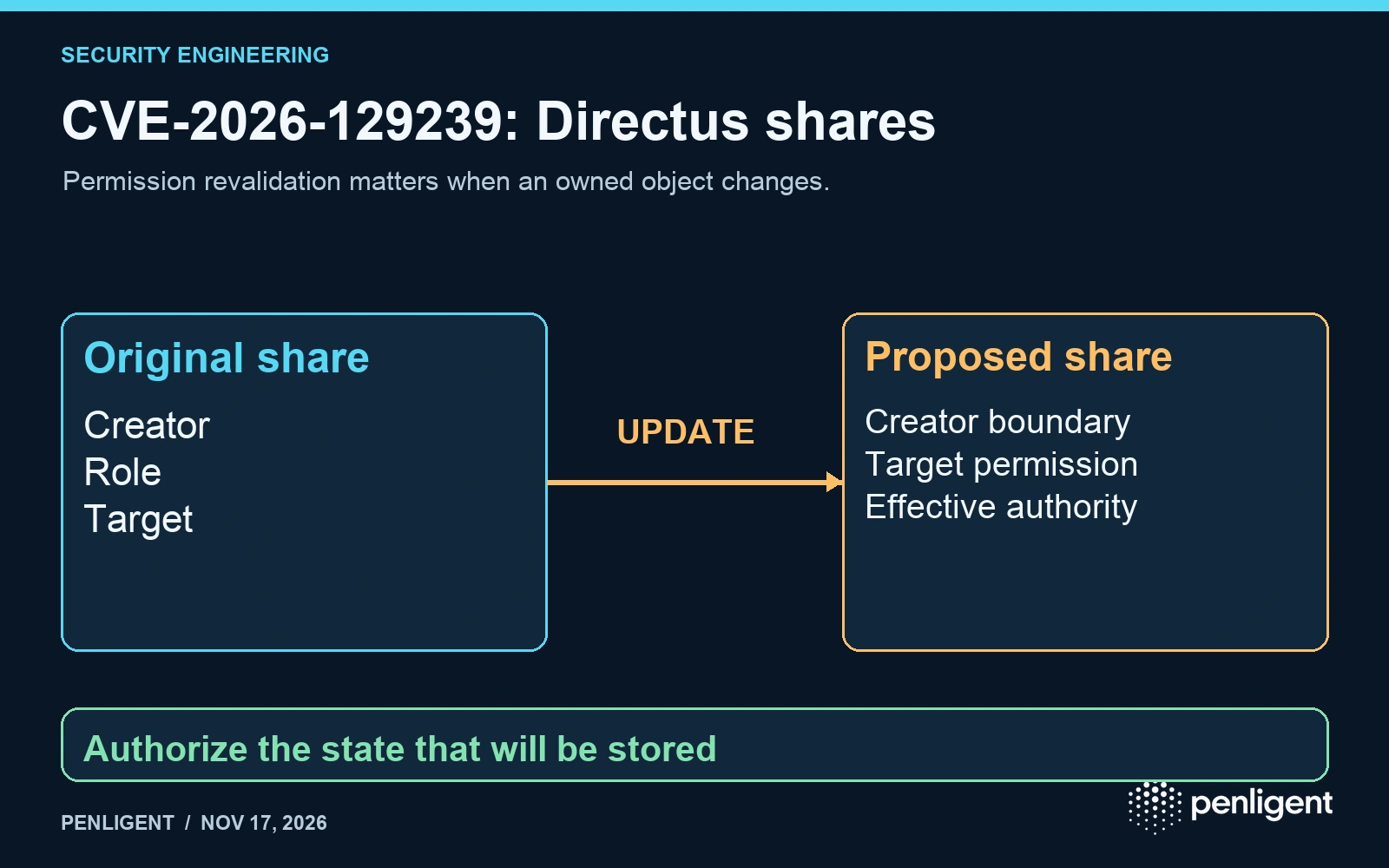
En OWASP authorization guidance recommends explicit permission enforcement and reviewable tests. Applying that principle to this registry means defining operation and object expectations, then checking them at the component that performs the action. The guidance is a design reference; it does not describe the registry’s current internal token implementation.
Use distinct evidence fields for authentication result and authorization result. In a controlled denied mutation, the record can show that the test identity signed in successfully while the prohibited operation was rejected. This is a stronger control than a failed login because it demonstrates enforcement for an otherwise valid caller. The exact evidence available depends on the application and its supported audit interfaces.
Revalidation after a permission change should test both a continuing session and the organization’s supported refreshed-session path when those observations are authorized and relevant. The owner should define the expected timing. If the system intentionally applies a documented propagation interval, record it. If the behavior is undefined, retain the question rather than inventing a safe interval after the test.
Deliver a repair record another operator can use
The response handoff should identify the deployment, component, previous and corrected artifact, activation evidence, retained-state review, credential decision, and remaining limitations. Keep source references beside the version and product claims. An operator should not need to rediscover which of the two CVEs a particular change addresses.
{
  "deployment": "owned-registry-test",
  "software_decisions": ["management authorization", "upstream validation"],
  "retained_state_review": ["group grants", "upstream entries"],
  "credential_decision": "documented by credential owner",
  "verification": ["approved operation passes", "prohibited mutation denied"],
  "exceptions": [],
  "evidence_owner": "registry service owner"
}
This example is a handoff shape, not a product schema. Its purpose is to make unfinished work visible. If one component remains unverified, add the exception, its owner, and the condition for returning it to service. If historical logs are missing, state the covered interval and the resulting credential or incident decision. An honest limitation is operationally useful because it tells the next owner where the evidence ends.
For an authorized application assessment using Penligent or another testing workflow, use the same synthetic assets and role expectations and request reproducible observations. Do not treat a general application-testing report as proof that a registry’s stored grants were reviewed or that its cloud credentials were recovered. Those conclusions need their own supported evidence.
Questions about the MCP Gateway Registry advisories
Does upgrading to 1.25.0 address both issues?
- No. AWS distinguishes the management-authorization correction from the later SSRF correction. Match each issue to the vendor’s separate version guidance.
- Use a current supported corrected release and verify the artifact that is actually active.
Are existing upstream registrations automatically trustworthy after upgrading?
- AWS says the SSRF correction leaves previously stored server configurations unchanged.
- Review retained addresses against approved ownership and destination records rather than assuming the new write-time checks reviewed old values.
Can an old privileged group mapping survive the management fix?
- The management bulletin says a previously written privileged mapping can continue granting access after the upgrade.
- Review intended grants and effective permission through the supported process, preserving relevant evidence before changes.
Do these two advisories prove that the issues were chained?
- No. They describe distinct failures in the same product. A real attack chain requires its own evidence.
- Keep product exposure, suspicious events, and confirmed unauthorized activity separate in the response record.
Should every credential be declared stolen?
- No. Follow the vendor’s review conditions and the authority present in your deployment.
- Document rotation decisions honestly when visibility is insufficient, and verify invalidation of replaced credentials.
Can a network rule replace the code correction?
- A network restriction can limit a reachable path, but it does not install the application fix or review retained grants and registrations.
- Track temporary containment and permanent remediation as separate tasks.
What does a passing verification establish?
- It supports the documented software and behavior decisions for the tested components, identities, configuration, and time.
- It does not by itself resolve prior compromise, missing logs, unreviewed components, or potentially exposed credentials.
Close the registry response when the running correction, retained authority, and recovery decisions agree on the same deployment. Keep each conclusion attached to evidence and an owner. That is the difference between installing a newer version and restoring a registry whose permissions and destinations can be trusted for the work it performs.
 Spanish
 English
 German
 French
 Portuguese
 Japanese
 Korean
 Hindi
 Arabic
 Turkish
 Hebrew