
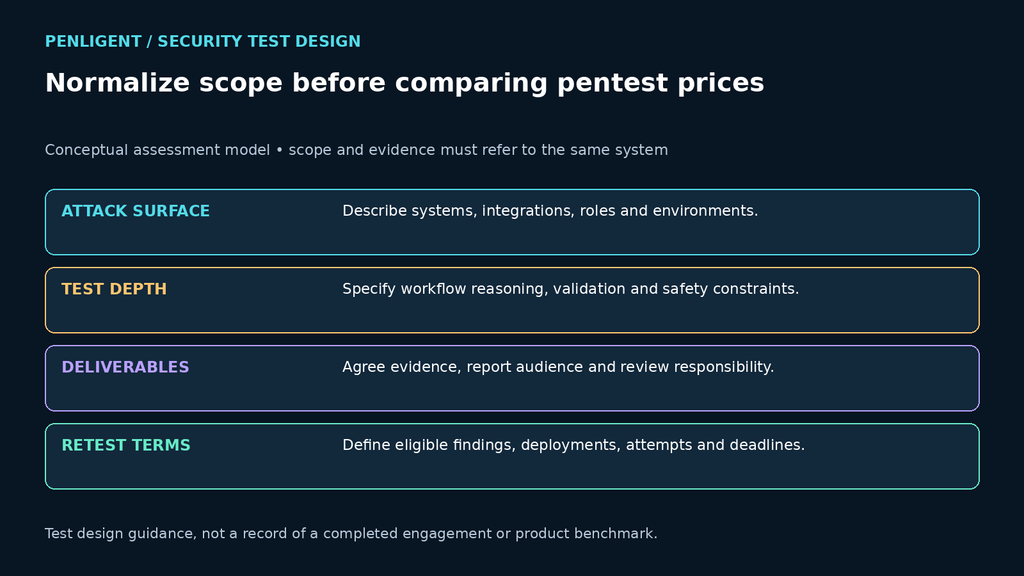
Penetration testing cost is primarily a scope and evidence question. A quote cannot be compared fairly until the buyer knows what will be tested, which identities and environments are included, how deeply workflows will be exercised, what evidence will be delivered and whether remediation retesting is part of the price.
Generic market ranges often hide these variables. They can encourage buyers to select a low quote that covers only unauthenticated scanning or to overpay for a broad label with no measurable testing depth. A better approach is to normalize every proposal into the same units and acceptance criteria.
The variables that change pentest pricing
| Variable | Why it changes effort | What to provide before quoting |
|---|---|---|
| Attack surface | More applications, APIs, hosts, roles and integrations increase discovery and validation work | Inventory with owners, environments and exclusions |
| Autenticación | Multiple roles and identity flows require setup, state management and authorization testing | Role matrix and synthetic accounts |
| Business logic | Stateful workflows cannot be assessed by generic payload coverage alone | Critical user journeys and security invariants |
| Technology | Cloud, mobile, thick client, GraphQL, event-driven and AI components need different methods | Architecture and data-flow summary |
| Medio ambiente | Production safety restrictions may reduce test intensity or require more coordination | Preferred staging target and production constraints |
| Assurance requirement | Compliance, customer due diligence or board reporting can change documentation needs | Required framework, audience and deadline |
| Evidence and retest | Developer-ready reproduction and verified remediation require additional work | Report format, ticket workflow and retest expectation |
Explore Penligent for authorized security testing
Common pricing models
| Modelo | Works well when | Watch for |
|---|---|---|
| Fixed engagement | The target and testing window are stable | Change-order rules may exclude new endpoints or roles |
| Time and materials | Research depth or architecture is uncertain | Budget control requires clear priorities and stop conditions |
| Subscription or PTaaS | The team needs recurring testing and retesting | Usage units and human validation may vary by tier |
| Application or asset tier | The provider has a consistent definition of an application or asset | Microservices, domains and environments may be counted unexpectedly |
| Outcome or finding based | Acceptance rules are unusually precise | Incentives can favor finding fragmentation or shallow severity labels |
Ask vendors to state what happens if the agreed scope is completed early, if a critical path requires deeper investigation or if a planned component is unavailable. The commercial model should not pressure the tester to stop before impact is understood or to manufacture more alerts.
Build a quote-ready scope
Use a scope brief that includes:
- applications, APIs, domains, IP ranges and cloud accounts;
- production, staging and development environments;
- roles, tenants, authentication methods and privileged paths;
- critical workflows such as invitations, billing, refunds, approvals and exports;
- mobile, desktop, browser extension, AI or integration components;
- third-party services that are in or out of scope;
- rate, safety, data-handling and test-window restrictions;
- report, ticket, executive summary and retest requirements.
En NIST testing guide provides a useful planning model, and the Guía de pruebas de seguridad web OWASP can help buyers identify relevant test areas. These references do not determine the price; they make hidden scope differences easier to see.
Compare proposals with normalized units
| Proposal field | Vendor A | Vendor B | Acceptance question |
|---|---|---|---|
| Targets and environments | Record | Record | Do both proposals test the same systems? |
| Roles and tenants | Record | Record | Is authenticated and cross-role testing included? |
| Manual or adaptive testing | Record | Record | Who investigates business logic and chained impact? |
| Pruebas | Record | Record | Can engineers reproduce accepted findings? |
| Retests | Record | Record | How many, during what period and with what output? |
| Human review | Record | Record | Who validates automated or AI-generated conclusions? |
| Deliverables | Record | Record | Are tickets, executive summary and evidence exports included? |
Hidden internal costs
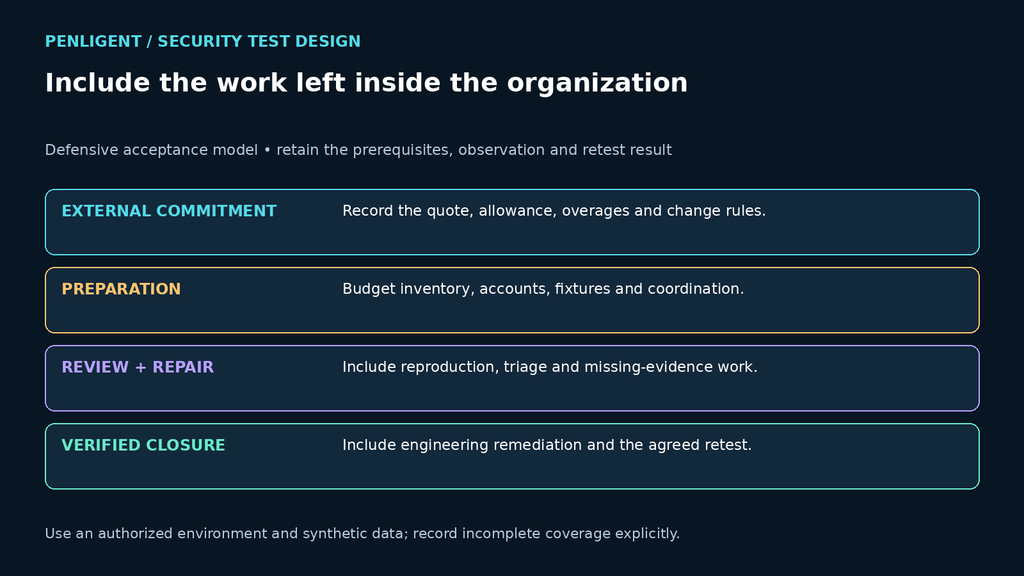
The external quote is only one part of total cost. Budget for asset inventory, test-account creation, staging data, architecture walkthroughs, allowlisting, support during the test, finding triage, engineering reproduction, remediation and retesting.
A cheap assessment can become expensive when reports lack request context, duplicate root causes, misidentify components or require internal analysts to rebuild every proof. A more expensive engagement may be lower cost if engineers accept the findings quickly and retests close the loop.
Compliance does not define sufficient depth
If a test supports PCI DSS, SOC 2, ISO 27001 or customer assurance, provide the precise requirement and the evidence the auditor expects. Do not assume that a compliance label guarantees coverage of tenant isolation, payment logic, cloud IAM or AI-agent behavior. The PCI Security Standards Council document library should be consulted for the applicable current PCI requirements rather than relying on a vendor’s shorthand.
Cost controls for AI and automated testing
AI-assisted and automated platforms introduce different cost drivers: model usage, worker infrastructure, test frequency, loop limits, analyst review and evidence repair. Request hard limits for concurrency, usage and out-of-scope actions. Ask whether the subscription includes human validation and whether findings remain exportable after cancellation.
Procurement questions
- What exact assets, roles, workflows and environments are included?
- Which testing activities are automated, analyst-led or excluded?
- What is the unit that triggers an overage or change order?
- What evidence accompanies each accepted finding?
- How are false positives, duplicates and disputed impact handled?
- How many remediation retests are included and when do they expire?
- Can all raw evidence, reports and audit logs be exported?
- What happens if the service causes disruption or leaves scope?
Explore Penligent for authorized security testing
Make the purchase measurable
The best-priced pentest is the one whose scope and evidence match the decision the organization needs to make. Normalize proposals before comparing price, and measure the cost per accepted, remediated and retested finding. Teams considering AI-assisted testing can evaluate Penligent with the same scope and evidence requirements.
The following Penligent overview introduces a general authorized testing workflow. It does not demonstrate that every assessment capability discussed in this guide is included in a particular product plan.
 Spanish
 English
 German
 French
 Portuguese
 Japanese
 Korean
 Hindi
 Arabic
 Turkish
 Hebrew