
Last updated: November 4, 2026.
Red team services should test a defined security objective against an agreed threat scenario. A broad promise to “act like an attacker” is not enough. Buyers need to know what business outcome is being protected, which controls are being exercised, which techniques are permitted and what evidence the red and blue teams will receive.
A penetration test usually seeks vulnerabilities within a defined technical scope. A red team exercise is often objective-led and may combine identity, applications, infrastructure and detection controls. That wider freedom also requires stronger rules of engagement and executive accountability.
For the assessment framework, consult NIST SP 800-115 and map the relevant guidance to the actual environment and authorized scope.
Start with an objective, not a technique list
Useful objectives are concrete and observable: obtain access to a synthetic sensitive record, reach a controlled administrative function, demonstrate a path to a segmented environment, or test whether a defined behavior produces an actionable alert.
| Objective element | Example decision |
|---|---|
| Protected outcome | Synthetic customer records or a controlled administrative action |
| Initial access | Assumed foothold, external access or approved social scenario |
| Permitted techniques | Application, identity, cloud and endpoint actions |
| Success condition | Minimum proof that the objective could be reached |
| Stop condition | Safety event, unexpected production impact or objective achieved |
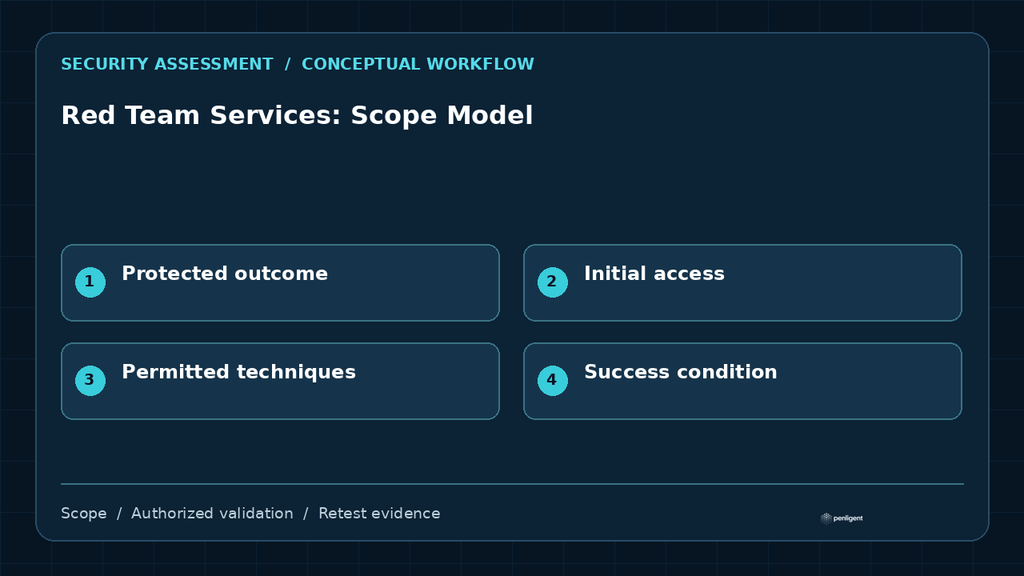
Turn the scope into testable evidence
Define an authorized target, validate meaningful attack paths, and keep the evidence connected to remediation and retesting.
Write rules of engagement that operators can follow
The rules of engagement should identify authorized targets, dates, contacts, third-party boundaries, prohibited data, persistence limits and actions that need approval. It should also explain how defenders will distinguish authorized activity from an actual incident if safety requires deconfliction.
- Named executive sponsor and exercise controller.
- Approved infrastructure, identities and test data.
- No-go systems and regulated or third-party environments.
- Payload, persistence, phishing and physical-access restrictions.
- Evidence handling, encryption, retention and destruction.
- Emergency stop, deconfliction and incident escalation process.
Collect evidence for both attack and defense
A red team report should connect each material step to the control that allowed it and to the telemetry defenders had available. The blue-team view matters: whether an event was logged, enriched, correlated, triaged and escalated is often more important than whether one tool generated an alert.
Plan remediation and replay
The exercise should end with more than a narrative. Map findings to control owners, detection changes and prevention work. A focused replay or purple-team session can verify that the corrected control changes the outcome without repeating the entire operation.
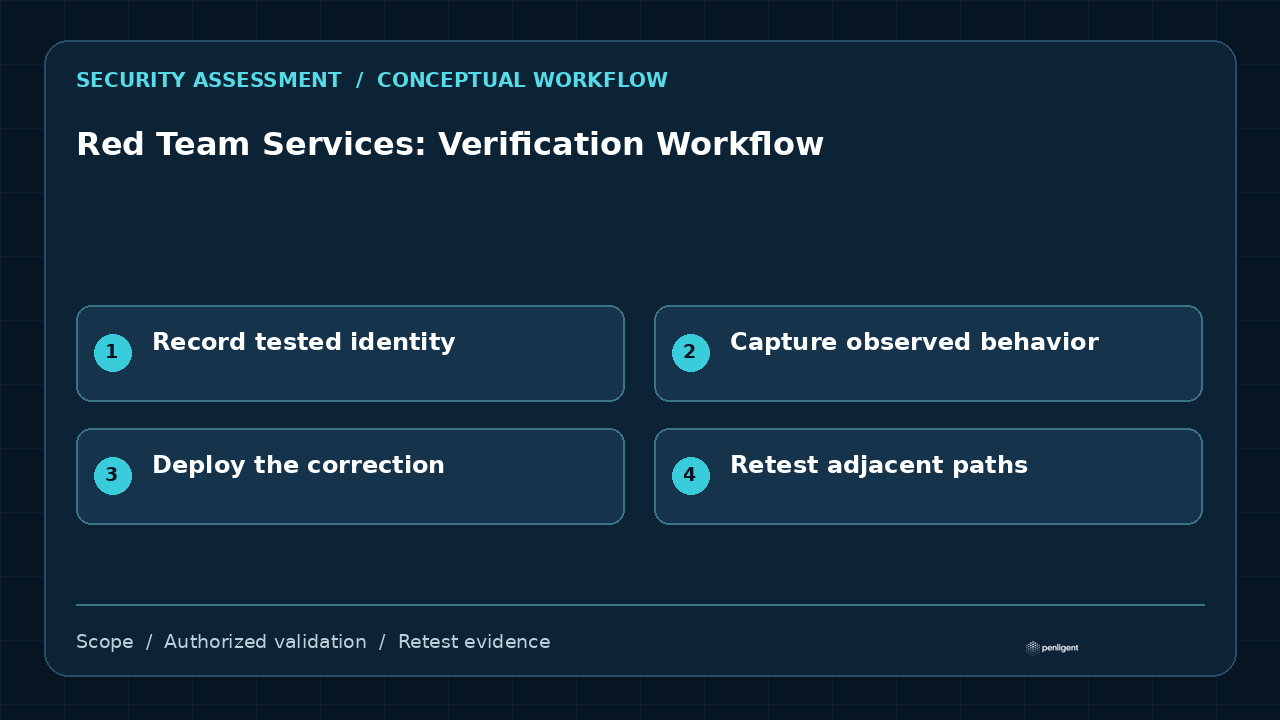
Turn the scope into testable evidence
Define an authorized target, validate meaningful attack paths, and keep the evidence connected to remediation and retesting.
Questions buyers should ask
- What business objective and threat assumptions drive the exercise?
- Which techniques require just-in-time approval?
- How are third-party systems, production safety and real incidents handled?
- Will the deliverable include detection timelines and a focused replay?
Conclusión
Choose red team services that can state the objective, constraints and evidence model before operations begin. A successful engagement leaves leadership with a verified attack path, defenders with a detection timeline and control owners with a testable remediation plan.
 Spanish
 English
 German
 French
 Portuguese
 Japanese
 Korean
 Hindi
 Arabic
 Turkish
 Hebrew