
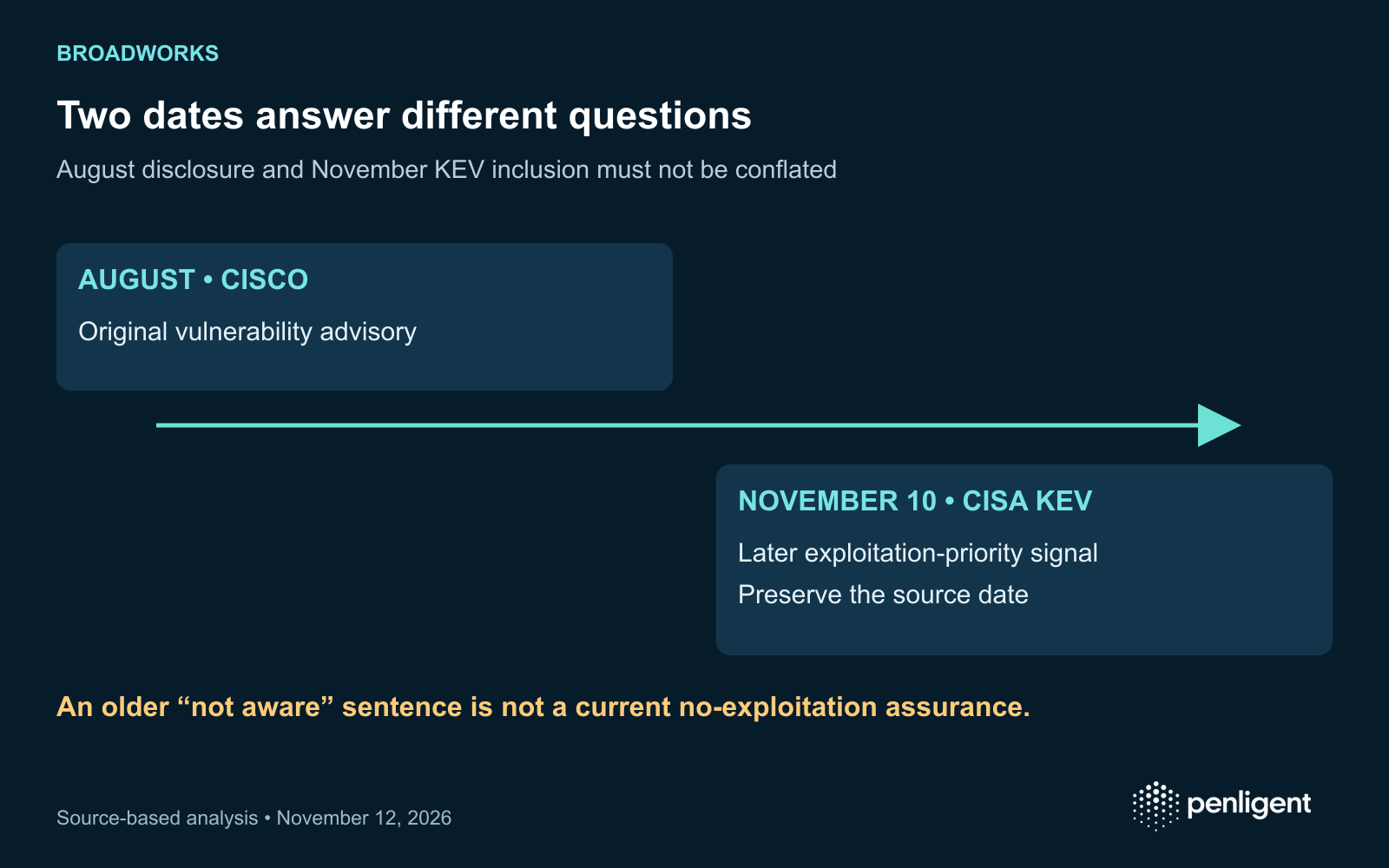
BroadWorks CVE-2026-20320 is a configuration-file disclosure issue in the OCI XML parser, not a newly announced November vulnerability. Cisco originally published the advisory in August; CISA’s November 10 KEV addition gives operators a new prioritization signal. The remediation task is to map every relevant product role to its corrected release and verify the service actually running.
Keep advisory age and exploitation evidence separate
Les Avis de Cisco says an unauthenticated remote attacker can read sensitive configuration information through crafted XML sent to OCI-P. External entity resolution is allowed by default in the vulnerable parser. The filesystem access is under the privileges of the BroadWorks user; this is not a statement that every file on the host is readable or that arbitrary command execution has been demonstrated.
The Cisco page reviewed still says PSIRT is not aware of malicious use. The CISA KEV catalog snapshot dated November 10, 2026 lists this CVE. Retain both dates and give the later KEV evidence its operational weight. Do not repeat the older vendor sentence as a current assurance that exploitation has never occurred.
Map the four affected product roles
Cisco lists these products as affected when running a vulnerable release, regardless of device configuration. Network reachability still changes who can reach the service, but a restricted deployment is not thereby a corrected software release. Cisco states that no workaround addresses the vulnerability.
| BroadWorks product | Affected release boundary in the advisory | First fixed release |
|---|---|---|
| Application Delivery Platform | Earlier than RI.2026.07; note covers OCS and OCIOverSoap | RI.2026.07 |
| Application Server | Earlier than RI.2026.07 | RI.2026.07 |
| Profile Server | Earlier than RI.2026.07 | RI.2026.07 |
| Xtended Services Platform | Earlier than RI.2026.07 | RI.2026.07 |
Use the advisory’s exact product mapping and an appropriate supported release. Do not treat similarly named Cisco products or a generic operating-system package update as proof that the BroadWorks component is fixed. For provider-managed components, obtain the provider’s asset and release evidence rather than inferring a version from a customer portal banner.
Assess exposure without reading sensitive files
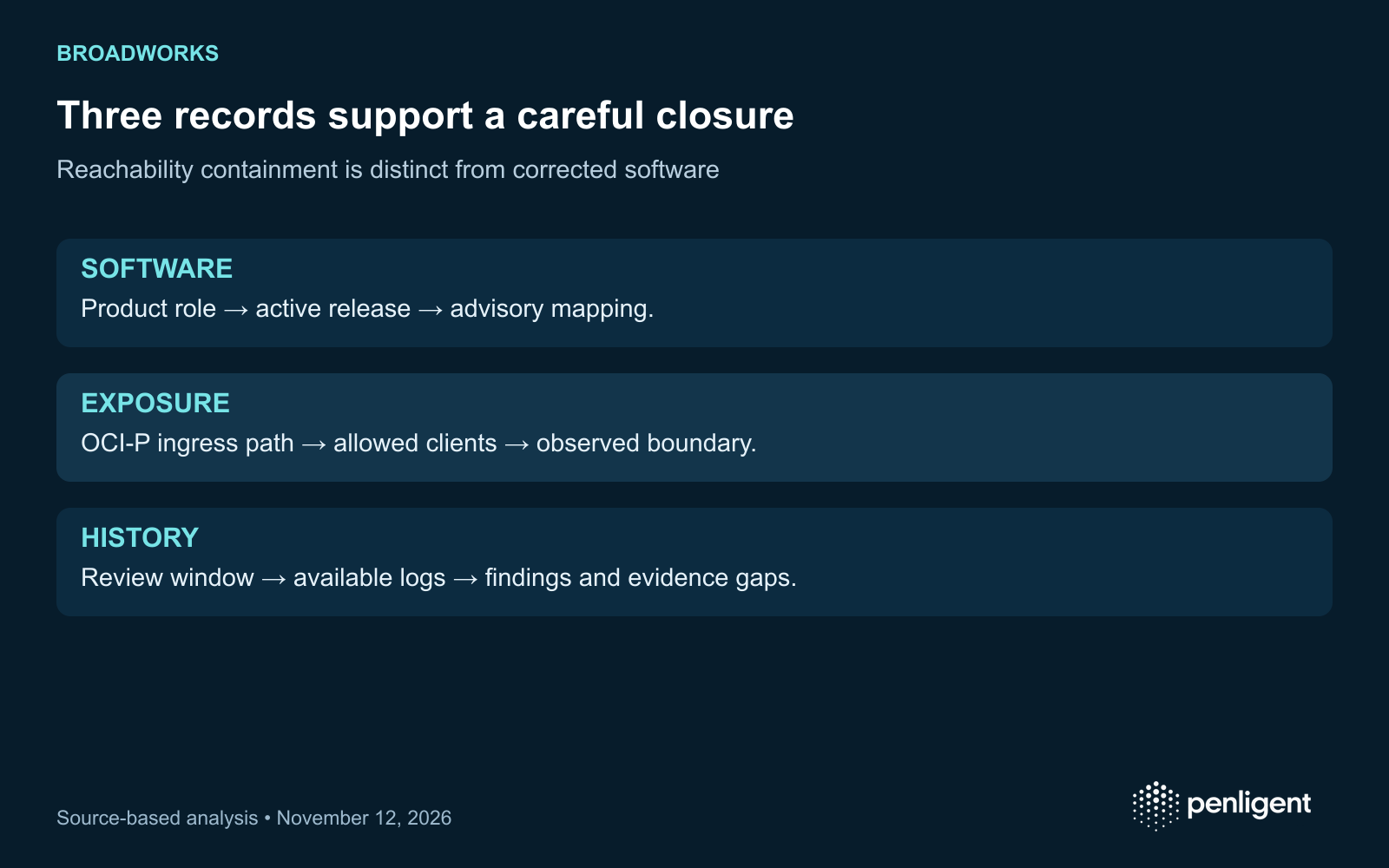
Inventory the OCI-P service, its owners, routing path and allowed clients through supported administrative records. Compare intended ingress restrictions with the actual deployment. Use a benign, documented service check if needed; do not send external-entity payloads or attempt to retrieve configuration files as a production verification step.
For each role, record whether the service was reachable during the relevant period and which logs can support historical review. Configuration files may contain sensitive operational information, but the impact of a particular disclosure depends on the actual file and privileges. Do not assume a credential was stolen solely because the host ran a vulnerable release.
Give patch state and incident review independent outcomes
| Closure question | Acceptable evidence | What stays unresolved |
|---|---|---|
| Correct component updated? | Product role, host identity, installed artifact and running release | Unidentified role or offline member. |
| Intended management boundary enforced? | Ingress policy and authorized service-path observation | Unknown alternate route or untested network segment. |
| Sensitive data accessed historically? | Available service, host and network evidence for a stated window | Missing collection, expired retention or incomplete source coverage. |
| Required service remains healthy? | Normal supported workflow after the upgrade | Availability check alone cannot prove the security fix. |
Asset → BroadWorks role → running release
Advisory mapping and evidence timestamp
OCI-P ingress path and authorized clients
Upgrade owner and completion record
Service health check
Historical review: window, sources, findings, gaps
Exception: owner and return-to-service condition
The KEV entry provides a federal remediation policy context as well as a strong prioritization signal. Your organization should apply its own applicable obligations and response process; the catalog deadline should not be presented as a universal legal deadline for every BroadWorks customer.
For a validation engagement, require component-specific release evidence and a bounded reachability review. Those checks answer a different question from reproducing file disclosure. Keep any incident investigation scoped and separately documented.
Close the BroadWorks patch task using product-role and service evidence. For a separate authorized application assessment, confirm Penligent scope and deliverables against the deployment you actually operate.
The official Penligent 3.0 video below demonstrates the general product workflow. It illustrates product use; the article’s assessment proposals and source findings are evaluated separately.
Method: AI-assisted review of the linked primary sources, checked November 12, 2026, with an original assessment framework. No exploit, production target or customer environment was tested for this article.
 French
 English
 German
 Spanish
 Portuguese
 Japanese
 Korean
 Hindi
 Arabic
 Turkish
 Hebrew