
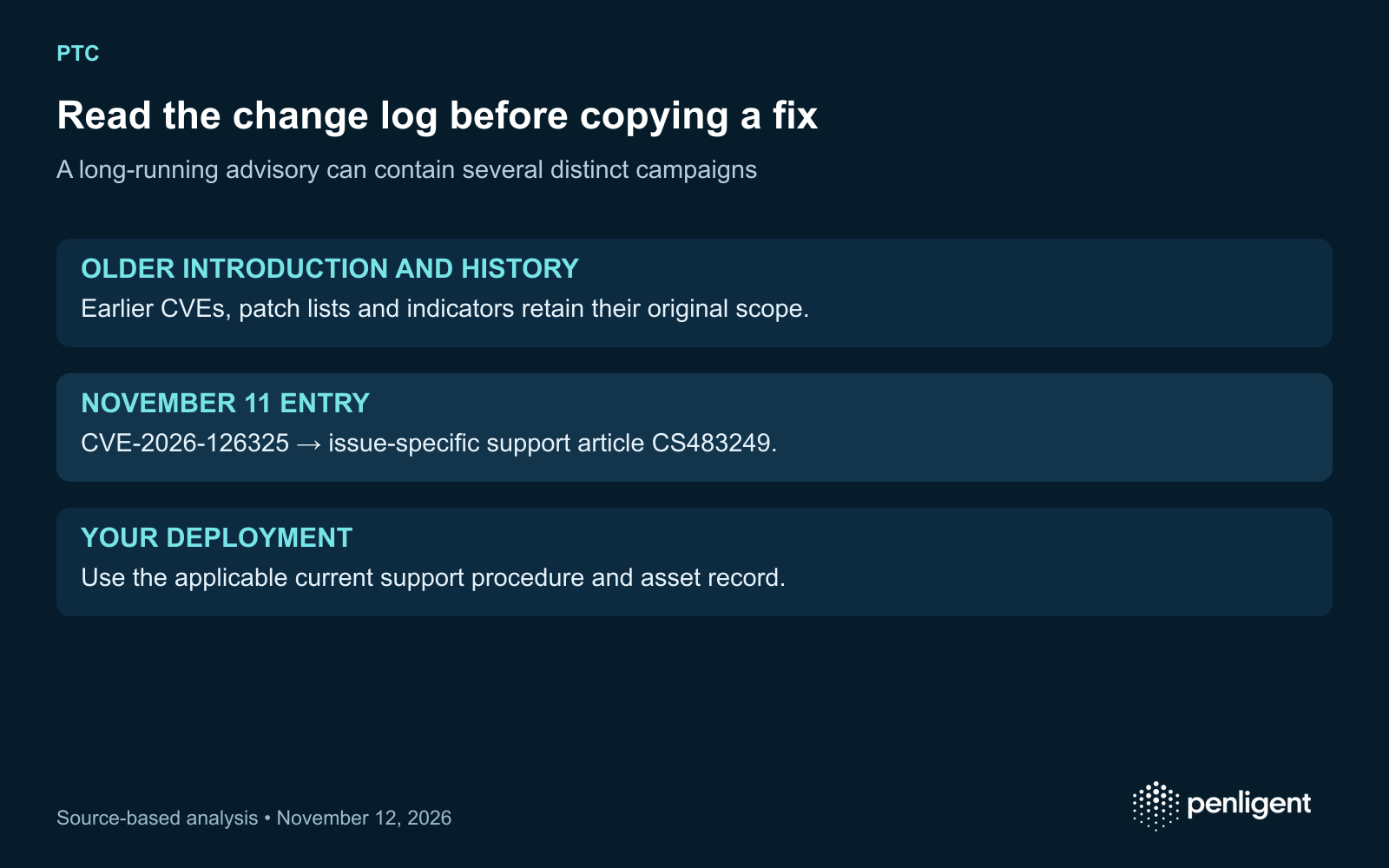
Use the November 11 entry for CVE-2026-126325 when assessing the new Windchill and FlexPLM patch. PTC’s public advisory is a long-running page whose introduction still discusses an earlier vulnerability. Its older title and historical patch lists should not be substituted for the new issue’s remediation instructions.
Read the dated entry, not just the page heading
PTC’s public Trust Center page adds a November 11, 2026, 10:30 AM ET entry saying a new security patch for CVE-2026-126325 is available. It directs administrators to support article CS483249. Earlier entries concern different CVEs and patch campaigns.
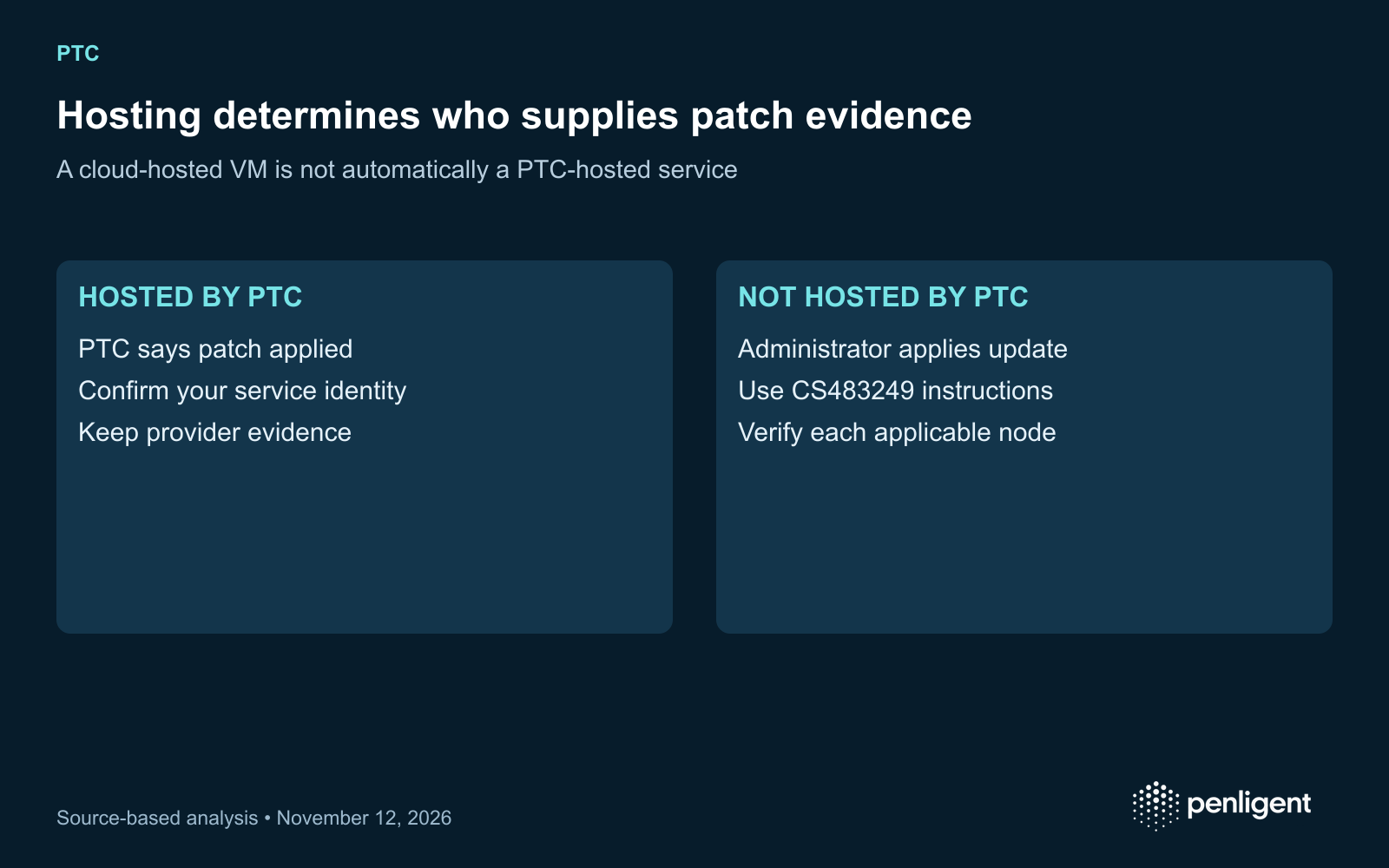
The new entry says PTC-hosted environments have had the patches applied on customers’ behalf and that no customer action is required for that hosted patch step. For environments not hosted by PTC, it urges prompt application by a Windchill administrator. Keep those deployment-specific instructions attached to the November entry.
Assign the patch duty to the actual hosting model
| Déploiement | Patch action described by PTC | Evidence to request |
|---|---|---|
| Hosted by PTC | PTC says the patches have been applied on customers’ behalf | Provider confirmation identifying your service and the relevant update. |
| Self-managed or hosted by another party | Customer administrator should apply the patch using CS483249 | Exact product/build, applicable support instructions, applied patch and active-service evidence. |
| Hosting responsibility unclear | Resolve ownership before treating the task as complete | Contract/service owner, environment inventory and maintenance contact. |
“Hosted” should identify who operates this Windchill or FlexPLM environment, not merely whether a virtual machine lives in a cloud. A third-party managed service should supply its own implementation record. Do not infer that PTC applied a patch to an environment it does not operate.
Obtain the issue-specific instructions through the supported channel
The publicly reviewed update does not provide a complete new affected/fixed build matrix. Use the authorized support article and the deployment’s support entitlement to determine the package and procedure. This article does not reproduce restricted instructions, invent a new version boundary or download a patch for you.
Save the support instruction revision, product identity and administrator’s applicability decision in the change record. If the environment has multiple application nodes or a standby that can return to service, require a disposition for each. A central change ticket is insufficient when its asset scope is unclear.
Keep three outcomes visible in the handoff
First, establish that the correct update was applied to the intended component. Second, check the supported business workflow after activation so availability issues are visible. Third, determine whether historical exposure needs investigation under the organization’s response process. These outcomes can share evidence, but none should silently substitute for the others.
Be particularly careful with the page’s older indicators and remediation entries. They can be useful historical context for their original incidents, but their presence on the same page does not prove that they identify exploitation of CVE-2026-126325. Date and identify the source beside every indicator used in an investigation.
Environment / product / hosting operator
Applicable entry: November 11, 2026 — CVE-2026-126325
Support procedure: CS483249 and reviewed revision
Affected nodes and administrator applicability decision
Applied update and active-service evidence
Normal workflow check and exceptions
Historical review: separately scoped evidence and limits
For a managed patch or validation engagement, ask for this record with named ownership of remaining exceptions. If the necessary support information or node evidence is unavailable, mark the applicability or deployment result unresolved rather than copying an older patch list into a completed ticket.
Retain the product-specific patch record as the remediation decision. If using Penligent for a separate application assessment, agree the reachable surface and reporting evidence in advance.
The official Penligent 3.0 video below demonstrates the general product workflow. It illustrates product use; the article’s assessment proposals and source findings are evaluated separately.
Method: AI-assisted review of the linked primary sources, checked November 12, 2026, with an original assessment framework. No exploit, production target or customer environment was tested for this article.
 French
 English
 German
 Spanish
 Portuguese
 Japanese
 Korean
 Hindi
 Arabic
 Turkish
 Hebrew