
Two Oracle Java findings in the November 2026 Critical Patch Update share supported product builds but have different exposure logic. Treating them as one generic “Java is remotely exploitable” issue creates false positives and can also miss an application that feeds untrusted input into a specific API.
This assessment is for Java platform owners, application security engineers, and incident responders inventorying Oracle Java SE or GraalVM. It uses the Oracle advisory and CVE records published November 17, 2026. It is a configuration and patch-verification guide; no exploit was reproduced for this article.
Separate the components before prioritizing
Oracle’s November 2026 advisory identifies CVE-2026-114939 in JGSS and CVE-2026-114940 in JSSE. Both CVE records list Oracle Java SE builds 8u511b33, 11.0.33.0.3, 17.0.21.0.3, 21.0.13.0.3, 25.0.5.0.3, and 27.0.1.0.3; Oracle GraalVM for JDK 17.0.21.0.3 and 21.0.13.0.3; and GraalVM Enterprise Edition 21.3.20.0.3. Java 8 performance builds are also listed. Use the vendor advisory for the exact product edition and platform, and the current Oracle security-alert page for the correction applicable to that line.
The shared build list does not mean the same workload conditions apply to both findings:
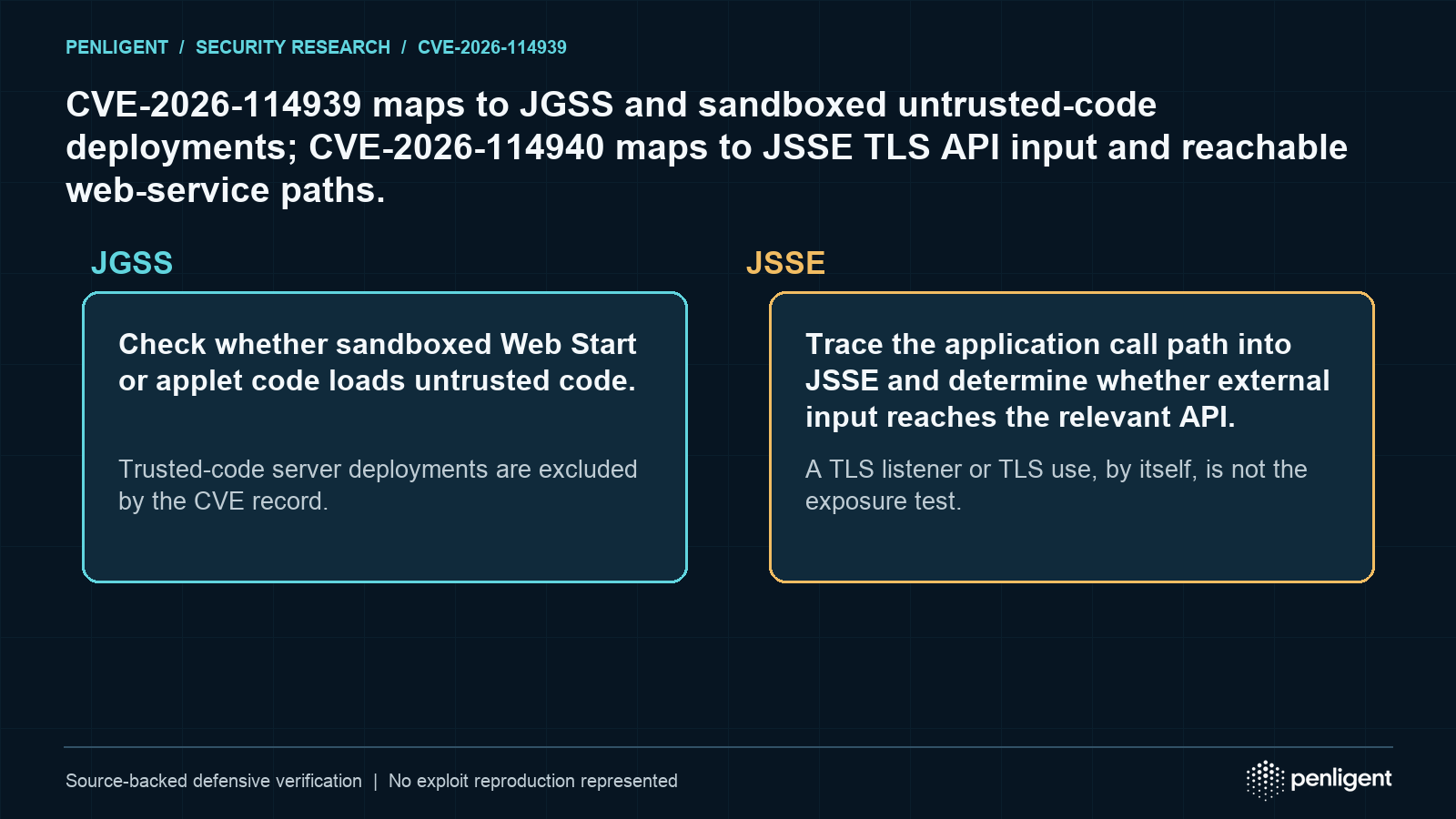
- CVE-2026-114939 (JGSS): the CVE record describes exploitation through multiple protocols and explicitly says the issue applies to sandboxed Java Web Start or applet deployments that load untrusted code and rely on the Java sandbox. It explicitly excludes server deployments that load only administrator-installed trusted code.
- CVE-2026-114940 (JSSE): the record describes network access via TLS. It notes that input supplied to JSSE APIs can reach the component, for example through a web service; it also applies to sandboxed clients that rely on the Java sandbox. Do not treat “uses TLS” alone as proof that attacker-controlled input reaches the relevant API.
Both records give CVSS 3.1 score 7.4 with high attack complexity and no required privileges or user interaction. The CISA enrichment in the published records says exploitation is not known. That is a recorded status, not proof that a particular deployment is safe.
Map the running process, not just the installed JDK
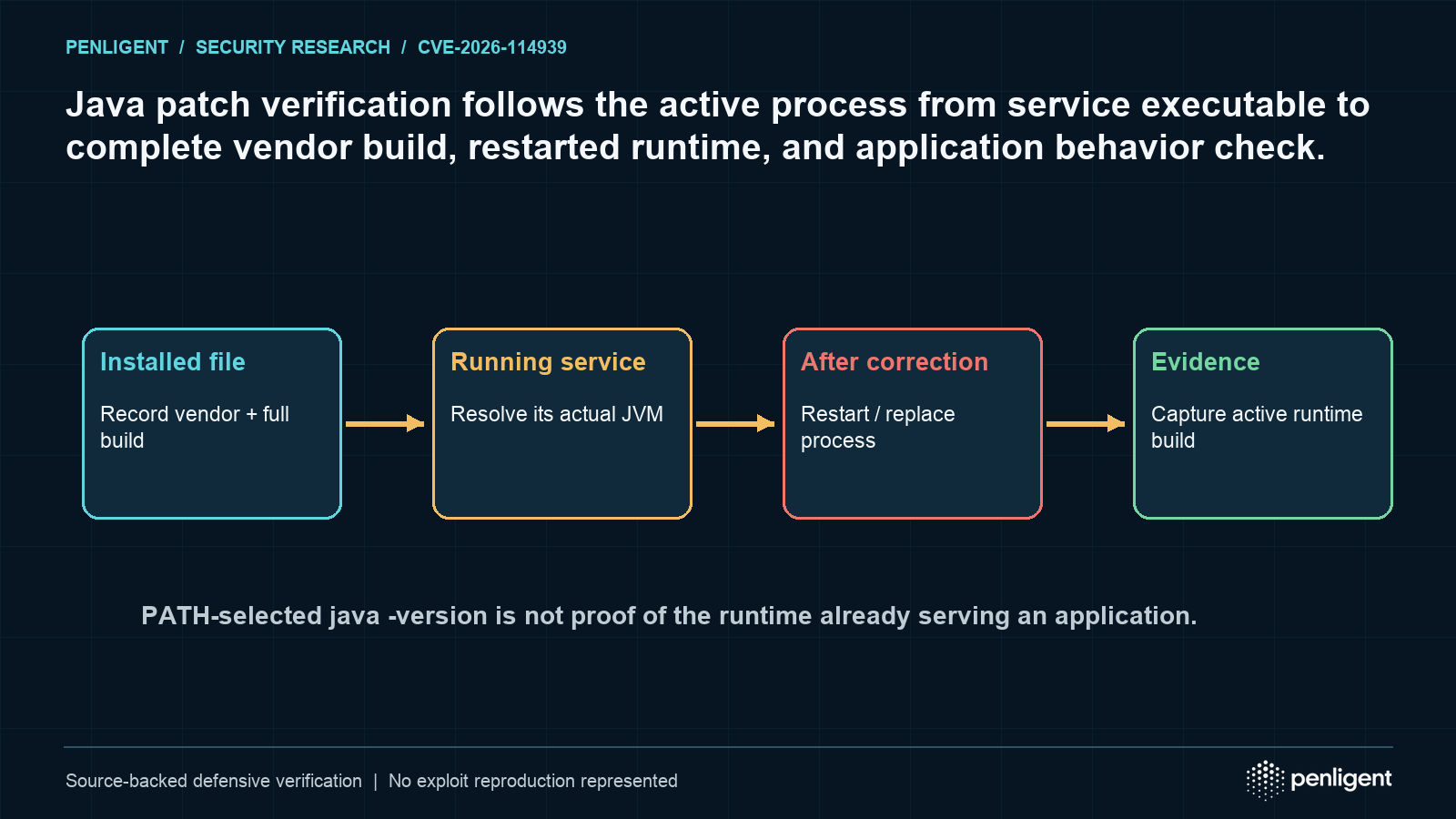
Begin with asset inventory: Oracle JDK, GraalVM, application-server runtimes, desktop Java clients, build agents, and container images may carry separate runtimes. On a host you administer, record the process, executable path, vendor, and full build. A shell check such as java -version describes whichever executable the current PATH selects; it does not identify a service’s already-running JVM.
For each Java process, record the actual executable and runtime home from the service definition or process inventory. Compare its complete vendor build with Oracle’s affected-version table. For downstream OpenJDK builds, GraalVM variants, and vendor-packaged applications, use that supplier’s advisory and backport statement rather than copying Oracle version strings onto a different distribution.
Then answer two separate questions. For JGSS, does the deployment run sandboxed untrusted Java Web Start or applet code that depends on the Java sandbox? For JSSE, which code path invokes the TLS APIs, and can attacker-controlled data reach that path? Document the answer and its evidence; do not infer an exposed path from a product name or open port.
Patch and close with runtime evidence
Install the supported Oracle CPU or the applicable downstream vendor correction. The listed builds are the affected builds, not a universal fixed-build matrix. Preserve the package or image digest, deploy the corrected artifact, and restart or replace every process that used the old runtime. A newer JDK on disk does not change a JVM that has not been restarted.
After rollout, capture the runtime identity from the service itself, reconcile every host and image against the vendor’s corrected release, and exercise the application’s legitimate JGSS or JSSE flows. If a service accepted untrusted Java code or processed external data through the relevant APIs while exposed, assess the earlier window using available application, identity, and network telemetry. The CVE records do not establish that exploitation occurred.
For an authorized application assessment, Penligent provides a workflow for testing scoped application paths. Keep the tested build and runtime identity alongside any assessment result; a completed test does not replace the vendor’s affected-version status.
Method: This article was prepared with AI assistance from the primary sources linked below. The deployment checks are an editorial synthesis of those sources; no first-hand exploit validation is claimed.
Sources : Oracle November 2026 CPU; CVE-2026-114939 record; CVE-2026-114940 record. Oracle’s records were checked November 23, 2026. No first-hand exploit testing is claimed.
 French
 English
 German
 Spanish
 Portuguese
 Japanese
 Korean
 Hindi
 Arabic
 Turkish
 Hebrew