
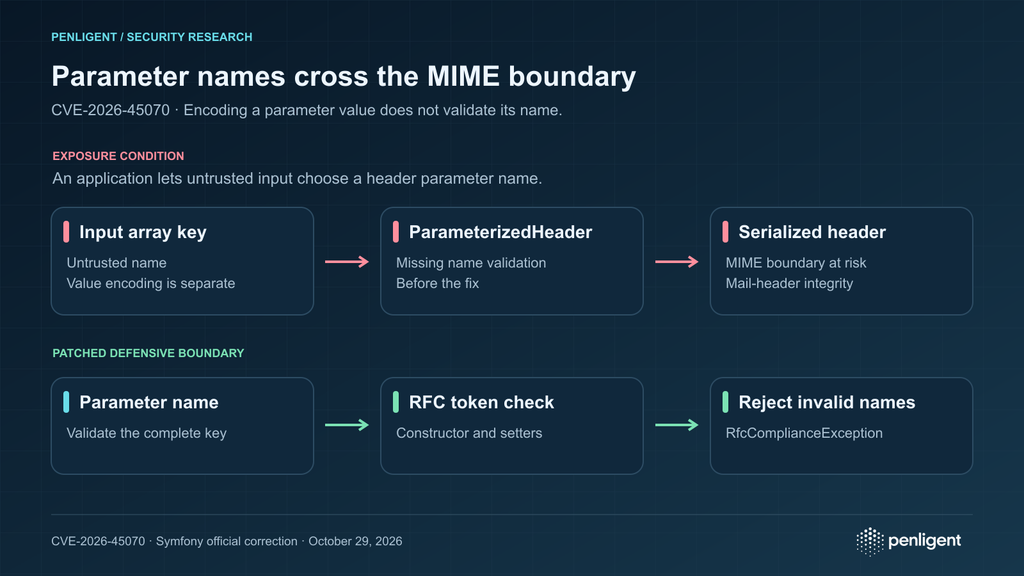
CVE-2026-45070 affects the way Symfony Mime validates parameter names in structured email headers. The vulnerable boundary is the parameter name, represented by a key in a PHP parameters array. Applications can be exposed when untrusted input reaches that name slot through ParameterizedHeader or related Headers APIs. Encoding a parameter value does not validate its name. The distinction matters because the name becomes part of the syntax of a serialized MIME header.
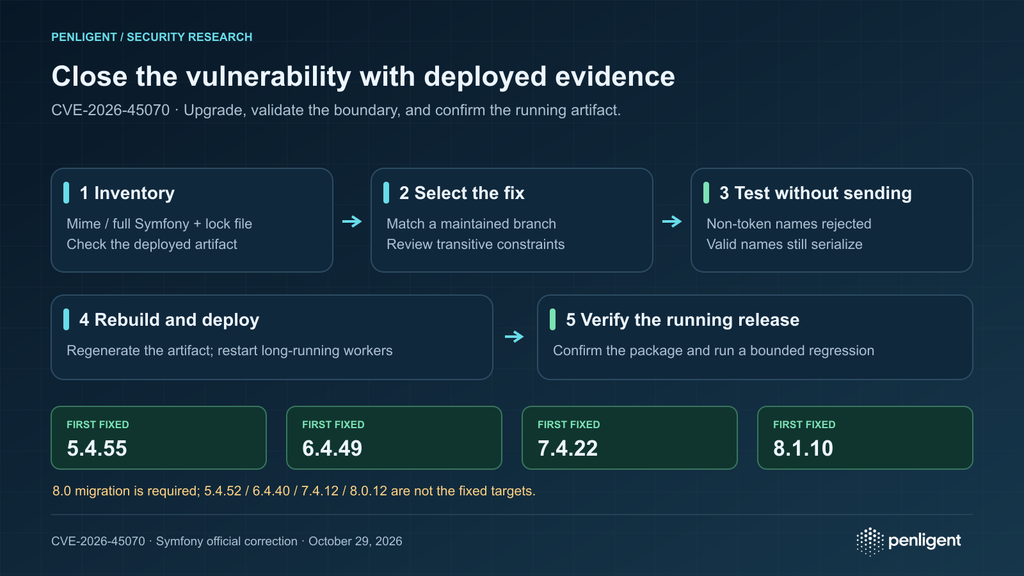
The remediation record changed materially on October 29, 2026. Symfony explained that the versions originally described as fixed in its May advisory did not actually contain the patch. The first releases delivering the fix were published on October 28: Symfony 5.4.55, 6.4.49, 7.4.22, and 8.1.10. Symfony 8.0 is no longer maintained and needs a move to 8.1.10 rather than an assumption that 8.0.12 is safe. Teams that closed this CVE after installing one of the originally listed versions should reopen the dependency check.
Start with the October 29 clarification, then the current Symfony security advisory. Update the locked dependency to an actual fixed release on a maintained branch, run a local test that rejects an invalid parameter name without sending mail, and verify the package inside every deployed web and worker artifact. A Composer change in a development checkout is not proof that a queue consumer is running corrected code.
Confirmed scope and the corrected version table
The current GitHub advisory lists both symfony/mime and the monolithic symfony/symfony package. Its affected ranges and fixed releases apply to both package entries. These are package-version ranges, not PHP-runtime versions and not a statement that every Symfony application can be exploited. Whether an application exposes the flaw depends on how it constructs parameterized headers and whether untrusted data can influence a parameter name.
| Package range listed as affected | First corrected release | Action |
|---|---|---|
< 5.4.55 | 5.4.55 | The advisory supplies no 5.4 lower bound. Inventory older installations too, then move to a supported fixed release and verify the deployed package. |
>= 6.0.0, < 6.4.49 | 6.4.49 | Move older 6.x installations to the supported 6.4 fix, resolving dependency constraints. |
>= 7.0.0, < 7.4.22 | 7.4.22 | Use the maintained 7.4 target rather than assuming an older 7.x minor has a separate fix. |
>= 8.0.0, < 8.1.10 | 8.1.10 | Move 8.0 installations to 8.1.10; the clarification says 8.0 is no longer maintained. |
The original advisory had named 5.4.52, 6.4.40, 7.4.12, and 8.0.12 as fixes. The corrected CVE announcement explains that those releases remained affected. A dependency scan, exception, or patch ticket based on the older information should be reconciled with the new thresholds. Preserve the original decision record and add the correction rather than deleting the history; the history explains why the CVE appeared closed and why it now requires action again.
The first advisory range is <5.4.55, without a >=5.4.0 qualifier. Do not silently narrow it to the 5.4 branch or exclude an older installation from inventory. If an application uses an unsupported line, choose a supported upgrade path that contains the fix and assess compatibility before deployment. The absence of a current maintenance release for an obsolete branch does not establish that its implementation is safe.
What a MIME parameter name controls
A structured email header contains several different syntactic slots. A header field has a field name and a field body. Some MIME field bodies include a primary value followed by parameters. A parameter then has a name and a value. For example, a harmless content-type description can have a primary value such as text/plain, a parameter name such as charset, and a parameter value such as utf-8. These three values have different grammar rules.
RFC 2045 defines MIME parameter syntax and the token grammar used for parameter attributes. Names must fit that grammar; arbitrary text is not an acceptable substitute. Values have separate representations, including quoted forms under the relevant rules. This is why a library can handle a value correctly while still failing to validate the name. Quoting or encoding the value only changes the value’s representation.
The broader email format is described by RFC 5322. Header structure and line handling are part of the message’s syntax, not ordinary free-form application text. A serializer therefore needs to preserve the distinction between text that is data and text that selects or creates structure. A parameter name belongs to the structural side of that boundary. Application code should not let an arbitrary request key select it.
RFC 2231 adds mechanisms for parameter value continuations and character-set information. Those mechanisms are useful for legitimate internationalized or long values. They do not mean that a caller can place arbitrary characters in a parameter name and expect value encoding to make it safe. When reviewing an email integration, identify which library API owns each grammar rule and where the data is allowed to change representation.
A useful code-review question is: who chooses the name? If the source code contains a fixed literal such as charset and only the value comes from a validated business field, the data path differs from one that iterates over arbitrary client-supplied keys. This observation is an exposure-analysis starting point, not a substitute for upgrading. Updating the library closes the library boundary and protects against future callers that may introduce a more flexible parameter map.
PHP array keys are part of the trust boundary
PHP makes associative arrays convenient for moving structured input between layers. A request object, decoded JSON object, configuration form, or extension API may expose a map whose keys and values both originate outside the trusted application code. Developers often validate values and overlook keys because keys look like field identifiers. In this CVE, that habit is dangerous precisely because a map key can become the name of a MIME parameter.
Les PHP array documentation explains that arrays are ordered maps and describes the allowed key types and conversions. That language behavior is not a MIME validator. A string being a valid PHP key says nothing about whether it is a valid token in a mail header. A type declaration of array likewise does not tell the callee which keys are allowed or where they came from.
Trace both sides of a map through the application. A controller may accept a JSON field called parameters, a service may pass the entire array to a mail helper, and the helper may instantiate a parameterized header. Every layer can look reasonable in isolation while the overall path gives an untrusted key structural authority. The repair should make the accepted names explicit at the application boundary and rely on the patched library’s syntax validation at the serialization boundary.
Prefer a small application-owned schema. For a use case that needs a character set and an attachment filename, define those as named business fields and construct the corresponding library calls yourself. Do not accept an arbitrary map simply because it is convenient for an administrative UI or third-party integration. If an extension genuinely requires custom parameter names, validate them against the supported grammar and the application’s allowlist, and preserve the trust level of the extension input.
Keep names and values separate in code review, tests, logs, and error messages. A checklist that says only “sanitize headers” is too broad to catch the distinction. Ask whether the header field name, primary body value, parameter names, parameter values, recipients, and envelope addresses are each supplied through the appropriate API. These are different surfaces. A fix at one surface should not be described as a proof about all the others.
What the patch changes
Les corrective Symfony commit validates every parameter-array key against the token grammar in ParameterizedHeader::setParameters(). An invalid name causes RfcComplianceException instead of being retained for later serialization. The accompanying tests cover construction, adding one parameter, and replacing the parameter map. That central check matters because callers can reach the same object state through more than one method.
The defensive property is rejection before serialization. An invalid name should not be silently stripped, shortened, normalized into another name, or combined with the next parameter. Silent transformation makes it hard for callers to understand what was accepted and can create collisions. A clear exception gives the application an opportunity to reject the request, record a bounded diagnostic event, and avoid producing a malformed message.
Do not rewrite the fix as a recommendation to escape every character manually. The grammar defines which names are valid, and the patched component enforces that grammar. Application code should keep supported names explicit and pass values through the library’s intended APIs. Handwritten header assembly can reintroduce the same class of problem in a different location even after the dependency is updated.
The release correction is a separate issue from the code change. A patch can exist in a repository without being present in the package version an application installed. The October clarification explains why teams must verify a released artifact rather than stopping at a commit reference or a changelog entry. For this CVE, the corrected package thresholds are the practical starting point; the commit supplies review evidence about the property the tests should protect.
Exposure conditions and impact limits
The confirmed risk is email header injection when untrusted input is used as a parameter name through an affected API. The application must provide the relevant data path. A service that never constructs parameterized headers from external keys has a different reachable surface from a generic message-building API that accepts an arbitrary map. Dependency presence and exploitable data flow are related but separate findings.
Do not equate this issue with arbitrary code execution. The official advisory describes a mail-header integrity boundary. Whether a malformed message changes a recipient’s display, processing behavior, routing, policy evaluation, or another downstream outcome depends on the application and mail pipeline. Those consequences must be demonstrated or documented for the deployment before being reported as facts. A library defect alone does not prove every possible mail abuse scenario.
Similarly, a user-controlled attachment filename is not automatically a user-controlled parameter name. In a normal typed attachment API, the filename is a value associated with a library-chosen name. The dangerous path for this CVE is code that lets untrusted input choose the name itself. Review convenience wrappers, plugin options, message template metadata, and administrative integration fields for maps that cross this boundary. Treat each as a candidate for inspection, not a claim that it is vulnerable by default.
The official sources reviewed for this article do not establish known exploitation in the wild. That is an evidence statement as of October 30, 2026, not a promise that exploitation has never occurred. Check current vendor notices and the CISA Known Exploited Vulnerabilities catalog when making a time-sensitive prioritization decision. Patch because the boundary is defective and the fixed package is available, while keeping exploitation claims tied to actual evidence.
Use two tracks for triage. The package track asks which deployed artifacts contain an affected version. The data-flow track asks whether an untrusted name can reach the relevant API. Upgrade all affected packages on supported paths, and use the data-flow result to prioritize urgency, choose compensating application controls, and decide how much retrospective message review is justified. This avoids treating “no identified path yet” as a reason to leave the library vulnerable indefinitely.
Inventory the package that is actually deployed
Begin in each application repository, not in the organization-wide framework name. An application can use Symfony Mime directly, receive it through Symfony Mailer, or depend on a package that includes it transitively. A project that is not marketed as a Symfony application can still have symfony/mime in its dependency tree. Conversely, the framework version displayed in a dashboard is not enough to prove the version of every installed component.
Les Composer command-line documentation describes the package inspection and audit commands. In an authorized local checkout, the following read-only commands are useful starting points. They inspect dependency state; they do not send email or test an external host:
composer show --locked symfony/mime
composer show symfony/mime
composer why symfony/mime
composer audit --locked
The locked package and the installed package answer different questions. The lock file records the dependency resolution intended for a reproducible install. The installed package describes the current vendor directory in that checkout. They can diverge if installation did not run after a lock change, if an image copies an old vendor directory, if a build step uses a different lock file, or if a mounted volume overlays the application. Investigate a mismatch rather than reporting the locked value as the runtime result.
Composer’s basic usage documentation explains why applications commit the lock file and install from it. For this remediation, capture the package name, version, source or distribution reference, lock-file revision, build identifier, and deployment target. Preserve the unmodified lock file as evidence. A screenshot of an advisory scanner without the package reference is weaker than a record that can be matched to the deployed artifact.
Utilisation composer why to find the path that brings Mime into the application. That path identifies the team and constraint that may need to change. A direct dependency can be owned by the application team; a transitive dependency may require a compatible parent-package update. If Composer cannot resolve the intended fixed version, use its conflict explanation commands in a branch and review the result. Do not remove constraints blindly or replace the library with a copied file from the Internet.
Inventory every deliverable, not only the main web application. Mail generation may run in a background worker, scheduled report process, command-line job, notification service, plugin host, or packaged customer deployment. Those components can be built from different repositories or refreshed on different schedules. Create one row per artifact and environment, with a responsible owner and an observed installed version. If a row has no evidence, mark it unknown rather than inheriting the web application’s status.
For containerized services, identify the image digest and the package metadata inside that image. A mutable tag such as a generic production label is not a stable evidence identifier. Confirm which digest each replica is running and whether old replicas remain during a rolling deployment. For virtual machines or bare-metal hosts, identify the release directory and package installation associated with the active process. A corrected directory that no running process uses does not close the finding.
Review backup and rollback artifacts as well. An old container image, deployment bundle, or recovery snapshot may be restored during an outage. Keep it labeled with its dependency state and prevent automatic rollback to a vulnerable artifact without an explicit risk decision. The practical goal is to avoid reintroducing the old package when the team is under operational pressure.
Lock files, SBOMs, and advisory data
A software bill of materials is useful for finding where symfony/mime exists across a fleet. It is not, by itself, a statement that the running application uses the corrected code. Connect the SBOM to an immutable artifact identifier, generate it from the build that will be deployed, and retain the package version and reference. If the organization generates SBOMs from repository manifests alone, label that scope clearly so consumers do not mistake them for runtime inventories.
Les CycloneDX 1.6 JSON specification provides a structured way to record components and dependency relationships. A dependency tree can show that a mailer wrapper brings Mime into a service and help route remediation to the correct owner. It does not identify which PHP array keys are reachable from a request. Combine component inventory with code review instead of asking either source to answer both questions.
Advisory databases are another layer. Their value depends on the version ranges they currently contain and when the scan consumed them. The October correction makes scan timestamps particularly important. A result that used the earlier thresholds may have accurately reflected stale advisory data while still giving the wrong remediation conclusion. Record the scanner version, advisory-feed timestamp when available, package evidence, and the manual comparison with the corrected vendor notice.
If a scanner continues to classify an originally listed version as fixed, create an internal correction with the current vendor references and open an upstream data issue through the tool’s normal process. Do not suppress the CVE broadly because of a feed mismatch. Scope any temporary exception to the exact artifact and rule, give it an expiry, and keep the manual fixed-version check visible until the feed catches up.
Use an explicit state model: affected package found; fixed package resolved; artifact built; regression passed; artifact deployed; runtime verified. A single “patched” flag hides the transition where this incident’s original remediation went wrong. The state model also makes partial completion easier to report: a repository may be fixed while a worker fleet remains on the old image.
Choose a maintained branch before updating
Symfony’s release information describes supported branches and their maintenance status. The October 29 clarification specifically says that 8.0 no longer receives the corrected release and that users should move to 8.1.10. This is a maintenance-path decision, not an instruction to jump every application to the newest major version. Select the fixed target that fits a supported branch and the application’s dependency constraints.
For the 5.4 line, the corrected target starts at 5.4.55. For applications using 6.x or 7.x packages, the advisory directs them to 6.4.49 or 7.4.22 respectively. For 8.x, it directs them to 8.1.10. If a project is pinned to an earlier minor, resolve why it is pinned and plan the compatible minor update. The application may have other packages with Symfony component constraints, and changing one component can require a coordinated set of updates.
Perform the dependency resolution in a reviewable branch or isolated working copy. Inspect the proposed lock-file changes, identify why each package changed, and run application tests before building the release. A broad update can resolve the CVE but also introduce unrelated behavior changes. A narrowly constrained update can fail because a parent dependency blocks the fixed version. Let the resolver explain the conflict, then make the smallest supported change that produces the intended corrected package set.
Check PHP and extension requirements in the target deployment environment. Composer’s check-platform-reqs command checks the actual platform against installed package requirements; use it in the build or deployment verification appropriate to the application. A developer workstation satisfying the requirements does not prove that a production worker image does. Record platform failures as deployment blockers, not as reasons to keep using an originally misidentified fix.
Do not invent an 8.0 backport by manually editing a vendor file and then report the application as running an official fixed release. A local patch may be necessary in an exceptional environment, but it has a different support and evidence burden: review, provenance, reproducible application, regression coverage, and a migration deadline. Prefer the vendor-supported maintained branch and clearly distinguish any temporary local deviation in the risk record.
A no-send local validation example
The following PHP CLI example checks one defensive property of the installed package: a parameter name containing a space is rejected. It deliberately uses a harmless invalid name, does not contain an injected header, does not create a transport, does not open a network connection, and does not send a message. Run it only in an isolated application checkout with the dependencies already installed. It is a library regression check, not a production exploit test.
<?php
declare(strict_types=1);

require __DIR__.'/vendor/autoload.php';

use Symfony\Component\Mime\Exception\RfcComplianceException;
use Symfony\Component\Mime\Header\ParameterizedHeader;

// Control case: a fixed, valid parameter name remains accepted.
new ParameterizedHeader(
    'Content-Disposition',
    'attachment',
    ['filename' => 'example.txt']
);

try {
    // A space is not valid in an RFC token parameter name.
    new ParameterizedHeader(
        'Content-Disposition',
        'attachment',
        ['bad name' => 'example.txt']
    );
} catch (RfcComplianceException $exception) {
    fwrite(STDOUT, "PASS: invalid parameter name rejected; no mail sent.\n");
    exit(0);
}

fwrite(STDERR, "FAIL: invalid parameter name accepted; review dependency state.\n");
exit(1);
Save the example as a local test file alongside the application’s existing test setup and run it with the project’s supported PHP interpreter. On a corrected package, the invalid-name case should raise the expected exception and print the pass message. On an affected package, acceptance of that name indicates that the desired rejection property is absent in that tested installation. An autoload failure, incompatible PHP version, or a different exception is a test-environment failure and needs investigation; it is not a pass.
This example is derived from the public patch’s rejection behavior, not from a working attack. It does not show how to create a second header or influence a mail server. The result also does not prove that every deployed process uses the same vendor directory. Run the check against the built artifact or an equivalent isolated verification environment and associate the result with the artifact digest.
Do not replace this minimal negative case with a live SMTP test against a production service. A network test adds message delivery, recipient handling, queueing, and infrastructure policy to a question that can be answered in memory. Those extra systems complicate failure interpretation and can create unwanted mail or misleading incident evidence. Keep the unit-level property local, then use ordinary application acceptance tests with synthetic recipients in a separate, approved test environment if business behavior needs verification.
Retain both a positive and a negative case. A test suite that rejects every header would technically reject the invalid name but break legitimate mail generation. The valid literal-name control demonstrates that the application still supports its intended operation. Add business-specific valid names only when they are part of the application’s approved schema; do not use a large arbitrary list as a substitute for understanding the integration.
Regression coverage across all construction paths
The patch tests show why one constructor check is not enough for a long-lived codebase. A header may be created with an initial parameter map, receive a new parameter later, or have its parameters replaced by a wrapper. Test all entry paths the application actually uses. The upstream corrective commit covers the constructor, setParameter()et setParameters(); use that as a model for protecting the boundary in local wrappers.
| Cas | Safe test input | Expected result | Objectif |
|---|---|---|---|
| Constructor with approved name | Literal nom de fichier key and synthetic text value | Accepted | Preserve normal behavior. |
| Constructor with invalid name | Harmless key containing a space | RfcComplianceException | Reject invalid grammar at creation. |
| Single-parameter update | Invalid key in setParameter() | Rejected | Protect later mutation. |
| Parameter-map replacement | Map containing one invalid key | Rejected | Protect bulk assignment. |
| Application schema boundary | Unknown but syntactically valid name | Rejected by application policy if unsupported | Separate grammar from business authorization. |
| Value handling | Approved literal name and ordinary internationalized value | Encoded by the intended library API | Ensure a name fix does not break supported values. |
Grammar validity and application authorization are different checks. A name can satisfy the token grammar and still be an unsupported option for a particular endpoint. The library should enforce syntax; the application should decide which names the user is allowed to select. Test both without duplicating the library’s regular expression in the application. Duplicated parsing logic can drift when either side changes.
Use synthetic data with no personal information. Test logs should record a stable test-case identifier and the expected outcome rather than dumping raw user-controlled strings. If a production error path is exercised in integration tests, assert that the response is a bounded validation error and that the application does not retry the same malformed request indefinitely through a mail queue.
Also test the wrapper that translates business objects into Mime calls. A library unit test can pass while the application bypasses that library for one special case. Search for handwritten header concatenation, generic parameter-map pass-through, and fallback code that catches a validation exception and writes the raw text instead. A safe exception should stop message construction or produce a controlled application error; it should not trigger an unsafe compatibility fallback.
Test the application contract, not just the component
The library regression test protects a low-level invariant. Application tests should prove the product contract around that invariant. If an API lets a tenant configure message metadata, identify which fields are public, which are administrator-only, and which are generated by the application. Test that unknown fields are rejected or ignored according to an explicit product decision. Do not pass a request map wholesale into a Mime header merely because the form currently exposes only a small subset.
For a web endpoint, use a local test kernel or controller test with a synthetic user and a fake transport. The test should assert that the application returns a controlled validation result when a parameter name is invalid, that no transport is called, and that the response does not reveal internal exception details. If the application intentionally hides optional mail metadata from the public request, assert that a submitted extra field cannot affect the constructed message. This verifies authorization and data-flow policy alongside MIME grammar.
For a background job, test both the producer and consumer. The producer may serialize a generic metadata map into a queue, while the consumer later constructs the header. The producer test should constrain the queued schema; the consumer test should reject a bad key even if an older or foreign producer sends one. Queue messages can outlive a deployment and are often processed after application code changes, so validating only at the initial HTTP boundary may leave a second boundary unprotected.
Use a fake mail transport for integration behavior and make the no-send property explicit. Symfony’s Mailer documentation explains that the Mailer component installs Mime and supports transports, including development-time capture approaches. For this particular vulnerability check, the small constructor test is enough; broader message tests should use an isolated capture transport or mock and assert that no real provider was contacted. Do not run a test with production DSN credentials.
Testing is more reliable when the expected exception is part of the test structure rather than an informal output string. The PHPUnit manual documents exception expectations and the order in which they are established. The application should also test its own exception mapping: which validation status is returned, what gets logged, and whether the mail job is discarded or quarantined. Avoid retry loops that repeatedly process the same invalid metadata.
Keep a regression test even after upgrading. A future refactor could bypass the validated API, introduce a raw header builder, or restore a permissive compatibility shim. A focused test names the required behavior and provides a guardrail during those changes. The test should refer to the public API contract, not duplicate Symfony’s private regular expression. Internal implementation details can change while the desired outcome remains stable.
Review API and data-model design
One durable defense is to remove arbitrary header parameters from interfaces where the business case does not require them. A notification feature normally needs recipient identity, template choice, locale, and a small amount of personalization data. It rarely needs end users to define arbitrary MIME parameter names. Keep those business concepts in a typed request object and translate them to a fixed set of library operations on the server.
If custom metadata is necessary for a trusted integration, define a specific schema with explicit names, types, maximum lengths, and authorization. Validate the schema at the point the integration is authenticated and again before serialization if the data can be stored or queued. Store the source and tenant context with the record so that a later worker can apply the same policy. A record created by an internal service is not automatically trusted if that service accepted external input.
Apply allowlists for names when the application has a finite supported set. An allowlist answers the business question “which options does this feature support?” The Mime token check answers the format question “which values can be serialized as a parameter name?” Both may be necessary. Avoid building a denylist of punctuation or trying to strip “suspicious” characters. String rewriting can silently turn one requested name into another, produce collisions, and obscure what was actually accepted.
Les OWASP Input Validation Cheat Sheet recommends validating both syntax and semantics, and warns against treating parsing or client-side checks as sufficient. This CVE illustrates why validation must be field-aware: a name and a value have different semantics even if PHP stores both as strings. Validate on the server after parsing and before the data is used to construct a structured message.
The general OWASP Injection Prevention guidance describes the core design principle: prevent untrusted data from becoming syntax in an interpreter or protocol. For MIME construction, the serializer is the component that knows the grammar, so use it rather than assembling a header line manually. If an application owns a custom serialization layer, it inherits responsibility for that grammar and should be reviewed as security-sensitive protocol code.
Keep error handling deliberate. An invalid name should fail message construction clearly, but the public API should not reveal class names, source paths, or vendor implementation details to an untrusted caller. The service can return a generic validation failure and log a structured event with a request correlation identifier. Avoid including the raw value if it may contain personal data, secrets, or control characters. Operators can use the field name, tenant, endpoint, and failure category to investigate without preserving the entire input.
Deployment verification across processes
Once the lock file resolves to a corrected package, follow the version through the build pipeline. Confirm the CI job used the intended branch and lock file, dependency installation completed successfully, tests passed, the release artifact was built, and the artifact was deployed to every target. Attach the package inventory or SBOM to the artifact digest. This is the evidence chain that connects the source fix to a running process.
Long-running PHP workers deserve a separate check. A worker can retain code loaded before a deployment, continue running inside an old container, or consume a queue after the web tier has already been replaced. Restart or roll workers using the platform’s supported procedure and confirm their process age or image digest. Verify scheduled tasks, consumers, and separate notification services too. A healthy website response does not prove the mail worker has refreshed its code.
In a rolling deployment, inventory replicas before and after the rollout. Confirm that old and new versions do not coexist longer than the change plan permits. During the rollout, route only the expected traffic to each pool and monitor failed mail jobs. If the deployment uses blue-green releases, verify the inactive environment is also updated before it becomes the next rollback target. A rollback should not silently restore the vulnerable package; label the old artifact and require an explicit security decision before reactivation.
After deployment, query the runtime’s package metadata through an approved diagnostic endpoint or host command that does not expose sensitive system details publicly. Compare it with the release manifest and image digest. If runtime introspection is not available, use the orchestration platform’s immutable image records and startup logs. The important point is to tie verification to what is actually executing rather than to a developer’s working tree.
Run a small post-deployment synthetic message test only if business behavior needs it. Use an internal capture mailbox or test transport and a synthetic recipient; do not target a real customer. Confirm expected headers and message delivery to the capture system, then remove or expire the test record according to policy. This is distinct from the security regression test, which should remain local and not send any mail.
Observe error rates, queue depth, retry counts, and delivery latency during the change. A corrected package may reject metadata that the old version accepted, revealing an application integration that depends on invalid names. Treat that as a schema defect to resolve, not as a reason to catch and ignore the exception. Identify the owning feature, define its legitimate parameters, and migrate stored configuration to the supported form.
Keep an explicit deployment result for each runtime: web, worker, scheduler, command-line task, and any external integration. Report the package version and artifact reference with the result. If a process is not reachable for verification, keep it in an unknown state and set a follow-up owner. NIST’s SP 800-40 Revision 4 frames patch management as identifying, prioritizing, acquiring, installing, and verifying updates; this CVE’s correction history makes the verification step particularly important.
How to handle the advisory correction
The October correction is not merely a typo in a page. It changes which package builds an organization can accept as fixed. A team that used the May table may have installed those listed versions, closed its work item, and generated a report that seemed internally consistent. When the vendor then states that the releases remained affected, the right response is to update the conclusion, preserve the original evidence, and rerun the inventory against current thresholds.
Start by finding all tickets and scanner exceptions that cite the original fixed builds. Search patch records, vulnerability platform notes, change tickets, SBOM evaluation results, and any release communications. Reclassify artifacts below the corrected thresholds as requiring remediation. A scan that was generated before October 29 may be useful historical evidence, but it cannot answer whether the artifact meets the corrected fixed version.
Next identify whether the source of the mismatch was a manual note, an advisory-feed cache, a copied release table, or an automated suppression. Fix that source so the same stale conclusion is not propagated to the next environment. If a vendor advisory feed is cached internally, record its refresh policy and provide an override process for urgent corrections. If the mismatch came from a manual table, link directly to the vendor clarification instead of duplicating version numbers in multiple documents.
Communicate the correction plainly. State that the previously recorded package version did not include the fix, identify the corrected threshold, and provide a new target date. Avoid phrasing that blames a team for following an earlier official statement. The issue is a change in authoritative remediation guidance; the engineering response should improve evidence flow and restart the affected work.
Use a short reconciliation report with three columns: previously considered fixed, corrected status, and action. For example, an artifact using 6.4.40 moves from “closed” to “affected pending update”; a 6.4.49 artifact can be marked “corrected package verified” after runtime confirmation; and an 8.0 installation moves to “migrate to 8.1.10.” Keep each row tied to an environment and artifact rather than reporting a single organization-wide state.
The update process should include both vulnerability data and release provenance. A commit can exist but not be in a tagged release; a release can exist but not be installed; a lock file can be correct but a worker can run an older image. Treat these as distinct checkpoints. The correction shows why “the vendor said fixed” is not enough unless the version, distribution, and running artifact are all identified.
Monitoring and incident response
Do not claim that CVE-2026-45070 has been exploited in the wild unless a credible source establishes it. The materials reviewed for this article describe the defect, code correction, and release history; they do not provide confirmed exploitation evidence. That leaves teams with a serious vulnerability to remediate, but it does not justify describing a specific campaign or victim without evidence. Recheck primary vendor notices and CISA’s catalog when the operational decision depends on current exploitation status.
For a service that constructs mail from user-controlled metadata, review relevant application logs for validation failures, rejected messages, unusual administrative changes, and sudden shifts in mail volume. Correlate these with account activity, API keys, queue producers, and provider-side delivery logs. An error mentioning an invalid parameter name can indicate an integration bug, malformed data, or a hostile request. Treat it as a signal to investigate context, not proof of exploitation.
Preserve the minimum useful evidence: timestamp with timezone, request or job correlation ID, tenant or account identifier, endpoint or job type, package and artifact version, outcome category, and transport result if a message actually entered the mail pipeline. Avoid retaining the full user-supplied key or message body unless the incident plan requires it and privacy controls allow it. If logs include structured input, ensure it is encoded safely for the log format to avoid confusing monitoring systems.
If you find evidence of unauthorized message construction, determine whether the issue is confined to header metadata or whether the same input reaches recipient selection, template content, attachments, or credentials. Those are separate findings that require separate evidence. Review provider logs for actual delivered messages and account audit logs for changes, but do not assume a header injection necessarily changed the SMTP envelope or bypassed provider policy. The message’s structured headers and its delivery envelope are related but distinct protocol layers.
Containment may involve disabling a feature that accepts arbitrary metadata, restricting it to administrators, or pausing a specific queue while the corrected artifact is prepared. Choose the narrowest action that prevents untrusted keys from reaching header construction. Preserve queued message metadata where necessary for evidence, but do not replay suspicious messages blindly after the update. Revalidate or quarantine them according to the product’s business and incident policies.
After patching, consider whether queued messages created before the update need review. The answer depends on whether the application persists raw parameter maps or serialized messages, whether any untrusted name was accepted, and whether messages were actually delivered. If evidence shows no untrusted key path and the application never exposes arbitrary parameter names, broad retrospective review may not add value. If arbitrary maps were stored or sent, inspect the affected time window and provider logs with the message owner.
Document what the investigation did and did not establish. “No malicious activity found in reviewed logs” is narrower and more defensible than “not exploited.” Note retention gaps and telemetry blind spots. The patched component may reject an invalid parameter name during header construction without logging the original data; this can stop that malformed input while leaving little forensic detail. Make future observability changes proportionate and privacy-aware.
Mail protocol and application architecture
Email generation spans multiple protocol stages. Application code creates a message object, a MIME serializer renders headers and body parts, a transport sends the message to a local or remote service, and a provider may apply its own policy before delivery. Symfony’s Mailer documentation describes supported transports and notes that the Mailer component installs Mime to create email messages. Knowing which stage owns the header is essential when deciding where to test and where to collect evidence.
RFC 5321 defines SMTP transport behavior, while RFC 5322 defines Internet message format. A header-level malformed message does not automatically establish a change to the SMTP envelope. For example, the visible message recipient fields are not the same thing as the transport’s envelope recipient command. Keep the distinction in incident reports and testing: inspect the message object and serialized header separately from the transport envelope.
This separation also helps identify compensating controls. A mail provider may reject malformed message syntax, enforce sender policies, or quarantine delivery. Those are useful layers, but they do not make the application serializer correct. A different provider or local sendmail transport may behave differently. The library’s validation should be enforced before the message leaves the application, and provider controls should be viewed as defense in depth.
Header folding is another reason to use a standards-compliant library. Long fields can be represented across lines according to message format rules. The serializer controls folding and quoting based on field type and value. If application code concatenates strings or applies a generic “sanitize header” routine, it may produce invalid syntax or incorrectly treat data as a new field. Do not copy raw serialized fragments between message contexts without understanding the grammar they carry.
Internationalization deserves careful handling. Email parameters may represent non-ASCII values using defined encoding and continuation mechanisms. A need to support Unicode display names or filenames does not justify relaxing the parameter-name grammar. Keep the name fixed and apply the library’s intended value encoding. Test realistic Unicode values in the value slot, not in the name slot, and verify that recipients display the expected text in supported clients.
Do not infer that every header type uses parameter names or the same grammar. A content type, disposition, and custom extension header can have different semantics. Use the appropriate structured API for each field. If a feature needs a custom extension field, confirm whether Symfony Mime supports it as a structured header, and review its serializer rather than passing it through a generic API based only on familiar syntax.
Using standards to scope validation
The relevant standards are useful because they turn “looks harmless” into a defined acceptance question. RFC 2045’s token grammar explains the allowed parameter-name characters for MIME parameters. RFC 5322 defines header fields and line structure. RFC 2231 explains extended parameter values. Read these as complementary sources, not interchangeable rules. A value accepted under an extended-value mechanism does not expand the allowed syntax of the name.
In tests, use the actual library boundary rather than building a second parser from an RFC excerpt. A local test that sends a name with a space to the patched constructor exercises the behavior that protects the application. Standards review helps explain why that name should be rejected; the dependency test confirms that the installed implementation does so. If the application has its own allowlist, test that policy too.
When reviewing a codebase, follow data from parser to serializer. Identify URL-encoded, JSON, form, message-queue, database, and configuration sources. Determine whether normalization or decoding occurs before validation and whether the value is decoded again afterward. OWASP’s input-validation guidance emphasizes validating the representation that is actually used. A check on one encoding layer can be invalidated if another component transforms the data later.
Also check the schema’s unknown-field behavior. Some decoders preserve arbitrary keys; others discard unknown properties. Do not assume a JSON schema is restrictive simply because it lists known properties. Confirm whether additional fields are rejected, and add a regression test for that behavior. If unknown fields are intentionally retained for forward compatibility, ensure they cannot become MIME parameter names without a second, explicit authorization and syntax check.
For cross-service APIs, version the schema and preserve compatibility deliberately. A new producer may send a metadata field that an older worker does not understand. The consumer should reject unsupported names safely and report a controlled failure. Avoid a generic fallback that interprets unknown fields as headers. Compatibility logic should map known business fields rather than promote arbitrary key/value pairs to protocol syntax.
Risk prioritization and owner handoff
Prioritize services according to the ability of external or lower-trust actors to influence parameter names, the criticality of the mail function, and the number of deployed replicas. An application that accepts arbitrary metadata from public users is a different review target from a service that uses a few hardcoded header parameters. Both should use the corrected dependency, but the first may require immediate feature restriction and deeper review.
Keep vulnerability state and code-path state separate in the work tracker. A package may be vulnerable while no untrusted name path is found; that is still a package update task. A service may use a fixed package but have a custom serializer elsewhere; that is a separate application security issue. This distinction helps keep owners focused and prevents a package scan from being treated as a complete application review.
Assign a single owner to reconcile the corrected fixed versions across repositories, CI policy, scanner exceptions, and runtime deployments. Supporting teams may include application engineering, platform engineering, security operations, mail administration, and compliance. A clear owner prevents each group from assuming another one closed the correction. Where the application cannot move to a maintained version quickly, require a time-bound compensating plan and a migration decision.
Track exceptions with the exact artifact, installed package, reason, compensating controls, owner, approver, deadline, and exit condition. “No known vulnerable call site” can inform priority, but it should not be a permanent exception to installing a security update. “Feed says fixed” is not valid evidence when the vendor has corrected the release thresholds. Exceptions should expire when the package is updated, the service is retired, or the migration target is approved and delivered.
For customer-facing status, report what has been verified. A useful statement says that affected Composer artifacts were identified, fixed package thresholds were corrected according to Symfony’s October 29 notice, and deployments are being checked across web and queue processes. Avoid broad statements like “all Symfony sites are vulnerable” or “the issue is fixed everywhere” unless the inventory supports them.
Questions fréquentes
What is CVE-2026-45070?
- It is a Symfony Mime email-header injection flaw involving parameter names that are not restricted to valid tokens before serialization. The relevant trust boundary is the name key, not simply any user-supplied parameter value.
Which versions contain the fix?
- The corrected first fixed releases are 5.4.55, 6.4.49, 7.4.22, and 8.1.10. Symfony clarified on October 29, 2026 that 5.4.52, 6.4.40, 7.4.12, and 8.0.12 from the earlier notice did not contain the fix. Symfony 8.0 is no longer maintained; move to 8.1.10.
Does using Symfony Mailer automatically make an application vulnerable?
- No. It brings Symfony Mime into the dependency tree, but application exposure depends on whether untrusted input can influence parameter names through the affected APIs. A filename value attached to a fixed name is a different data path. Update the dependency regardless and inspect custom data flows.
Is exploitation in the wild confirmed?
- The official material reviewed for this article does not confirm in-the-wild exploitation. Check current Symfony notices and CISA’s catalog before making a time-sensitive claim; absence of a report is not proof that exploitation never occurred.
How can I validate the fix without sending an email?
- Run a local unit test against the installed package. A harmless invalid key containing a space should raise
RfcComplianceException. Use no mail transport, no external endpoint, and no crafted header string.
Is a corrected composer.lock enough?
- No. Confirm the package in the build artifact and the running web, queue, scheduler, and notification processes. Long-lived workers and old container replicas can continue using an earlier dependency.
Conclusion
CVE-2026-45070 is a boundary-validation problem in Symfony Mime: the parameter name must remain valid header syntax. The strongest operational lesson comes from the correction history. The first versions that truly contain the fix are 5.4.55, 6.4.49, 7.4.22, and 8.1.10; the earlier May release numbers should not be treated as remediation. Symfony 8.0 users need a supported migration to 8.1.10.
Inventory the component, update the lock file, verify the built package, and confirm every running process uses the corrected artifact. Keep arbitrary keys out of MIME construction, test the invalid-name rejection locally without sending mail, and maintain monitoring that distinguishes a validation failure from confirmed abuse. Those checks turn a corrected advisory into a verifiable deployment state.
 French
 English
 German
 Spanish
 Portuguese
 Japanese
 Korean
 Hindi
 Arabic
 Turkish
 Hebrew