
CVE-2026-107181 affects Telegram Desktop before 7.2.9 and connects a desktop messaging boundary to account security. The published CVE record describes IPC record-separator injection that can expose local files, including session material, and enable account takeover. The immediate action is to verify the client that actually runs, update through an official or supported distribution route, and investigate possible session exposure separately from software maintenance.
This is a previously disclosed vulnerability receiving renewed attention, not a claim that Telegram announced a new zero-day today. The record was published on October 7 and updated on November 9, 2026. Search interest is not exploitation telemetry. Neither a rising query nor the existence of public research establishes that a particular account was accessed or that every platform has been independently tested.
The original beaksec research describes a clicked-link chain and confirms testing on Windows. Its prerequisites and process handoff matter: this should not be advertised as universal zero-click compromise. The defensive work below focuses on exposure checks, the IPC trust boundary, safe educational validation, and account recovery without reproducing an operational file-theft payload.
Two completion claims must remain separate. Updating a client addresses the reported software issue. Recovering an account addresses authority that may already have been exposed. A deployment receipt cannot establish the second claim, and a session review cannot establish that every old desktop copy has been replaced. A useful response plan makes both states visible.
Verify the affected product before interpreting the version
Begin with product identity. The record concerns Telegram Desktop. A team should not infer that a mobile application, a browser session, or an unrelated third-party client shares the same code path merely because it uses the same messaging service. Inventory the actual application, its distribution source, its installed version, and the user context in which it runs. Route other clients to their own supported update guidance.
The reference fixed release is 7.2.9, which is available in the official Telegram Desktop release repository. That historical release is a boundary for this record, not a recommendation to downgrade a newer supported installation. Use the current official or distribution-supported package appropriate to the device, and retain evidence connecting that package to the security fix.
For an individual user, the relevant question is simple: what version does the application currently running on this computer report after an update and relaunch? For an enterprise, that question expands into a population problem. Different users may have different installation locations, managed and unmanaged copies may coexist, and a portable copy may sit outside the normal software-deployment inventory. A machine-level assignment can miss a user-level application.
Do not rely on a directory name or shortcut label as version evidence. The shortcut may point to a different executable than expected, and a package record may describe the intended installation rather than the active process. Use the supported application information and endpoint inventory available to the organization. Preserve the observation method so another administrator can distinguish direct running-state evidence from an inferred package mapping.
Downstream distributions require additional care. A distributor may backport a security fix while retaining a lower upstream version string, or package the application under its own release identifier. That possibility does not justify assuming a backport exists. Obtain the distributor’s advisory or package changelog that explicitly maps the installed build to the fix. If the mapping remains unknown, record it as unresolved and choose a supported update path.
Separate an affected version from demonstrated exploitation. An old client establishes an exposure condition. Evidence of an external link launch, suspicious file activity, or unexpected account access may support further investigation, but each observation needs context. A user remembering an unfamiliar group invitation is not enough to prove the complete chain. The response can still reduce risk immediately while preserving a careful distinction between possibility and confirmed activity.
Include devices that are not currently online. A laptop used only for travel or a virtual desktop restored from an old image can return after the main rollout. Define a return-to-service condition for those devices and make the remaining population visible. An enterprise report should distinguish verified corrected clients, known affected clients, offline clients, and installations whose version mapping is unresolved.
Finally, preserve the time dimension. A client corrected today may have run an affected release during the relevant interval. That historical fact can matter to an account investigation even when the current update task is complete. Record the earliest reliable fixed-state observation and retain earlier inventory where available. Avoid rewriting the device’s history by replacing every old observation with the latest version value.
The vulnerable boundary is the handoff between processes
A desktop application can receive an external link through an operating-system protocol handoff. When another instance is already running, the newly launched process may pass information to it through local IPC. “Local” describes the transport endpoint, not the origin or trustworthiness of every value carried over that endpoint. A message arriving through a local channel can still contain data that originated outside the application’s trusted control.
In the researcher’s account, unescaped separators in the single-instance IPC format let one supplied value be interpreted as additional records. A reachable internal handler then provided a more consequential operation. The relevant engineering lesson has two parts: preserve data boundaries during serialization, and authorize privileged operations independently of the transport that delivered them.
Those are different defects in a trust model. A correct serializer should prevent data from creating extra messages. An authorization boundary should prevent an externally influenced message from invoking an internal capability merely because parsing succeeded. Fixing either can interrupt a particular chain, but relying on only one makes the design fragile when a new parser or entry point is added later.
Consider a generic desktop application that forwards a document identifier from a launcher to a running process. The launcher knows it has one identifier. If it concatenates that identifier into a delimiter-based command string, it can lose that structural fact. The receiver may reconstruct several commands from what the sender considered one value. This problem is about the format contract, not about whether the document identifier looks like a familiar URL.
The receiver should also know the purpose of the message. Opening a user-selected document, running an internal maintenance operation, and publishing a file are not equivalent authorities. A design that uses one untyped list for all of them makes it difficult to enforce the distinction. The safer architectural question is not simply “did this arrive from another local process?” but “which operation may this message request, with which data, under which authorization?”
Process reuse complicates testing because the cold-start and already-running paths can differ. A link can be handled directly when the application starts and forwarded through IPC when it is already open. A regression test that exercises only one state can miss the other. The engineering test plan should cover both states using benign fixtures and should assert the number and type of operations produced, not merely that the application did not crash.
The same reasoning applies to multiple operating-system entry routes. A browser, a file association, a command-line launch, and an application’s own link handler can reach different code paths. That does not prove that every route is vulnerable in this case. It means a defensive review should enumerate the routes actually supported by the product and test each route’s boundary with harmless data. The implementation, rather than a broad product category, determines the result.
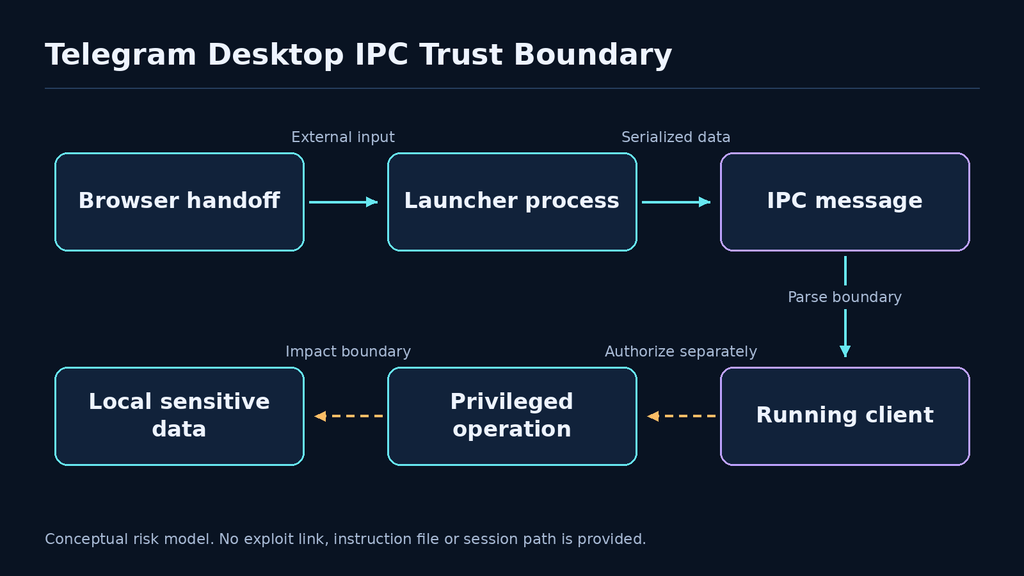
For responders, this model suggests a disciplined limit: investigate the relevant entry and identity effects without trying the published theft chain on a production account. A safe assessment can establish the installed release, confirm inclusion of the patch, review the account’s sessions, and preserve the relevant endpoint evidence. It does not need to read or transmit the user’s session files to demonstrate that the organization took the correct protective action.
What the source patch changes and what it does not prove
Les official source patch removes the internal interpret handler and changes IPC value escaping. It also constrains combinations of command and URL records. These changes address both message interpretation and reachable functionality. They support a code-level explanation of the fix, but they are not evidence that every installation has received or is running the changed code.
A patch review should identify the invariant each change is intended to preserve. Escaping should keep a supplied value inside one record. Removing an internal handler should reduce the set of privileged operations reachable through that dispatch path. Restricting mixed records should prevent an input from combining capabilities that the application does not intend to expose together. Those are useful review questions even when the reviewer does not reproduce the original exploit.
Do not treat a commit hash as a deployment attestation. The source repository shows what changed in that repository. A release artifact, downstream package, local installation, and running process are additional steps in the chain. Each step needs evidence appropriate to it. An enterprise can record the supported package identity and the post-relaunch version observation without claiming it independently rebuilt and verified every binary from source.
The patch also does not settle historical impact. If a device ran an affected client before maintenance, a later source comparison cannot determine whether a user followed a relevant link or whether session material left the device. Historical assessment needs its own evidence. Keep the patch analysis in the software-remediation record and connect, rather than conflate, it with any account or endpoint incident case.
For maintainers of other desktop software, avoid copying a narrow escaping change without reviewing the receiving contract. The sender and receiver must agree on encoding, decoding order, malformed input handling, maximum sizes, and allowed operations. A change that escapes one separator but leaves another route to privileged dispatch can preserve the deeper authorization problem. Use the source patch as a prompt for architectural review, not as a universal drop-in recipe.
Choose the verification method according to the decision it must support. Package inventory identifies installed-release scope; source review explains a code invariant; endpoint evidence informs historical investigation; and the account’s supported controls address session authority. Retain those results as connected records with separate limits. This lets the incident owner approve current protection without pretending that a version observation reconstructs account history or that a session review establishes which binary is running.
A safe IPC example tests framing and authorization separately
This example uses a fictional message format and a display-only operation. It does not use Telegram URI schemes, connect to a socket, read a file, access an account, or transmit data. Everything stays in Python memory. The input is deliberately ordinary text containing a separator, so the test demonstrates a structural property rather than a working attack against any application.
import json

value = "meeting-note|display|second-note"

# A delimiter-only representation loses the one-value boundary.
naive_wire = "display|" + value
naive_parts = naive_wire.split("|")
assert len(naive_parts) == 4

# A structured representation preserves the value as data.
wire = json.dumps({"operation": "display", "value": value})
message = json.loads(wire)
assert message["value"] == value
assert set(message) == {"operation", "value"}

def authorize(message, external=True):
    if set(message) != {"operation", "value"}:
        return False
    if not isinstance(message["value"], str):
        return False
    if len(message["value"]) > 1024:
        return False
    allowed = {"display"} if external else {"display", "maintenance"}
    return message["operation"] in allowed

assert authorize(message)
assert not authorize({"operation": "maintenance", "value": "demo"})
assert not authorize({"operation": "display", "value": "demo", "extra": True})
print("One value preserved; external operation authority remains limited")
The first assertion shows that concatenation and splitting do not preserve the sender’s intended one-value structure. The JSON round trip demonstrates one way to preserve it for this toy. The authorization function then applies a separate policy: an external message can request display, but not maintenance. A valid structured message can still be unauthorized. Those are independent test outcomes and should remain independent in a real regression suite.
This example is not a recommendation to accept arbitrary JSON from any local process. A production protocol needs a complete contract, including peer and operation authorization, size limits, error handling, compatibility, and resource control. JSON does not provide those properties by itself. The toy is useful because its small scope makes the two invariants visible without involving a privileged handler or sensitive data.
Extend the exercise with benign values containing quotes, Unicode, line breaks, repeated separators, and an empty string. Assert that one submitted value remains one value after decoding. Then vary the operation and assert that the allowed set stays unchanged. A parser test should not accidentally become an authorization test whose policy changes with the input. Keep the two expected results explicit.
Add malformed inputs only inside the test process. Examples include a missing field, an unexpected field, a non-string value, and an oversized string. The expected outcome should be a safe rejection with no privileged operation and no partial side effect. Do not use production session data or an actual application protocol merely to make the demonstration feel more realistic. The educational value comes from the invariant, not the sensitivity of the test material.
For a desktop engineering review, turn the invariants into assertions around the real dispatch interface in an isolated development environment. A test can verify that a benign external value produces exactly one permitted action, that internal operations remain unavailable, and that invalid input leaves the application in a defined state. Such tests can support a patch review without publishing a ready-to-use account-theft chain.
Roll out the update to the client people actually launch
An update program should begin with a trusted distribution path and end with a post-relaunch observation. Between those points, preserve the package identity, target device or user, installation result, and any action needed to activate the update. Do not count a targeted deployment as a completed deployment, and do not count a completed installation as a verified running state until the relevant application has been checked.
Inventory managed and user-installed copies separately. If the organization permits portable applications, decide how those copies are discovered and governed. A device can carry an updated managed installation while a shortcut launches an older portable copy. The remediation policy should identify which installation is approved and how unapproved copies are handled through the organization’s normal endpoint-management process.
Use a small representative rollout first when operationally appropriate. Include the installation types and user contexts that matter to the environment. Verify that the approved client launches, reports the intended version, and preserves the required user workflow. Keep the test account and data limited. A successful pilot should demonstrate the rollout method rather than expose a sensitive executive or administrator account to unnecessary testing.
Tell users what they must do and how they can verify completion. If a relaunch is required by the supported update path, provide a clear instruction and a way to report failure. Avoid vague advice such as “make sure Telegram is safe.” A user can follow a concrete instruction to open the approved application, check its version, and contact support if it differs from the expected release.
Handle devices that miss the rollout explicitly. Maintain an exception list with an owner, last check-in time, approved access posture, and next action. A travel laptop should not silently resume its old state after the fleet report says complete. The organization can require a supported update and verification before the device returns to normal use, using the endpoint controls available to it.
Check reusable images and installation sources. A virtual-desktop image, software catalog, or internal package cache can reintroduce an affected client after individual devices are corrected. Update or retire the source through the approved process, then test a newly provisioned device. This closes the loop between fixing the current population and preventing the next installation from starting with the same exposure.
For a downstream package, record the distributor’s security mapping rather than forcing the upstream version rule onto an incompatible naming scheme. The reviewer should be able to see why the installed build is considered corrected. If the evidence is only a general statement that updates are enabled, the mapping remains unresolved. Automatic updates are a mechanism for change, not proof of a particular observed result.
Finish the rollout report with a denominator and evidence time. State how many identified installations are verified, which remain affected, which are offline, and which require vendor or distributor clarification. Those categories can change as devices return. A durable report makes that evolution visible instead of presenting a one-time percentage that no longer corresponds to the actual population.
Treat possible session exposure as an identity-recovery task
If session material may have been exposed, use a trusted device and a supported account-recovery route. Telegram’s official FAQ describes Devices or Active Sessions controls for terminating sessions and distinguishes Two-Step Verification from a local application passcode. These controls serve different purposes. Do not assume that changing one password automatically proves every previously authorized session is no longer usable.
Begin by establishing which account and devices are in scope. A user may operate personal and business accounts, or use the same account on several computers. Record the account identifier through an approved private channel and identify the trusted device from which recovery will occur. The incident record should not collect session files, login codes, recovery secrets, or full private conversation histories merely to document that a review happened.
Review the account’s session list through the supported interface. Investigate unfamiliar or unnecessary sessions with the user and terminate them according to the service’s controls and the organization’s procedure. Preserve a minimal record of the decision and time. An unfamiliar session deserves attention, but its label or approximate location should not be treated as perfect attribution to a person or attacker without additional evidence.
Use Two-Step Verification and recovery settings according to the official guidance, and protect the recovery channel. The objective is to strengthen future account access while addressing the authority already present in sessions. A local passcode protects a different boundary on the device. These controls should be recorded separately in the response plan so a completed setting change does not hide an unfinished session review or software update.
Assess business consequences using the account’s actual role. An account used for customer support, release announcements, or administrative coordination may influence other people and systems. Review recent relevant actions, group or channel administration, and business requests during the suspected interval. Do not announce that every message was read or every contact targeted without evidence. Focus on the actions and authority that matter to the organization.
If the endpoint investigation identifies exposure of other credentials, route those identities through their own supported recovery processes. The scope should follow evidence of what was available and accessed, rather than a blanket assumption that every secret on the computer was taken. Prioritize high-consequence identities and preserve the difference between confirmed exposure, plausible access, and an unobserved possibility.
Coordinate communications through a trusted channel if account integrity is uncertain. Business contacts should receive clear instructions about which requests require independent verification. Avoid sending recovery secrets through the account under investigation. A response that restores software but continues to use an uncertain communication channel for approvals can leave a practical authority problem unresolved.
Close identity recovery with a bounded statement: which sessions were reviewed or terminated, which settings were changed, which business actions were checked, and what uncertainty remains. A clean session list at one moment is useful current evidence. It does not reconstruct every historical access. The account owner and incident lead should understand both the protection achieved and the limits of the available history.
Investigate the endpoint without turning evidence into a new exposure
An endpoint investigation should follow an approved collection plan. Preserve relevant application-version history, process-launch observations, browser or protocol-handoff evidence where available, and the timeline of user-reported activity. Use the organization’s endpoint-response tooling and evidence procedures. Do not test the public theft chain against the user’s live account to decide whether the device was vulnerable.
Link observations to a precise interval. The user’s recollection can help identify a starting point, but it should remain labeled as a recollection. Endpoint records can support or refine it. Preserve original timestamps and time zones, note collection gaps, and avoid converting a plausible sequence into a confirmed one merely because the events occur near each other.
Protect the content of messaging data. Investigators may need metadata about a group invitation, link launch, or account action without needing the full conversation. Collect the minimum required for the question being answered, retain originals under controlled access when necessary, and use redacted extracts for broader coordination. The incident workspace should not become an unnecessary archive of private messages and authentication material.
Separate the presence of a downloaded file from evidence that a privileged action occurred. A file can be harmless, a user can decline a launch, and a browser can handle a link differently. The investigation should establish each meaningful transition with the available records. Where a transition cannot be observed, state the gap and decide whether containment or recovery is still warranted under the circumstances.
A lack of endpoint telemetry can change the recovery decision. A device with reliable historical observations may support a narrower assessment than an unmanaged device with no retained records. That does not mean the unmanaged device is automatically compromised. It means the organization has less evidence to exclude consequential activity and should account for that uncertainty when deciding on device recovery and account protections.
When a rebuild is appropriate under the incident procedure, preserve required evidence first and restore only approved data and configuration. Avoid copying an entire uncertain application profile back into the recovered environment without review. Re-establish account access through the supported service workflow from a trusted device state. The goal is to create a documented new trust state, not merely a fresh operating-system installation carrying the same unresolved authority.
Define a message contract that preserves intent
For desktop maintainers, the most useful response to this class of finding is a written message contract. The contract should define what an external launch can request, how data is represented, how the receiver determines the request’s origin, and which side effects are permitted. A protocol that works only because every caller follows an unwritten convention is difficult to secure when new launch routes or integrations are added.
Begin with explicit operation types. A request to display a resource should not share an unrestricted dispatch path with maintenance, publication, or administrative operations. Give each operation a defined input schema and an authorization rule. Unknown operations should fail safely. The design should not depend on a user-facing link filter to protect an internal capability that remains reachable through another entry route.
Preserve framing independently of content validation. The receiver needs to know where one message ends before it can interpret the message’s fields. Escaping, length framing, or another structured representation can support that contract when implemented consistently. A content allowlist does not repair a framing format that lets data create extra records. Test the two properties separately so one successful check cannot conceal the other’s failure.
Define encoding and decoding order precisely. If one layer decodes a value before splitting records while another splits before decoding, the sender and receiver may disagree about the message structure. A review should identify the exact representation at each boundary and assert that a round trip preserves the intended value and operation count. The educational JSON example is deliberately simpler than a production protocol; the actual application needs its own tested contract.
Specify how malformed input fails. A truncated message, unsupported field, invalid encoding, or oversized value should produce a defined rejection without partially executing earlier operations from the same request. If the protocol permits a batch, define whether it validates the entire batch before any side effect or uses another explicit transactional rule. Ambiguous partial execution makes both security testing and incident interpretation harder.
Bound resource use as part of the contract. Maximum message length, operation count, queue depth, and processing time should reflect the application’s legitimate needs. These are defensive design recommendations, not claims about a particular limit in Telegram. A parser can preserve framing and still be vulnerable to unreasonable work if it accepts unbounded input or dispatches an excessive number of valid operations.
Keep internal capabilities out of the external contract unless the product deliberately needs them. A development helper or release-management function should not become externally callable merely because it uses the same dispatch machinery. Review its intended callers, required authority, and production availability. Removing an unnecessary capability can be a stronger simplification than adding another pattern filter around it.
Document compatibility behavior. If older and newer components can communicate, define which protocol versions are accepted and how unsupported messages fail. A security fix should not accidentally re-enable a permissive legacy parser when it encounters an unfamiliar format. Test the supported combinations in an isolated environment and retain the expected rejection behavior for unsupported ones.
Build a regression matrix around process and entry state
A regression suite should test the state transitions that create the boundary, not just a list of suspicious characters. Use harmless fixtures and a development build or isolated test harness. The important assertions concern the number of operations, the operation types, the data value after decoding, the authorization result, and the absence of unintended side effects. A test that merely avoids a crash can pass while the trust model is still wrong.
| Test dimension | Benign case | Expected invariant |
|---|---|---|
| Application state | Cold start and already-running instance | Equivalent permitted intent; no extra operation |
| Entry route | Supported external launcher and internal navigation | Route-specific authorization remains explicit |
| Value content | Separators, quotes, Unicode and empty strings | One value remains one value |
| Operation authority | Display versus internal maintenance | External input cannot select internal authority |
| Malformed request | Missing, extra or oversized fields | Safe rejection without partial side effect |
| Compatibility | Supported and unsupported protocol versions | No fallback to an unintended permissive path |
For the already-running case, verify the actual IPC path in the isolated test environment. It is easy for a test runner to start a fresh application every time and never exercise single-instance forwarding. Record which process receives the initial input and which process performs the permitted action. The test evidence should establish that the intended path was exercised rather than inferring it from a successful user-interface result.
For entry routes, avoid assuming equivalence. An internal navigation action may legitimately have different context from an operating-system launch. The suite should preserve those differences and assert the intended authority for each route. A test that forces all routes through one helper can miss the production path the helper bypasses. Integration coverage should include the supported launch mechanism as well as unit-level parsing tests.
For values, use a small deterministic corpus with explicit expected results. Include ordinary text and structural edge cases, but keep them disconnected from real privileged operations. The test should be understandable to a reviewer: this input is one display value, and the receiver must produce one display action containing the same value. That clarity is more useful than a long opaque payload list whose expected behavior no one can explain.
For authorization, test both allowed and denied operations. A denied-operation test should assert no side effect, not only an error return. In a harness, side effects can be represented by an in-memory event list or a fake dependency. This lets the suite verify that a rejected message did not reach a privileged action without involving real files, accounts, or network connections.
For malformed requests, inspect the state after rejection. An application should not retain a half-parsed command that becomes active when the next message arrives, nor should the test assume that an exception automatically resets the connection state. Define the desired behavior and test it with isolated fake inputs. The exact state machine belongs to the application’s implementation and should be documented with the protocol contract.
For compatibility, keep a deliberate support policy. If a legacy sender is no longer supported, a safe rejection is an acceptable result. If compatibility is required, test the intended parser and authorization behavior explicitly. Silent fallback can make a security fix difficult to reason about because the effective contract depends on an input’s shape rather than an approved version negotiation.
Finally, retain the regression tests with the code change and make failures actionable. A future refactor that alters serialization, dispatch, or protocol registration should trigger the relevant suite. The tests should explain which invariant failed so the engineer can repair the boundary without weakening the policy to make the test pass. This turns a one-time vulnerability fix into a maintained property of the desktop application.
Keep local protection, new login, and existing sessions distinct
A desktop account can have several layers of protection, each governing a different action. A local application passcode concerns access to the application’s local state. A service login control concerns establishing account access. An existing session represents authority already established. Treating those layers as one generic “password” setting makes recovery advice ambiguous and can cause users to believe one completed action solved every part of the problem.
The original researcher’s mitigation discussion describes a local passcode as a protection relevant to stolen session material, not a repair for the underlying file-exposure path. That distinction is the useful takeaway. Do not promise that a particular setting prevents every consequence of a vulnerable client, and do not treat it as a substitute for installing the corrected software.
When writing recovery instructions, name the action and the boundary it changes. “Update and relaunch the approved desktop client” addresses software state. “Review and terminate unnecessary sessions through the supported interface” addresses current account authority. “Configure the appropriate account and local protections” addresses additional access conditions. The instructions can be concise while remaining technically separate.
Recovery evidence should reflect those boundaries. The endpoint team can provide the running version and device trust decision. The account owner can confirm the supported session review and relevant settings. The incident team can assess the historical evidence and business consequences. None of those groups should claim a conclusion outside its observations merely because the overall recovery ticket has one owner.
For organizations, define which account uses require stronger operational controls. A personal conversation account and an account used to authorize production changes can create different business consequences. The application vulnerability is the same, but the response priority and verification depth can differ. Record the account’s actual role rather than assuming that every desktop messaging account is either harmless or a privileged administrative identity.
Users should also know what evidence to report safely. An unfamiliar session, an unexpected business request, or an update failure can be described without sending authentication files or one-time codes to support. Provide an approved reporting route and explain that support will not need reusable session material. A recovery procedure should reduce authority exposure rather than asking users to package it for an analyst.
Keep the final decision modest and useful. The organization can verify a corrected client and a completed session-recovery procedure while acknowledging limited historical visibility. That is a meaningful result. It does not need to become an unsupported declaration that every private file was safe or that every possible account action has been reconstructed.
Use a recovery acceptance record with separate outcomes
A recovery record should let another reviewer identify the exact device and account state that was accepted. Include the device identifier, approved application source, installed and running version observations, relaunch time, account-session review status, and any unresolved historical questions. Use references to controlled evidence rather than embedding sensitive contents in the report. The record should be useful after the original responder’s shift ends.
Define the acceptance criteria before the final check. For software, the criterion is a supported corrected build running through the approved launch path. For identity, it is completion of the supported review and recovery actions appropriate to the case. For the endpoint, it is the organization’s device-trust decision based on the available evidence. For business use, it is the owner’s approval to resume the account’s intended role.
| Réclamation | Suitable evidence | Important limit |
|---|---|---|
| Client corrected | Supported package mapping and post-relaunch running version | Does not reconstruct earlier activity |
| Old copies governed | Inventory reconciliation and approved launch-path check | Offline devices remain exceptions |
| Account reviewed | Supported session and settings review with time and owner | Current state does not prove complete history |
| Endpoint accepted | Documented investigation or trusted recovery decision | Confidence depends on evidence coverage |
| Business role restored | Owner-approved workflow and communications check | Approval applies to the defined account and purpose |
Positive verification should use benign activity. Launch the approved application, confirm the expected version, and perform a harmless account function appropriate to the test account or user. Negative verification should avoid the operational exploit. Check the intended policy state through supported controls or a safe test harness. A live theft attempt against the user’s session files is neither necessary nor proportionate for routine patch acceptance.
Record failures without hiding them behind a successful installation. If the version remains uncertain, keep the software task open. If the user cannot complete session recovery through the supported interface, route the case through the service’s recovery process. If a device remains offline, preserve its exception. Each failure has a different owner and next action; one generic “update failed” category makes the remaining work harder to resolve.
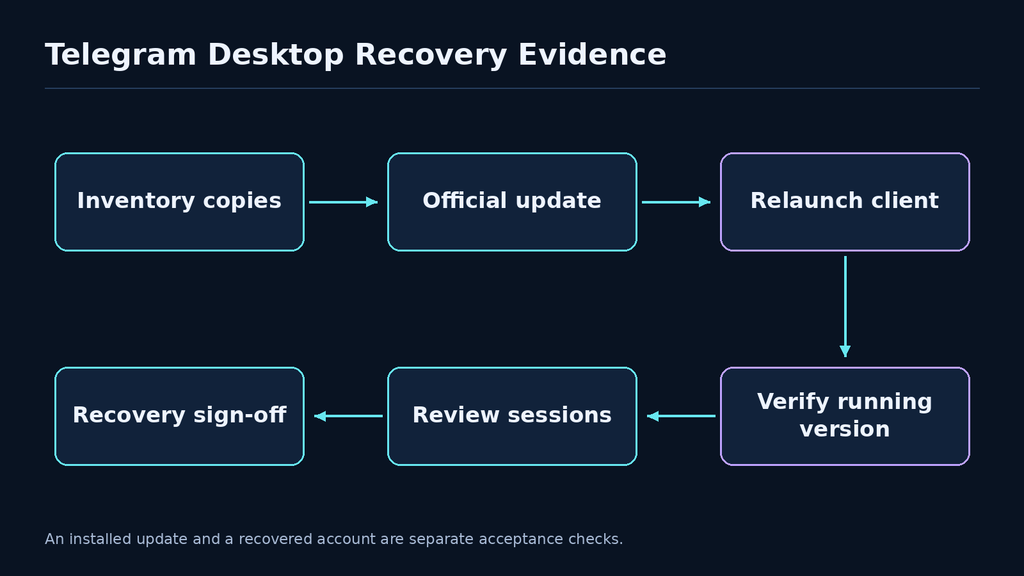
A fleet report should preserve the population behind each result. Report verified installations, affected installations, offline devices, unresolved package mappings, and accounts still undergoing recovery. Do not combine those categories into a single compliance percentage without explaining the denominator. A useful report tells the support team exactly which assets require attention and tells the incident lead which conclusions remain bounded.
Retain the recovery decision with its evidence timestamp. If a user later launches an old portable copy or a restored image introduces an earlier build, the new observation should reopen the relevant software task without erasing the previous work. If new historical evidence appears, reassess the incident question it changes. A well-structured record lets the organization respond to new information without declaring the entire earlier recovery either perfect or worthless.
Give support teams a privacy-preserving decision tree
Support teams need a small number of clear branches. The first branch is routine update verification: the user has no specific suspicious activity to report and needs help confirming the approved client. The second is an account-integrity concern: unfamiliar sessions or business actions require the supported recovery workflow. The third is an endpoint-security concern: relevant device observations require the organization’s incident team. These branches can overlap, but they should not be confused.
For routine verification, request the application identity, version, distribution source, and device identifier through the approved support system. A screenshot may be useful if it contains no unnecessary private information. Do not ask the user to upload the application’s data directory. The support question can usually be answered from software evidence without collecting authentication material or conversation content.
For an account concern, direct the user to a trusted device and the service’s supported controls. Record the outcome rather than the secrets used to achieve it. If the user receives an unexpected login or recovery request, the support team should verify the request through its own trusted process. Urgency should not become a reason to accept a one-time code, session file, or recovery secret in a general ticket.
For an endpoint concern, preserve the device state according to the incident procedure and avoid speculative cleanup. A support agent should not run a downloaded proof of concept, open a suspicious instruction file, or browse attacker infrastructure to reproduce the report. Escalate the relevant metadata and observation time to the team with approved collection tools and authority. The handoff should state what the user observed and what support changed.
Use a fictional case during training. A user reports that an update completed, but the version they launch is still old. The support team should identify the actual launch path and approved installation. In a second case, a user has a corrected client but an unfamiliar active session. The team should route identity recovery rather than reinstalling the application repeatedly. The cases test whether staff understand which boundary each action changes.
A third case can involve a downstream package with a backported fix. The support team should obtain the distributor’s explicit mapping instead of declaring the client affected solely from the upstream number or declaring it safe solely because the package manager says current. The result may remain unresolved until authoritative evidence is available. That is a better outcome than a confident answer unsupported by the installed package’s provenance.
A fourth case can involve an offline business laptop returning after the main rollout. The support team should apply the defined return-to-service process and record the new observation. It should not count the device as verified because the original deployment targeted it. This exercise connects ordinary support work to the accuracy of the enterprise remediation population.
At the end of the handoff, name the next owner and the next observable result. “Security will investigate” is less useful than a case reference, a preserved interval, and a defined evidence request. “User will update” is less useful than an approved package and a post-relaunch version check. The decision tree should move each case toward an assessable outcome while collecting as little private material as possible.
Peer trust does not replace message purpose
A maintainer reviewing local IPC should consider peer identity and message purpose separately. A connection from an expected local process can still carry externally supplied data. Authenticating the peer may be necessary for the application’s design, but it does not transform every value the peer forwards into an internal instruction. The receiver needs an authority model for the requested operation as well as confidence about the connection.
Consider a fictional launcher that handles both a user-selected document and an external navigation link. The same executable can legitimately forward both. If the receiver grants its entire internal command set to that executable, it may lose the distinction between the two purposes. A safer design gives the external-navigation path a restricted message type whose allowed operations remain narrow even when the local forwarding process is genuine.
Do not rely on an unauthenticated field that simply declares the message trusted. The protocol needs a supported way to establish the relevant authority, and the receiver must enforce it. In some designs, separate channels or separate dispatch interfaces make the distinction easier to reason about. The appropriate mechanism depends on the application and operating system; the review should document what the deployed design actually guarantees.
Review the producer side too. A launcher should preserve the provenance and intended purpose of input instead of converting everything into a general command string. The receiver should still validate the request independently. This is not redundant work: the producer protects the handoff contract, while the receiver protects the operation boundary. A future producer or a malformed message should not silently acquire privileges because the original launcher was well behaved.
Use fake dependencies to test authority. An isolated receiver can record requested operations in memory, with privileged operations represented by counters rather than real side effects. Send benign messages through each supported producer path and assert which counter may change. A test should fail if external navigation reaches an internal operation, even when the input parses correctly and the peer identity is expected.
Test failure isolation across messages. A rejected request should not influence the authority of the next request on the same connection. A valid low-authority message should not inherit permissions from a previous internal operation. The implementation may use connection state for legitimate reasons, but that state needs a documented lifecycle and explicit reset conditions. The test should exercise those transitions instead of assuming each message is processed in a fresh environment.
Keep diagnostic output useful without exposing input unnecessarily. A rejection log can identify the message type, reason category, and correlation identifier. It generally does not need to record a complete user link or document path in a broadly accessible log. In development, detailed fixtures can be retained in the test suite. In production, the organization should balance troubleshooting needs with the sensitivity of the data carried by the protocol.
This review can also reduce maintenance complexity. A small external contract with explicit authority is easier to test than a general-purpose dispatcher surrounded by many special cases. When a new feature needs an internal operation, the engineer can decide deliberately whether it belongs in that contract. The security benefit comes from making the permission decision visible in the architecture and regression tests, rather than leaving it implied by a local transport.
These recommendations are general engineering practices derived from the boundary model, not claims that additional undisclosed Telegram flaws exist. They give maintainers a way to apply the lesson to their own authorized codebase while keeping this vulnerability’s verified product scope, patch, and historical evidence limits intact.
Frequently asked questions about CVE-2026-107181
Is this a zero-click Telegram vulnerability?
- Les original research describes a clicked-link chain with specific process and file-placement conditions.
- Do not turn renewed search interest into a claim of universal zero-click exploitation or a newly disclosed global campaign.
Which version is the fix boundary?
- Les CVE record identifies Telegram Desktop before 7.2.9. Use a current supported corrected package and verify the running client after relaunch.
- For a downstream backport, retain the distributor’s explicit security mapping.
Does this establish that mobile Telegram clients are affected?
- No. The product scope and the researcher’s tested environment must remain explicit. Do not generalize a desktop IPC path to unrelated client implementations.
- Inventory each application and follow its own supported release guidance.
Does changing an account password replace session recovery?
- Use the service’s supported session controls and verify the intended result. Account login settings, local application protection, and existing sessions are separate boundaries.
- Les official FAQ explains the relevant account and device controls.
Can a local passcode replace the update?
- No. Additional local protection does not repair the vulnerable message and capability boundary.
- Complete software correction and any case-specific account recovery separately.
Should I test a real session-file theft to verify the patch?
- No. Use supported release evidence, a benign regression harness where appropriate, and the organization’s endpoint and account procedures.
- The in-memory example above demonstrates framing and authorization without accessing real files or accounts.
What should an enterprise retain as completion evidence?
- Keep the approved package mapping, actual launch-path and running-version checks, unresolved installation exceptions, and the relevant account-recovery outcome.
- State the evidence time and historical limits. A corrected client is meaningful current protection, not proof that every earlier action is known.
The practical result should be easy to describe: the approved desktop client runs corrected code, old copies and offline devices have a governed path back to service, and any account-integrity concern has its own supported recovery record. The IPC lesson is equally concrete. Data framing must preserve the sender’s intent, and a successfully parsed message must still be limited to the authority its origin is allowed to request.

 French
 English
 German
 Spanish
 Portuguese
 Japanese
 Korean
 Hindi
 Arabic
 Turkish
 Hebrew