
CVE-2026-12569 is not a routine enterprise patch note. Public vulnerability records describe it as a critical remote code execution issue affecting PTC Windchill PDMLink and PTC FlexPLM, with exploitation tied to deserialization of untrusted data and improper input validation. NVD lists it with a CVSS v3.1 score of 9.8, CISA has added it to the Known Exploited Vulnerabilities catalog, and CISA’s enrichment marks exploitation as active, automatable, and technically total in impact. For defenders, that combination should move the issue out of the normal “upgrade when possible” queue and into an emergency validation, mitigation, and compromise-assessment workflow. (nvd.nist.gov)
The risk is amplified by where Windchill and FlexPLM usually sit. These systems are not disposable web apps. They often support product lifecycle management, engineering collaboration, product data, design workflows, bill of materials processes, supplier interaction, manufacturing coordination, and integration with other business systems. Field Effect described Windchill as a centralized web application used for product data, engineering workflows, and manufacturing processes, and warned that compromise could affect intellectual property, design data, supply chain information, and integrations with ERP, supplier platforms, and manufacturing operations. (fieldeffect.com)
That is the practical frame for CVE-2026-12569. The issue matters because a remote-code-execution path in a PLM system can become a bridge into engineering data, trusted service accounts, file stores, replicas, integration middleware, and supplier-facing workflows. The immediate goal is not to prove that an exploit works. The immediate goal is to determine whether any exposed Windchill or FlexPLM deployment is affected, apply PTC’s supported remediation or mitigations, verify that known exposed paths are blocked, and look for signs that attackers already landed web shells or staged classes before the window closed.
Ce qui est confirmé
The following facts are safe to use operationally. They do not require guessing about exploit internals or relying on untrusted proof-of-concept code.
| Zone | Confirmed information | Signification opérationnelle |
|---|---|---|
| CVE | CVE-2026-12569 | Track it separately from earlier PTC Windchill and FlexPLM issues, even when the underlying weakness class looks similar. |
| Affected products | PTC Windchill PDMLink and PTC FlexPLM | Inventory both product families, not only the obvious internet-facing Windchill portal. |
| Weakness class | Improper input validation and deserialization of untrusted data | Treat it as a server-side code execution risk, not just input sanitization hygiene. |
| Sévérité | NVD lists CVSS v3.1 9.8 critical, and the CNA score is CVSS v4 9.3 critical | High priority is justified even before local exploit attempts. |
| Exploitation state | CISA KEV entry indicates known exploitation, and NVD SSVC enrichment marks exploitation as active | Begin compromise assessment, not only patch deployment. |
| Automatisation | NVD’s CISA enrichment marks the issue as automatable | Assume repeated scanning and exploitation attempts are plausible once the path is known. |
| Technical impact | NVD’s CISA enrichment marks technical impact as total | A successful exploit may affect confidentiality, integrity, and availability. |
| Publicly discussed post-exploitation behavior | Security reporting and PTC indicators reference JSP web shells, suspicious request patterns, and staged files | Hunt for artifacts, not only vulnerable versions. |
| Short-term mitigation | PTC published Apache and IIS controls to block a high-risk servlet path, alongside patching and exposure reduction guidance | Apply vendor-supported mitigations everywhere, including file servers and replicas. |
| Main uncertainty | Exact fixed builds and CPS status can be release-specific | Do not infer safety from one version string alone. Confirm through PTC’s advisory and support channel for the exact deployed release. |
NVD’s record includes both the broad description of a critical RCE issue and detailed affected product entries for multiple Windchill PDMLink and FlexPLM release families. It also records the publication date as June 17, 2026, the last modification date as June 26, 2026, and PTC as the source. (nvd.nist.gov)
PTC’s public response center describes the underlying class as a remote code execution issue that may be exploited through deserialization of untrusted data. The same public page lists Windchill PDMLink and FlexPLM versions across multiple release families and states that the advisory applies to all CPS versions. (ptc.com)
That last point is important. Some public wording around the PTC advisory refers to releases prior to 11.0 M030, while NVD’s affected-product analysis also lists specific supported release families and versions. Security teams should not reduce that to a simplistic rule such as “anything after one named release is fine.” Treat the exact risk as product, release, CPS, and deployment specific. If the asset is in scope, confirm its status through PTC’s current advisory and support materials, apply the relevant patch or mitigation, and verify the deployed configuration rather than relying on a single version label.
Why the CVE matters more than the score
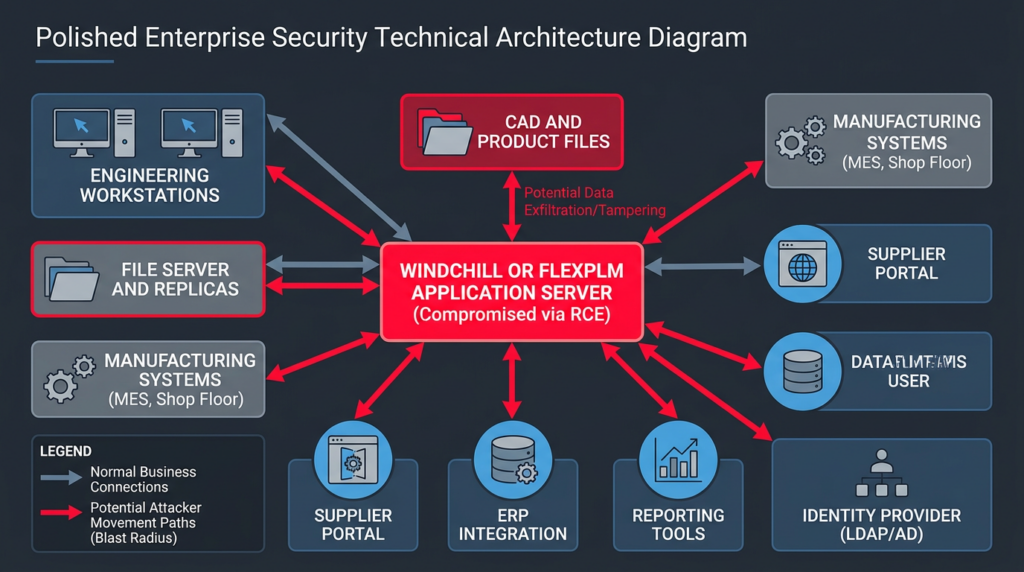
A CVSS score of 9.8 is enough to justify urgent attention, but the score is not the whole story. The operational severity of CVE-2026-12569 comes from four conditions appearing together.
First, the affected systems are high-value enterprise platforms. Windchill and FlexPLM are typically close to engineering, product data, design artifacts, supply chain processes, manufacturing planning, and integration workflows. A compromise can expose data that is more sensitive than ordinary application records.
Second, the weakness class is dangerous. Untrusted deserialization has a long history of turning network-reachable application paths into code execution when attacker-controlled serialized objects reach dangerous code paths or gadget chains. OWASP’s deserialization guidance explains that native serialization formats can support powerful language features and that unsafe handling of malicious serialized data can lead to denial of service, access control bypass, or remote code execution. (Série d'aide-mémoire de l'OWASP)
Third, the exploitation status is no longer theoretical. CISA added CVE-2026-12569 to the KEV catalog, and NVD’s CISA enrichment states that exploitation is active, exploitation is automatable, and technical impact is total. NVD also records a CISA due date of June 28, 2026, along with the required action to apply vendor mitigations, follow BOD 26-04 and forensic triage requirements, or discontinue the product if mitigations are unavailable. (nvd.nist.gov)
Fourth, public reporting has described post-exploitation behavior. SecurityWeek reported successful in-the-wild exploitation and stated that attackers have deployed persistent JSP web shells for remote command execution and data exfiltration. The Hacker News similarly reported that PTC confirmed heightened threat activity and that attackers were deploying JSP web shells. (SecurityWeek)
The combination changes the defender’s job. A vulnerability ticket asks, “Are we affected, and did we patch?” A compromise-assessment ticket asks, “Were we exposed, did anyone reach the vulnerable path, did any code land, what did it do, what credentials or integrations might now be untrusted, and how do we prove remediation was effective?” CVE-2026-12569 belongs in the second category for any exposed or potentially exposed deployment.
The product context, why Windchill and FlexPLM are attractive targets
Attackers do not choose targets only because a CVE has a high score. They choose targets because the system offers useful access, useful data, or useful trust relationships. PTC Windchill and FlexPLM can offer all three.
In many enterprises, PLM systems sit between engineering teams, product managers, manufacturing functions, quality teams, suppliers, and downstream enterprise applications. They may store or broker access to CAD files, product structures, part data, change requests, release workflows, product documentation, supplier documents, materials data, and lifecycle decisions. They may also connect to identity providers, file servers, replication systems, ERP systems, manufacturing execution systems, reporting tools, and supplier portals.
That makes a PLM server different from an ordinary brochure site. Even when the server itself is not domain-admin material, it may have trusted access to sensitive application data and service integrations. It may store authentication tokens, cached files, service credentials, or application secrets. It may be allowed to make outbound connections to internal services that are not exposed to the internet. It may have upload, download, transformation, and publishing features that attackers can abuse after initial access.
SecurityWeek noted that Windchill is widely deployed across industrial and manufacturing organizations, including automotive, aerospace, defense, and heavy machinery. That is exactly the type of environment where intellectual property, engineering data, and operational dependencies make post-exploitation consequences harder to contain. (SecurityWeek)
A realistic risk scenario does not require a dramatic “factory shutdown” narrative. A quieter scenario is enough: an attacker lands a web shell, lists engineering documents, identifies service accounts, pulls integration configuration, exfiltrates selected product files, and maintains access through a JSP placed in a login-adjacent directory. That can create legal, commercial, export-control, supplier, and incident-response obligations even if the application still appears to function.
Affected versions and inventory traps
The first operational step is inventory. It sounds basic, but PLM estates are often messier than security teams expect.
Start with the obvious systems: public Windchill portals, FlexPLM portals, reverse proxy entries, load-balanced application nodes, and known production servers. Then expand outward. Look for development, staging, user acceptance testing, training, disaster recovery, reporting, file server, and replica environments. PTC’s remediation page specifically calls out applying the Apache or IIS update to every system, including File Server and Replica systems. (ptc.com)
Inventory should include the following:
| Asset class | Pourquoi c'est important |
|---|---|
| Public Windchill and FlexPLM hosts | Highest immediate risk if reachable from the internet or exposed through supplier portals. |
| Internal-only Windchill nodes | Still important if attackers have VPN access, supplier access, compromised credentials, or footholds elsewhere. |
| File Server and Replica systems | PTC explicitly includes these in the mitigation scope, and they may hold valuable replicated content. |
| Load balancer backends | One unmitigated backend can remain reachable even if the public VIP appears corrected. |
| Reverse proxy and WAF rules | Controls may block the edge path but fail on alternate hostnames, legacy vhosts, or direct backend access. |
| Test and staging systems | Often run older builds, weaker controls, and copied production data. |
| Disaster recovery environments | May lag behind patch windows and may not receive urgent config changes. |
| Supplier or partner access routes | External trust paths can make an “internal” deployment effectively reachable. |
| Admin and publishing components | High-value functions may expose dangerous servlet paths or file-processing behavior. |
Avoid one common mistake: do not ask only, “What version is production running?” Ask, “Which Windchill and FlexPLM components exist, which release and CPS level is each running, which network paths can reach each component, which of those paths bypass the intended reverse proxy, and which nodes have the PTC mitigation or patch actually applied?”
NVD’s affected product section includes multiple Windchill PDMLink and FlexPLM entries, including 11.x, 12.x, and 13.x release families. PTC’s public page also lists a broad set of affected Windchill PDMLink and FlexPLM releases and says the advisory applies to all CPS versions. (nvd.nist.gov)
That means a local spreadsheet with one “Windchill version” column is not enough. You need per-node release, CPS, patch status, mitigation status, exposure status, and evidence status. For emergency work, a minimal inventory table should look like this:
| Hostname | Produit | Release and CPS | Rôle | Internet reachable | Supplier reachable | Apache or IIS mitigation | Vendor patch applied | Logs preserved | Triage status |
|---|---|---|---|---|---|---|---|---|---|
| windchill-prod-01 | Windchill PDMLink | Confirmed from admin console and filesystem | App node | Yes or no | Yes or no | Yes or no | Yes or no | Yes or no | Not started, clean, suspicious, compromised |
| flexplm-prod-01 | FlexPLM | Confirmed from admin console and filesystem | App node | Yes or no | Yes or no | Yes or no | Yes or no | Yes or no | Not started, clean, suspicious, compromised |
| windchill-replica-01 | Windchill File Server or Replica | Confirmed locally | Replica | Yes or no | Yes or no | Yes or no | Yes or no | Yes or no | Not started, clean, suspicious, compromised |
That table is not bureaucratic overhead. It prevents the most damaging response failure: patching the obvious web node while leaving a replica, staging host, or partner-facing route untouched.
Timeline and exploit status
PTC’s public response center describes a critical remote code execution vulnerability in Windchill and FlexPLM associated with deserialization of untrusted data. That page references CVE-2026-4681 and states that, at the time of that earlier notice, PTC had no evidence of confirmed exploitation affecting PTC customers. (ptc.com)
CVE-2026-12569 has a different operational status in public vulnerability infrastructure. NVD records it as published on June 17, 2026, last modified on June 26, 2026, sourced from PTC, and added to CISA KEV with known exploitation. NVD’s CISA enrichment for CVE-2026-12569 marks exploitation as active, automatable as yes, and technical impact as total. (nvd.nist.gov)
SecurityWeek reported on June 26, 2026 that CISA had added CVE-2026-12569 to KEV after successful in-the-wild exploitation, and that this was the first PTC vulnerability added to KEV. The same report said PTC began releasing patches and mitigations on June 17 and published indicators of compromise the next day. (SecurityWeek)
The timeline matters because defenders often read an early advisory, remember “no confirmed exploitation,” and fail to update their mental model after the situation changes. For CVE-2026-12569, the correct working assumption is that exploitation has occurred in the wild. That does not mean every exposed Windchill or FlexPLM deployment is compromised. It does mean that an exposed deployment deserves log review, file-system review, and post-remediation validation.
How untrusted deserialization becomes code execution
Serialization turns an object or data structure into a format that can be stored, transmitted, and later reconstructed. Deserialization reverses that process. In safe designs, the application accepts only data formats and object types it expects, validates the source and structure, and treats untrusted input as hostile. In unsafe designs, attacker-controlled serialized data reaches code that reconstructs objects or invokes behavior with too much trust.
PortSwigger describes insecure deserialization as a condition where user-controllable data is deserialized by an application, allowing an attacker to manipulate serialized objects and sometimes trigger behavior before the deserialization process finishes. Potential impacts can include remote code execution, privilege escalation, arbitrary file access, and denial of service. (PortSwigger)
The dangerous detail is that the exploit path may not look like a normal command injection parameter. In many deserialization attacks, the attacker is not simply putting ; id into a form field. Instead, the attacker supplies data that causes the application to instantiate classes, call methods, resolve properties, load resources, or traverse a chain of objects that were never meant to be attacker-controlled. If a usable gadget chain is present on the classpath, deserialization can become code execution without a direct “execute this shell command” parameter in the application’s source code.
CWE-502 captures this failure mode directly. CWE warns that assuming the code in a deserialized object is valid can be dangerous and that gadget chains can perform unauthorized actions, including generating a shell. (CWE)
CVE-2026-12569 is recorded with CWE-502 and CWE-20. That pairing is meaningful. CWE-20, improper input validation, describes the broader failure to validate input before processing it. CWE-502 describes the specific danger of deserializing untrusted data. In a real enterprise Java application, the two often overlap: the application accepts data from a request path, fails to constrain it sufficiently, and passes it into a dangerous object-reconstruction process.
A useful mental model is this:
| Couche | Defensive question | Failure mode |
|---|---|---|
| Request routing | Should this endpoint be reachable by this user or network path? | Sensitive servlet paths are exposed to untrusted clients. |
| Input validation | Is the data format, type, length, and source expected? | Attacker-controlled data reaches dangerous processing logic. |
| Deserialization controls | Are allowed classes restricted and unsafe types blocked? | The application reconstructs objects that can trigger unsafe behavior. |
| Runtime context | What privileges does the application server have? | Code execution inherits application privileges and access. |
| Egress control | Can the compromised process call out? | Web shells or payloads communicate with attacker infrastructure. |
| File integrity | Can new server-side files be written and executed? | JSP web shells persist across simple request-level blocking. |
That model also explains why a WAF alone is rarely enough. A WAF rule can block a known path or a known request signature. It cannot reliably prove that no dangerous deserialization path exists, no internal route bypasses the edge, no backend node is still reachable, and no web shell was already deployed before the rule was enabled.
Why unauthenticated RCE changes the response model
Public reporting on CVE-2026-12569 describes the issue as allowing a remote unauthenticated attacker to execute arbitrary code via crafted requests. (SecurityWeek)
Unauthenticated RCE changes response in three ways.
First, credential logs are not enough. If exploitation does not require login, “no suspicious successful login” does not clear the system. You need web access logs, servlet logs, application logs, file-system artifacts, process evidence, and outbound network telemetry.
Second, exposure is the main risk driver. An internet-facing host is a priority even if no suspicious accounts exist. A supplier-facing host is also a priority, because supplier portals and partner networks can behave like semi-public exposure during a mass exploitation window.
Third, access controls must be verified at the path and backend levels. A reverse proxy rule that protects the public hostname may not protect an alternate hostname, a direct IP, a VPN path, a load-balancer health route, a replica, or an internal-only vhost reachable from a compromised workstation.
Immediate containment and remediation
PTC’s remediation guidance says the company was actively developing and releasing patches for supported Windchill versions. It also says organizations should protect publicly accessible Windchill servers, apply the same precautions to FlexPLM, and apply the Apache or IIS update to every system, including File Server and Replica systems. For releases prior to 11.0 M030, PTC says the primary means of lowering risk is to ensure the system is not internet connected. (ptc.com)
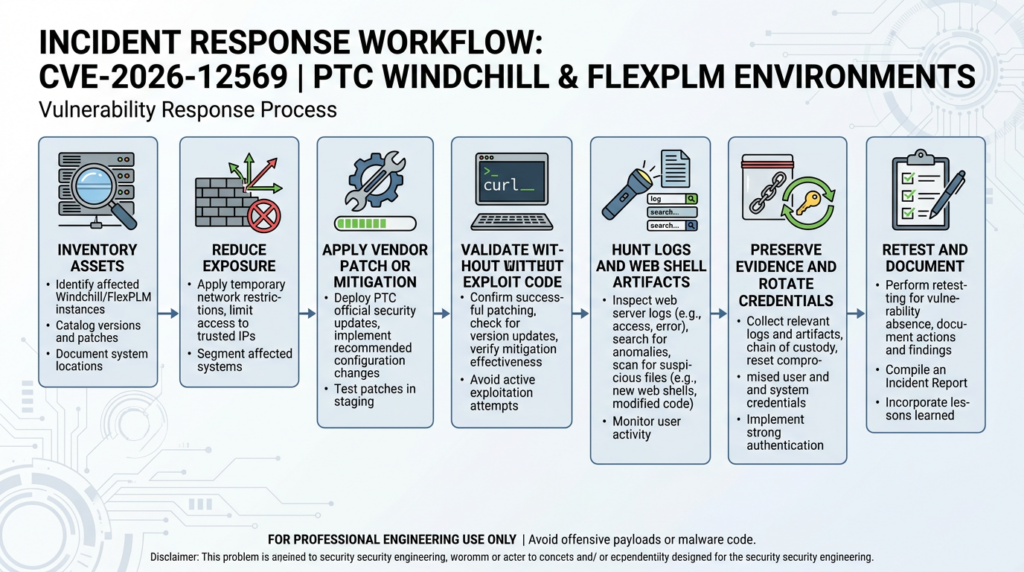
That guidance leads to a practical order of operations.
First, identify every exposed Windchill and FlexPLM host. Include production, DR, staging, training, supplier-facing, file server, and replica nodes.
Second, apply the vendor-supported patch or mitigation for the exact release and CPS. Do not depend on a single version threshold without checking PTC’s current support material.
Third, block public access to vulnerable paths using PTC’s Apache or IIS configuration where applicable. This is a mitigation and exposure-control step, not a universal substitute for patching.
Fourth, remove public exposure where the system does not need it. If the business insists on external access, place it behind strong identity-aware controls, enforce least privilege, and restrict paths.
Fifth, preserve logs before rotating, rebuilding, or cleaning. Emergency patching that destroys forensic evidence can leave the organization unable to determine whether data was accessed.
Sixth, perform file-system and application log triage for known artifacts and suspicious patterns. Treat a clean IOC search as helpful but not conclusive.
Seventh, retest the control path safely. Use non-exploit requests to confirm that intended blocks are active. Do not run public exploit code against production to prove remediation.
Apache control for the known high-risk servlet path
PTC’s public mitigation includes an Apache LocationMatch control that denies access to a servlet path involving WindchillGW ou WindchillAuthGW et com.ptc.wvs.server.publish.Publish. PTC’s example places the rule in an Apache configuration file with a filename sequence between 90 and 99 and instructs administrators to restart Apache. (ptc.com)
# Example based on PTC's public mitigation guidance.
# Confirm the exact file path and deployment convention for your environment.

<LocationMatch "^.*servlet/(WindchillGW|WindchillAuthGW)/com\.ptc\.wvs\.server\.publish\.Publish(?:;[^/]*)?/.*$">
    Require all denied
</LocationMatch>
The purpose of this rule is narrow and important. It blocks a known risky route pattern. It does not prove that the system is fully patched. It does not remove a web shell that may already exist. It does not cover a backend node that bypasses Apache. It does not replace incident response if there were exploitation attempts before the rule was applied.
After deploying the control, verify that the rule is loaded on every Apache instance in the path. Then verify from the outside and from relevant internal network zones that the protected path returns a denied response. Keep the test non-destructive.
TARGET="https://windchill.example.com"

curl -sk -o /dev/null -w "%{http_code}\n" \
  "$TARGET/servlet/WindchillGW/com.ptc.wvs.server.publish.Publish/test"
A 403 response is consistent with the rule denying access, but it is not a vulnerability scan result. It proves only that this request path is blocked from the network location where the test was run. Repeat the check through all relevant hostnames, VIPs, partner routes, VPN routes, and direct backend paths that are in scope.
IIS URL Rewrite control
PTC’s public remediation page also provides guidance for IIS environments, including installing IIS URL Rewrite and adding a deny rule for the same Windchill publish servlet route, followed by iisreset. (ptc.com)
A simplified defensive pattern looks like this:
<rewrite>
  <rules>
    <rule name="Block Windchill Publish Servlet" stopProcessing="true">
      <match url="^.*servlet/(WindchillGW|WindchillAuthGW)/com\.ptc\.wvs\.server\.publish\.Publish(;[^/]*)?/.*$" ignoreCase="true" />
      <action type="CustomResponse"
              statusCode="403"
              statusReason="Forbidden"
              statusDescription="Access Denied" />
    </rule>
  </rules>
</rewrite>
Use PTC’s exact supported instructions for production. The example above is useful for understanding the intent: block access to the risky servlet pattern before the request reaches the vulnerable application path.
The same validation caveats apply. Confirm the rule is present, loaded, active, and applied at every relevant IIS layer. Test from the same network positions an attacker or supplier could use. Check that direct backend routes do not bypass the control. Do not stop at “the public homepage works.”
Safe validation without exploit code
A safe validation workflow should answer four questions:
- Is the affected product present?
- Is the affected release or CPS present?
- Is the vendor patch or mitigation applied to every relevant node?
- Is there evidence of attempted or successful exploitation?
It should not require running exploit payloads against production.
A practical validation checklist looks like this:
| Validation step | Evidence to collect | Risk reduced |
|---|---|---|
| Confirm product and release | Admin console screenshot, build file, package inventory, change record | Prevents false assumptions about affected status. |
| Confirm patch or CPS | Vendor advisory mapping, installed package evidence, PTC case or support confirmation | Confirms remediation is release-specific, not guessed. |
| Confirm Apache or IIS rule | Config file, rule export, service restart record, change ticket | Shows known risky route is blocked. |
| Confirm path behavior | Non-exploit boucler response showing expected denial from multiple network zones | Verifies the control is effective from tested paths. |
| Confirm all nodes covered | Load balancer backend list, server inventory, replica inventory | Prevents one unmitigated backend from remaining exposed. |
| Preserve logs | Apache, IIS, Windchill, MethodServer, proxy, WAF, EDR, DNS, outbound firewall | Enables compromise assessment. |
| Hunt IOCs | Request patterns, web shell paths, staged files, hashes, suspicious headers | Detects known post-exploitation behavior. |
| Retest after patch | Repeat safe route checks and version verification | Confirms remediation survived restart and load balancer routing. |
The following shell pattern is intentionally non-exploitative. It checks response behavior for a known route pattern after a blocking rule is expected to be active.
#!/usr/bin/env bash
set -euo pipefail

target="${1:-https://windchill.example.com}"

paths=(
  "/servlet/WindchillGW/com.ptc.wvs.server.publish.Publish/test"
  "/servlet/WindchillAuthGW/com.ptc.wvs.server.publish.Publish/test"
)

for path in "${paths[@]}"; do
  code="$(curl -sk -o /dev/null -w "%{http_code}" "${target}${path}")"
  printf "%s %s\n" "$code" "${target}${path}"
done
Expected results depend on your architecture, but a properly deployed deny rule should block these test paths from untrusted networks. If one hostname returns 403 and another returns 200, 302, 500, or inconsistent behavior, investigate routing, rewrite-rule placement, and backend coverage.
Do not use public exploit code as a health check. In an emergency response window, exploit attempts can corrupt evidence, trigger malware controls, cause application instability, or cross legal boundaries. A safer workflow is to confirm exposure, patch status, mitigation behavior, log evidence, and file-system integrity. If exploit validation is necessary, run it only in a controlled lab or with explicit written authorization, clear scope, and non-production targets.
Hunting for web shells, staged classes, and suspicious requests
PTC published indicators that include suspicious request patterns, staged files, class files, JSP artifacts, and log messages. PTC also cautioned that one User-Agent indicator is valid only when observed with suspicious HTTP request patterns such as run?p=, .jsp?p=, run?c=ou .jsp?c=. (ptc.com)
The operational lesson is simple: do not overfit to a single User-Agent. Hunt for combinations of route, method, query, path, header, file creation, and application error behavior.
PTC’s public indicators include file-system artifacts such as GW.class, payload.bin, random JSP files matching a dpr_<8-hex-digits>.jsp pattern, and several class names. PTC also lists log and error indicators referencing GW_READY_OK, ClassNotFoundException pour GW, and Windchill gateway errors. (ptc.com)
The Hacker News reported additional indicators, including POST activity to /Windchill/login/*.jsp, a suspicious header X-windchill-req:, and a web shell path pattern resembling /Windchill/login/[0-9a-f]{16}.jsp. It also reported a SHA-256 hash for a suspicious artifact and listed IP addresses that PTC advised customers to block or investigate. (The Hacker News)
Start with logs. Apache, IIS, reverse proxy, load balancer, WAF, and application logs may each hold part of the story. If your Windchill logs use Log4j, Splunk’s detection guidance for the related PTC Windchill exploitation path calls out request patterns such as run?c=, run?p=, .jsp?c=, .jsp?p=, and probes such as GW_READY_OK, along with Windchill logger names including wt.servlet.ServletRequestMonitor.request et wt.method.MethodContextMonitor.contexts.servletRequest. (Splunk Security Content)
A simple first-pass access-log search can look like this:
grep -E \
'(/servlet/(WindchillGW|WindchillAuthGW)/com\.ptc\.wvs\.server\.publish\.Publish|run\?p=|run\?c=|\.jsp\?p=|\.jsp\?c=|/Windchill/login/[0-9a-fA-F]{16}\.jsp|X-windchill-req|GW_READY_OK)' \
/var/log/httpd/*access* /var/log/apache2/*access* 2>/dev/null
Adapt the paths to your deployment. On Windows, search IIS logs and application logs with equivalent patterns.
$patterns = @(
  "servlet/(WindchillGW|WindchillAuthGW)/com\.ptc\.wvs\.server\.publish\.Publish",
  "run\?p=",
  "run\?c=",
  "\.jsp\?p=",
  "\.jsp\?c=",
  "/Windchill/login/[0-9a-fA-F]{16}\.jsp",
  "X-windchill-req",
  "GW_READY_OK"
)

Get-ChildItem "C:\inetpub\logs\LogFiles" -Recurse -File |
  Select-String -Pattern $patterns |
  Select-Object Path, LineNumber, Line
Then inspect the file system for known artifact names and suspicious JSP placement. The following is a helper pattern, not a complete forensic method:
WINDCHILL_ROOT="/opt/ptc/Windchill"

find "$WINDCHILL_ROOT" -type f \( \
  -name 'GW.class' -o \
  -name 'payload.bin' -o \
  -name 'flst.txt' -o \
  -regex '.*/dpr_[0-9a-fA-F]\{8\}\.jsp' -o \
  -regex '.*/Windchill/login/[0-9a-fA-F]\{16\}\.jsp' \
\) -print
For SIEMs, express the search in terms of behavior and context, not just a single literal. A Splunk-style query might start like this:
index=web OR index=windchill
(
  "run?c=" OR "run?p=" OR ".jsp?c=" OR ".jsp?p=" OR
  "GW_READY_OK" OR "X-windchill-req" OR
  "/Windchill/login/"
)
| table _time host src_ip method uri status user_agent
A more focused web shell hunting query might look for POST requests to login-adjacent JSP files:
index=web
method=POST uri_path="/Windchill/login/*.jsp"
| rex field=uri_path "/Windchill/login/(?<jsp_name>[0-9a-fA-F]{16}\.jsp)"
| search jsp_name=*
| stats count min(_time) as first_seen max(_time) as last_seen values(src_ip) as src_ip by host uri_path status
These searches should be tuned to your log schema. The important idea is to combine path, method, timestamp, source IP, response code, and file-system evidence. A lone 404 probe is different from a successful POST to a newly created JSP followed by outbound connections from the application server.
IOC hunting limits
IOC hunting is necessary, but it is not sufficient. Attackers can rename files, change headers, use different paths, delete artifacts, or access the system through internal routes that are not logged at the same edge. A clean grep result does not prove safety.
Use IOC searches to answer narrow questions:
| Question | Good evidence | Weak evidence |
|---|---|---|
| Did anyone probe known patterns? | Edge logs showing source, URI, method, timestamp, and response code | “No WAF alert” without raw log review |
| Did a JSP web shell land? | File creation evidence, hash, timestamp, web request, EDR event | Only searching one directory |
| Did code execute? | Process tree, application errors, outbound connection, suspicious child process | HTTP 500 alone |
| Did data leave? | Proxy logs, firewall logs, DNS logs, large outbound transfer, archive creation | No known exfil tool found |
| Did the attacker persist? | New JSP, new account, modified startup script, scheduled task, changed config | No active session at the moment |
| Was every node protected? | Backend inventory plus rule verification per node | Public VIP test only |
If you find a hit, preserve before cleaning. Copy logs, hash suspicious files, record timestamps, capture process and network state, and coordinate with incident response. Deleting a web shell before collecting evidence can make the later business decision harder, especially when engineering data or supplier data might be involved.
From one vulnerable server to an engineering incident
A successful CVE-2026-12569 exploitation path should be treated as an application-server compromise until proven otherwise.
That does not mean panic. It means the investigation should follow the trust relationships.
Start with the host. Determine whether new files were written, whether suspicious JSP files appeared, whether new class files or payload files exist, whether application directories changed, whether server-side logs show command probes, and whether the application process spawned unusual child processes.
Then move to identities. Check service accounts used by Windchill or FlexPLM. Review application accounts, administrator accounts, integration users, supplier users, and recently created accounts. Look for password changes, role changes, failed login bursts, access from unusual geographies, and use outside normal working hours.
Then move to data. Identify what repositories, file vaults, product structures, design files, documents, exports, reports, and integrations the application server can access. Review whether large downloads, archive creation, unusual search activity, or bulk export operations occurred around the suspected window.
Then move to integrations. PLM systems often connect to ERP, identity services, document management, reporting platforms, manufacturing systems, and supplier portals. If the Windchill application server holds credentials or tokens for those integrations, rotate them after containment and confirm that downstream systems did not receive suspicious calls.
Then move to network behavior. Review outbound proxy, firewall, DNS, and EDR telemetry from the affected hosts. Web shells often need command-and-control, payload retrieval, staging, or exfiltration routes. A server that normally talks only to internal databases but suddenly connects to unfamiliar VPS infrastructure deserves deeper review.
Finally, review backups and recovery. If the host must be rebuilt, make sure backups are clean, patch levels are known, and restored systems do not reintroduce vulnerable configuration. A restore from a vulnerable image can recreate the same exposure.
Patch, retest, and preserve evidence
Patching is necessary, but it is not the end of the CVE-2026-12569 response.
A mature remediation record should include:
| Preuves | Pourquoi c'est important |
|---|---|
| Affected asset list | Shows scope and prevents missed nodes. |
| Vendor patch or mitigation reference | Shows the action corresponds to PTC guidance, not guesswork. |
| Change ticket and timestamp | Supports audit and incident review. |
| Config snapshot | Proves Apache or IIS control was present after deployment. |
| Safe validation output | Confirms expected blocking behavior without exploit code. |
| Log preservation hash or archive record | Keeps investigation evidence intact. |
| IOC search results | Shows known indicators were checked. |
| Follow-up retest | Confirms controls remained active after restart or routing changes. |
| Business owner sign-off | Confirms engineering and PLM stakeholders understand residual risk. |
For authorized teams that need to turn emergency verification into repeatable evidence, AI-assisted pentest and validation workflows can help if they keep scope, commands, artifacts, screenshots, timestamps, and report language organized instead of replacing technical judgment. Penligent describes its platform as an AI-powered penetration testing tool focused on finding vulnerabilities, verifying findings, and executing authorized exploits; its Cisco FMC unsafe deserialization write-up is also a useful example of treating Java deserialization in a management plane as an exposure and validation problem, not just a CVSS number. Use such workflows only inside approved scope and avoid running exploit automation against production PLM systems during incident response. (Penligent)
The key is evidence quality. A screenshot saying “patched” is weaker than a record showing the affected host, exact release, applied fix, config state, denied route behavior, log review, and date of retest. CVE-2026-12569 is the kind of vulnerability where auditors, executives, engineering leaders, and customers may later ask, “How do we know we were not exposed?” Good evidence answers that question without reopening the incident.
Hardening patterns that outlive this CVE
The long-term fix is not only “patch faster.” Faster patching matters, but architecture determines blast radius.
Start by removing direct internet exposure where possible. PLM systems should not be treated like public marketing sites. If external access is required, place it behind identity-aware access, strong MFA, device posture controls, IP restrictions where possible, and clear supplier access boundaries.
Use path-level controls at reverse proxies. Sensitive servlet paths, publishing functions, administrative endpoints, file operations, and integration routes should have explicit access rules. Default-allow routing makes emergency mitigation harder because every route must be rediscovered during crisis.
Segment application tiers. Windchill and FlexPLM application servers should have only the outbound access they need. They should not be able to reach arbitrary internet hosts. They should not have broad internal network reach simply because they are “enterprise application servers.”
Protect file vaults and replica systems. A replica may feel secondary, but replicated product files can be high-value. Ensure file servers receive the same mitigation, logging, file integrity monitoring, and patch governance as primary application nodes.
Limit service account privileges. Application service accounts should not have unnecessary domain privileges, broad file-share access, or unrestricted database permissions. If a web shell runs under the application context, every excessive permission becomes attacker capability.
Monitor for server-side file creation. JSP web shells are not subtle if file integrity monitoring covers the right directories and alert thresholds are reasonable. Baseline expected deployment directories and alert on new executable server-side files.
Control egress. If an application server rarely needs outbound internet access, block it by default. If it needs vendor updates or specific APIs, allow only those destinations. Egress controls can turn code execution into a contained incident rather than a quiet exfiltration path.
Treat supplier access as real exposure. A system behind partner VPN or supplier SSO is not truly private. Threat actors often reach “internal” applications through compromised third parties or stolen credentials.
Tie KEV to service-level objectives. CISA KEV inclusion is not just a federal-agency concern. For private organizations, KEV is a practical risk signal. A known-exploited, automatable, high-impact RCE in a high-value enterprise system should receive a short remediation clock and a documented triage requirement.
Related CVEs that explain the pattern
CVE-2026-12569 sits in a wider family of enterprise deserialization and management-plane RCE problems. The following CVEs are not the same bug, but they help explain why defenders should treat this class seriously.
| CVE | Why it is relevant | Exploitation condition | Real-world risk | Remediation lesson |
|---|---|---|---|---|
| CVE-2026-4681 | Earlier PTC Windchill and FlexPLM RCE record tied to deserialization of untrusted data | Public PTC page describes RCE through deserialization in the same product family | Shows that similar weakness classes can appear across adjacent advisories and timelines | Track each CVE separately and update status when exploitation information changes. |
| CVE-2023-46604 | Apache ActiveMQ OpenWire deserialization-style RCE involving manipulated serialized class types | Network access to the broker or client using the OpenWire protocol | Message brokers often sit in trusted integration paths, making RCE highly valuable | Upgrade quickly and reduce broker exposure to only trusted network paths. |
| CVE-2023-43208 | Mirth Connect deserialization of untrusted data and KEV-listed exploitation | Vulnerable integration server processing unsafe serialized data | Healthcare and integration middleware can bridge many sensitive systems | Patch integration platforms quickly and audit connected systems, not only the vulnerable host. |
| CVE-2026-20131 | Cisco FMC insecure Java deserialization through the web management interface | Crafted serialized Java object sent to the management interface | Management-plane compromise can become root-level control of a security appliance | Keep management interfaces off untrusted networks and validate patch status with evidence. |
CVE-2026-4681 is the closest contextual relative. PTC’s response center describes a critical Windchill and FlexPLM RCE issue that may be exploited through deserialization of untrusted data and references CVE-2026-4681. The same page stated that, at that time, PTC had no evidence of confirmed exploitation affecting customers. (ptc.com)
CVE-2023-46604 shows how dangerous serialized-class handling can be in integration infrastructure. NVD describes it as an Apache ActiveMQ issue where a remote attacker with network access to a broker or client could manipulate serialized class types in the OpenWire protocol to instantiate classes on the classpath and execute arbitrary shell commands. (nvd.nist.gov)
CVE-2023-43208 is relevant because it affected Mirth Connect, an integration platform, through deserialization of untrusted data and was later included in CISA KEV. Integration systems often hold trusted connectivity across sensitive environments, so the post-exploitation impact can be broader than the product name suggests. (nvd.nist.gov)
CVE-2026-20131 is a useful management-plane comparison. NVD describes it as a Cisco Secure Firewall Management Center vulnerability caused by insecure deserialization of user-supplied Java byte streams, exploitable through a crafted serialized Java object sent to the web-based management interface, with potential arbitrary code execution and privilege escalation to root. (nvd.nist.gov)
The shared lesson is not “all deserialization bugs are identical.” They are not. The lesson is that unsafe object handling becomes especially dangerous when it appears in high-trust enterprise systems: PLM, integration middleware, message brokers, security management consoles, and administrative portals. These systems often have privileged network position, sensitive data, and trusted service relationships. That makes exposure reduction as important as patching.
Common mistakes during CVE-2026-12569 response
The most common mistake is treating mitigation as patching. A rewrite rule can reduce exposure to a known route. It does not necessarily remove the vulnerable code, patch every node, or prove the system was not already compromised.
The second mistake is checking only the public production hostname. A PLM environment may have direct backend IPs, alternate hostnames, supplier URLs, file servers, replicas, training systems, and disaster recovery nodes. A single clean public test does not cover the estate.
The third mistake is relying only on vulnerability scanners. Scanners may identify exposed versions or known paths, but they may miss deployment-specific routing, already-deployed web shells, or internal-only replicas. Combine scanning with manual inventory, config review, log review, and file-system inspection.
The fourth mistake is deleting suspicious files before evidence collection. If a JSP web shell exists, hash it, copy it safely, record permissions and timestamps, capture logs around first appearance, and coordinate with incident response before removal.
The fifth mistake is ignoring application credentials. If attackers achieved code execution, assume application secrets may be exposed until reviewed. Rotate integration credentials, service account passwords, API keys, and supplier tokens that the compromised server could access.
The sixth mistake is closing the incident after patching. A known-exploited RCE with web shell reports needs post-remediation validation and retrospective hunting. Patching stops a known path going forward. It does not answer what happened before patching.
A practical 24-hour response plan
For organizations discovering CVE-2026-12569 exposure during an active exploitation window, a simple response plan helps avoid paralysis.
Hour 0 to 2, scope and exposure
Build a rapid asset list. Include Windchill PDMLink, FlexPLM, file servers, replicas, staging, DR, and supplier-facing systems. Identify public hostnames, VPN-only hostnames, partner-access routes, load balancer backends, and direct IP paths.
Freeze log retention. Increase retention where possible. Export or snapshot logs that may rotate quickly, especially access logs, reverse proxy logs, WAF logs, application logs, and EDR telemetry.
Apply network containment where business impact allows. If a deployment does not need public exposure, remove it from the internet. If it must remain reachable, restrict by identity, IP, VPN, or ZTNA while remediation proceeds.
Hour 2 to 6, mitigation and safe validation
Apply PTC’s supported patch or mitigation for each affected release. If using Apache or IIS controls, deploy them to every relevant node and restart the required service. Confirm that File Server and Replica systems are included, as PTC’s guidance explicitly calls them out. (ptc.com)
Run non-exploit validation against every hostname and network path. Confirm that the protected route returns the expected denial. Document timestamps and command output.
Check load balancers. Ensure every backend received the rule or patch. Disable unpatched backends until they are remediated.
Hour 6 to 12, IOC and artifact hunting
Search for suspicious HTTP patterns, including run?c=, run?p=, .jsp?c=, .jsp?p=, GW_READY_OK, suspicious login-adjacent JSP paths, and X-windchill-req. PTC and security reporting identify these as relevant indicators or hunting patterns. (ptc.com)
Search file systems for known artifacts and suspicious JSP files. Compare file creation times with suspicious HTTP events. Review application logs for errors that align with exploitation attempts.
Review outbound network telemetry from the application servers. Look for unfamiliar external IPs, unusual DNS, large transfers, and connections shortly after suspicious HTTP events.
Hour 12 to 24, triage and business risk
If evidence is clean, document the scope of the review and plan a follow-up retest. If evidence is suspicious, escalate to incident response. Preserve the host, collect forensic artifacts, rotate credentials, and assess data access.
Engage engineering and business owners. They can identify sensitive product lines, regulated data, supplier workflows, and downstream systems that security may not understand from logs alone.
Prepare communication paths. A PLM incident may affect legal, compliance, customers, suppliers, manufacturing, and executive leadership. Good technical evidence supports better business decisions.
FAQ
Is CVE-2026-12569 being actively exploited?
- Yes. NVD’s CVE record includes CISA KEV information, and CISA’s enrichment marks exploitation as active.
- Public security reporting also describes in-the-wild exploitation and JSP web shell deployment.
- Treat exposed Windchill and FlexPLM deployments as requiring both remediation and compromise assessment.
- Do not assume compromise solely from exposure, but do not stop at patch status.
Which PTC products should I check first?
- Start with PTC Windchill PDMLink and PTC FlexPLM.
- Prioritize internet-facing systems, supplier-facing systems, VPN-accessible systems, file servers, and replicas.
- Include staging, test, training, disaster recovery, and legacy systems.
- Confirm release and CPS level through local evidence and PTC’s current advisory or support material.
Does the Apache or IIS rule fully fix CVE-2026-12569?
- No. The rule is an exposure-control mitigation for a known risky servlet path.
- It does not replace vendor patching for affected releases.
- It does not remove artifacts if attackers already exploited the system.
- It must be applied to every relevant node, including file servers and replicas where applicable.
- Always pair the rule with safe validation, log review, and file-system hunting.
What logs should defenders review first?
- Review Apache, IIS, reverse proxy, WAF, and load balancer logs for suspicious request paths and query patterns.
- Review Windchill and MethodServer logs for application errors, servlet request records, and suspicious gateway messages.
- Review EDR, process, DNS, proxy, and firewall logs for outbound connections or suspicious child processes.
- Search for patterns such as
run?c=,run?p=,.jsp?c=,.jsp?p=,GW_READY_OK,/Windchill/login/[hex].jspetX-windchill-req. - Preserve logs before restarting, rebuilding, or deleting suspicious files.
How is CVE-2026-12569 different from CVE-2026-4681?
- Both are associated with PTC Windchill and FlexPLM deserialization-related RCE risk in public PTC material.
- CVE-2026-4681 appears in earlier PTC advisory context, where PTC stated at that time that it had no evidence of confirmed exploitation affecting customers.
- CVE-2026-12569 has a stronger current operational signal because it is listed in CISA KEV and marked with active exploitation in NVD’s CISA enrichment.
- Track them separately in tickets, asset records, and remediation evidence.
Can a non-internet-facing Windchill system still be risky?
- Yes. Internal exposure can still matter if attackers have VPN access, supplier access, compromised credentials, or an internal foothold.
- Internal systems may have weaker monitoring, older builds, and more direct access to sensitive file stores or integrations.
- Supplier-facing or partner-accessible systems should not be treated as fully private.
- The priority may be lower than a public internet-facing host, but validation and patching are still necessary.
Should I run public exploit code to verify remediation?
- No, not against production systems during emergency response.
- Use safe checks to confirm version, patch status, mitigation configuration, and expected denial behavior on known paths.
- Preserve logs and hunt for artifacts instead of generating new exploit noise.
- If exploit validation is required, use a controlled lab, written authorization, defined scope, and non-production targets.
- For production, evidence-based validation is usually safer and more defensible than live exploitation.
Closing assessment
CVE-2026-12569 deserves urgency because it combines a dangerous weakness class, high-value enterprise systems, public exploitation status, and reported web shell behavior. The most important question is not whether the CVSS score is critical. It is whether a specific Windchill or FlexPLM deployment was reachable, whether the vendor patch or mitigation is applied everywhere, whether known exploitation artifacts are present, and whether the organization can prove what happened during the exposure window.
The right response is disciplined and evidence-driven: inventory every node, reduce exposure, apply PTC’s supported remediation, validate controls without exploit code, preserve logs, hunt for web shells and staged files, rotate exposed credentials if compromise is suspected, and keep the incident open until the engineering and security evidence agree.
 French
  English
  German
  Spanish
  Portuguese
  Japanese
  Korean
  Hindi
Hindi  Arabic
  Turkish
  Hebrew