
CVE-2026-20245 is a Cisco Catalyst SD-WAN vulnerability that turns an already privileged position into root-level control of a high-trust network management system. Cisco describes the bug as a CLI issue caused by insufficient validation of user-supplied input. An attacker with netadmin privileges can upload a crafted file to the affected system and execute arbitrary commands as root. NVD records the vulnerability as affecting Cisco Catalyst SD-WAN Controller, formerly vSmart, Cisco Catalyst SD-WAN Manager, formerly vManage, and Cisco Catalyst SD-WAN Validator, formerly vBond. (NVD)
That authentication requirement matters, but it should not create comfort. Cisco’s public record says the attacker must have netadmin privileges, and that those privileges would require valid credentials or exploitation of related SD-WAN vulnerabilities. Cisco also stated that it observed limited cases where exploitation of the bug resulted in configuration changes pushed to edge devices. In other words, the practical concern is not only a shell on a management appliance. The concern is root access inside infrastructure that can affect the SD-WAN fabric. (NVD)
Mandiant later published a detailed account of real-world exploitation. In early 2026, Mandiant identified a threat actor targeting SD-WAN infrastructure at a service provider. After initial access, the actor exploited CVE-2026-20245 as a zero-day to escalate from a compromised administrative account to root-level access. Mandiant attributed the weakness to a file upload feature that lacked proper filtering of malicious data, and it documented anti-forensic behavior such as deleting files, restoring modified configuration, and checking whether indicators had been removed. (Google Cloud)
The operational response should be evidence-first. Upgrade to a fixed release, but do not treat patching as proof that the environment is clean. A system that may have been used to push configuration to edge devices, hold administrative credentials, participate in peering trust, or manage network policy needs compromise review, credential review, configuration validation, and log preservation before normal vulnerability management language is enough.
The facts that matter first
| Champ d'application | Current public information |
|---|---|
| CVE | CVE-2026-20245 |
| Vendor | Cisco |
| Product family | Cisco Catalyst SD-WAN |
| Components named in NVD | Cisco Catalyst SD-WAN Controller, Manager, and Validator |
| Former names | vSmart, vManage, and vBond |
| Classe de vulnérabilité | Command injection and privilege escalation through insufficient input validation in a CLI file upload workflow |
| CWE | CWE-116 according to NVD’s CVE record |
| CVSS 3.1 vector | AV:L/AC:L/PR:L/UI:N/S:U/C:H/I:H/A:H |
| CVSS 3.1 score | 7.8, High |
| Required attacker position | Authenticated local attacker with netadmin privileges |
| User interaction | Aucun |
| Successful impact | Arbitrary command execution as root |
| Exploitation status | Cisco reported limited exploitation, and CISA added the vulnerability to KEV |
| Known practical intrusion detail | Mandiant observed a malicious CSV upload used to obtain root-level access |
| Main detection sources | /var/log/scripts.log, /var/log/auth.log, command history, rollback files, admin-tech collections, and SD-WAN configuration evidence |
| Fixed releases reported publicly | 20.9.9.2, 20.12.7.2, 20.15.4.5, 20.15.5.3, 20.18.3.1, 26.1.1.2, or later |
| Related vulnerabilities that change the risk picture | CVE-2026-20182, CVE-2026-20127, CVE-2026-20262, CVE-2026-20133, CVE-2026-20128, CVE-2026-20122, and CVE-2022-20775 |
CISA added CVE-2026-20245 to the Known Exploited Vulnerabilities catalog on June 9, 2026. Independent mirrors of the KEV entry list the required action as applying vendor instructions, following BOD 22-01 guidance for cloud services where applicable, or discontinuing use if mitigations are unavailable, with a federal due date of June 23, 2026. CISA’s own site may block automated fetches, but the KEV status is also reflected in NVD change records and multiple security databases. (NVD)
What CVE-2026-20245 actually is
The most precise public description is narrow: the vulnerability sits in the CLI of Cisco Catalyst SD-WAN control components, and exploitation requires uploading a crafted file to the affected system. The software fails to validate user-controlled input safely, which allows command injection and root-level execution. NVD’s record includes the full vector and maps the issue to CWE-116, Improper Encoding or Escaping of Output. (NVD)
The real-world attack path makes that dry description more concrete. Mandiant observed the threat actor exploiting the bug in April 2026 after establishing an SSH session with the l'administration account. The actor used a tenant upload command to load a file named evil_tenant.csv. Mandiant’s report states that this malicious CSV contained the exploit payload and that the activity resulted in creation of a root-privileged account named troot. (Google Cloud)
That does not mean defenders need a public proof-of-concept to act. It means the opposite. Public proof-of-concept status is the wrong decision point when a trusted vendor, CISA, and Mandiant have all described confirmed exploitation. A defensive team should focus on whether the device is in scope, whether the vulnerable release is present, whether an attacker could have obtained the required administrative position, and whether the evidence trail shows upload, password, root account, SSH, or configuration anomalies.
The bug also illustrates why “local attacker” language can mislead readers who are not used to appliance advisories. In this case, local does not mean a person standing in a data center with a keyboard. The attacker position can be reached through administrative SSH access, compromised credentials, earlier SD-WAN control-plane exposure, or other paths that place the actor inside the management plane. Cisco’s own language names CVE-2026-20182 and CVE-2026-20127 as known paths that can provide the required privilege context for related June 2026 SD-WAN issues. (NVD)
Why root on SD-WAN Manager is a fabric problem
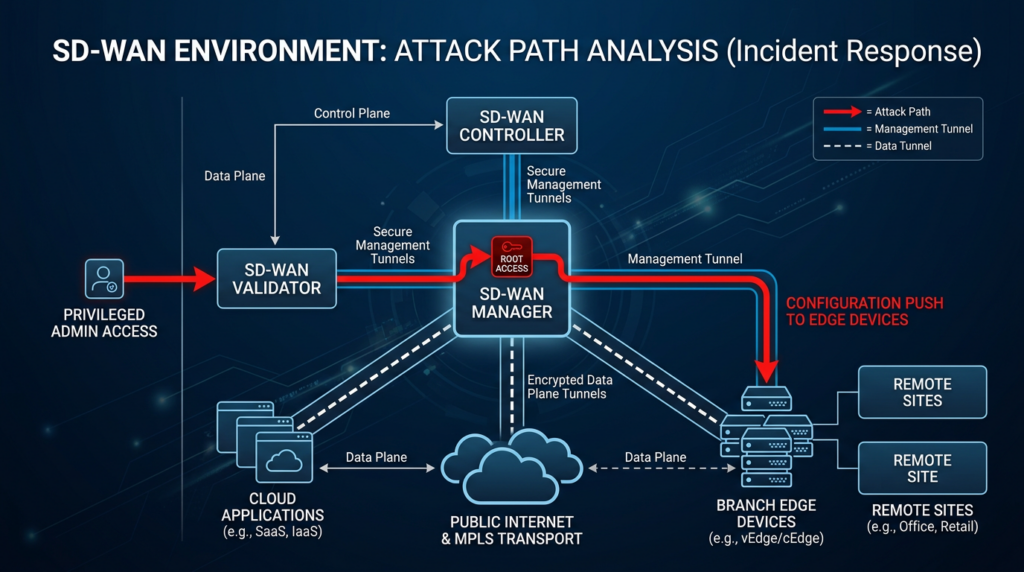
Root access on an ordinary Linux host is already serious. Root access on an SD-WAN management component is different because the component is part of the system that defines, distributes, and enforces network trust.
Mandiant’s SD-WAN explanation is useful here. Traditional WANs rely heavily on physical routers, while SD-WAN decouples management and control logic from underlying hardware. A centralized controller can orchestrate remote sites from a single dashboard. SD-WAN deployments are common in distributed environments such as banks, retail organizations, technology service providers, and healthcare providers. (Google Cloud)
Inside that model, peering is a trust process. SD-WAN components establish authenticated relationships, exchange routing information, and build secure tunnels. If a threat actor can insert itself into this trust structure, manipulate credentials, or reach root on the management appliance, the blast radius is not limited to a single web process. It can reach routing, policy, device onboarding, certificates, edge configuration, and the administrator’s ability to trust what the dashboard reports. (Google Cloud)
Cisco observed limited cases where exploitation of CVE-2026-20245 resulted in configuration changes pushed to edge devices. That single detail should change how defenders triage the incident. A configuration change pushed from a compromised manager can survive after the exploit file is deleted. It can affect branch traffic, segmentation, tunnel behavior, policy enforcement, monitoring visibility, or access paths used by later stages of an intrusion. (NVD)
The right mental model is not “one appliance has a privilege escalation.” It is “the management plane may have been used as an attacker-controlled control point.” That distinction changes evidence collection, escalation paths, and the cleanup checklist.
The observed intrusion chain
Mandiant’s June 25, 2026 report gives the strongest public view of how the vulnerability was used in the wild. The actor targeted SD-WAN infrastructure at a service provider and used a sequence of administrative access, credential manipulation, exploitation, root account creation, and cleanup. (Google Cloud)
The first stage was not the CVE itself. Mandiant observed unauthorized peering connections from late 2025 to January 2026. It stated that those earlier connections may have involved exploitation of CVE-2026-20127 or CVE-2026-20182, although the report is careful to note uncertainty because the vulnerabilities were not disclosed and patches were not available during that period. In March 2026, more unauthorized peering connections were observed on a device not affected by CVE-2026-20127, and Cisco confirmed those March connections did not use CVE-2026-20182 either. Mandiant wrote that stolen certificate material from a previous compromise could explain the later activity. (Google Cloud)
The second stage involved authentication as vmanage-admin and manipulation of the default l'administration account. Mandiant observed successful SSH authentication using vmanage-admin, followed by commands that changed the default l'administration account password. The actor then authenticated to the SD-WAN Manager web application using the l'administration account and exfiltrated SD-WAN fabric configurations. Mandiant also observed the actor changing the password back to its original state, likely to reduce the chance of administrator detection during normal operations. (Google Cloud)
The third stage was exploitation of CVE-2026-20245. Mandiant observed the actor using an administrative tenant upload command to load evil_tenant.csv. The malicious file contained an exploit payload. Mandiant’s public report says the payload attempted to append malicious entries to /etc/passwd et /etc/shadow, create backups of those files, and create a new root-privileged user named troot. The actor then accessed the new account from the l'administration account using su. (Google Cloud)
The fourth stage was cleanup. Mandiant identified deletion of files created by the actor, restoration of modified configuration, and use of a validation script to check whether traces were gone. The script checked for files in /home/admin, le troot entry in password files, and the tenant list file under /usr/share/viptela. (Google Cloud)
That sequence is important because it shows why simple file-based detection can miss compromise. A defender who looks only for the malicious CSV may find nothing after cleanup. A defender who checks only patch level may miss that the vulnerable system was already used. A defender who trusts the current l'administration password state may miss that the password was changed and reverted. The investigation has to join multiple weak signals: SSH source, authentication time, rollback entries, script logs, command history, root-account artifacts, configuration deltas, and edge-device changes.
What the prerequisite really means
The public record says exploitation requires netadmin privileges. The safest interpretation is not “only insiders can exploit this.” The safer interpretation is “the attacker needs to become or impersonate a privileged SD-WAN administrator first.”
| Common reading | Better operational reading |
|---|---|
| “Authenticated local attacker” means low risk | It means the vulnerability is post-auth, but the required position may be reached through stolen credentials, prior compromise, rogue peering, or related SD-WAN bugs |
| “No remote unauthenticated exploit” means routine patching is enough | The vulnerability has been exploited in real attacks, and Mandiant observed a broader intrusion chain before root escalation |
| “We do not see the malicious CSV” means we are clean | Mandiant documented anti-forensic cleanup and deletion of actor-created files |
| “The score is only 7.8” means it is not emergency-grade | CVSS does not fully capture SD-WAN management-plane impact or confirmed exploitation |
| “We already patched CVE-2026-20182” means the chain is closed | Earlier exposure may have left credentials, certificate material, unauthorized peers, or configuration changes behind |
| “The affected device is cloud-managed” means no action is needed | Cloud and managed deployment responsibility needs to be clarified with Cisco support and internal ownership, not assumed away |
This distinction is especially important because CVE-2026-20182 and CVE-2026-20127 sit near the same control-plane trust problem. CVE-2026-20182 is a critical authentication bypass in Cisco Catalyst SD-WAN Controller and Manager. Penligent’s earlier technical analysis of CVE-2026-20182 describes the control-plane consequence: an unauthenticated remote attacker may gain access as an internal high-privileged non-root account and reach NETCONF, which can affect SD-WAN fabric configuration. (Penligent)
The point is not that every CVE in the SD-WAN cluster is identical. They are not. CVE-2026-20182 is an authentication bypass. CVE-2026-20127 is a separate peering authentication issue. CVE-2026-20245 is a post-auth command injection and privilege escalation. CVE-2026-20262 is an arbitrary file write issue in SD-WAN Manager. Their relationship is operational: together, they create a risk environment where initial access, credential position, file manipulation, root escalation, and configuration influence can appear in the same campaign.
Security teams handling authorized validation across large environments need a repeatable way to turn those relationships into evidence. A tool such as Penligent can be useful in that narrow workflow when used inside approved scope: mapping affected assets, organizing test steps, preserving command output, and turning version checks, log searches, and configuration observations into a report that another engineer can reproduce. It should not replace Cisco TAC, incident response judgment, or change-control approval, but it can help reduce the manual drift that often appears when teams are checking several related CVEs across many appliances. (Penligent)
Affected releases and fixed versions
The Hacker News reported Cisco’s June 12 update listing fixed releases for the affected Cisco Catalyst SD-WAN trains. Mandiant’s remediation section also states that organizations should upgrade to 20.9.9.2, 20.12.7.2, 20.15.4.5, 20.15.5.3, 20.18.3.1, 26.1.1.2, or later. Cisco’s advisory should remain the final authority for production decisions because Cisco can update release guidance after publication. (The Hacker News)
| Cisco Catalyst SD-WAN release train | First fixed release reported publicly |
|---|---|
| 20.9.9.1 and earlier | 20.9.9.2 |
| 20.12.7.1 and earlier | 20.12.7.2 |
| 20.15.4.4 and earlier | 20.15.4.5 |
| 20.15.5.2 and earlier | 20.15.5.3 |
| 20.18.3 | 20.18.3.1 |
| 26.1.1.1 and earlier | 26.1.1.2 |
Do not treat this table as a substitute for support validation. SD-WAN deployments can include clusters, disaster recovery pairs, standby nodes, managed cloud instances, lab appliances tied to production credentials, and out-of-band jump paths. Version inventory needs to include every control-plane component, not just the device that appears in the dashboard most often.
A clean upgrade plan should answer five questions before the first maintenance window closes. Which devices are affected? Which release train is each device on? Which fixed release is approved for that train? Was admin-tech collected before upgrade? Did the team review logs and configuration state before concluding there was no compromise?
What to collect before changing the system
Mandiant’s remediation guidance recommends collecting logs and diagnostic data from SD-WAN devices using request admin-tech on all control-plane components, then scanning those collections for known indicators and threat-hunting patterns. It also states that suspicious activity or confirmed indicators should be forwarded to Cisco TAC for comprehensive review and assistance. (Google Cloud)
The reason is simple: upgrades change evidence. They can rotate logs, alter file timestamps, clear volatile state, and disrupt command history. That does not mean teams should delay emergency patching indefinitely. It means evidence collection and patching need to be coordinated, not treated as competing priorities.
A defensible collection plan should include at least the following:
| Evidence source | Pourquoi c'est important |
|---|---|
| Admin-tech bundles from each control-plane component | Preserves diagnostic state before upgrade or remediation |
/var/log/scripts.log | Captures tenant upload script execution anomalies tied to the CVE |
/var/log/auth.log | Captures SSH logins, password changes, and su activity |
| Viptela CLI command history | May show tenant upload commands or other administrative operations |
/var/confd/rollback/ | Can preserve configuration deltas, including password-related changes |
| Current user and privilege state | Helps identify unauthorized accounts or root-equivalent users |
| SD-WAN configuration snapshots | Supports comparison against expected network state |
| Edge-device configuration state | Needed because Cisco observed configuration changes pushed to edge devices |
| Known IOC sweep results | Helps confirm whether public indicators appear in the environment |
The collection should be scoped across all relevant components. CVE-2026-20245 is not just a web UI issue on one device. NVD names Controller, Manager, and Validator components. Mandiant’s intrusion analysis includes peering, SSH, web application access, command execution, password manipulation, and configuration exfiltration. A single GUI screenshot is not enough. (NVD)
Safe detection commands for defenders
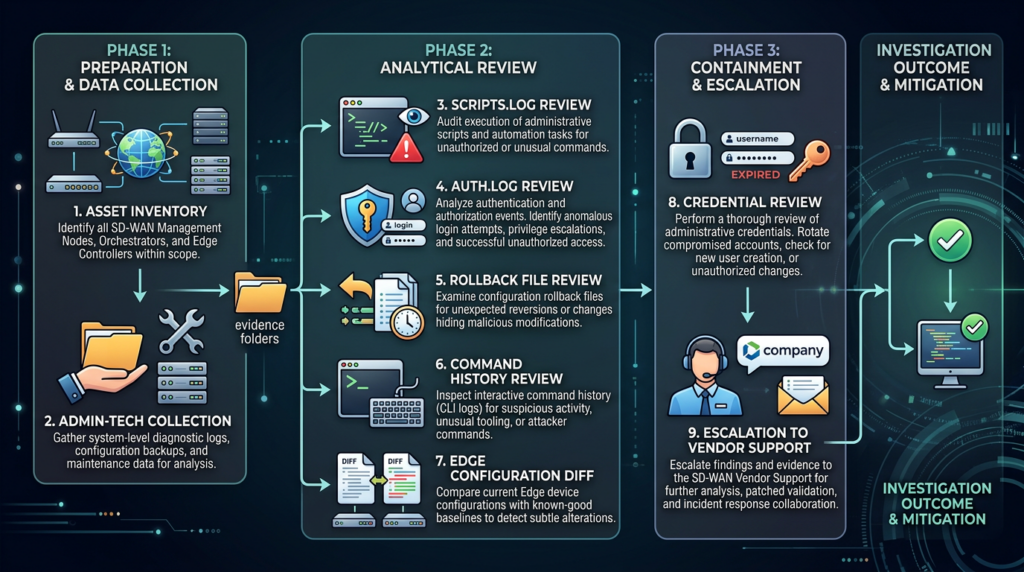
The following commands are defensive examples. They do not exploit the vulnerability. They help a responder search for log patterns described publicly by Mandiant and Cisco-linked reporting. Run them only on systems you are authorized to administer, and preserve original evidence before filtering or copying logs.
Start with script log evidence. Mandiant tells defenders to monitor /var/log/scripts.log for unauthorized execution of vconfd_script_upload_tenant_list.sh, and its example includes a tenant upload using a file path under /home/admin. (Google Cloud)
# Search for tenant-list upload activity associated with the vulnerable workflow.
# Run on authorized Cisco Catalyst SD-WAN systems or preserved log copies.

grep -nEi \
  'tenant.*upload|vconfd_script_upload_tenant_list|tenant-list|evil_tenant|/home/admin/.*\.csv' \
  /var/log/scripts.log* 2>/dev/null
Then inspect authentication logs for unexpected administrative access. Mandiant specifically calls out monitoring /var/log/auth.log for logins from unexpected external IP addresses using vmanage-admin, and it also documents suspicious l'administration authentication and later su activity. (Google Cloud)
# Look for unexpected administrative SSH access.
grep -nEi \
  'Accepted .* for (vmanage-admin|admin)|Failed .* for (vmanage-admin|admin)' \
  /var/log/auth.log* 2>/dev/null

# Look for root-account switching behavior from admin sessions.
grep -nEi \
  'su\[[0-9]+\]:.*(Successful|session opened).*|Successful su for' \
  /var/log/auth.log* 2>/dev/null
Password changes deserve separate attention. Mandiant observed password manipulation involving the default l'administration account, including changes that were later reverted. A defender should not only search for a current unauthorized password state. The interesting evidence may be two password events close together, followed by a normal-looking final state. (Google Cloud)
# Look for admin password changes and account modification events.
grep -nEi \
  'usermod.*admin|passwd.*admin|change user.*admin|password.*admin' \
  /var/log/auth.log* 2>/dev/null
Rollback files can reveal configuration changes that no longer appear obvious in the current running configuration. Mandiant points defenders to /var/confd/rollback/ for configuration delta commits targeting user passwords. (Google Cloud)
# Review rollback files for user/password-related changes.
# Copy evidence first; avoid destructive operations.

grep -RniE \
  'Created by: vmanage-admin|user admin|password|aaa' \
  /var/confd/rollback/ 2>/dev/null
Command history can help connect a suspicious login to the tenant upload action. Mandiant notes that defenders can query active command execution history using show history inside the Viptela CLI for the upload command. (Google Cloud)
show history
A suspicious line might resemble the administrative upload pattern Mandiant described:
request tenant-upload tenant-list /home/admin/<unexpected_file>.csv vpn 0
Do not assume every tenant upload is malicious. Some administrative operations may be legitimate. The suspicious pattern is a tenant upload from an unexpected account, unusual source IP, unusual time window, unexpected file path, unapproved change ticket, or connection to later root-account or password-change evidence.
A simple parser for timeline reconstruction
For larger environments, manual grep output becomes difficult to compare. The following Python script reads copied log files and extracts lines matching patterns relevant to the public Mandiant detections. It does not connect to devices. It does not exploit anything. It is intended for offline triage of preserved logs.
#!/usr/bin/env python3
"""
Defensive log triage helper for Cisco SD-WAN CVE-2026-20245 investigations.

Usage:
  python3 sdwan_cve_2026_20245_timeline.py /path/to/copied/logs/*.log

The script prints matching lines with a basic category label.
Run only on logs you are authorized to analyze.
"""

from __future__ import annotations

import re
import sys
from pathlib import Path

PATTERNS = {
    "tenant_upload": re.compile(
        r"(tenant.*upload|vconfd_script_upload_tenant_list|tenant-list|/home/admin/.*\.csv)",
        re.IGNORECASE,
    ),
    "admin_ssh": re.compile(
        r"(Accepted .* for (vmanage-admin|admin)|Failed .* for (vmanage-admin|admin))",
        re.IGNORECASE,
    ),
    "password_change": re.compile(
        r"(usermod.*admin|passwd.*admin|change user.*admin|password.*admin)",
        re.IGNORECASE,
    ),
    "su_activity": re.compile(
        r"(Successful su for|su\[[0-9]+\].*(session opened|Successful))",
        re.IGNORECASE,
    ),
    "suspicious_root_user": re.compile(
        r"(\btroot\b|uid=0|root:/root:/bin/bash)",
        re.IGNORECASE,
    ),
    "hidden_sensitive_backup": re.compile(
        r"(\.orig_passwd|\.orig_shadow|\.orig_vbond_vsmart_tenant_list)",
        re.IGNORECASE,
    ),
}

def scan_file(path: Path) -> None:
    try:
        with path.open("r", encoding="utf-8", errors="replace") as handle:
            for line_no, line in enumerate(handle, start=1):
                for label, pattern in PATTERNS.items():
                    if pattern.search(line):
                        print(f"{path}:{line_no}:{label}: {line.rstrip()}")
    except OSError as exc:
        print(f"error: cannot read {path}: {exc}", file=sys.stderr)

def main(argv: list[str]) -> int:
    if len(argv) < 2:
        print("usage: python3 sdwan_cve_2026_20245_timeline.py <logfile> [<logfile> ...]", file=sys.stderr)
        return 2

    for item in argv[1:]:
        for path in sorted(Path().glob(item)):
            if path.is_file():
                scan_file(path)

    return 0

if __name__ == "__main__":
    raise SystemExit(main(sys.argv))
The script deliberately errs on the side of broad matching. A match is not proof of exploitation. It is a reason to preserve the surrounding time window, correlate source IPs, compare change tickets, and check whether the same session later touched credentials, uploaded files, or switched users.
Detection signals and how to interpret them
| Signal | Source | Pourquoi c'est important | False-positive risk | Next action |
|---|---|---|---|---|
vmanage-admin SSH login from an unusual IP | /var/log/auth.log | Mandiant observed unauthorized SSH access using vmanage-admin | Medium, if admins use jump hosts or rotating VPN egress | Compare against approved admin source ranges, jump logs, and maintenance tickets |
l'administration password change followed by another change soon after | /var/log/auth.log, rollback files | Mandiant observed password modification and later restoration | Moyen | Review exact actor, source, transaction ID, and configuration delta |
| Tenant upload using unexpected CSV path | /var/log/scripts.log, CLI history | Mandiant observed exploitation through a malicious CSV upload | Moyen | Correlate with admin session, file name, timestamp, and change request |
vconfd_script_upload_tenant_list.sh execution anomaly | /var/log/scripts.log | Public detection point for the vulnerable upload workflow | Moyen | Review surrounding logs and file paths |
su de l'administration to unknown privileged account | /var/log/auth.log | Mandiant observed su access to troot | Low to medium | Vérifier /etc/passwd, /etc/shadow, account creation history, and shell access |
| Hidden backups of password or tenant files | Filesystem, admin-tech | Mandiant observed backups such as .orig_passwd et .orig_shadow | Faible | Preserve files, hash them, and engage incident response |
| Known malicious CSV hash | File remnant, malware repository, EDR | Mandiant published a SHA256 for recovered evil_tenant.csv remnant | Low if exact match | Treat as confirmed compromise and contact Cisco TAC |
| Edge-device configuration change without approved change | SD-WAN Manager logs, edge config state | Cisco observed configuration changes pushed to edge devices in limited cases | Moyen | Compare intended config, check commit history, validate tunnels and policy |
| Rogue peering IP or unknown control-plane connection | Control connection history, network logs | Mandiant observed unauthorized peering connections | Moyen | Review certificate trust, peers, control connections, and historical exposure |
Mandiant published network indicators for the activity it observed, including IP addresses used as rogue devices and one IP associated with exploitation of CVE-2026-20245. It also published the SHA256 hash b82936f37648518425c7d3cf9e09eaffa41d7cdb3840f6a40287e3a108880f7b for a remnant of evil_tenant.csv. These indicators are valuable, but they are not sufficient alone. The actor used cleanup techniques, and infrastructure can change. (Google Cloud)
Indicator-based hunting should be paired with behavior-based hunting. Search for administrative patterns that should be rare: unexpected vmanage-admin logins, password changes outside maintenance windows, tenant upload commands from odd paths, hidden backup files, root-equivalent users, and rollback entries created by accounts that do not match the change record.
Why the Mandiant report changes the response priority
Before Mandiant’s public write-up, many defenders had to work from concise advisory language: command injection, crafted file, root, netadmin prerequisite, fixed releases, and limited exploitation. That was enough to patch. It was not enough to understand the intrusion chain.
Mandiant’s report adds three crucial realities.
First, the vulnerability was used after earlier control-plane compromise activity. The actor did not begin with CVE-2026-20245 in isolation. It appeared inside a larger pattern involving rogue peering connections, SSH access, credential manipulation, and configuration exfiltration. (Google Cloud)
Second, the actor’s goal was not just to run a command once. The observed payload created root-level access by modifying sensitive account files, and the actor then used su to reach the new privileged account. That behavior moves the incident into full host compromise territory. (Google Cloud)
Third, the actor cleaned up. Mandiant observed deletion of files, restoration of configuration, and validation checks to confirm that indicators were gone. A clean current state is therefore not proof of a clean historical state. (Google Cloud)
For defenders, that means CVE-2026-20245 should be triaged as a possible incident, not only as a patch. If the device was vulnerable, reachable by privileged administrators, or previously exposed to SD-WAN authentication bypass risks, the response should include historical review.
Prioritization, why CVSS is not enough
The CVSS 3.1 score is 7.8 High. That is useful metadata, but it is not the whole risk story. The attack vector is local and privileges are required, which pulls the score below the maximum. The affected role pulls operational urgency back up. (NVD)
| Priority driver | Why it raises urgency |
|---|---|
| Confirmed exploitation | Public sources state the vulnerability was exploited in real environments |
| SD-WAN management role | The component can influence routing, policy, onboarding, and edge configuration |
| Root-level impact | Successful exploitation allows commands as root |
| Related credential paths | CVE-2026-20182 and CVE-2026-20127 can change the meaning of the privilege requirement |
| Anti-forensic cleanup | Absence of files is not enough to rule out compromise |
| Edge configuration impact | Cisco observed limited cases of configuration changes pushed to edge devices |
| No user interaction | Once the attacker has the required position, no victim click is needed |
| Cluster and DR complexity | Partial upgrades or partial hunts can leave gaps |
| Credential and certificate risk | SD-WAN control-plane compromise can affect trust material and administrative access |
| KEV inclusion | CISA KEV status confirms known exploitation and drives remediation urgency |
A mature risk decision should ask a more useful question than “Is this critical or high?” It should ask, “What would an attacker control if this appliance became root-compromised, and how much of the network fabric could they influence before we noticed?”
Patch, but do not patch blindly
Mandiant recommends prioritizing immediate patching and upgrades to the fixed releases. That is not optional. Leaving a known exploited SD-WAN management-plane vulnerability open is hard to justify when fixed versions are available. (Google Cloud)
The order of operations matters. If compromise is plausible, collect evidence before upgrading. If active compromise is suspected, isolate access paths and coordinate with Cisco TAC and incident response. If the device is internet exposed or broadly reachable from internal networks, treat the situation as higher urgency. If the appliance is managed by Cisco or a service provider, clarify who collects evidence, who upgrades, who validates configuration, and who confirms whether the customer has access to relevant logs.
A practical patch workflow should look like this:
CVE-2026-20245 response workflow

1. Scope
   - Identify every Cisco Catalyst SD-WAN Controller, Manager, and Validator.
   - Include old vSmart, vManage, and vBond names in CMDB and search queries.
   - Include clusters, DR systems, lab systems, and managed deployments.

2. Preserve
   - Collect admin-tech from each control-plane component.
   - Copy relevant logs before upgrade or cleanup.
   - Record current version, uptime, admin users, and known peers.

3. Reduce exposure
   - Restrict management access to approved admin networks.
   - Confirm jump-host controls and MFA where applicable.
   - Review internet exposure and broad internal reachability.

4. Upgrade
   - Move each affected release train to the Cisco fixed release.
   - Validate all nodes, not only the primary manager.
   - Record upgrade evidence and post-upgrade version output.

5. Hunt
   - Search for Mandiant indicators.
   - Review authentication, tenant upload, password, rollback, and su evidence.
   - Compare edge-device configurations with approved baselines.

6. Recover trust
   - Rotate relevant administrative credentials.
   - Review certificate material and peering state.
   - Validate SD-WAN policy, templates, and device onboarding state.
   - Escalate confirmed or suspicious activity to Cisco TAC.

7. Report
   - Preserve the evidence chain.
   - Document affected assets, fixes, findings, false positives, and residual risk.
The response should not end with the version number. It should end with confidence that the SD-WAN control plane is trustworthy again.
Credential and certificate review
Mandiant’s report makes credential review unavoidable. The actor authenticated with vmanage-admin, changed the default l'administration password, authenticated to the web application, exfiltrated configurations, restored the password, and later used su after root account creation. (Google Cloud)
That sequence creates several cleanup questions.
Were any administrative passwords changed outside approved windows? Were they later reverted? Did any unknown SSH keys appear? Were default accounts used in ways that differ from normal operations? Did any service account or jump-host credential appear in logs near suspicious upload or password-change activity? Were configuration exports downloaded? Were certificates or key material accessible to the actor? Did any unexpected peering relationship appear before or after patching?
Credential rotation should be risk-based, but it should not be cosmetic. Rotating one GUI password while leaving SSH keys, API tokens, service accounts, certificates, or jump-host credentials untouched can leave the attacker’s path intact. The right scope depends on evidence, architecture, and Cisco TAC guidance.
Edge-device configuration validation
Cisco’s observation that some exploitation led to configuration changes pushed to edge devices is one of the most operationally important facts in the record. It means defenders should not stop at the compromised Manager or Controller. They need to verify what was sent downstream. (NVD)
A configuration review should answer:
| Question | Pourquoi c'est important |
|---|---|
| Were templates changed during suspicious windows? | Template changes can affect many devices at once |
| Were policies changed and pushed to branch edges? | Routing or segmentation policies may shift traffic paths |
| Were tunnel, VPN, or control settings modified? | Attackers may create covert access or weaken trust boundaries |
| Were device onboarding or certificate settings touched? | Peering trust may be abused beyond a single host |
| Were changes reverted after being pushed? | Reverted management state may hide temporary attacker actions |
| Do edge devices match approved baselines now? | Current state must be validated, not assumed |
| Do logs show failed or partial pushes? | Failed operations can still reveal attacker intent |
| Did the suspicious account perform configuration exports? | Exfiltrated configs can support later attacks |
Treat configuration validation as a separate workstream from patching. A patched Manager can still manage devices that hold unauthorized configuration. A clean current template does not necessarily prove there was no temporary change. If logs show a suspicious window, compare before, during, and after.
The related Cisco SD-WAN CVEs that change the risk picture
CVE-2026-20245 sits inside a larger Cisco SD-WAN exploitation context. This does not mean every SD-WAN CVE is part of the same exploit chain. It means defenders should avoid single-ticket thinking when the same management and control-plane infrastructure has seen multiple exploited vulnerabilities.
| CVE | Why it is relevant | Attack conditions | Risque pratique | Remediation focus |
|---|---|---|---|---|
| CVE-2026-20182 | Cisco names it as a known way an unauthenticated attacker could obtain the privileged position needed for later SD-WAN issues | Unauthenticated remote exposure of affected SD-WAN Controller or Manager | Access as an internal high-privileged non-root account and possible NETCONF-driven fabric manipulation | Upgrade fixed releases, preserve admin-tech, hunt peering and NETCONF evidence |
| CVE-2026-20127 | Earlier critical peering authentication bypass tied to SD-WAN control-plane trust | Unauthenticated remote exposure of affected components | Rogue peer behavior, administrative access, and broader control-plane compromise risk | Patch, restrict exposure, review rogue peering and historical compromise |
| CVE-2026-20245 | The root escalation issue discussed here | Authenticated local netadmin position, possibly obtained through credentials or earlier SD-WAN compromise | Root commands on SD-WAN control components and possible edge configuration impact | Upgrade fixed release, inspect logs, validate configuration, rotate credentials |
| CVE-2026-20262 | Arbitrary file write in Cisco Catalyst SD-WAN Manager, disclosed shortly after CVE-2026-20245 | Authenticated remote attacker with sufficient access | File creation or overwrite on Manager filesystem, potential later root escalation | Upgrade, review web UI upload evidence and Manager logs |
| CVE-2026-20133 | SD-WAN Manager information disclosure issue in the broader 2026 exploitation timeline | Product-specific conditions described by Cisco and public reporting | Sensitive information may support credential or configuration abuse | Patch and review exposed data paths |
| CVE-2026-20128 | Credential-related SD-WAN Manager issue discussed in the same broader activity | Product-specific conditions described by Cisco and security reporting | Recoverable or exposed credentials can support later stages | Patch, rotate credentials, review account usage |
| CVE-2026-20122 | Arbitrary file overwrite issue in SD-WAN Manager reporting | Authenticated conditions according to public summaries | File overwrite can support persistence, disruption, or escalation chains | Patch and review file-write artifacts |
| CVE-2022-20775 | Older Cisco SD-WAN privilege escalation issue referenced in broader SD-WAN post-compromise discussion | Existing access to affected SD-WAN software | Post-compromise escalation in older attack paths | Confirm old exposure was patched and investigated |
Cisco’s June remediation context and public summaries connect CVE-2026-20245 and CVE-2026-20262 to the earlier authentication bypasses CVE-2026-20182 and CVE-2026-20127. The relationship matters because the later bugs require credentials, while the earlier bugs may have helped attackers obtain the required administrative position. (Penligent)
Triage should therefore include a historical question: “Could this environment have been exposed to the earlier SD-WAN control-plane issues before it was patched?” If the answer is yes or unknown, the CVE-2026-20245 response should include review of earlier peering, authentication, and NETCONF activity.
The difference between vulnerability validation and exploit reproduction
Many security teams blur two activities that should be separate: validating exposure and reproducing exploitation. For a known exploited infrastructure bug, defenders rarely need to reproduce the exploit to make a decision. They need to prove whether they are affected, whether the fixed release is installed, whether the vulnerable workflow was used, and whether compromise evidence exists.
A responsible validation path for this issue includes:
Exposure validation
- Identify affected Cisco Catalyst SD-WAN components.
- Confirm product names, including vManage, vSmart, and vBond aliases.
- Confirm software versions and fixed release targets.
- Confirm management and control-plane reachability.

Evidence validation
- Preserve admin-tech bundles.
- Search scripts, auth, rollback, and command history logs.
- Review configuration export, template, and edge-device changes.
- Search for known IOCs and behavior patterns.

Remediation validation
- Confirm fixed release installation on every relevant node.
- Confirm management access restrictions.
- Confirm credential and key review.
- Confirm Cisco TAC escalation where evidence is suspicious.

Trust validation
- Compare edge configurations against baselines.
- Review certificate and peering state.
- Confirm no unauthorized root-equivalent accounts remain.
- Document residual risk and monitoring.
Exploit reproduction is not necessary and may be harmful on production SD-WAN control components. A crafted file exploit that touches account files, configuration files, or tenant upload logic can create outage risk or damage forensic evidence. Authorized lab testing should use isolated systems, vendor guidance, and non-production data. Production response should use version checks, logs, configuration review, and vendor-supported remediation.
Common mistakes during response
The first mistake is treating the vulnerability as a scanner-only finding. CVE-2026-20245 has confirmed exploitation and public intrusion details. A scanner can tell you a version is affected. It cannot prove that the device was not used to push a malicious configuration last month.
The second mistake is patching before preserving evidence. Sometimes emergency patching must happen fast, but if the device might already be compromised, collect admin-tech and relevant logs first when feasible. Mandiant and Cisco-linked guidance both emphasize evidence and TAC escalation for suspicious activity. (Google Cloud)
The third mistake is checking only one component. NVD names Controller, Manager, and Validator. The intrusion involved peering, SSH, web application access, CLI upload, account modification, and configuration behavior. Review the fabric, not only the UI. (NVD)
The fourth mistake is relying only on indicators. Mandiant published IP addresses and a hash, but it also described anti-forensic cleanup. Absence of those exact indicators is not a clean bill of health. (Google Cloud)
The fifth mistake is ignoring edge devices. Cisco observed limited cases where exploitation resulted in configuration changes pushed to edge devices. If your response never asks what changed downstream, it may miss the business impact. (NVD)
The sixth mistake is treating cloud-managed deployments as someone else’s problem. Managed deployment changes responsibility boundaries, not technical risk. The customer still needs clarity on patch status, evidence availability, log access, configuration validation, and incident escalation.
Hardening after the emergency
After fixed releases are installed and evidence review is complete, the long-term work is mostly about reducing the attacker’s chance of reaching the prerequisite position again.
Restrict SD-WAN management and control-plane access to explicitly approved networks. Administrative interfaces should not be reachable from the internet, and broad internal reachability should be challenged. Use jump hosts, strong identity controls, and logging that preserves source attribution.
Review default accounts and administrative roles. Mandiant’s observed chain involved vmanage-admin et l'administration. Default accounts need clear ownership, strong credential controls, rotation expectations, and alerting around use outside maintenance windows. (Google Cloud)
Treat peering trust as a monitored asset. Unauthorized peering is not just a networking anomaly. In the Mandiant case, rogue peering connections were part of the path to access and later privilege escalation. Control connection history, certificate state, peer identity, and unexpected public IPs should be part of routine monitoring. (Google Cloud)
Improve log retention for appliances. Mandiant notes that edge and network appliances can be black-box environments with limited telemetry, making them attractive for stealthy access. If logs rotate quickly or are not centralized, the attacker’s cleanup job becomes easier. (Google Cloud)
Create a repeatable SD-WAN CVE runbook. The runbook should not be a list of CVE numbers. It should map each component, release train, log source, credential store, peering trust artifact, edge-device configuration path, and escalation owner. For each future SD-WAN advisory, the team should know which evidence to collect before the maintenance window.
FAQ
What is CVE-2026-20245?
- CVE-2026-20245 is a Cisco Catalyst SD-WAN vulnerability in the CLI file upload workflow.
- Cisco and NVD describe it as insufficient validation of user-supplied input that allows an authenticated local attacker to upload a crafted file.
- Successful exploitation can execute arbitrary commands as root.
- The affected Cisco Catalyst SD-WAN components include Controller, Manager, and Validator, using the older vSmart, vManage, and vBond names in many environments. (NVD)
Is CVE-2026-20245 actively exploited?
- Yes. Cisco reported limited exploitation, and CISA added the vulnerability to the Known Exploited Vulnerabilities catalog.
- Mandiant later described real-world zero-day exploitation against SD-WAN infrastructure at a service provider.
- The observed actor used the vulnerability after gaining administrative access and escalated to root.
- Active exploitation means teams should treat affected systems as possible incident-response subjects, not just patch targets. (Google Cloud)
Does the attacker need credentials?
- Yes, the vulnerability is not described as unauthenticated by itself.
- Cisco says the attacker must have netadmin privileges on the affected system.
- The practical risk is that those privileges may be obtained through valid stolen credentials, previous compromise, rogue peering, or related SD-WAN vulnerabilities.
- CVE-2026-20182 and CVE-2026-20127 are especially important because public Cisco-linked records identify them as known paths that can change the prerequisite story for later SD-WAN compromise. (NVD)
What versions fix CVE-2026-20245?
- Public reporting and Mandiant’s remediation section list fixed releases including 20.9.9.2, 20.12.7.2, 20.15.4.5, 20.15.5.3, 20.18.3.1, and 26.1.1.2 or later.
- Cisco’s advisory should remain the final source for production upgrade decisions.
- Teams should verify every relevant node, including clusters, standby systems, disaster recovery systems, and managed deployments.
- Patch status should be recorded with command output or other evidence that another engineer can validate. (Google Cloud)
Should we patch first or collect evidence first?
- If compromise is plausible and time allows, collect admin-tech and relevant logs before upgrading.
- Mandiant recommends collecting logs and diagnostic data from SD-WAN devices using
request admin-techon all control-plane components. - If active exploitation is suspected, coordinate evidence preservation, containment, upgrade, and Cisco TAC escalation.
- Do not delay urgent patching indefinitely, but do not destroy the only evidence that could show whether the device was already used. (Google Cloud)
What logs should defenders check?
- Vérifier
/var/log/scripts.logfor tenant upload andvconfd_script_upload_tenant_list.shanomalies. - Vérifier
/var/log/auth.logfor unexpectedvmanage-adminoul'administrationSSH logins, password changes, andsuactivity. - Check Viptela CLI command history for tenant upload commands.
- Vérifier
/var/confd/rollback/for configuration deltas involving administrative passwords. - Check edge-device configuration changes because Cisco observed limited cases where exploitation pushed configuration changes to edge devices. (Google Cloud)
If the malicious CSV file is gone, are we safe?
- No. Mandiant observed anti-forensic cleanup, including deletion of actor-created files and restoration of modified configuration.
- A missing file may mean no compromise, or it may mean the attacker cleaned up.
- Correlate file evidence with authentication logs, script logs, rollback files, command history, root-account traces, and edge configuration changes.
- Exact IOC matches are useful, but behavior-based hunting is necessary because attacker infrastructure and filenames can change. (Google Cloud)
How does CVE-2026-20245 relate to CVE-2026-20262?
- Both affect Cisco Catalyst SD-WAN management infrastructure and were part of the June 2026 SD-WAN risk conversation.
- CVE-2026-20245 is a post-auth CLI command-injection and privilege-escalation issue that can execute commands as root.
- CVE-2026-20262 is an arbitrary file write issue in Cisco Catalyst SD-WAN Manager’s web UI file upload process.
- The detection paths differ: CVE-2026-20245 hunting emphasizes script logs and tenant upload behavior, while CVE-2026-20262 hunting emphasizes Manager web and service logs.
- Both should prompt defenders to review related authentication bypass issues, credentials, file manipulation, and management-plane trust. (Penligent)
Arrêt de clôture
CVE-2026-20245 is dangerous because it sits at the point where privileged SD-WAN administration can become root-level control of the management plane. The vulnerability is not the easiest possible initial-access bug, but real attackers do not need every vulnerability to be unauthenticated. They need one path into trust, one path to privilege, one path to persistence, and one way to hide.
The correct response is not panic, and it is not routine patching. It is a controlled sequence: identify every affected SD-WAN component, preserve evidence, upgrade to Cisco’s fixed release, hunt for the observed behaviors, review related SD-WAN CVEs, validate edge-device configuration, rotate credentials where risk justifies it, and document the evidence chain. If any indicator is confirmed or the evidence is ambiguous in a high-value environment, involve Cisco TAC and the incident response team before declaring the fabric trusted again.
 French
  English
  German
  Spanish
  Portuguese
  Japanese
  Korean
  Hindi
Hindi  Arabic
  Turkish
  Hebrew