
NFS2ROOT is the research name for CVE-2026-99362, a critical memory-corruption flaw in Linux’s in-kernel NFS server. The immediate task is to identify servers that expose NFSv4.1 or NFSv4.2, match their kernel packages to the correct vendor advisory, and verify that the fix is active in the running kernel. A package installed on disk, an NFS error reply, or a quiet network sensor cannot close that investigation by itself.
The Linux CNA assigns CVSS 3.1 9.8 and describes a SEQUENCE reply-cache heap overflow. Its record was published on November 19, 2026, and updated on November 23. OpenSec Intelligence published its NFS2ROOT research on November 25, 2026. These are different events: the CVE record’s publication date should not be replaced with the research post’s date. Sources: Linux CNA record et original OpenSec research.
Which NFS servers need immediate attention?
Start with the intersection of implementation, protocol, reachability, and patch state. The affected component is Linux nfsd, not every product that speaks NFS. The research and Red Hat’s assessment identify the relevant service configuration as NFSv4.1 or NFSv4.2, normally reached over TCP 2049. A Linux machine operating only as an NFS client does not present that server attack surface. Red Hat also states that its default configurations do not enable the in-kernel NFS server. Source: Red Hat’s CVE assessment.
| Evidence on the host or network | Decision it supports | What it does not establish |
|---|---|---|
Linux in-kernel nfsd is serving NFSv4.1 or NFSv4.2 | The relevant service path is enabled. | Whether its running kernel has the fix. |
| TCP 2049 is reachable from a client network | Include that network in the exposure review, even if it is internal. | That the listener is Linux nfsd, or that a vulnerability was exploited. |
| The vendor marks the exact installed kernel track fixed | A suitable package may be available or installed. | That the host has booted or otherwise activated it. |
| The host is a client only, or the server does not enable v4.1/v4.2 | The reviewed configuration does not expose this specific session path. | That its kernel is patched, or that future configuration changes are safe. |
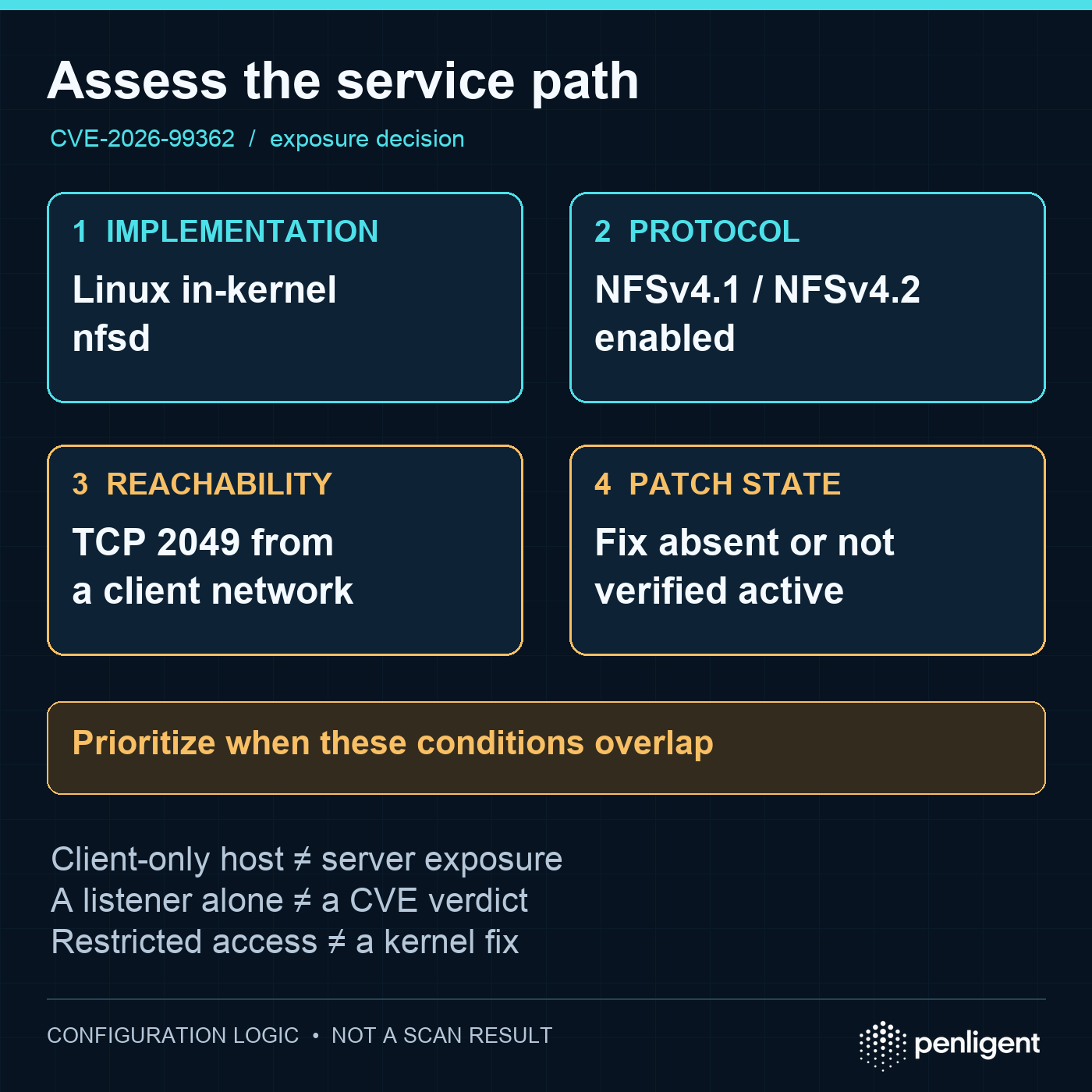
Export permissions and a rule that allows only internal storage clients are not substitutes for a kernel fix. The CNA’s network and no-privileges assessment concerns a session-processing path before ordinary file access. Review reachability from storage VLANs, compute nodes, container hosts, and other systems that are permitted to connect. Restricting that reachability reduces exposure while maintenance is arranged; it does not repair memory corruption. Any service or firewall change needs the normal storage availability plan.
What the upstream fix changes
The upstream change 35ff1a7a7e38 adds a size preflight before nfsd4_sequence() narrows the reply buffer and accepts the session slot. It checks that the reply, including space needed to report a later operation’s error when applicable, fits the negotiated limit. Failure returns through the error path without advancing the slot state. This ordering matters: rejecting an oversized reply after the unsafe state change would miss the boundary the fix protects.
The CNA lists the following upstream branch fix points. Read each row within its own branch. This is pas a universal numerical threshold for distribution kernels, appliances, cloud images, or custom backports.
| Upstream branch | Fix point recorded by the Linux CNA |
|---|---|
| 5.10 | 5.10.275 |
| 5.15 | 5.15.226 |
| 6.1 | 6.1.193 |
| 6.6 | 6.6.163 |
| 6.12 | 6.12.117 |
| 6.18 | 6.18.61 |
| 7.3 | 7.3.2 |
| Mainline development | 7.4-rc1 |
For vendor-supported systems, use the vendor’s exact CVE and package status rather than replacing its kernel with an arbitrary upstream release. Backports can change security status without changing the familiar upstream version prefix. Conversely, a newer-looking package name is insufficient evidence unless it belongs to the supported track and includes the relevant fix.
Debian and Red Hat show why package tracks matter
The following is a November 26, 2026 snapshot of two official distribution sources. Debian’s tracker reports source packages; those version strings should not be confused with every binary image name or with uname -r. The Red Hat rows record affected status, not a newly announced fixed build. Sources: Traqueur de sécurité Debian et Red Hat’s machine-readable CVE record.
| Distribution and source-package track | Version or state observed | Operational reading |
|---|---|---|
Debian bookworm, linux | 6.1.176-1: vulnerable; security track 6.1.192-2: vulnerable | These listed versions do not close this CVE. |
Debian bookworm security, linux-6.12 | 6.12.117-1~deb12u1: fixed | A different source-package track has a recorded fix. Follow Debian’s support and upgrade guidance for the deployed host. |
Debian trixie, linux | 6.12.117-1: fixed; security track 6.12.118-1: fixed | Verify the installed binary package’s mapping to the fixed source and the running kernel. |
RHEL 6, 7, 8, 9 and 10, kernel | Affected in the retrieved Red Hat record | No fixed package build is supplied by these rows. Check the current product-specific advisory and entitlement stream. |
RHEL 7, 8 and 9, kernel-rt | Affected in the retrieved Red Hat record | Assess the real-time track separately; do not apply a standard-kernel package conclusion to it. |
The bookworm contrast is the useful case: “Debian has a fix” is too broad, while “every bookworm kernel is vulnerable” is also too broad. The tracker distinguishes linux de linux-6.12. Record the host’s actual package origin, release, architecture, and kernel track before choosing a remediation path. The Red Hat record also lists older products as affected, demonstrating why an upstream introduction version alone cannot classify a heavily backported vendor kernel.
Collect a local, read-only exposure record
Run these commands only on systems you administer. They read local state and do not send crafted NFS traffic. Keep the output with the remediation ticket. A permissions error, missing virtual file, or empty command result needs interpretation; it is not an automatic “not affected” result.
# Distribution identity and the kernel currently executing
cat /etc/os-release
uname -r

# Enabled kernel NFS server protocol versions, where nfsd is mounted
cat /proc/fs/nfsd/versions

# Local TCP listener only; this does not test remote reachability
ss -ltn '( sport = :2049 )'
En /proc/fs/nfsd/versions, an enabled v4.1 or v4.2 entry is relevant to this review. If the file is unavailable, verify the server implementation and service configuration through the distribution’s supported interfaces. The kernel documents this virtual filesystem in its nfsd administration interfaces. A local listener establishes neither internet exposure nor the contents of a firewall rule; corroborate those separately from the network configuration.
Use the package family that applies to the host. Package inventory can include kernels that are not running. In the Debian-family query, retain the status column and distinguish installed entries marked ii from other package states.
# Debian-family hosts: status, image package name and version
dpkg-query -W -f='${db:Status-Abbrev}\t${binary:Package}\t${Version}\n' 'linux-image*'

# RPM-family hosts: installed standard and real-time kernel packages
rpm -q kernel kernel-core kernel-rt

# Optional local crash/context review; access depends on host policy
journalctl -k --since '24 hours ago' --no-pager
Do not compare the entire distribution release string with the upstream table using a simple greater-than test. Use the vendor advisory’s binary-to-source mapping or approved package inventory to identify the build behind the running release. If the system uses live patching, require the vendor’s explicit coverage and activation evidence for this CVE; the existence of a live-patch service is not enough.
Close the patch ticket with an evidence chain
- Identify the supported fix. Record the exact vendor CVE page, product stream, source or binary package, and fixed status. Treat “affected” or “under investigation” as an open item.
- Verify installation. Confirm that the approved fixed package is installed on this host, rather than merely available in a repository.
- Verify activation. Match
uname -rto the intended fixed image after the planned reboot, or record explicit vendor-supported live-patch activation for this CVE. - Recheck the service boundary. Confirm the intended NFS versions and permitted client networks. Retain storage health checks separately from the security evidence.
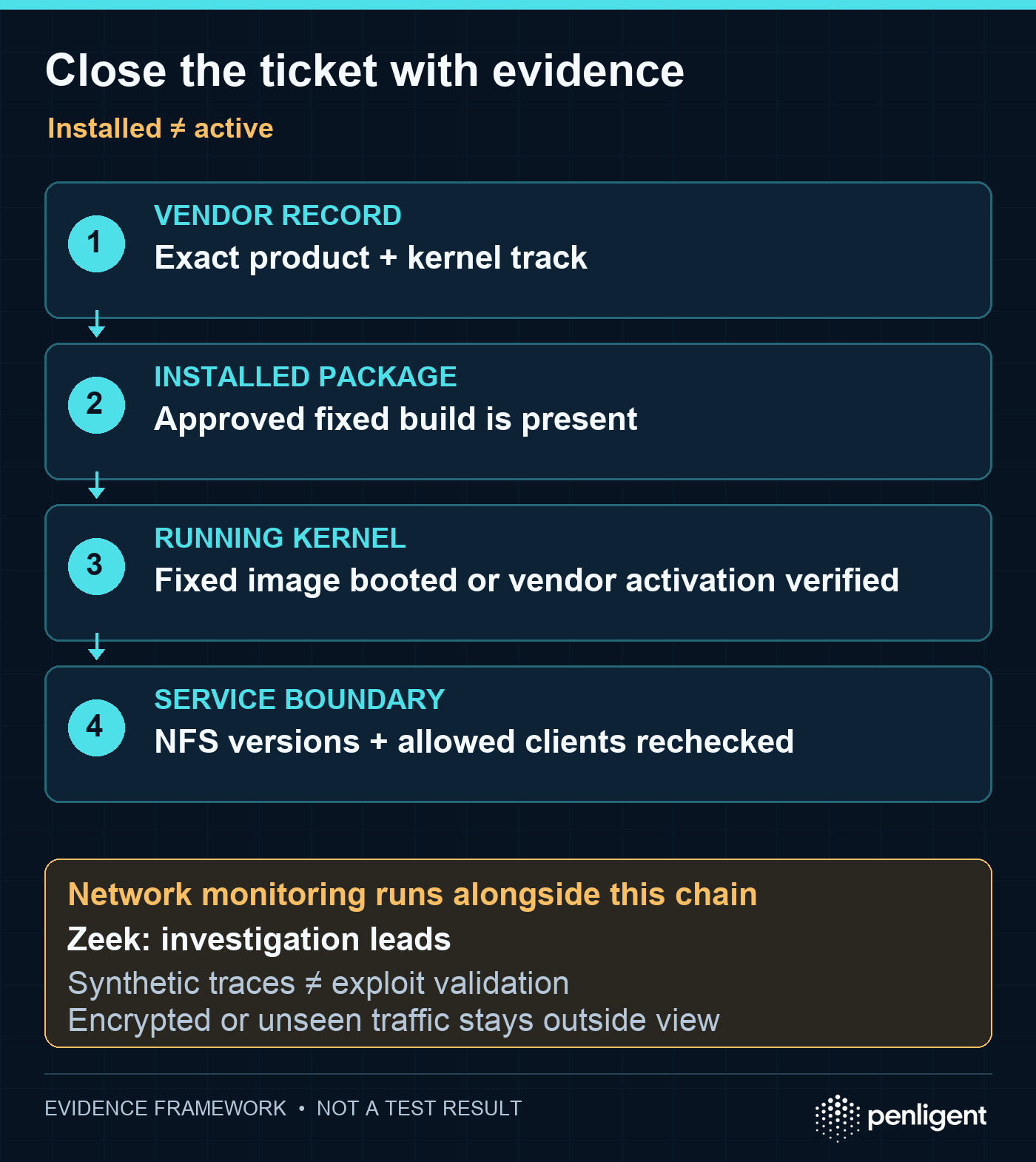
This workflow supports two separate conclusions: whether the reviewed server path is exposed, and whether a supported fix is active. Keeping both in the ticket prevents a temporary access restriction from being mistaken for patch completion and prevents a package deployment from being mistaken for a kernel activation.
The Zeek package provides leads, not a patch verdict
The third-party initconf/nfs2root Zeek package is log-only. It correlates unusual session/cache negotiation with subsequent request patterns and records the replies it can observe. That can help prioritize a client/server investigation. It does not block requests, demonstrate that a host was compromised, or reliably attest to its patch state.
Its README is explicit about the evidence limits: the source-level overflow analysis was not reproduced against a live server; the test traces are synthetic and deliberately remain below the overflow; and the default thresholds had not been checked against real NFSv4.1 client traffic. The project’s test claims belong to that project. Penligent has not executed or reproduced them.
| Visibility limit documented by the detector | Consequence for triage |
|---|---|
| Session creation and later use on different TCP connections | Per-connection correlation can miss the relationship. |
RPC-over-TLS or Kerberos privacy (krb5p) | The sensor cannot inspect the protected NFS content. |
| Multi-fragment RPC records | The documented parser limitation can leave relevant data unexamined. |
| Dropped packets or traffic outside the observation point | Absence of an alert is not evidence of absence. |
| Untuned thresholds and an unresolved cluster no-reply logging issue | Validate local baselines and deployment behavior before assigning strong meaning to a notice or its absence. |
An error reply can show that one observed request was rejected; it does not prove the exact fix is present. Silence can reflect packet loss, routing, a closed connection, service failure, or other causes. Correlate suspicious traffic with host kernel logs, service health, client ownership, and the package evidence chain. Preserve relevant evidence under the organization’s incident process without turning a sensor notice into a confirmed exploitation claim.
What the research demonstration establishes
OpenSec states that it demonstrated a pre-authentication remote-root chain and includes a recording in its November 25 post; it says the complete exploit remains private. Those are the researcher’s claims. Penligent has not independently reproduced the chain or verified the recording. A research demonstration, the CNA’s severity score, and a public network detector are separate kinds of evidence. None alone establishes exploitation in the wild.
For the operational decision, the confirmed memory-corruption flaw and the vendor’s affected status already justify prioritizing reachable, unpatched NFS servers. There is no need to run a malformed-request probe against production storage to decide whether to install and activate a supported fix.
For teams reviewing how to organize authorized security validation, Penligent provides the following general product workflow demonstration. It is not evidence of exploitation, detection coverage, or remediation for CVE-2026-99362.
Method and scope: Prepared with AI assistance from the Linux CNA, the upstream fix, official Debian and Red Hat records, and the original research and detector documentation, checked on November 26, 2026. The distribution rows are a dated snapshot. No exploit, malformed NFS request, or detector test was run for this article. The diagrams explain configuration and evidence relationships; they are not test results.
 French
 English
 German
 Spanish
 Portuguese
 Japanese
 Korean
 Hindi
 Arabic
 Turkish
 Hebrew