
PHP2Shell is the name used for two PHP remote code execution vulnerabilities: CVE-2026-109618, involving out-of-memory corruption, and CVE-2026-109619, involving stale worker-global state. Both require attention to the PHP interpreter that actually handles web requests, rather than only the application or a command-line binary.
Route PHP2Shell remediation to the component that actually serves requests
One machine can contain a command-line PHP binary, multiple FPM pools, control-panel handlers and packaged appliance components. A successful php -v check answers only for the executable invoked by that command. Build the remediation inventory around the request-serving component and its owner.
| Déploiement | Éléments à recueillir | Remediation route | Closure trap |
|---|---|---|---|
| Distribution PHP package | Full package release, vendor advisory, SAPI and active FPM/CGI or module path. | Use the distribution-supported security package; verify activation in the serving process. | CLI updated while another pool or module still serves traffic. |
| Plesk-managed PHP | Each enabled handler, assigned sites/pools, handler build and panel-managed components. | Apply the hosting vendor’s supported updates for each relevant component. | One handler repaired while another site’s handler remains unreviewed. |
| Container or immutable image | Runtime provenance, image digest, deployment revision and every active replica. | Rebuild with the corrected component, redeploy and verify replica identities. | A corrected image exists but old replicas or rollback artifacts remain active. |
| PAN-OS appliance | Exact PAN-OS build, vendor advisory status and management-interface reachability. | Apply the vendor-supported PAN-OS correction and its access restrictions. | Attempting to replace an appliance’s PHP package manually or treating web-app PHP instructions as an appliance fix. |
The PHP2Shell identifiers are CVE-2026-109618 and CVE-2026-109619. Unit 42’s research and October 29 update distinguish PHP runtime remediation from the PAN-OS management-interface incident. Use the linked vendor guidance for current affected and fixed appliance versions rather than transferring a PHP release number onto a PAN-OS build.
A compact evidence record for every serving instance
Record the hostname or workload ID, owner, request route, SAPI/handler, binary or image identity, selected advisory, installed correction, activation event and verification time. If you cannot map a domain to its actual handler, mark the result unresolved. Collect that mapping through trusted administrative configuration; do not leave a public phpinfo() page online to obtain it.
Review exploitation evidence separately. The Unit 42 hunting guidance warns that suspicious child processes under a PHP worker are not specific to these CVEs and may have legitimate explanations. Correlate process ancestry, request timing, account context and application behavior before assigning a cause. “Patched,” “no suspicious event found in retained logs,” and “no compromise occurred” are three different conclusions.
The fixed-release table below gives the upstream baseline for each supported branch. For a distribution or hosting-provider package, verify the full vendor revision, the active serving runtime, and whether the repaired process has been restarted or replaced. Treat earlier suspicious activity as a separate investigation; deploying a fix does not establish that a host was never compromised.
November 2026 verification update
PHP2Shell update: CVE-2026-109618 and CVE-2026-109619
PHP released 8.5.12, 8.4.27, 8.3.36 and 8.2.35 on October 21, 2026 to fix two Critical vulnerabilities that can allow unauthenticated remote code execution. Both identifiers appear in the Catalogue des vulnérabilités connues et exploitées de la CISA. Prioritize internet-exposed serving instances and retain forensic evidence separately from patch-completion evidence.
| CVE | Confirmed mechanism | Temporary risk reduction |
|---|---|---|
| CVE-2026-109618 | Out-of-memory handling can interrupt PHP while internal request data is only partially initialized; cleanup can then treat invalid state as valid. | Use an administrator-enforced unlimited PHP memory_limit, conservative request limits and worker-scoped container/cgroup memory boundaries. These controls are incomplete. |
| CVE-2026-109619 | Request-owned internal state can remain after its backing memory is freed. | Disable session.upload_progress.enabled, restart every worker, and on PHP 8.5 set fatal_error_backtraces=0. These block confirmed paths, not every possible variant. |
The fixed upstream versions are 8.5.12, 8.4.27, 8.3.36 et 8.2.35. Distribution and appliance packages can use different visible version strings when they backport fixes, so verify the vendor advisory and package build. Unsupported PHP branches need migration, not an assumption that a matching local patch exists.
Inventory the serving SAPI, not only the CLI. Check PHP-FPM pools, Apache mod_php, php-cgi, FrankenPHP, LiteSpeed, containers, serverless images and appliances. After updating, restart or replace every worker and verify the active process reports the corrected build. A new package on disk does not remediate workers that still hold the vulnerable interpreter in memory.
php -v
php --ini
php -i | grep -E 'Server API|memory_limit|post_max_size|upload_max_filesize|session.upload_progress.enabled|fatal_error_backtraces'

# FPM examples; adapt service names to the platform
systemctl status 'php*-fpm' --no-pager
ps -eo pid,lstart,cmd | grep '[p]hp-fpm'
If the pre-patch exposure included internet-facing web requests, collect web-server, proxy, WAF, PHP error, process, file-change and authentication telemetry according to the incident-response plan. Updating closes the vulnerable code path; it does not prove that the earlier exploitation window was clean.
Do not confuse CVE-2026-115560 with the two PHP2Shell CVEs
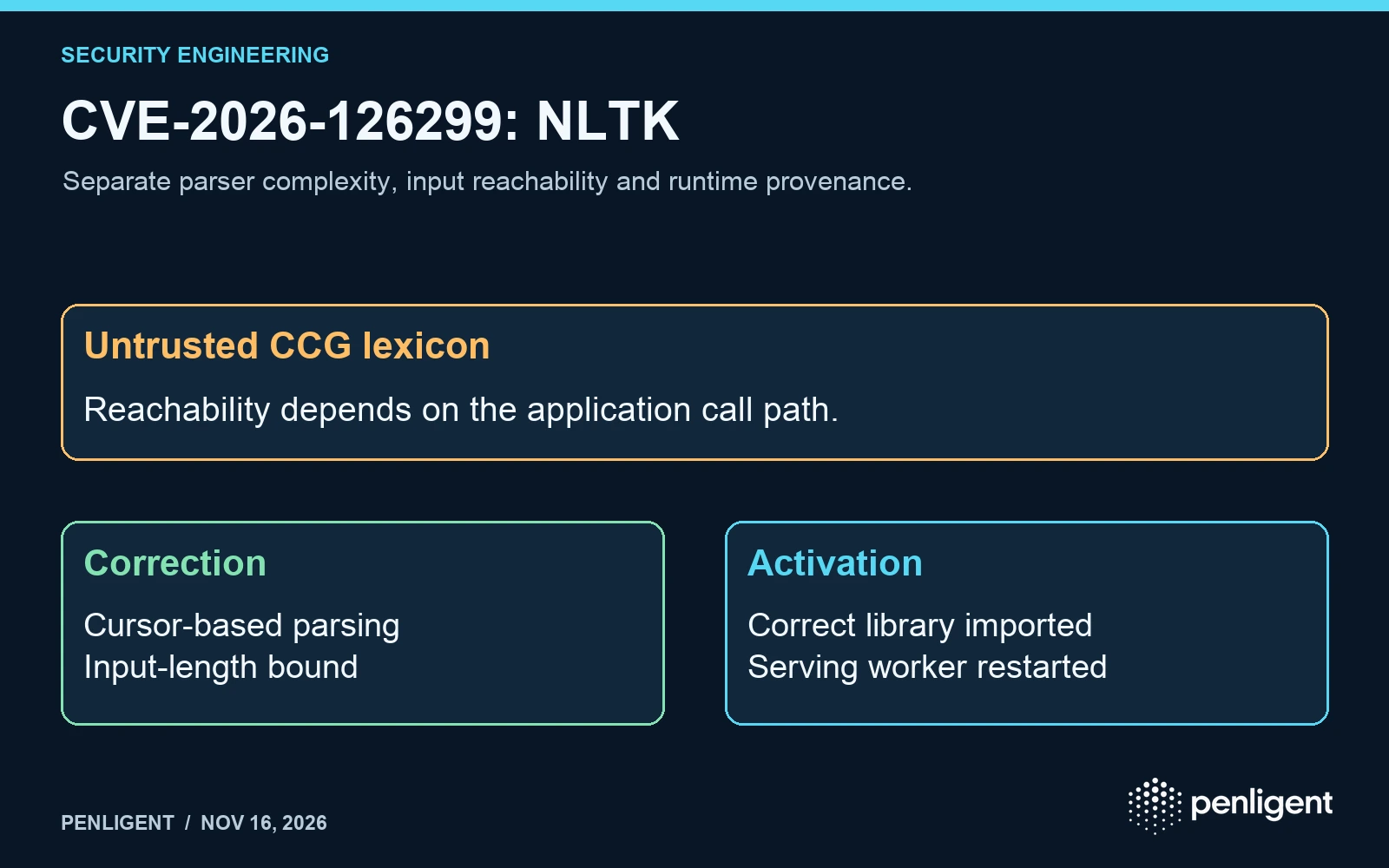
CVE-2026-115560 is a later, narrower session upload progress issue requiring an unusual serializer transition before session_start(). Keep session.upload_progress.enabled=0 where PHP recommends it until the corresponding regular bugfix advisory is complete, but track that finding separately from CVE-2026-109618 and CVE-2026-109619.
Which PHP versions fix PHP2Shell?
| PHP branch | First upstream security release for both CVEs | What to record |
|---|---|---|
| 8.5 | 8.5.12 | Serving instance and active runtime |
| 8.4 | 8.4.27 | Package provider and revision |
| 8.3 | 8.3.36 | Restart or replacement completed |
| 8.2 | 8.2.35 | Patch now; plan branch migration |
| 8.1 and older | Use a verified vendor backport or migrate | Provider advisory covering both CVEs |
Les PHP announcement also provides minimal source backports for 7.4, 8.0 and 8.1, while noting that these branches are no longer maintained by the PHP project. A backport is not an extension of upstream support. PHP 8.2 reaches end of life on December 31, 2026. For distribution packages, compare the complete vendor revision with that vendor’s advisory; an older base version alone cannot settle whether a patch was backported.
Treat the table as a release baseline, not a remote scanner. It does not identify the build running behind your hostname, and it cannot tell you whether an already-compromised host is trustworthy. If the installed revision is unclear, leave that instance open in the maintenance record rather than converting uncertainty into a green status.
October 28 update: CISA KEV and investigation
CISA’s official KEV data lists both PHP2Shell CVEs as added October 26, 2026, with a catalog due date of October 29 and forensic triage marked “Yes.” Follow the catalog’s applicable directive and triage instructions. Those fields do not establish that an individual server was compromised, and completing a package update does not resolve the separate investigation of earlier activity.
For a WordPress owner or a developer running a PHP application, the first question is who updates the interpreter that actually serves the website. Updating a plugin, rebuilding the frontend, or checking the PHP binary in your shell does not establish that the serving runtime received either fix. Ask for the package revision, the running service and the evidence connecting them.
Exploitation update, October 22, 2026: watchTowr reports observing exploitation through its Attacker Eye honeypot network as of October 21. This is the researcher’s observation; it does not establish whether a particular server was compromised. Preserve relevant logs and investigate suspicious history separately from patch deployment.
Exploitation reports move the investigation window before disclosure
October 22 update. Amazon Threat Intelligence reports a PHP2Shell exploitation attempt in MadPot telemetry on October 17, 2026, followed by additional attempts on October 21. AWS says it could not establish whether those attempts would have succeeded against real deployments; its later assessment describes broad exploitation in the wild. An observed attempt, successful code execution on a sensor and a confirmed intrusion into your server are separate findings. The report does not establish how the earlier actor obtained exploit information.
For an exposed deployment, preserve evidence from at least October 17 where retention permits, extending further when the actual exposure history warrants it. Correlate suspicious requests with PHP process activity, unexpected file changes and outbound connections. Record missing retention rather than treating the first available log entry as the start of risk. AWS cautions that its listed addresses include shared anonymization infrastructure: a match is an investigation lead, not attribution or a sufficient reason to block an address indiscriminately.
After patching: investigate credential access separately
Correction, October 26, 2026. In its October 25 update, Unit 42 withdrew its October 23 assessment linking a European government intrusion to PHP2Shell. It could not confirm that initial access used either CVE. The earlier report must not be treated as proof of a PHP2Shell intrusion. Other researchers’ exploitation observations remain separate claims requiring their own evidence.
Unit 42 also cautions that its PHP-process hunting query can detect other web application attacks and produce false positives. Validate alerts against expected application activity. Do not label an individual host compromised solely because a generic behavioral rule matched.
For your response record, keep three decisions separate. A corrected interpreter closes a software exposure; it does not revoke a stolen credential or explain a suspicious directory authentication. The following is an investigation worksheet, not a claim that these events occurred in your environment.
| Decision | Evidence to retain | Closeout condition |
|---|---|---|
| Is the serving runtime fixed? | Provider advisory, full package revision, active instance inventory and rollout time | Every in-scope serving instance accounted for; exceptions have an owner |
| Were application secrets accessed? | Preserved host and application evidence, affected credential scope and uncertainty | Incident owner decides containment, revocation and replacement from a trusted administrative context |
| Did activity reach identity infrastructure? | Correlated endpoint, network and directory authentication records with timestamps | Identity responder distinguishes attempted access from successful access and records remaining gaps |
Preserve evidence before routine cleanup when compromise is suspected. If logs are missing, write down that limitation rather than recording “no compromise.” Assign runtime maintenance and incident investigation separate owners so a successful deployment does not silently close an unresolved intrusion review.
A WAF event and a repaired PHP runtime prove different things
Cloudflare reports default PHP2Shell protections for customers with WAF deployed, including Free plans, from October 21 at 03:02 UTC. It also reports hostile traffic and changing payloads. Its new response rules can combine request and response signals and stop a matching origin response from reaching the requester. That is an additional defensive layer; it does not replace PHP’s fix. For paid plans, Cloudflare asks operators to confirm that the Managed Ruleset is deployed in block mode. Review the current rule IDs in its advisory and correlate the recorded action, path and time.
A blocked response is not proof that the origin never processed the request. A request blocked at the edge establishes a different boundary. Keep the actual action and processing stage in the evidence record. Also inventory origin addresses, alternate hostnames and other access routes that may not traverse that control. Do not test those routes without authorization or expose a private origin merely to obtain a comparison.
Les AWS WAF guidance likewise describes partial controls: limiting request size cannot cover every memory-amplification path, and request inspection cannot repair server-side stale state. Evaluate upload requirements and false positives before enforcement. Keep the patch owner and deadline open even when the edge dashboard shows successful blocks.
What the two fixes actually change
Les CVE-2026-109618 advisory describes an out-of-memory failure interrupting work while request data is incomplete. Cleanup can then use invalid state. The repair replaces the unsafe OOM jump with deferred handling at a VM safe point and a hard process exit at a higher threshold. Demonstrated mod_php exploitation can occur before application code runs; FPM susceptibility does not imply an equally demonstrated exploit for this CVE.
The practical distinction is between abandoning an operation and finishing it safely. If cleanup assumes initialization completed, jumping out halfway through leaves it with a false premise. An application validator cannot repair that premise after request startup has already failed. The patch changes how the engine crosses that failure boundary; it is more than an extra check in a WordPress route.
Les CVE-2026-109619 advisory concerns worker-global references to request-owned memory. A request can leave a reference after its memory is released; a subsequent request on the same worker may consume it before normal initialization resets it. The complete fix resets the wider state. Confirmed paths include session upload progress and PHP 8.5 fatal backtraces. Other state families remain conditional on a reachable producer and consumer.
Here the boundary is a request’s lifetime. A worker can remain alive while the data belonging to one request has ceased to exist. Reusing the worker does not make that old reference valid. This is why the existence of multiple workers is not a useful reason to postpone the update: distributing requests changes which worker sees them, not the correctness of a stale reference. It is also why an ordinary successful page load is a weak negative test.
| Failure boundary | What the repair must establish | What your smoke test establishes |
|---|---|---|
| Interrupted initialization | Cleanup cannot act on incomplete state | The chosen normal request still works |
| End of request lifetime | Persistent references no longer point into released request memory | The chosen user flow still works after replacement |
| Deployment activation | Requests reach the intended fixed runtime | Only the instances and routes actually observed |
Prioritize the runtime, then identify every serving instance
La security announcement covers FPM, mod_php, CGI, FrankenPHP and LiteSpeed, with the highest stated risk for mod_php. That is a reason to prioritize exposed mod_php deployments, not to exclude other serving modes. Keep the two CVEs separate when reading technical prerequisites: a demonstrated path for one does not automatically establish the same path for the other.
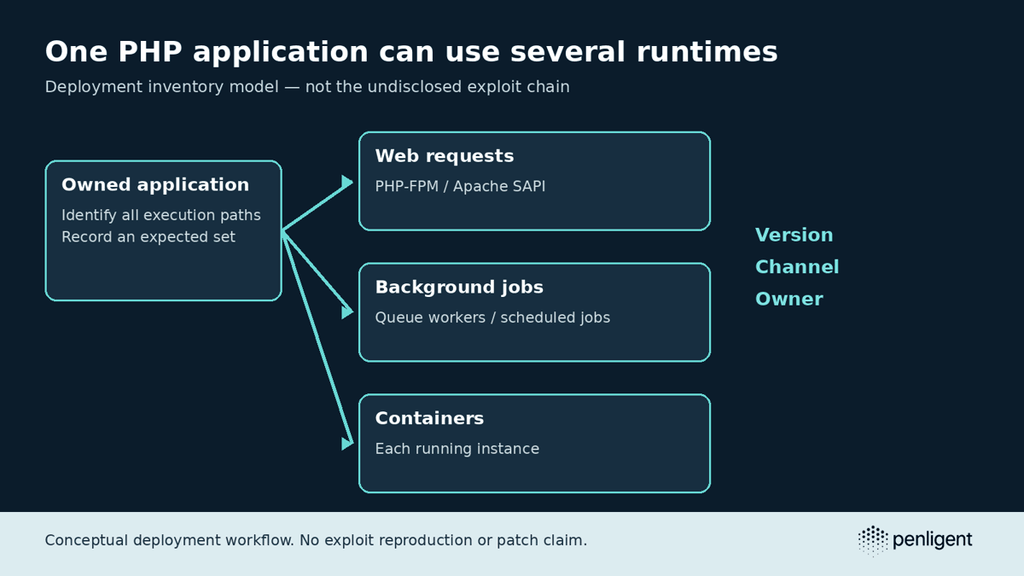
Follow one hostname from the web-server configuration to its backend socket, service or container. If a hosting panel selects PHP per site, record the site-specific choice. If the application has several replicas, record the entire active replica set. A single newly replaced pod is insufficient evidence for an old pod that still receives traffic. Background jobs should also be inventoried, while keeping their reachability distinct from an internet-facing web request.
The following commands are narrow CLI inventory examples based on PHP’s documented command-line switches. Run them only in a context you administer. They were not executed against a live PHP2Shell target for this article. The result describes that invocation, not every web worker on the machine.
php -v
php --ini
php -r 'echo json_encode(array(
  "version" => PHP_VERSION,
  "sapi" => PHP_SAPI,
  "ini" => php_ini_loaded_file()
), JSON_PRETTY_PRINT), PHP_EOL;'
Keep that record separate from your serving-runtime observation until you can connect them. A command inside an administrative container can be correct and still say nothing about the application container. Prefer an existing access-controlled operational view over publishing a phpinfo page. Collect the minimum needed fields; a full environment dump can create a new disclosure problem.
For a container you own, inspect its identity without changing it. The Docker inspect reference documents formatted output. Match the result with the deployment definition and the actual request path; the image identifier is evidence of identity, not a standalone security verdict.
docker inspect --type=container \
  --format '{{.Name}} {{.Image}} {{.Created}}' YOUR_PHP_CONTAINER
Why disabling upload progress is not a complete fix
Les stale-state advisory says disabling upload progress blocks the demonstrated session paths, while PHP 8.5 fatal-backtrace handling and other state paths require separate consideration. The project’s response guidance requires the setting to apply before request parsing and every worker to restart. Application-level ini_set() is too late for that boundary. These are partial exposure reductions, not substitutes for the complete update.
; Partial mitigation for confirmed session paths only
; Apply through startup/server configuration and restart every worker
session.upload_progress.enabled = 0
A change ticket should state exactly which path a temporary setting addresses and which owner will replace it with a fixed runtime. Otherwise the workaround can become a permanent control whose scope nobody remembers. Confirm any effect on upload-progress functionality with the application owner. Do not describe the site as fully protected simply because its configuration now contains this line.
Les PHP response guidance also discusses administratively enforcing memory_limit=-1 as a partial OOM-path measure, combined with conservative request-size controls and an external availability boundary. It explicitly warns against RLIMIT_AS and RLIMIT_DATA. Removing PHP’s limit is not a casual tuning change: evaluate resource containment and service availability with the runtime owner. An underlying allocation failure remains relevant, and updating is the complete solution.
Avoid copying a configuration bundle from another host. Your frontend, upload needs, pool layout and resource limits determine what it will do. In an urgent window, a provider-supported fixed package is easier to verify than a collection of emergency settings whose interactions have not been reviewed. If you cannot update, record the remaining exposure and an accountable decision about restricting access.
What temporary controls do and do not buy you
La current emergency advisory separates temporary exposure reduction from a complete update. If maintenance cannot finish immediately, choose controls for the actual failure path and deployment. Keep the owner, activation scope, expiry and unresolved risk in the change record; do not relabel a configuration change as patched software.
| Temporary control in the official guidance | Boundary it addresses | Important limitation |
|---|---|---|
| memory_limit=-1, with application overrides reviewed | Removes the controllable PHP memory-limit failure | Underlying allocation failure remains possible; review availability limits with the operator. |
| Request-size and parsing limits | Reduces attacker-controlled request work | Cover decoded bodies and requests without a usable Content-Length; not a complete RCE fix. |
| Container or cgroup resource boundary | Contains availability impact | PHP explicitly warns against substituting RLIMIT_AS or RLIMIT_DATA for this purpose. |
| Disable session upload progress before request parsing | Blocks confirmed session-state paths for CVE-2026-109619 | Restart every worker; FPM .user.ini or application ini_set is insufficient. |
| Disable PHP 8.5 fatal backtraces | Blocks that confirmed stale-state path | Other reachable producers/consumers remain outside this measure. |
The table summarizes the PHP team’s measures and their limits; it is not a command sequence tested on a customer server. Do not introduce unlimited process memory casually or weaken host protections to copy a workaround. A managed host should select and activate any interim control. Once the fixed runtime is deployed, reconcile emergency settings with the normal service policy rather than letting an undocumented exception become permanent.
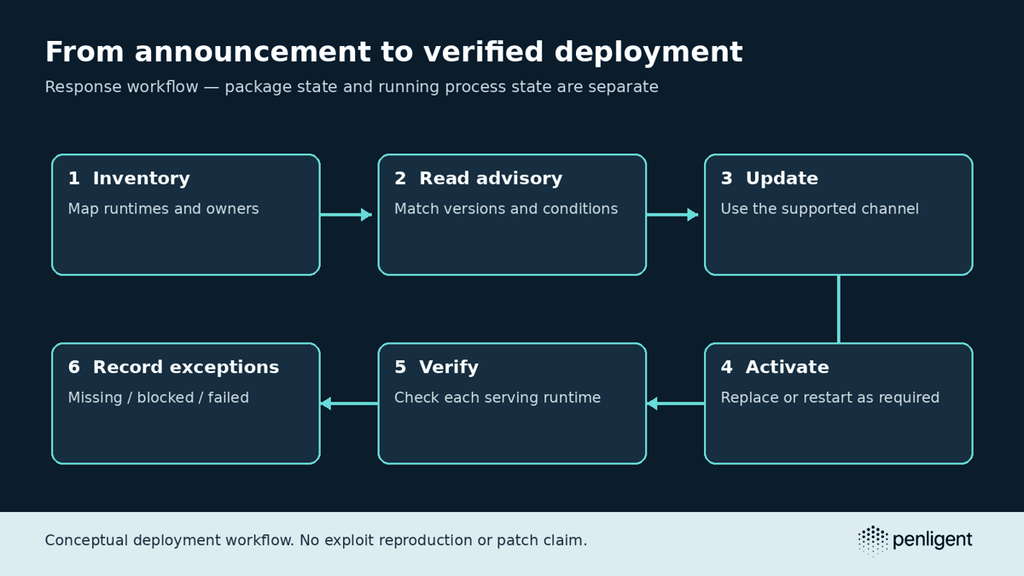
For closeout, distinguish installed, active and observed. Installed means a trusted package record covers both CVEs. Active means the intended workers and replicas were replaced or restarted onto that build. Observed means an approved request reached the intended runtime and the normal application flow worked. None of those observations alone settles whether earlier exploitation occurred.
Verify activation without pretending a normal request is an exploit test
Use separate acceptance gates for software delivery, activation and application behavior. First obtain the provider’s fixed revision. Then confirm the expected runtime is active for every serving instance. Finally exercise ordinary flows with dedicated test accounts. Keep a failure at any gate visible. Closing the ticket on package installation alone loses the distinction between a file on disk and the process handling requests.
| Gate | Evidence to keep | Do not infer |
|---|---|---|
| Paquet | Vendor advisory and installed full revision covering both CVEs | That all workers were replaced |
| Activation | Service/deployment event plus active instance inventory | That a background or old replica is also fixed |
| Functionality | Login, expected page/API behavior, upload if required, scheduled work | That a specific exploit was blocked |
| Incident review | Preserved logs and investigation outcome | That patching removed prior attacker access |
For a small application, select a short repeatable smoke test: sign in using a test account, open an expected protected page, submit one harmless operation, and inspect a background job if the product relies on it. Record the expected result before the change when possible. A pre-existing failure should not be mistaken for a regression, and a passing test should not be marketed as proof of vulnerability absence.
If you roll back to restore service, reopen the security decision immediately. The replacement runtime and the resulting security status must stay together. Keep the last known-good application recipe, but do not assume the old interpreter is an acceptable long-term recovery state. The incident owner needs both the availability result and the unresolved security exposure.
PHP2Shell in Docker: inspect the created container, not only the tag
For a containerized site, retain the identity of the image used by the serving container. Docker’s Compose images command lists images used by created containers; container inspect provides container details. Run these read-only commands against your own deployment. Replace YOUR_PHP_CONTAINER with its actual name or ID. These commands were not run against a PHP deployment for this article.
# Run from the directory containing your Compose configuration.
docker compose images

# Record the configured reference and image ID of an existing container.
docker container inspect --format '{{.Config.Image}} {{.Image}}' YOUR_PHP_CONTAINER
Connect the result to the approved build record. An image ID does not establish the PHP package revision or prove that every request reaches that container. Confirm the serving runtime with the checks above, include workers and scheduled jobs, and retain the image-to-package evidence. Keep internal deployment identifiers private.
Docker’s build guidance distinguishes refreshing a base image with --pull from bypassing build cache with --no-cache. Tags can move while a pinned digest stays fixed. Rebuilding with an unchanged digest can retain the same base; select an approved corrected base and follow your normal rollout procedure. Building or downloading an image alone does not replace an existing serving container.
Google Cloud: automatic patching depends on the deployment
Google Cloud’s response guidance was revised October 22 at 4:07 p.m. PDT (October 23 at 7:07 a.m. in Singapore and China). It distinguishes supported App Engine standard runtimes, which update automatically, from App Engine flexible deployments requiring redeployment. For supported Cloud Run services and functions, automatic base-image updates determine whether a rebuild or redeployment is needed. Custom container images remain the customer’s responsibility.
| Deployment decision | Evidence to request |
|---|---|
| Relying on a managed runtime update | Supported runtime, applicable automatic-update setting and serving revision |
| Rebuilding an owned image | Patched PHP artifact, resulting image digest and deployed instance set |
| Using WAF protection during rollout | Enforced policy, inspected request coverage and remaining backend paths |
The same guidance distinguishes Cloud Armor managed rules from the runtime repair and calls out bodies beyond configured inspection limits. Google’s security-platform status does not certify the state of a customer’s PHP workload. The practical closeout is deployment-specific: identify what was patched automatically, what your team rebuilt, and which serving revision now receives traffic.
For an operational review, trace a representative request from its public entry point to the backend revision. Then account separately for alternative routes and other active revisions. A WAF policy attached to one load balancer is evidence about that path; it cannot establish the state of an unrelated origin. Record coverage gaps and rollout exceptions beside the runtime inventory so ownership remains visible.
What to ask a managed WordPress host
A useful hosting ticket asks for a concrete, site-specific answer. The provider may operate several PHP distributions and per-site selections, so a general statement that its fleet is updated is insufficient for your application. Request confirmation through the host’s normal authenticated support channel; do not include login cookies, private reset links or database credentials.
Please confirm for my site [OWNED HOSTNAME]:
1. Which PHP provider, branch and full package revision currently serve it?
2. Which vendor notice confirms fixes for both CVE-2026-109618 and CVE-2026-109619?
3. Have all serving workers/instances activated that fixed build?
4. Are any replicas or fallback pools still pending?
5. Which application smoke tests were completed after activation?
Keep the response with your deployment evidence. If a host supplies a backport, ask for the complete revision and advisory rather than insisting that every package display an upstream version from the table. If it cannot confirm delivery, leave the update unresolved and ask for the next specific action and owner.
Do not confuse PHP2Shell with CVE-2026-115560
PHP also published a separate issue, CVE-2026-115560, involving a specific session configuration and upload-progress path. The documented combination requires session.serialize_handler être php_binary ou php_serialize, application code to change it to php avec ini_set() avant session_start(), and session upload progress to remain enabled. That is not one of the two PHP2Shell CVEs. Follow the PHP security archive and your provider notice separately; PHP recommends disabling session.upload_progress.enabled temporarily only when that documented path applies.
Need evidence for an authorized application review? Penligent offers a 19-page English sample pentest report with synthetic findings, SOC 2 criteria mapping and ISO/IEC 27001 risk-treatment examples. It is a sample, not a certification or audit-acceptance guarantee.
View the Sample Pentest Report — SOC 2 and ISO 27001 Mapping →What should a PHP operator patch first?
- Update the serving PHP runtime for CVE-2026-109618 and CVE-2026-109619, then verify all workers and replicas. Separately review whether the exact session configuration for CVE-2026-115560 exists in your application.
Patch verification and application testing answer different questions
Once the runtime is updated, a separate authorized application assessment can examine authentication, authorization and business logic on an owned staging site. Penligent is an option for that workflow; ask it to produce reproducible evidence tied to dedicated test accounts. This article does not demonstrate a PHP2Shell-specific detector or claim that an application-testing report proves the interpreter patch is present.
Likewise, do not run an unreviewed public exploit against a live storefront just to strengthen a maintenance screenshot. A responsible regression exercise needs provenance, an isolated target, a known vulnerable/fixed pair and a clear success condition. No PHP2Shell exploit or production assessment was executed for this update. The technical mechanism above is attributed to the released PHP advisories.
PHP2Shell questions from site owners
Are the PHP2Shell patches available now?
Yes. The upstream release baseline is 8.5.12, 8.4.27, 8.3.36 or 8.2.35, published October 21, 2026. Match your provider’s package revision and activate it on the serving instances.
Does updating WordPress fix PHP2Shell?
A WordPress update does not establish that the underlying PHP interpreter was replaced. Confirm the runtime update separately with the host or deployment owner.
Is PHP-FPM automatically safe?
No. Read each advisory’s SAPI-specific conditions and update. Avoid converting a difference in demonstrated exploit paths into a blanket exemption.
Does a successful version check prove I was not compromised?
No. It records software state at a point in time. Historical compromise requires a separate investigation; do not discard relevant logs after patching.
Should I disable upload progress instead of upgrading?
Treat it as a partial measure for the documented session paths, applied before request parsing with worker restarts. It does not replace the complete runtime fix.
Close this maintenance task when the fixed runtime is demonstrably serving the intended application, normal operations work, and any suspicious history has a separate owner. The useful end state is a traceable deployment decision—not a screenshot of a version string from an unrelated shell.
 French
 English
 German
 Spanish
 Portuguese
 Japanese
 Korean
 Hindi
 Arabic
 Turkish
 Hebrew