Learn what Insecure Direct Object Reference (IDOR) means, how attackers exploit it, and how developers can prevent IDOR vulnerabilities using secure coding practices, access-control patterns, and automated testing platforms.
What Is IDOR?
Insecure Direct Object Reference (IDOR) is a security vulnerability where an application exposes internal object identifiers—such as user IDs, order numbers, or file names—without verifying whether the requester is authorized to access that object. By changing a parameter in a URL or API call, an attacker can view, modify, or delete data they should not have access to.
Understanding IDOR: Why This Vulnerability Still Matters
IDOR belongs to the broad category of Contrôle d'accès défaillant, which OWASP has ranked as one of the most critical web security risks for years. The danger of IDOR lies in its simplicity: the attacker does not need advanced exploitation techniques, payload encoding, or privilege escalation. A single altered parameter—often just a number—can expose private information.
A typical vulnerable pattern looks like this:
bash
/api/user/profile?id=1002
If the application doesn’t verify ownership or authorization, changing the ID to 1003 may reveal another user’s data.
Modern applications—especially those involving APIs, microservices, or mobile clients—often rely heavily on parameterized object access. This architecture, while fast and flexible, can easily introduce IDOR when authorization checks are inconsistent or missing.

CVE-2025-13526: A Real-World IDOR Case in the Wild
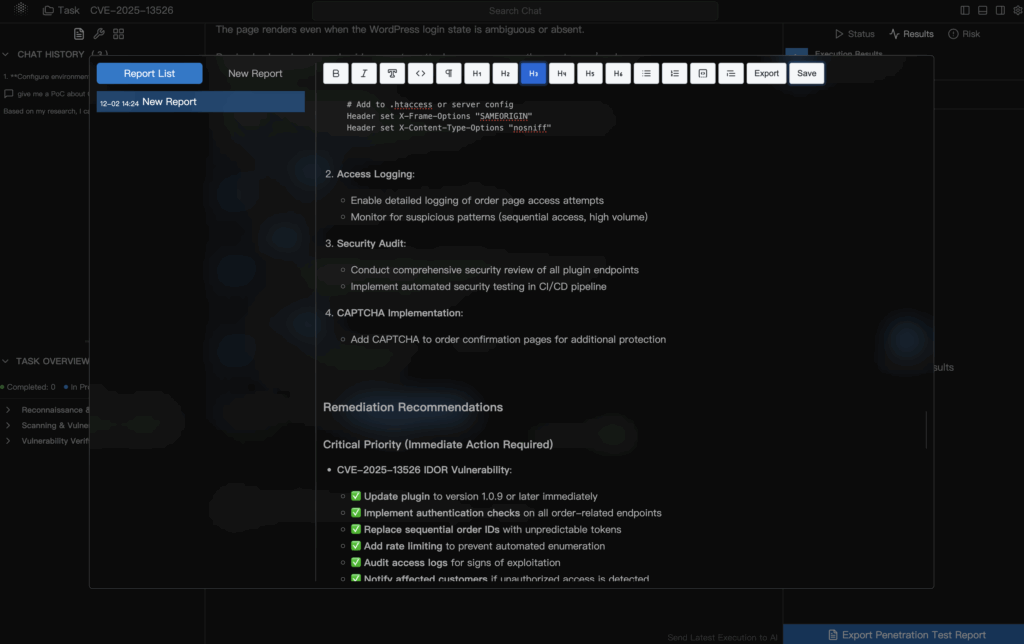
One of the most recent high-visibility examples of IDOR exploitation is CVE-2025-13526, affecting the popular WordPress plugin OneClick Chat to Order (versions ≤ 1.0.8).
- The vulnerability resides in the plugin’s
wa_order_thank_you_overridefunction. The plugin trusts anorder_idparameter from the URL query string — without checking that the request comes from the order’s rightful owner. - Attackers (even unauthenticated ones) could simply manipulate the
order_idvalue on the “thank-you” page URL (e.g., changingorder_id=123456àorder_id=123455) and retrieve other customers’ order details. Data exposed included names, email addresses, phone numbers, billing/shipping addresses, order items and prices, payment method metadata. wiz.io+2Gowri Infosec+2 - Because order IDs were sequential and predictable, mass enumeration became trivial — meaning an attacker or automated script could harvest thousands of orders in minutes. Moyen+1
- The vulnerability was assigned a CVSS v3.1 base score of 7.5 (High), reflecting the ease of exploitation (no auth needed) and the severity of data exposure.
- The developer fixed the issue in version 1.0.9, by implementing proper authorization checks to ensure only rightful owners (or authorized users) can view order data. Site owners were urged to upgrade immediately. Gowri Infosec+1
This real-world breach shows that IDOR is not a theoretical or legacy bug — it remains live, exploitable, and with potentially serious privacy and compliance consequences.
Common Real-World Scenarios Where IDOR Occurs
IDOR can appear in any system that references internal objects via user-controlled input. Below are common contexts:
| Application Type | Object Example | Why IDOR Occurs |
|---|---|---|
| Account systems | ID utilisateur | Directly exposing user identifiers |
| E-commerce apps | orderId | Improper validation of ownership |
| File management | fileId | Lack of access control for files |
| Ticketing platforms | ticketId | Users access other users’ tickets |
| SaaS multi-tenant apps | tenantId | Cross-tenant data leaks |
Attackers often enumerate predictable IDs, attempt sequential IDs, or replay authenticated requests with modified parameters.
How Attackers Exploit IDOR (Safe, Controlled Examples)
Below are safe illustration examples showing typical vulnerable patterns and their secure counterparts. These are not harmful exploits; they model common mistakes to help developers recognize unsafe patterns.
Example 1: IDOR in Node.js / Express
javascript
// ❌ Vulnerable Example: trusting user-supplied ID
app.get('/api/user/profile', (req, res) => {
const userId = req.query.id;
db.users.findById(userId).then(user => {
res.json(user);
});
});
// ✅ Secure Example: enforce authorization
app.get('/api/user/profile', (req, res) => {
const authenticatedId = req.user.id;
db.users.findById(authenticatedId).then(user => {
if (!user) return res.status(404).json({ error: "User not found" });
res.json({ id: user.id, email: user.email, role: user.role });
});
});
Example 2: A Common Pattern in Python / Flask
python
#❌ Insecure: no ownership validation
@app.get("/invoice")
def get_invoice():
invoice_id = request.args.get("id")
return get_invoice_by_id(invoice_id)
#✅ Secure: permission check added
@app.get("/invoice")
def get_invoice_secure():
invoice_id = request.args.get("id")
user_id = session["user_id"]
invoice = get_invoice_by_id(invoice_id)
if invoice.owner_id != user_id:
return {"error": "Unauthorized"}, 403
return invoice
Example 3: Back-End and Front-End Combined Defense (Java + React)
Java (Spring Boot)
java
// ❌ Missing authorization check
@GetMapping("/orders")
public Order getOrder(@RequestParam String orderId) {
return orderRepository.findById(orderId);
}
// ✅ Secure implementation
@GetMapping("/orders")
public ResponseEntity<?> getOrder(
@RequestParam String orderId,
Principal principal) {
Order order = orderRepository.findById(orderId);
if (!order.getUser().equals(principal.getName())) {
return ResponseEntity.status(HttpStatus.FORBIDDEN)
.body(Collections.singletonMap("error", "Access denied"));
}
return ResponseEntity.ok(order);
}
React-side secure request
javascript
async function fetchOrder(orderId) {
const res = await fetch(/orders?orderId=${orderId}, {
headers: { "Authorization": Bearer ${localStorage.getItem("token")} }
});
if (!res.ok) throw new Error("Unauthorized or not found");
return res.json();
}
Detecting IDOR Vulnerabilities: Practical Developer Approaches
Finding IDOR is often harder than exploiting it. Unlike injection vulnerabilities, IDOR does not always produce obvious technical errors—its symptoms are logical and behavioral.
Common detection techniques include:
- Differential fuzzing (testing multiple IDs)
- Replay testing (capture → modify → replay)
- Multi-user role switching
- Parameter enumeration
Safe fuzzing pseudo-code:
python
Simple safe fuzzing example
ids = ["1001", "1002", "1003"]
for i in ids:
res = client.get(f"/api/user/profile?id={i}")
print(i, res.status_code, len(res.text))
Preventing IDOR: Best Practices Developers Must Follow
IDOR prevention is not about obfuscation—it’s about authorization, performed consistently at the server level.
Never trust object identifiers from the client
Every parameter is modifiable. Even encrypted IDs can be tampered with.
Enforce server-side authorization on every request
Use recognized access control models:
- RBAC (Role-Based Access Control)
- ABAC (Attribute-Based Access Control)
- ACLs (Access Control Lists)
- Policy-as-code systems like OPA
Authority resources:
- OWASP: https://owasp.org
PortSwigger Web Security Academy: https://portswigger.net/web-security/access-control
Prefer non-enumerable identifiers
UUIDs reduce—but do not eliminate—the risk of IDOR.
Validate tenant boundaries in multi-tenant environments
Cross-tenant IDOR is one of the most severe and costly forms.
Use a Backend-for-Frontend (BFF) layer
A BFF can centralize authorization logic, reducing inconsistencies across clients.
Additional Advanced Examples
Example 4: Go API with Missing Authorization
go
// ❌ Vulnerable handler
func GetDocument(w http.ResponseWriter, r *http.Request) {
id := r.URL.Query().Get("id")
doc := db.FindDocument(id)
json.NewEncoder(w).Encode(doc)
}
// ✅ With ownership validation
func GetDocumentSecure(w http.ResponseWriter, r *http.Request) {
id := r.URL.Query().Get("id")
user := r.Context().Value("user").(string)
doc := db.FindDocument(id)
if doc.Owner != user {
http.Error(w, "Unauthorized", http.StatusForbidden)
return
}
json.NewEncoder(w).Encode(doc)
}
Example 5: GraphQL Endpoints and Object Authorization
javascript
// ❌ Vulnerable resolver
const resolvers = {
Query: {
order: (_, { id }) => db.getOrder(id),
}
};
// ✅ Secure resolver with ownership check
const resolversSecure = {
Query: {
order: (_, { id }, context) => {
const order = db.getOrder(id);
if (order.owner !== context.user.id) {
throw new Error("Access denied");
}
return order;
}
}
};
Example 6: Secure Access in Rust (Actix Web)
rust
// ❌ Vulnerable
async fn get_ticket(path: web::Path<String>) -> impl Responder {
let id = path.into_inner();
let ticket = db::find_ticket(&id);
web::Json(ticket)
}
// ✅ Secure version
async fn get_ticket_secure(
path: web::Path<String>,
user: LoggedInUser
) -> impl Responder {
let id = path.into_inner();
let ticket = db::find_ticket(&id);
if ticket.owner != user.id {
return HttpResponse::Forbidden().json("Access denied");
}
HttpResponse::Ok().json(ticket)
}
Automating IDOR Detection: Why Traditional Tools Struggle
Most traditional vulnerability scanners cannot detect IDOR reliably because IDOR requires two things scanners traditionally fail to do:
- Business-logic awareness
- Contextual multi-user testing
Scanning tools that rely solely on signature-based detection or single-user requests usually miss IDOR entirely, especially in APIs.
How Penligent Helps Identify IDOR Automatically
C'est ici que Penligent, an AI-driven penetration testing platform, provides a unique advantage. Unlike conventional scanners, Penligent performs:
- Automatic multi-user simulation
- Cross-object parameter inference
- Intelligent ID patterns recognition
- Behavioral differential analysis
- AI fuzzing that adapts based on observed responses
A sample of Penligent’s safe, anonymized detection output:
vbnet
`Potential IDOR detected:Endpoint: /orders?id=1002Observed behavior:
- User A received Order #1003 (owned by User B)Risk: Unauthorized access to another user’s data`
This kind of insight is difficult to achieve with static tools or manual review alone.
Reducing IDOR Risks Across CI/CD with Penligent
Penligent integrates naturally into CI/CD pipelines and provides continuous coverage:
- API and route auto-discovery
- Real-time permission matrix inference
- Scanning of staging and production-like environments
- Automatic generation of safe, reproducible PoC sequences
This reduces:
- Business-logic blind spots
- Multi-tenant exposure
- Regulatory risks (GDPR, HIPAA, SOC2)
Conclusion: IDOR Is Simple but Devastating—And Preventable
IDOR remains one of the most common and damaging forms of access control vulnerabilities. Because it hides within business logic, it often slips past traditional tools. By enforcing consistent authorization checks, using non-predictable identifiers, validating tenant boundaries, and adopting automated testing platforms like Penligent, organizations can dramatically reduce the risk of large-scale data exposure.
IDOR cannot be fully eliminated by chance or good intentions—it requires structured access control, consistent engineering principles, and continuous testing.