
An AI gateway can concentrate the authority of several model providers behind one application. If an attacker can read that application’s provider configuration, the incident can extend beyond a single chatbot to the upstream accounts that pay for inference. The urgent question is which deployed interface can reveal, replace, or exercise those credentials.
Amazon Threat Intelligence’s November 13, 2026 report describes agent records that pursued exactly that concentration of access. The records named LiteLLM, One API and related gateways, alongside application platforms including Dify, Langflow and RAGFlow. They described pooling stolen provider keys to power further credential hunting. This is a reported campaign objective and agent-reported workflow; Amazon explicitly says it could not independently verify the outcomes the agents reported on systems outside its sensors.
For defenders, the useful response is to separate three boundaries: access to the gateway’s management plane, access to its stored provider credentials, and permission to consume upstream inference. Each requires its own evidence. A working chat endpoint does not establish that the administrative interface is protected, and an administrative interface behind a login does not establish that every configuration route enforces the same policy.
What the new reporting establishes
Amazon says MadPot decoy sensors captured requests from October 3 through November 5. Those sensors presented LLM inference interfaces. Requests included persistent agent context, instructions and descriptions of earlier activity. The researchers observed those requests directly; they did not observe every action described inside them.
This distinction matters when translating the research into an incident ticket. A named product is a targeting lead, not proof that all installations are vulnerable. A claimed successful key extraction is not an independently verified breach count. The November 16 news coverage renews attention to a November 13 research publication; it does not turn the underlying vulnerabilities into newly disclosed November 16 CVEs.
The reported playbook combined unfinished installations, default credentials, exposed management functions, known application flaws and secrets in public artifacts. It was not one universal exploit shared by every named platform. Treat each route into the credential store as a separate hypothesis to check against the exact deployment.
In a separate November 13 investigation, Cloudflare described identity-chained activity involving ARTEX. One case involved a compromised account-level API token previously used for CI/CD. Cloudflare reported newly created Workers and database dump requests. The article does not establish that every request returned data. Its findings should not be merged with Amazon’s agent records into a single confirmed intrusion.
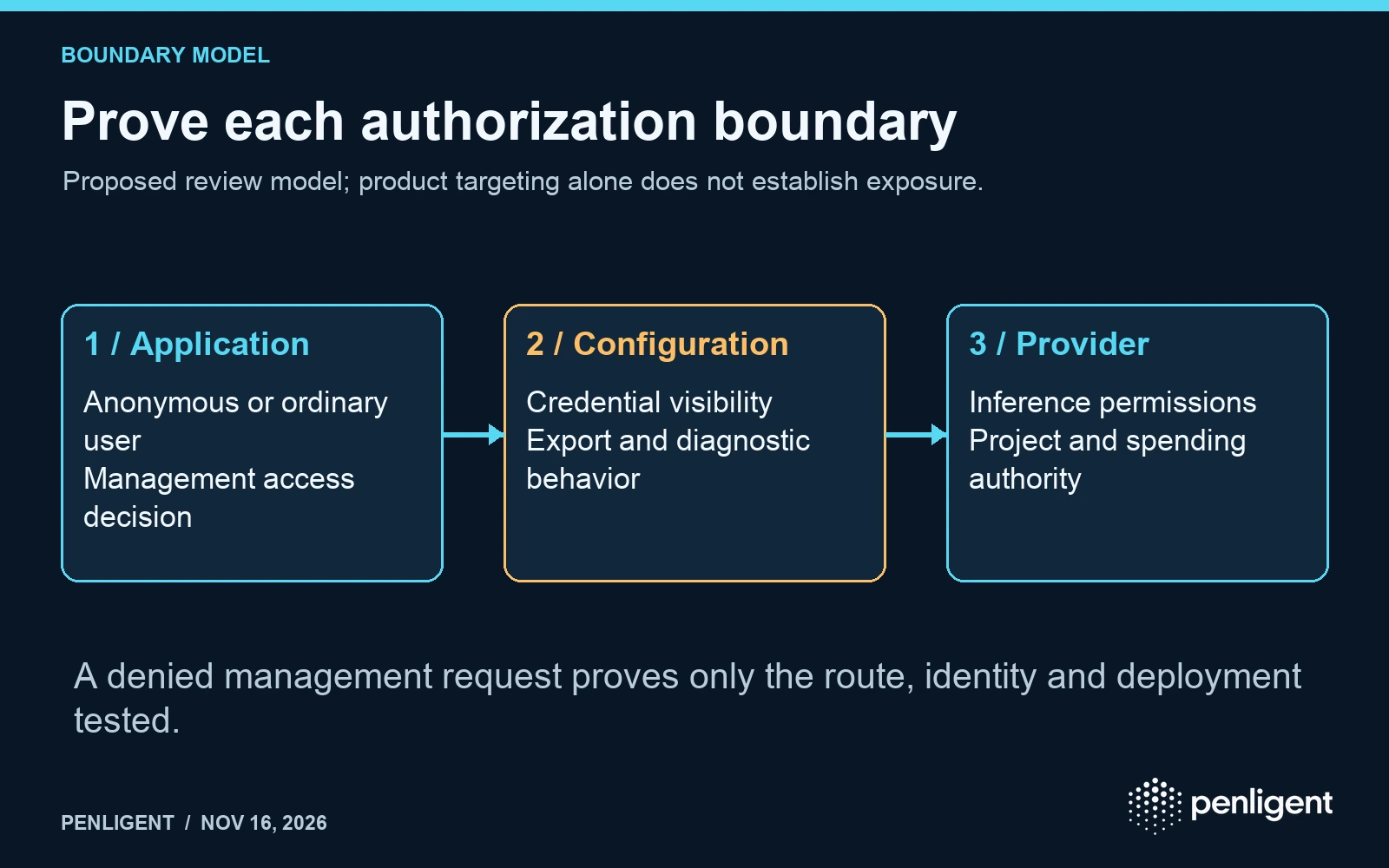
Build a gateway authority map before testing
Inventory deployed services by function rather than product name alone. One deployment may serve inference through a public route while keeping management behind an identity proxy; another may expose both through the same reverse proxy. A third may still have an initialization flow reachable from the internet. Those are materially different assessment scopes.
The following map is a proposed defensive method, not a finding about the installations in Amazon’s report. Complete one row for each actual deployment, including staging systems that contain production provider keys.
| Boundary | Evidence to collect without revealing a secret | Decision it supports |
|---|---|---|
| Internet to application | Ingress rules, identity-proxy policy, exposed hostname and service owner | Which routes an external caller can reach |
| User to management plane | Route-specific authorization policy and a controlled denied-access result | Whether an ordinary or anonymous caller can administer the service |
| Management plane to credential store | Secret references, database access roles and configuration export behavior | Whether application access can disclose reusable upstream authority |
| Gateway to model provider | Provider project, key identifier, permissions and spending controls | Which upstream account and services require containment |
| CI/CD to runtime | Deployment identity, secret-injection path and configuration change records | Whether a separate automation identity can alter the same authority |
Keep secret values out of the worksheet. Record a provider-issued identifier or an approved redacted reference. Hashing a short secret does not automatically make it safe to distribute. The map needs to identify ownership and relationships, not preserve an attacker-usable copy.
Look for shared authority across environments. If a development gateway and a production application use the same provider credential, restricting the production application alone leaves another path to the same account. That is an architectural inference to test against your inventory, not an assertion that the reported victims all shared credentials.
Use product-specific facts, not a generic affected-version list
The campaign’s targeting list cannot serve as an affected-product matrix. Amazon names products and entry patterns, but does not provide a complete version and fix boundary for every pattern.
| Reported target or condition | Source-backed statement | What an owner still needs to establish |
|---|---|---|
| Langflow, CVE-2025-3248 | Amazon names the flaw; CISA’s KEV entry identifies missing authentication leading to code execution | Exact running release, current maintainer guidance, supported upgrade path and exposure history |
| RAGFlow, CVE-2026-28797 | ה repository advisory describes authenticated template injection in Agent components, lists v0.24.0 under affected versions and lists no patched version | The deployed code and current maintainer guidance; do not read an empty patched-version field as proof that no later release changed the behavior |
| RAGFlow later development | ה v0.25.0 release notes include an SSTI-related sandbox change | Whether that change covers the deployed components and configuration; a release-note entry alone is not a complete cross-version security verdict |
| One API family header-based bypass | Amazon describes a bypass associated with the isCliRequest header | Affected fork, revision, route and maintainer fix; the report gives no universal fixed version |
| Default credentials or unfinished setup | Amazon describes these as playbook entries, including a LiteLLM default master key | Whether the actual instance uses a default, whether setup is complete and which interface accepts the credential |
Do not label CVE-2026-28797 an unauthenticated vulnerability. The repository advisory states that a registered account is required and notes default-enabled self-registration. Those conditions can make an exposed deployment easier to reach, but authentication prerequisites remain part of the finding.
Similarly, updating a package does not establish that a default administrator credential changed or that an unfinished installation is no longer claimable. Version correction and deployment configuration belong in separate closure fields.
Validate boundaries with a synthetic provider configuration
Use a staging copy that matches the relevant routing and authorization configuration. Remove real provider credentials before the assessment and use a synthetic configuration reference or an owner-controlled test project with restricted authority. Do not import production secrets simply to make the test more realistic.
Define expected behavior for three identities: an anonymous caller, an ordinary application user and an authorized administrator. Check the specific management and export functions documented for that product. Do not guess undocumented endpoints or spray headers across production routes.
The anonymous identity should be denied management access. The ordinary user should have only the permissions explicitly assigned by the deployment owner. The administrator may manage provider settings, but that does not automatically justify returning raw reusable keys through every export or diagnostic view. Record what the application actually returns and whether the behavior matches its documented design and your policy.
A browser hiding the configuration panel is not sufficient evidence. Retain the server’s authorization decision for the approved test request. Conversely, a single denied request is narrow evidence: it does not cover an alternate route, another tenant, a background API or a different proxy rule.
For each check, retain the deployment revision, identity class, function, expected outcome, observed outcome and evidence reference. Record secret redaction separately from access denial. A response may be appropriately restricted to administrators while still creating unnecessary credential exposure in logs or exports.
Keep those fields in a repeatable worksheet. It needs no exploit payloads, live targets or reusable credentials. Its purpose is to keep evidence tied to the boundary that was tested.
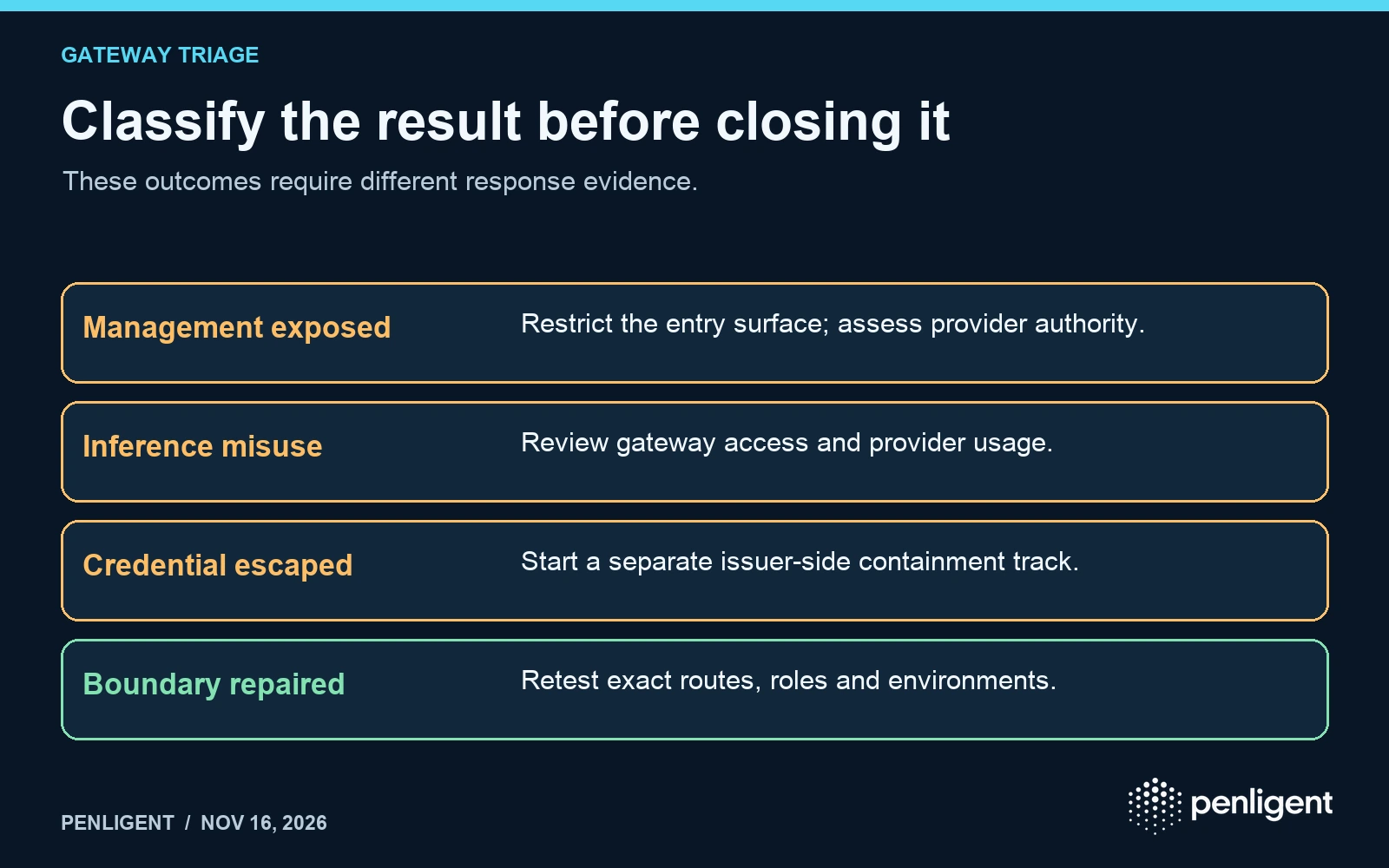
Prioritize exposure and authority together
Start with an externally reachable management or setup surface that can affect a broadly privileged provider credential. Restrict the entry surface while its owner investigates credential exposure. Where a real credential may already have escaped, credential containment needs its own incident process; repairing the original route does not retrieve copies.
Next review deployments where the public interface is limited to inference but provider authority is poorly separated. This situation may create unauthorized usage or unexpected spend without exposing a raw key. A provider key need not be stolen for an attacker to consume inference through an inadequately protected gateway. Classify the observed behavior accurately so that the response addresses the actual access path.
Finally, review internal and staging instances. “Internal” is a network placement, not a complete authorization policy. Check who can reach the service through VPNs, development environments, CI runners and other applications. The immediate question is whether any of those identities can turn limited application access into broader provider authority.
For a confirmed secret exposure, use the existing ARTEX exposed-secrets response article for issuer-side revocation, token-lifetime questions and historical resource review. This article’s distinct task is finding and validating the gateway boundaries that can create that exposure.
Correlate application changes with provider activity
Monitor changes to provider configuration, new administrative users, API-key creation and unusual export activity where the product records those operations. Correlate them with upstream usage and billing records using identifiers and timestamps. Do not log the credential value to make correlation easier.
Unexpected spending can justify investigation, as Amazon recommends, but it does not uniquely identify ARTEX. A legitimate deployment, a runaway background job and unauthorized consumption can all change usage. Compare the activity with deployment records, authorized identities and the models that the application normally uses.
Cloudflare’s published Worker names are useful leads inside its specific case. A matching name alone does not attribute activity, and a different name does not clear an account. Where Cloudflare is part of the environment, inspect token permissions and changes alongside the application investigation. Its token documentation describes optional expiry and client-IP restrictions; whether those controls fit a particular automation path requires an owner-approved design.
For an authorized follow-up assessment using Penligent, specify the management-plane and provider-configuration boundaries, test identities and evidence required. Ask for the observed authorization outcome rather than accepting an agent-generated success narrative as proof.
What closes the finding
A useful closure record identifies the corrected entry condition, the exact deployed change, the tested identities and the remaining provider authority. It distinguishes a configuration repair from a credential incident and records any route or environment that was not tested.
For example, denying anonymous access to a provider-settings function closes only that tested boundary. It does not establish that an exposed key was revoked, that an alternate export route is protected or that a staging copy has the same configuration. Keep those conclusions separate until their evidence exists.
The ARTEX records make concentrated model-provider authority a concrete inventory priority. The defensible action is to trace that authority through deployed interfaces and prove where access is denied, where it is allowed and what each allowed identity can actually do.
Method: AI-assisted review of the linked primary research, repository advisories and documentation, checked November 16, 2026. The authority map, validation matrix and companion worksheet are proposed defensive analysis. No customer environment, live credential or ARTEX framework was tested.
General product workflow
The official Penligent 3.0 video demonstrates the general product workflow. It is product context and does not reproduce the reported campaign or validate the proposed gateway checks.
 Hebrew
 English
 German
 French
 Spanish
 Portuguese
 Japanese
 Korean
 Hindi
 Arabic
 Turkish