
CVE-2026-47876 is a VMXNET3 out-of-bounds write in VMware ESX. Broadcom says an attacker with local administrative privileges inside a virtual machine configured with a VMXNET3 adapter may execute code on the host. Non-VMXNET3 virtual adapters are not affected by this issue. Its critical host impact must be read together with those guest-side preconditions.
The assessment needs two inventories: the guests using VMXNET3 and the fixed ESXi builds running their workloads. Updating a guest package does not prove that the hypervisor is repaired, and patching one host does not close a finding for every host that can run the VM. Preserve the guest-to-host mapping alongside the vendor’s branch-specific patch evidence.
Sources: Broadcom VMSA-2026-0006.2 וה CVE record.
Keep the guest precondition in the finding
The described actor already has local administrative privileges on a VM with a VMXNET3 adapter. This is a guest-to-hypervisor boundary, distinct from unauthenticated network access to the ESXi management plane. Broadcom rates the flaw CVSS 3.1 9.3 Critical. The numeric score does not remove the adapter or local-administrator requirements stated in the advisory.
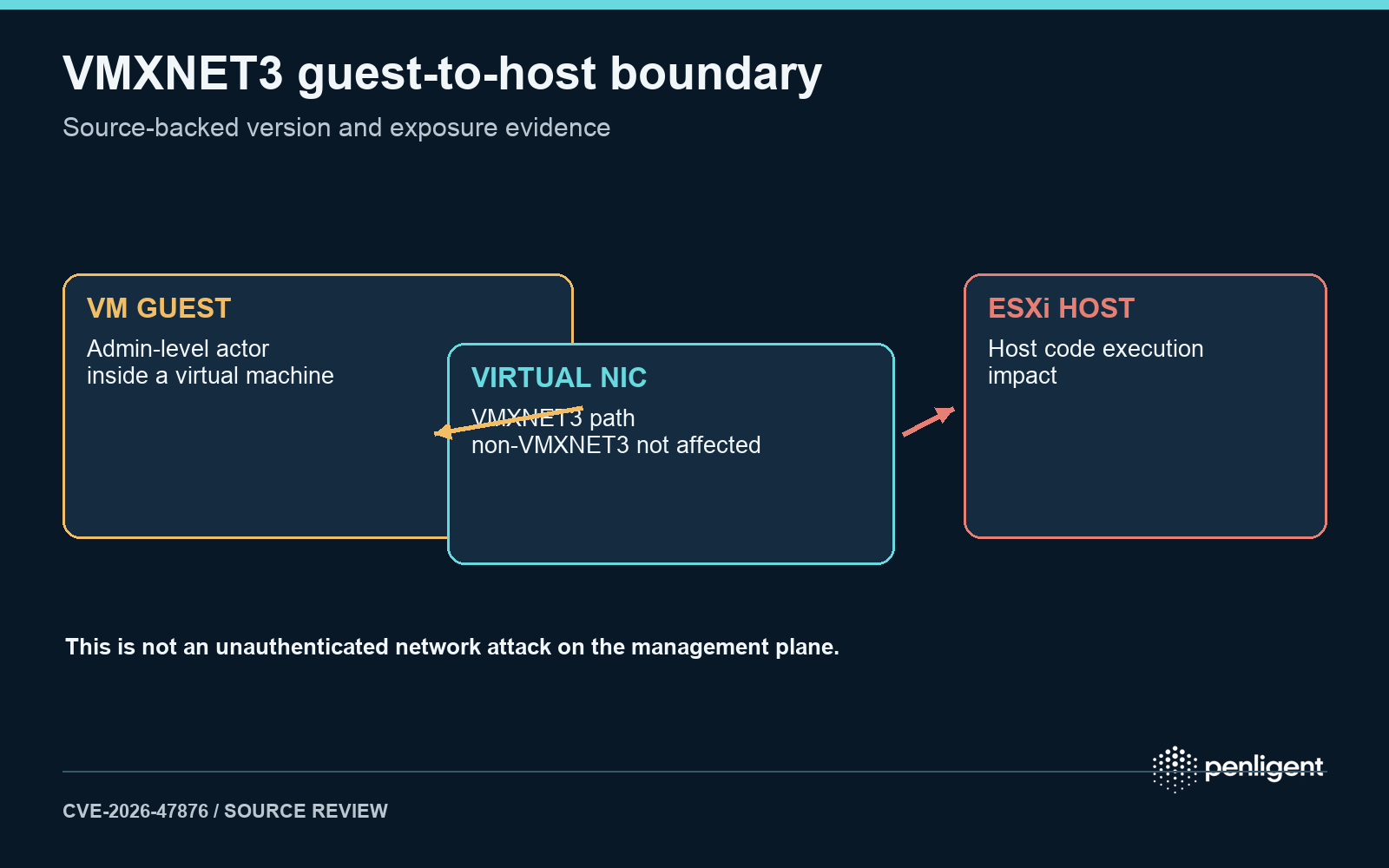
Inventory each VM’s adapter model, current host and allowed migration destinations. Mark VMXNET3 guests as relevant to this CVE’s stated device path. Record guest administration as a threat-model condition; finding a VMXNET3 adapter is not proof of exploitation. A non-VMXNET3 guest is outside the stated affected adapter path, but other guests can still expose the shared host.
Match the complete ESXi build to its branch
Broadcom’s response matrix gives distinct fixed builds. Use the row for the installed product and branch. The advisory was updated August 19, 2026; its body identifies revision .2 even though the portal heading still displays .1. The table below follows the body and response matrix. Newer supported cumulative patches may include the repair; the listed builds are repair boundaries rather than a claim that they are the newest releases.
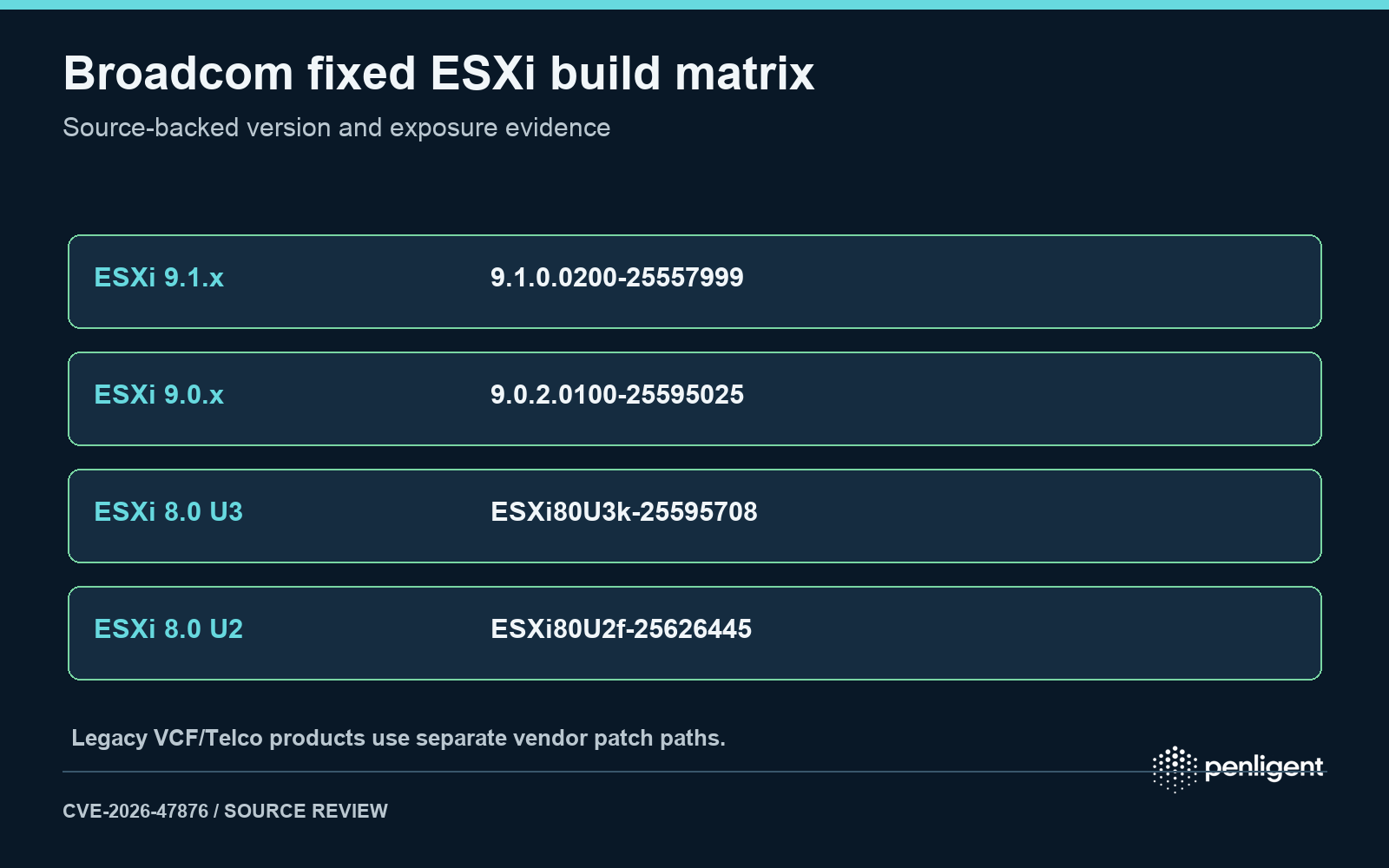
| ESXi branch | Fixed build listed for this CVE | Interpretation |
|---|---|---|
| 9.1.x | ESXi-9.1.0.0200-25557999 | Match the running ESXi image/build |
| 9.0.x | ESXi-9.0.2.0100-25595025 | Use the complete identifier |
| 8.0 U3 | ESXi80U3k-25595708 | Separate branch threshold |
| 8.0 U2 | ESXi80U2f-25626445 | Additional fixed branch in revision .2 |
| Cloud Foundation 5.x | Async Patching Guide KB88287 | Follow the product-specific workflow |
| Telco Cloud Platform 5.0.x / 5.1.x | KB449886 | Use the platform remediation path |
| ESXi 7.0 | Contact Broadcom Support with extended support | No public fixed build listed in this row |
The CVE record names Cloud Foundation, vSphere Foundation and Telco Cloud Platform product lines. The response matrix resolves the ESXi repair build or product-specific patch route. Do not copy a fixed build across branches or treat the VCF marketing version alone as proof that a host is repaired. Keep the bundle’s lifecycle instructions with the change record.
Close both sides of the boundary
- Export the VM inventory with adapter model and current host. Include templates and powered-off VMs that may return to service.
- Map relevant guests to the hosts and clusters allowed to run them, including migration destinations.
- Record each host’s product branch, full build/image profile and matching fixed threshold or supported bundle remediation.
- Patch through the supported lifecycle workflow and verify the running host build after the required restart.
- Refresh the guest-to-host map after maintenance and preserve the inventory time and advisory revision used.
Broadcom lists no workaround. Adapter inventory helps identify the documented attack surface; it is not a substitute for the host patch. Removing or changing adapters can affect workload networking and is not a vendor-listed remediation for this issue.
The CVE record’s CISA enrichment marked exploitation “none” at its July 30 update. That dated assessment is not a live guarantee. Penligent did not reproduce the vulnerability or test an ESXi environment. AI assisted article organization and diagrams. The original contribution is the two-sided inventory method and reconciliation of the CVE product list with the detailed vendor response matrix.
The video below is a general Penligent workflow demonstration. It does not demonstrate or validate CVE-2026-47876.
 Hebrew
 English
 German
 French
 Spanish
 Portuguese
 Japanese
 Korean
 Hindi
 Arabic
 Turkish