
CVE-2026-98260 is a Linux kernel use-after-free involving POSIX CPU timers and a non-leader thread executing a new program. ה kernel CVE announcement of October 6, 2026 identifies a cleanup-order correction in fs/exec.c. For operators, two questions matter: which supplier build contains the fix, and whether that corrected kernel is actually running.
Reviewed October 23, 2026. This is a mechanism and remediation guide, not a working exploit. No vulnerable kernel was attacked for this article. The commands below collect deployment evidence; they do not trigger the timing and failure conditions described in the advisory.
How a timer can be freed while its queue entry remains reachable
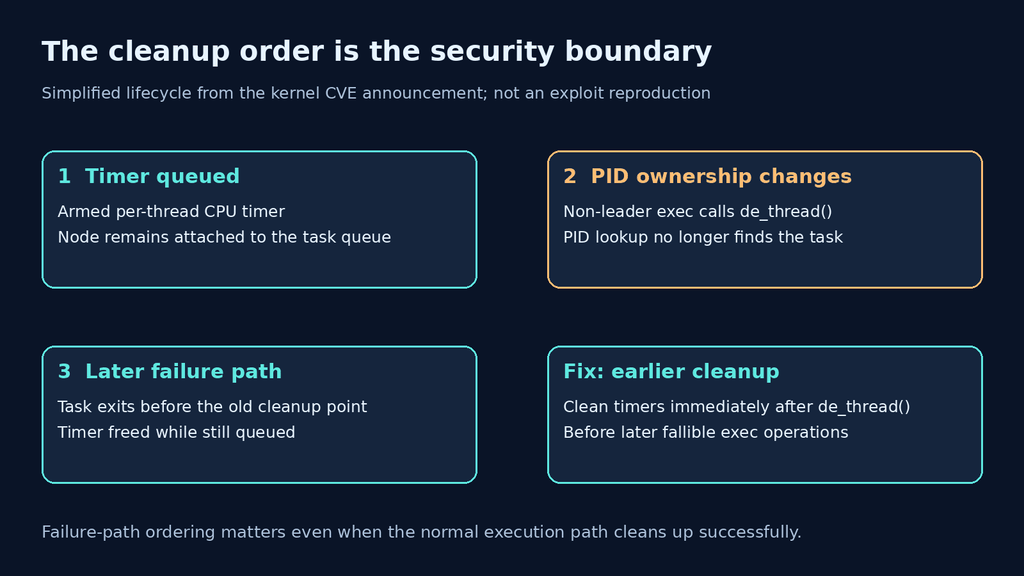
Oracle’s CVE description explains the ownership mismatch. An armed per-thread CPU timer has a node in the thread’s timer queue and refers to its PID. When a non-leader thread executes a new program, de_thread() changes PID ownership. A later lookup can fail even though the old task still has the timer node queued. The ordinary cleanup path removes it, but certain execution failures can terminate the task before that cleanup occurs.
The result is an ordering problem: the timer object can be freed while its node remains queued, and later task reaping touches that freed node. Moving cleanup immediately after de_thread() closes the interval before later failures can divert execution. That is the documented correction, not evidence of a reproduced privilege-escalation chain.
The broader lesson is useful when reviewing systems code. A failed lookup and an empty ownership structure are different facts. Code can correctly decide that an identifier no longer resolves while still being wrong about whether another structure retains a reference. Cleanup needs to reconcile both sides of that relationship before destruction makes the remaining reference unsafe.
Why a successful normal exec is a weak regression signal
ה kernel announcement describes cleanup being reached on the normal path, with the problematic interval exposed by failures after the transition. A test that only confirms successful program execution therefore does not exercise the relevant error path. The conceptual ordering below illustrates the correction; it is not compilable kernel code or a patch to apply manually.
The important engineering question is which invariants must hold if each later operation fails. An acceptance test can pass because it never visits the state where an object is both freed and still referenced. This does not make functional testing useless; it makes the expected coverage explicit. Ordinary service smoke tests and a targeted kernel regression test support different conclusions.
Do not improvise a stress test by repeatedly forcing process failures on production. Without a reviewed reproducer and an isolated environment, a crash is operational risk with poor evidentiary value. Use supplier patch evidence for remediation and reserve failure-path reproduction for a controlled kernel-testing workflow.
Upstream fix baselines and distribution packages answer different questions
The October 6 upstream announcement lists introduction in 5.7 and fixes in 6.6.158, 6.12.112, 6.18.54, 7.2.8 and 7.3-rc4. It recommends complete stable updates rather than unsupported individual cherry-picks. These historical baselines are not a recommendation to deploy a release candidate or leave your distribution’s supported kernel stream.
| Source of version evidence | Published mapping | How to use it |
|---|---|---|
| Upstream kernel announcement | 6.6.158 / 6.12.112 / 6.18.54 / 7.2.8 / 7.3-rc4 | Identify the relevant upstream correction; select an appropriate maintained kernel |
| Debian bookworm linux source | 6.1.190-1 fixed | Use the matching Debian security package and installed flavor |
| Debian trixie linux source | 6.12.113-1 fixed | Verify the package supplied for that release |
| Debian bookworm linux-6.12 source | 6.12.113-1~deb12u1 fixed | Do not confuse this source package with the default bookworm linux line |
The Debian rows come from the Debian security tracker, checked October 23. It explicitly labels these as source-package data. A source version in that table is not necessarily the string printed by uname or the name of a binary package. Preserve the link between the advisory, installed binary package and the host that boots it.
For another distribution or kernel flavor, obtain its own mapping. A vendor may backport a correction without adopting the corresponding upstream version number. Conversely, an apparently recent version string does not establish the provenance of a custom build. Compare the exact supplier artifact, not a numeric fragment copied from a scanner banner.
Read the running kernel and installed-package inventory separately
On a Linux system you administer, uname -r reports the running kernel release. The package inventory answers what is installed. The examples below are read-only starting points for their respective package systems; choose the applicable one. They have not been executed against your production systems and do not automatically determine CVE status.
A missing package name may mean the distribution uses different packaging. It does not prove that the kernel is absent or safe. An installed update may coexist with an older running kernel. After the supported activation procedure, collect fresh runtime evidence and connect it to the selected package. Retain the collection time, host identity, supplier and relevant advisory.
Treat a supported live-patch service as its own evidence path. A short running-kernel version may remain unchanged while an update service applies a documented correction. Verify explicit coverage of this CVE, the target kernel and successful application through that supplier’s tooling. Do not assume that the mere presence of a live-patch client covers the issue.
For containers, follow the kernel boundary to the node
A standard Linux container usually shares the host kernel rather than booting the kernel package installed inside its filesystem. Rebuilding an application image can update userspace while leaving the executing kernel unchanged. That architectural distinction is why workload inventory should identify the node or virtual machine supplying the kernel.
Do not overgeneralize that model to every hosted container platform. Sandboxed runtimes and microVM-based services can introduce different boundaries. Ask the platform owner which kernel executes the workload, who updates it and what activation evidence is available. A managed-service label alone does not answer those questions.
| Deployment observation | What it can establish | What remains open |
|---|---|---|
| New application image deployed | Userspace artifact changed | Whether the executing kernel changed |
| Kernel package installed | A candidate boot artifact is present | Whether the host activated it |
| Fresh running-kernel observation | Which release is executing | Whether the supplier maps that build to the fix |
| Supplier live-patch success | The documented patch applied to its target | Coverage of other nodes or unsupported flavors |
| Application smoke test passes | The tested service path works | Whether the CVE failure path was exercised |
Prioritize local execution surfaces without calling this a remote RCE
Oracle’s preliminary CVSS assessment is 7.0 with a local attack vector, high complexity and low privileges required. The page marks those metrics subject to review. That assessment does not establish that every web request can trigger the flaw or that every local account has a reliable privilege-escalation exploit.
For prioritization, identify where untrusted or separately administered code can run on affected hosts. Build workers, development environments and shared compute nodes may deserve early attention based on their actual access model. These are triage recommendations, not a claim that each workload satisfies all trigger conditions.
Keep system stability and incident investigation separate from patch activation. A kernel crash can have unrelated causes, while missing crash records can reflect incomplete collection. Preserve available evidence through the organization’s normal incident process and avoid labeling every timer-related failure as successful exploitation.
A closeout another operator can audit
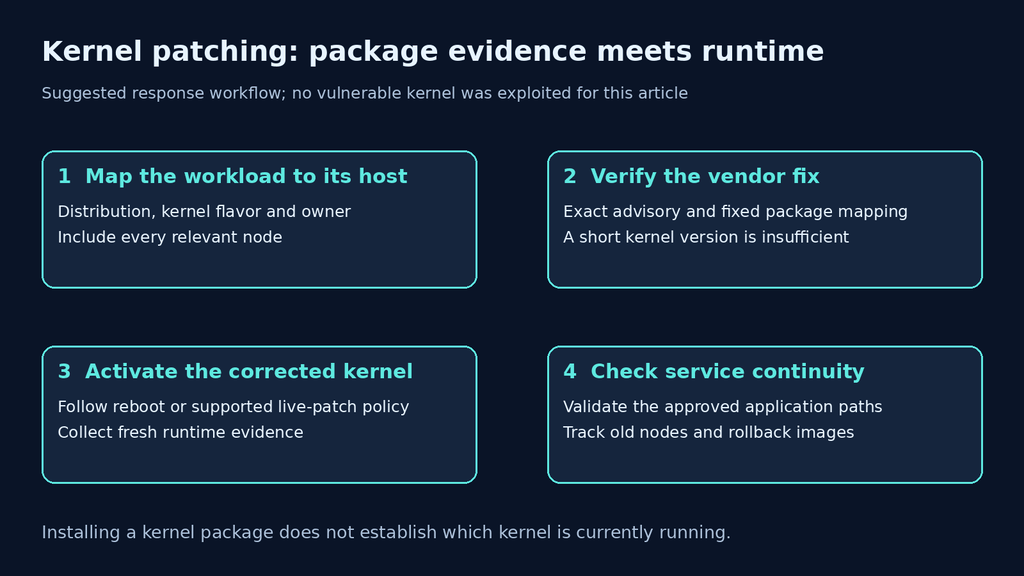
The maintenance record should name the supplier’s corrected artifact, the affected node set, the activation method and the fresh observations collected afterward. Record nodes still pending instead of hiding them behind a fleet-wide “updated” label. Review rollback images too: restoring an older boot artifact may restore the vulnerable code.
After activation, use approved application smoke tests for service continuity. Keep those results alongside—not in place of—the kernel evidence. A successful login, completed CI job or healthy API response is useful operational evidence; none independently proves that a specific use-after-free failure path is gone.
Questions about CVE-2026-98260
Does installing a newer kernel finish the repair? Installation and activation are separate. Verify the running state or an explicitly supported live-patch result for every relevant host.
Should I manually cherry-pick the listed commit? Follow your supplier’s maintained kernel update. The upstream announcement recommends complete stable updates and warns against isolated cherry-picks.
Does updating a container fix the host kernel? Not in the ordinary shared-kernel model. Identify the boundary used by your actual platform.
Does a negative remote scan prove the host is patched? No. A remote application observation does not establish a private kernel package’s patch provenance or activation state.
Where application testing fits after host remediation
If the same hosts run your application, a scoped assessment can review the application’s own trust boundaries after maintenance. Evaluate Penligent for that separate authorized workflow, with clear identities, expected access rules and reviewable evidence. This article does not establish a dedicated CVE-2026-98260 detector or claim that an application scan certifies a host kernel.
The product walkthrough below provides application-testing context. It is not a kernel exploit demonstration.


 Hebrew
 English
 German
 French
 Spanish
 Portuguese
 Japanese
 Korean
 Hindi
 Arabic
 Turkish