
CVE-2026-123637 is a BIG-IP APM configuration-dependent issue. A version-only search can overstate exposure, while checking only the management interface can miss the relevant data-plane configuration.
This guide is for F5 administrators and security teams who own BIG-IP APM virtual servers. It translates F5’s advisory conditions and the published CVE version data into a review sequence. It does not reproduce exploit requests; F5 describes the triggering requests as undisclosed.
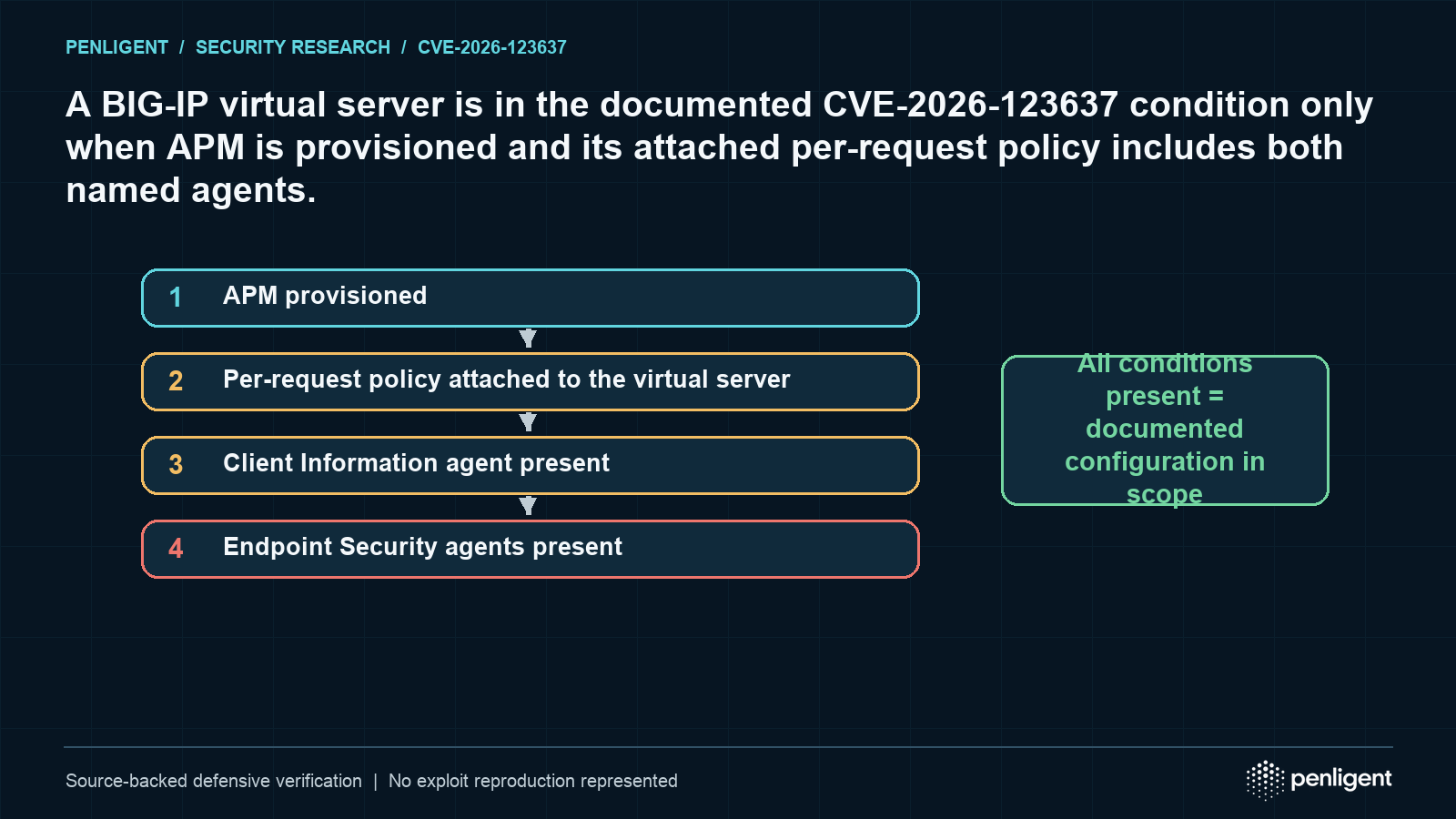
Confirm the complete policy condition
על פי F5’s advisory K000163937 וה CVE record, exposure requires BIG-IP APM to be provisioned and a per-request policy containing the Client Information agent and Endpoint Security agents to be applied to a virtual server. Review the policy actually attached to each virtual server; an unused policy object is not the same evidence as an active policy binding.
F5 says undisclosed requests can cause the Traffic Management Microkernel (TMM) to terminate. Traffic is disrupted while TMM restarts, and the issue may allow remote unauthenticated denial of service and possibly remote code execution. F5 describes this as a data-plane issue; the advisory states there is no control-plane exposure. Do not recast it as an administrative-interface compromise.
Use the branch-specific ENG evidence carefully
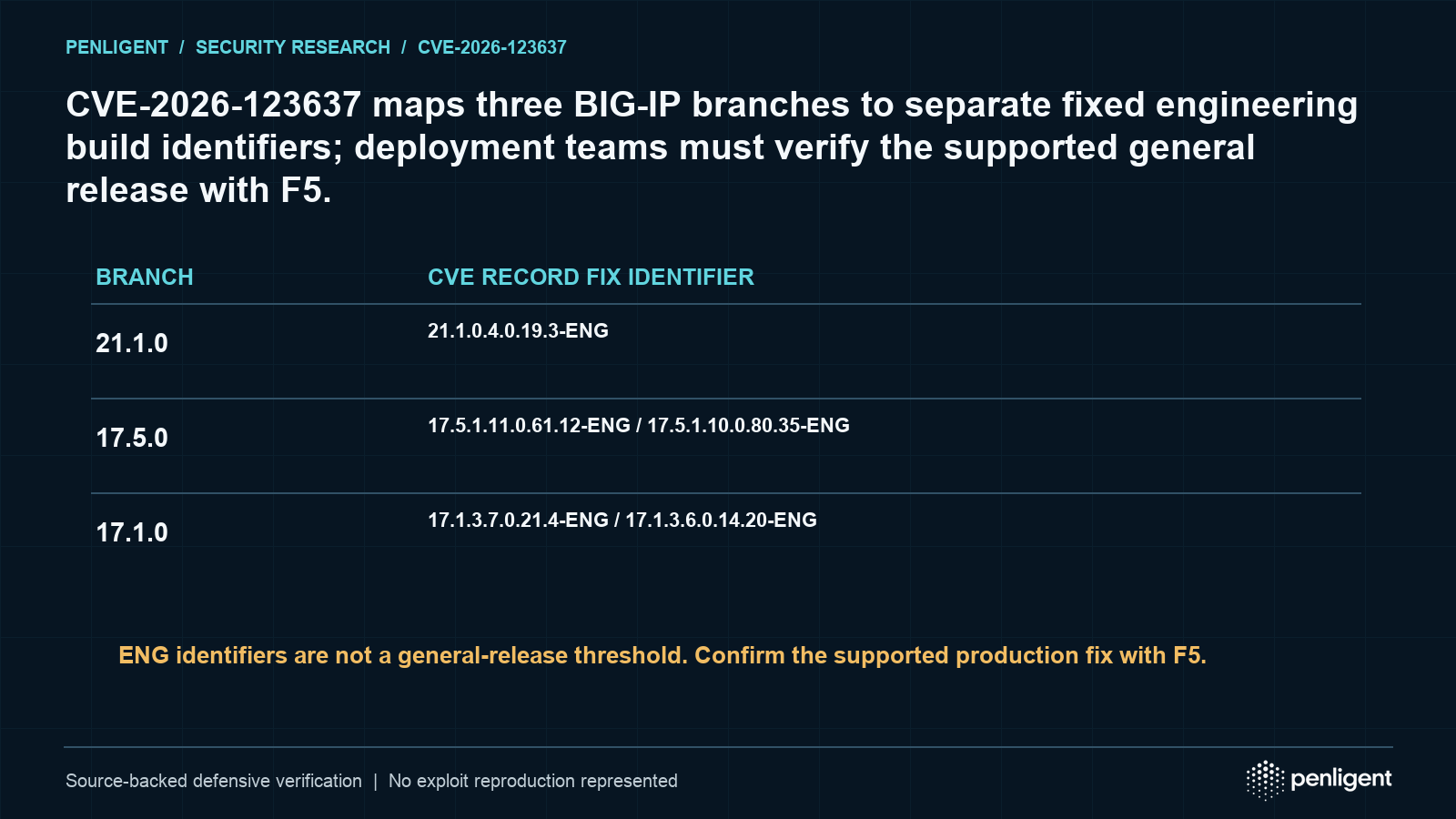
The CVE record currently identifies the following BIG-IP APM branch states and engineering fixes:
- 21.1.0 branch: fixed at
BIGIP-21.1.0.4.0.19.3-ENG. - 17.5.0 branch: fixed at
BIGIP-17.5.1.11.0.61.12-ENGאוBIGIP-17.5.1.10.0.80.35-ENG. - 17.1.0 branch: fixed at
BIGIP-17.1.3.7.0.21.4-ENGאוBIGIP-17.1.3.6.0.14.20-ENG.
These identifiers are explicitly marked ENG builds in the CVE record. Before deployment, check the current F5 advisory for an applicable generally available release, hotfix instructions, and platform-specific guidance. Do not treat an ENG identifier as a generic version threshold for every appliance or assume branches absent from the record were evaluated. F5 notes that versions at end of technical support were not evaluated.
Build an auditable virtual-server inventory
- Inventory appliances, software branches, APM provisioning state, and active virtual servers.
- For each virtual server, export or inspect the attached per-request policy and verify whether both named agents are present.
- Map the exact running build to the branch-specific status in the current F5 advisory.
- Apply the supported correction through the normal change process, recording device and image/build identity.
- Confirm the corrected build is active and exercise the expected APM access flow while monitoring TMM health and service traffic.
If the configuration condition is absent, record the policy and virtual-server evidence rather than simply labeling an entire appliance “not affected.” If it is present on a supported affected branch, prioritize the F5 correction. Review TMM restart and traffic telemetry during the earlier exposure window if the appliance was reachable, but a TMM restart alone does not prove exploitation.
Method: This article was prepared with AI assistance from the primary sources linked below. The deployment checks are an editorial synthesis of those sources; no first-hand exploit validation is claimed.
מקורות: F5 advisory K000163937; CVE-2026-123637 record. Source status checked November 23, 2026. The engineering build identifiers are reproduced as listed; no appliance testing is claimed.
 Hebrew
 English
 German
 French
 Spanish
 Portuguese
 Japanese
 Korean
 Hindi
 Arabic
 Turkish