
CVE-2026-21510: When the Prompt Doesn’t Show Up What a Windows Shell Trust-Boundary Failure Means in Practice
1) Treat it as a trust-boundary failure, not “just another Patch Tuesday item”
NVD characterizes CVE-2026-21510 as a protection mechanism failure in Windows Shell that lets an attacker bypass a security feature. It carries a CVSS v3.1 base score of 8.8 (network-reachable, low complexity, no privileges required; user interaction remains).(NVD)
That’s already a serious profile. What pushes it into “drop everything” territory is the operational context:
- Microsoft has flagged exploitation, and multiple Patch Tuesday roundups list it as actively exploited / zero-day class.(BleepingComputer)
- CISA added it to the פגיעויות ידועות שנוצלו (KEV) catalog with a remediation due date of 2026-03-03 (a real prioritization lever inside organizations).(NVD)
ZDI’s Patch Tuesday review makes the defender-relevant point bluntly: even though Microsoft labels it as a “feature bypass,” in practical terms it’s close to one-click execution because the safety boundary you expect (SmartScreen / prompts) doesn’t reliably appear.(Zero Day Initiative)
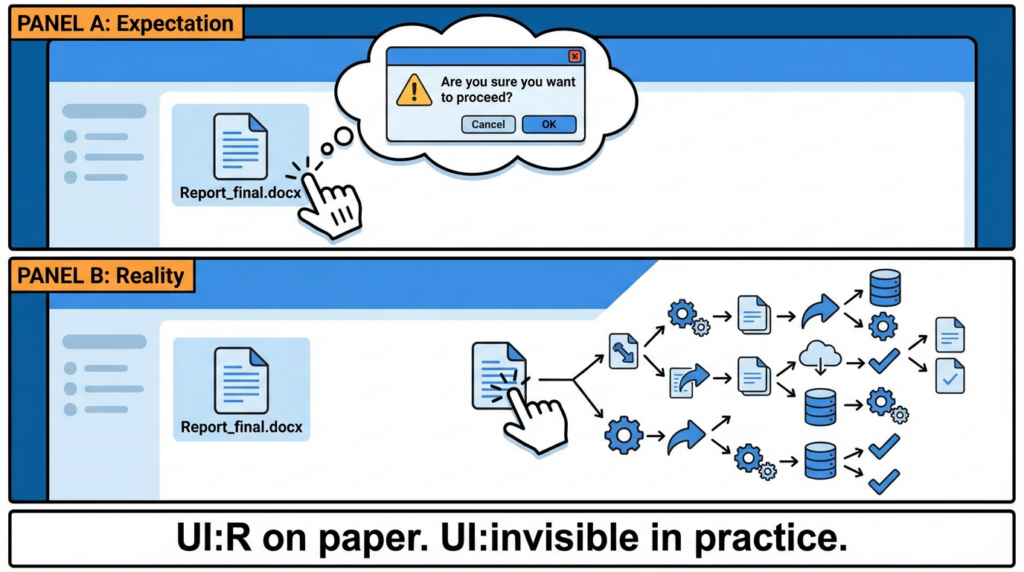
2) The real damage: SmartScreen / MOTW / Shell prompts stop being a dependable line of defense
Most endpoint programs implicitly rely on a chain of friction:
- MOTW (Zone.Identifier) signals “this came from the Internet.”
- SmartScreen and shell prompts add “are you sure?” moments at the exact point users make mistakes.
For CVE-2026-21510, the “cost” of exploitation is lower because the user never gets the psychological speed bump.
Sophos quotes Microsoft’s description: an attacker could bypass SmartScreen and Shell prompts, allowing attacker-controlled content to execute without warning or user consent, and it affects all supported Windows (client and server).(sophos.com)
Rapid7 frames related risk in terms of trust markings and “Mark-of-the-Web” realities in enterprise pipelines (where tags can be lost through common workflows).(Rapid7)
3) Likely delivery patterns: links and shortcuts are the cheap, scalable carrier
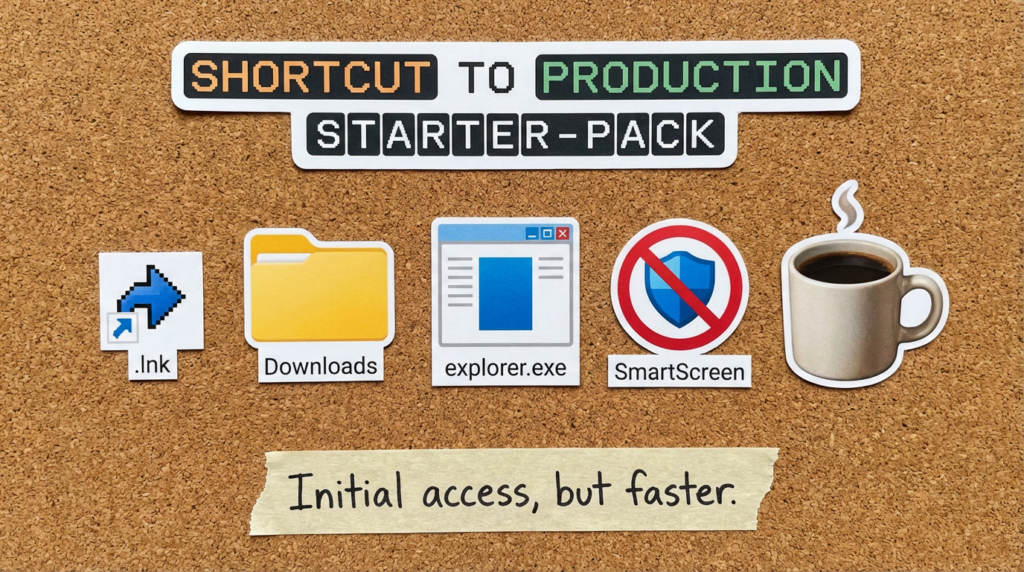
Across reporting, the recurring exploitation narrative is consistent: convince the user to open a malicious link or shortcut file (often discussed in the context of .lnk) and the normal warnings don’t show.(שבוע האבטחה)
This doesn’t mean the CVE is the whole intrusion. It means it’s a reliability booster for initial access:
- fewer user-reported “weird warning” moments
- fewer early IR tickets
- easier mass-targeting because “one click” is a scalable requirement
That is exactly why it shows up alongside other exploited February 2026 issues in major Patch Tuesday roundups.(BleepingComputer)
4) Related CVEs worth modeling alongside CVE-2026-21510
These aren’t filler. They’re how real-world attackers build chains: bypass → execute → escalate.
| CVE | רכיב | כיתה | מדוע זה חשוב |
|---|---|---|---|
| CVE-2026-21510 | Windows Shell | Security feature bypass (exploited) | Suppresses safety prompts, making initial access more reliable.(NVD) |
| CVE-2026-21513 | MSHTML framework | Security feature bypass (exploited) | Often discussed in the same “file / shortcut / rendering” orbit during Feb 2026 Patch Tuesday.(BleepingComputer) |
| CVE-2026-21514 | Microsoft Word | Security feature bypass (exploited) | Document open workflows remain a prime initial access vector.(שבוע האבטחה) |
| CVE-2026-21519 | מנהל חלונות שולחן העבודה | EoP (exploited) | Common post-compromise move to elevate privileges.(Tenable®) |
| CVE-2026-21525 | RasMan | DoS (exploited) | Not always core, but exploited status signals attacker attention.(Tenable®) |
5) “Top CTR terms” in the wild: what people are actually clicking on
Publicly, you can’t see true Google CTR per query without owning the Search Console/ads data. But you יכול infer what’s pulling clicks by looking at how the top security publishers frame the story.
For Feb 2026, the high-click intent cluster is consistent across BleepingComputer, Sophos, Rapid7, Tenable, CrowdStrike, SecurityWeek:
- “actively exploited / zero-day”
- “SmartScreen / security prompt bypass”
- “Patch Tuesday fixes X zero-days”(BleepingComputer)
Those phrases match how engineers triage: Is it exploited? Does it hit endpoints? What do I patch first?
We’ve integrated that same intent into this piece, but kept it engineering-first: actionable detection, verification, and durable controls.
6) Prioritization: patching is necessary — “provable remediation” is the goal
Use a 3-signal triage triangle rather than CVSS alone:
- Exploit reality (KEV + exploited in the wild + low-friction UI)(NVD)
- Exposure (user populations with heavy external file flow: finance, sales, HR, support)
- Ingress paths (Downloads, web cache, sync folders, VDI redirection, shared drives)
Your two audit-grade questions should be:
- Can we להוכיח our MOTW/SmartScreen trust chain still behaves correctly after patching?
- If the prompt is bypassed, what second-line controls still prevent execution (ASR/WDAC/app control/EDR containment)?
7) Validation you can defend: check trust markings, not just “patch installed”
7.1 MOTW (Zone.Identifier) inventory in common ingress folders
# Inventory suspicious files lacking MOTW (Zone.Identifier) in common ingress folders
$paths = @(
  "$env:USERPROFILE\\Downloads",
  "$env:USERPROFILE\\Desktop",
  "$env:USERPROFILE\\Documents"
)

$exts = @("exe","dll","js","vbs","ps1","cmd","bat","lnk","url","hta","msi","iso","img","zip")

$results = foreach ($p in $paths) {
  if (Test-Path $p) {
    Get-ChildItem -Path $p -Recurse -File -ErrorAction SilentlyContinue |
      Where-Object { $exts -contains $_.Extension.TrimStart(".").ToLower() } |
      ForEach-Object {
        $zone = Get-Content -Path ($_.FullName + ":Zone.Identifier") -ErrorAction SilentlyContinue
        [PSCustomObject]@{
          Path = $_.FullName
          Extension = $_.Extension
          HasMOTW = [bool]$zone
          ZoneId = ($zone | Select-String "ZoneId" | ForEach-Object { $_.ToString() }) -join ";"
          LastWriteTime = $_.LastWriteTime
        }
      }
  }
}

$results | Sort-Object HasMOTW, LastWriteTime -Descending | Select-Object -First 200
Rapid7’s Patch Tuesday write-up explicitly situates the month’s risk around exploitation signals and MOTW realities in enterprise workflows (where “marking” can be lost).(Rapid7)
8) Detection engineering: build reusable “LNK/Explorer execution-chain” primitives
8.1 Sigma template
title: Suspicious Child Process Spawned by Explorer After LNK Open
id: 3b1d2a52-6b9b-4cc1-9b5e-21510-template
status: experimental
description: Detects suspicious process execution spawned by explorer.exe that often follows malicious LNK execution chains (SmartScreen / prompt bypass context).
references:
  - <https://nvd.nist.gov/vuln/detail/CVE-2026-21510>
  - <https://www.cisa.gov/known-exploited-vulnerabilities-catalog>
author: detection-engineering
date: 2026/02/16
logsource:
  product: windows
  service: sysmon
detection:
  selection_parent:
    ParentImage|endswith: '\\explorer.exe'
  selection_suspicious_child:
    Image|endswith:
      - '\\powershell.exe'
      - '\\pwsh.exe'
      - '\\cmd.exe'
      - '\\wscript.exe'
      - '\\cscript.exe'
      - '\\mshta.exe'
      - '\\rundll32.exe'
      - '\\regsvr32.exe'
      - '\\bitsadmin.exe'
  selection_user_paths:
    CommandLine|contains:
      - '\\Users\\'
      - '\\Downloads\\'
      - '\\AppData\\Local\\Temp\\'
  condition: selection_parent and selection_suspicious_child and selection_user_paths
falsepositives:
  - Rare: legitimate scripting from Downloads
level: high
tags:
  - attack.initial_access
  - attack.execution
This is durable because it doesn’t depend on a specific exploit; CVE-2026-21510 simply makes the chain more reliable.(Zero Day Initiative)
8.2 Microsoft Defender KQL hunting examples
// Explorer spawning script interpreters or LOLBins from user-writable paths
DeviceProcessEvents
| where InitiatingProcessFileName =~ "explorer.exe"
| where FileName in~ ("powershell.exe","pwsh.exe","cmd.exe","wscript.exe","cscript.exe","mshta.exe","rundll32.exe","regsvr32.exe")
| where ProcessCommandLine has_any ("\\\\Users\\\\", "\\\\Downloads\\\\", "\\\\AppData\\\\Local\\\\Temp\\\\")
| project Timestamp, DeviceName, AccountName, InitiatingProcessFileName, FileName, ProcessCommandLine, FolderPath, InitiatingProcessCommandLine
| order by Timestamp desc
// LNK files created in common ingress folders
DeviceFileEvents
| where FileName endswith ".lnk"
| where FolderPath has_any ("\\\\Downloads\\\\", "\\\\Desktop\\\\", "\\\\AppData\\\\Local\\\\Temp\\\\", "\\\\INetCache\\\\")
| project Timestamp, DeviceName, AccountName, ActionType, FolderPath, FileName, SHA256
| order by Timestamp desc
The emphasis on links/shortcuts is consistent across Patch Tuesday reporting.(שבוע האבטחה)
9) Hardening: assume prompts can fail, and design for “execution still blocked”
Start with the highest ROI moves:
- strengthen ASR / script control for high-risk user groups
- block high-risk interpreters/LOLBins from user-writable paths
- raise EDR severity on “Downloads → Explorer → script/LOLBins” chains
Think of it as building a second line behind SmartScreen/MOTW, not replacing them.
For teams pushing “provable remediation,” the pain is rarely understanding the CVE — it’s turning validation into repeatable evidence. Platforms like Penligent (AI-driven pentest + verification workflows) can help operationalize that: standardize environment baselines, validation steps, and evidence capture so “we fixed it” becomes a defensible artifact, not a hope.
Also, the difference between “feature bypass” and “effectively one-click execution” changes how you prioritize. ZDI explicitly calls out that practical classification gap.(Zero Day Initiative)
הפניות
https://nvd.nist.gov/vuln/detail/CVE-2026-21510 (NVD)
https://www.cve.org/CVERecord?id=CVE-2026-21510 (cve.org)
https://www.cisa.gov/known-exploited-vulnerabilities-catalog (CISA)
https://www.cisa.gov/news-events/alerts/2026/02/10/cisa-adds-six-known-exploited-vulnerabilities-catalog (CISA)
https://www.thezdi.com/blog/2026/2/10/the-february-2026-security-update-review (Zero Day Initiative)
https://www.rapid7.com/blog/post/em-patch-tuesday-february-2026/ (Rapid7)
https://www.sophos.com/en-us/blog/februarys-patch-tuesday-assumes-battle-stations (sophos.com)
https://www.bleepingcomputer.com/news/microsoft/microsoft-february-2026-patch-tuesday-fixes-6-zero-days-58-flaws/ (BleepingComputer)
https://www.securityweek.com/6-actively-exploited-zero-days-patched-by-microsoft-with-february-2026-updates/ (שבוע האבטחה)
https://www.crowdstrike.com/en-us/blog/patch-tuesday-analysis-february-2026/ (CrowdStrike)
https://www.tenable.com/blog/microsofts-february-2026-patch-tuesday-addresses-54-cves-cve-2026-21510-cve-2026-21513 (Tenable®)
https://www.penligent.ai/hackinglabs/cve-2026-21510-poc-the-smartscreen-moment-that-never-happens/ (penligent.ai)
https://www.penligent.ai/hackinglabs/notepad-rce-when-a-lightweight-app-learns-markdown-it-inherits-browser-sized-risk/ (penligent.ai)
 Hebrew
  English
  German
  French
  Spanish
  Portuguese
  Japanese
  Korean
  Hindi
Hindi  Arabic
  Turkish