
CVE-2026-85091 concerns zlib’s non-blocking gzip writer and retained input-buffer state. The immediate operational question is which implementation an application actually uses, followed by whether the relevant write path is reachable. Ubuntu’s October 22 security notice provides corrected packages and describes possible denial of service or arbitrary code execution. That potential impact is not proof that every application linked to zlib exposes a remotely exploitable path.
For defenders, the difficult part is reconciling an upstream version range, a distribution’s backport, and the library copy inside a running workload. A scanner finding is a reason to establish those identities. Suppressing the alert because the base version looks old, or declaring compromise because the library exists, skips the evidence that makes the finding actionable.
Read the writer path before assuming a decompression bug
ה zlib manual distinguishes in-memory compression interfaces from the gz-prefixed gzip file-access functions. This CVE’s reported mechanism concerns non-blocking writes. Do not transfer assumptions from an unrelated Brotli decoder or a malformed compressed-input issue to an application simply because both use a compression library.
ה Ubuntu CVE record describes stale external buffer pointers after a non-blocking write stalls, followed by a formatted-write operation that can reach an unchecked memory move. Its description names upstream 1.3.1.2 through 1.3.2. The same record warns that classification of earlier versions remains under evaluation. Use that uncertainty when interpreting inventory results; a narrower headline range is not a vendor-issued clearance for every older package.
In an application review, establish the writer API, how its file descriptor is configured, how errors or retryable conditions are handled, and which input can reach subsequent operations. A library dependency cannot answer these questions. An internet-facing service may never call the relevant writer; a background export job may. Reachability belongs to the application and its deployment configuration.
What the upstream correction changes
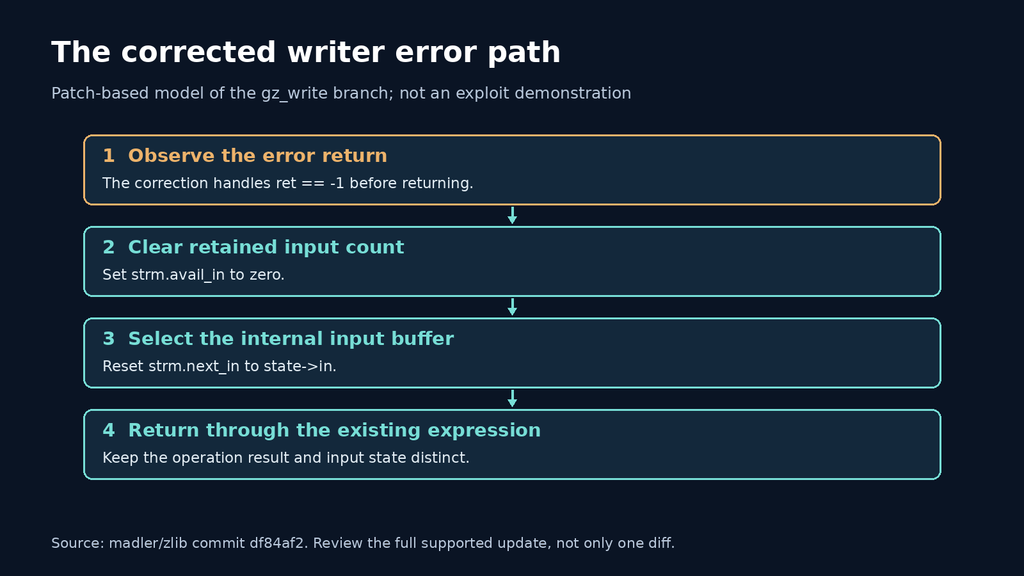
ה upstream fix df84af2 changes the error-return branch in gz_write. Before returning when ret is -1, it clears strm.avail_in and points strm.next_in back to the internal input buffer. Those assignments are visible in the patch; they are more precise evidence than a generic claim that the patch adds bounds checks everywhere.
The practical interpretation is that pending-input metadata must describe storage the next operation can legitimately use. After an interrupted operation, preserving a pointer and count from a different buffer context can violate that expectation. This is an explanation of the state boundary addressed by the diff, not a claim that we reproduced the reported memory corruption.
In the maintainer discussion, the owner identifies the correction and advises against selecting only that change when other fixes are also available. Prefer your supplier’s reviewed update or a supported upstream release containing the correction. A commit link is useful for tracing provenance; it is not a reason to replace a distribution’s package-management process with an improvised production build.
Ubuntu fixes and the limits of version matching
| Ubuntu release | USN-listed corrected zlib package version |
|---|---|
| 26.10 | 1:1.3.dfsg+really1.3.2-3ubuntu1.1 |
| 26.04 LTS | 1:1.3.dfsg+really1.3.1-1ubuntu3.2 |
| 24.04 LTS | 1:1.3.dfsg-3.1ubuntu2.3 |
ה security notice lists runtime and development package variants. Record all installed architectures and the package used by the workload. Do not compare these strings as ordinary text or remove the epoch and distribution revision: those fields are part of the package identity that distinguishes a corrected backport from its predecessor.
ה Debian security tracker separately tracks its own packages and lists 1:1.3.dfsg+really1.3.2-4 as the unstable fix reference. That is not an instruction to install an unstable package on a stable system. Consult the entry for the exact release and follow its supported update route; an Ubuntu fixed version is not a Debian fixed version.
Where a supplier still says “needs evaluation” or marks a branch vulnerable, preserve that status in the review. Absence of an update in one repository is not evidence that the application is safe. Equally, a package backport can correct a defect without changing the upstream-looking portion of the version string. Keep supplier status and application reachability as separate findings.
Collect a read-only inventory before changing packages
On an owned Debian-family system, the following commands use dpkg-query’s package fields ו dpkg’s version comparison to collect inventory and compare the installed runtime package against a fixed reference. They install nothing. Run the comparison only for the matching Ubuntu 24.04 package line shown in this example; its result says nothing about an unrelated distribution or a statically embedded library.
# Run only after confirming the Ubuntu 24.04 package line.
dpkg-query -W -f='${binary:Package}\t${Version}\t${Architecture}\t${db:Status-Abbrev}\n' \
  'zlib1g*' 'lib32z1*' 'lib64z1*' 'libx32z1*'
apt-cache policy zlib1g

# Compare the installed runtime package against this release's reference.
installed_version=$(dpkg-query -W -f='${Version}' zlib1g) || exit 1
if dpkg --compare-versions "$installed_version" ge \
  '1:1.3.dfsg-3.1ubuntu2.3'; then
    printf '%s\n' 'Version meets reference; verify package status and origin.'
else
    printf '%s\n' 'Version is below the stated reference; review the update.'
fi
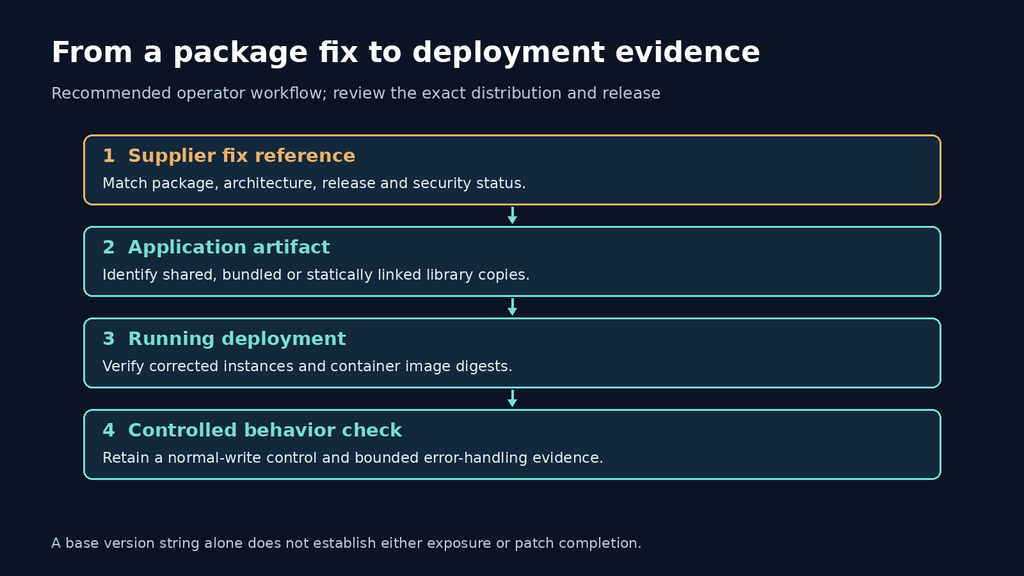
A missing-package message is not a clean bill of health. The application may use a bundled or statically linked copy, a container filesystem, or a runtime supplied by another vendor. An installed package may also be unrelated to the process being assessed. Preserve the command output as inventory evidence and then map it to the workload.
For source-built software, record the source revision, patch set, build recipe and resulting artifact identity. For a vendor-delivered appliance or application bundle, obtain that vendor’s assessment instead of changing files inside the product without a supported procedure. The relevant question is which copy executes, not which development package happens to be visible in the administrator’s shell.
Turn patch completion into deployment evidence
Plan the update around the affected workload. For a dynamically linked application, verify its selected library and restart through the normal deployment process when required to load the corrected copy. For a statically linked application, replace or rebuild the application artifact. Updating a shared system library cannot establish that a separate embedded copy changed.
For containers, update reviewed build inputs and recreate the workload from the corrected image. Keep the image digest and running deployment identity together. A package inventory taken from a new image does not show that every old replica was replaced; an update inside one running container does not correct the image that will create its successor.
| ראיות | Question it answers | What remains |
|---|---|---|
| Supplier CVE status | Which package revision addresses the issue? | Identify the workload’s actual copy |
| Build and artifact record | Did corrected inputs reach the deliverable? | Verify deployment and active instances |
| Runtime inventory | Which copy does this workload use? | Check relevant writer behavior |
| Controlled regression | Does the intended workflow still behave correctly? | A passing test does not prove universal non-exploitability |
Use bounded regression tests instead of a production crash attempt
In a controlled engineering test, exercise the application’s ordinary writer workflow and its supported error handling with synthetic data. If non-blocking output is part of the product, use an isolated test harness to control that prerequisite and observe recovery. Compare expected output, error reporting and termination with a normal-write control. Keep the exact library build and test conditions with the result.
Do not run an internet proof of concept against a production service merely to decide whether to update a vendor-marked vulnerable package. A crash alone would not establish exploitability or explain the input-to-writer path. If a crash has already occurred, retain the relevant diagnostic artifacts through the incident process while handling credentials and customer data appropriately.
The useful closure record ties a supplier fix to an application artifact, a deployed instance and a bounded behavior check. If reachability remains unresolved, say so while proceeding with the supported update. That produces a decision another engineer can audit without pretending that a version string or a clean test run answered every security question.

 Hebrew
 English
 German
 French
 Spanish
 Portuguese
 Japanese
 Korean
 Hindi
 Arabic
 Turkish