
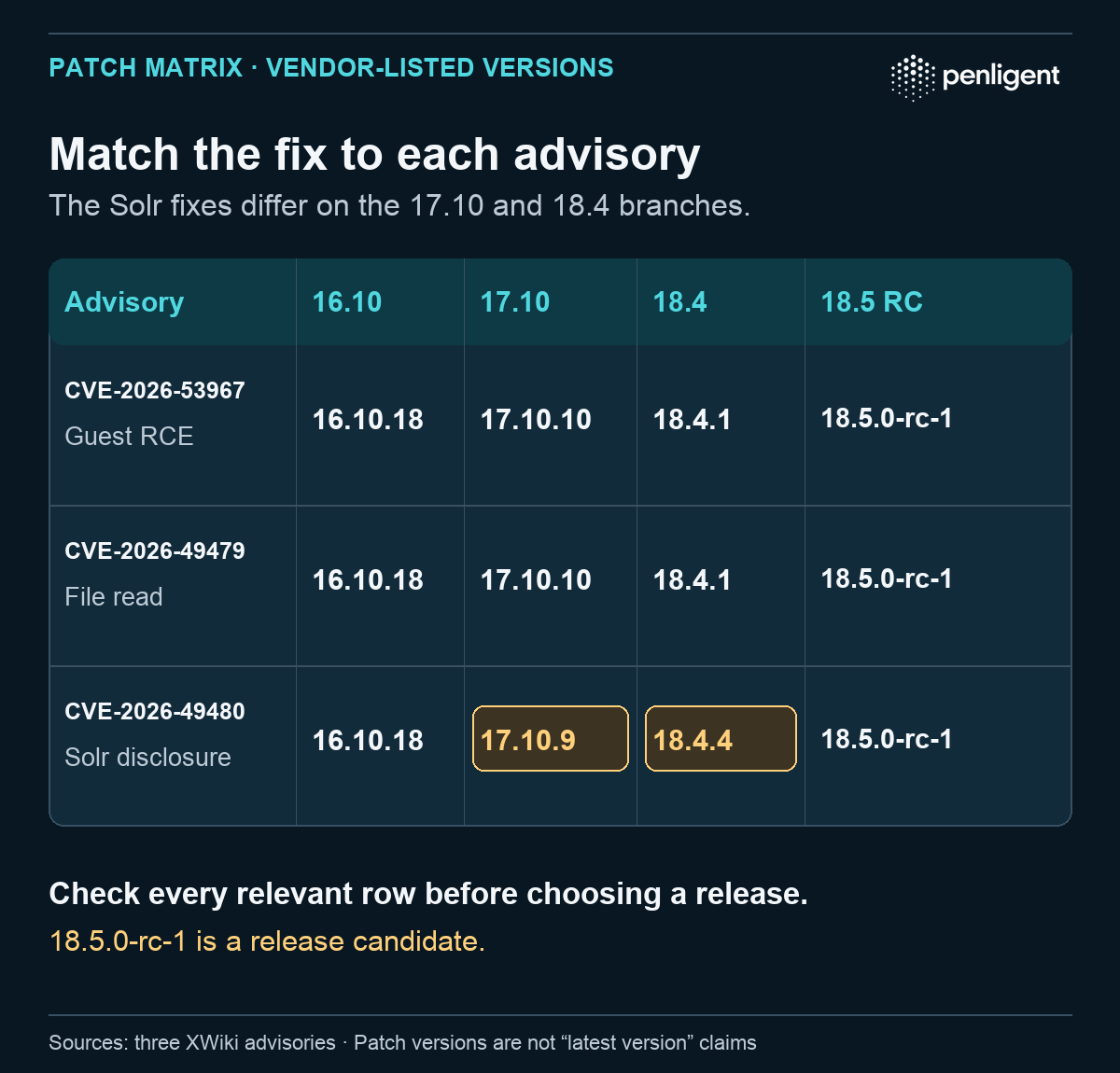
Three XWiki guest-access advisories require separate checks, and their fixed versions do not line up on every branch. CVE-2026-53967 concerns code execution through UserDirectoryMacros; CVE-2026-49479 concerns temporary-resource path traversal; CVE-2026-49480 concerns Solr disclosure of XObject data. On the 18.4 branch, the first two list 18.4.1 as fixed, while the Solr issue lists 18.4.4. Closing all three findings after checking only the RCE version would miss that difference.
XWiki published the three official repository advisories on November 16, 2026. The matrix below reconciles their release lists, followed by checks for the distinct code, configuration and index state involved. These issues are assessed independently; the cited sources do not establish an exploit chain connecting them.
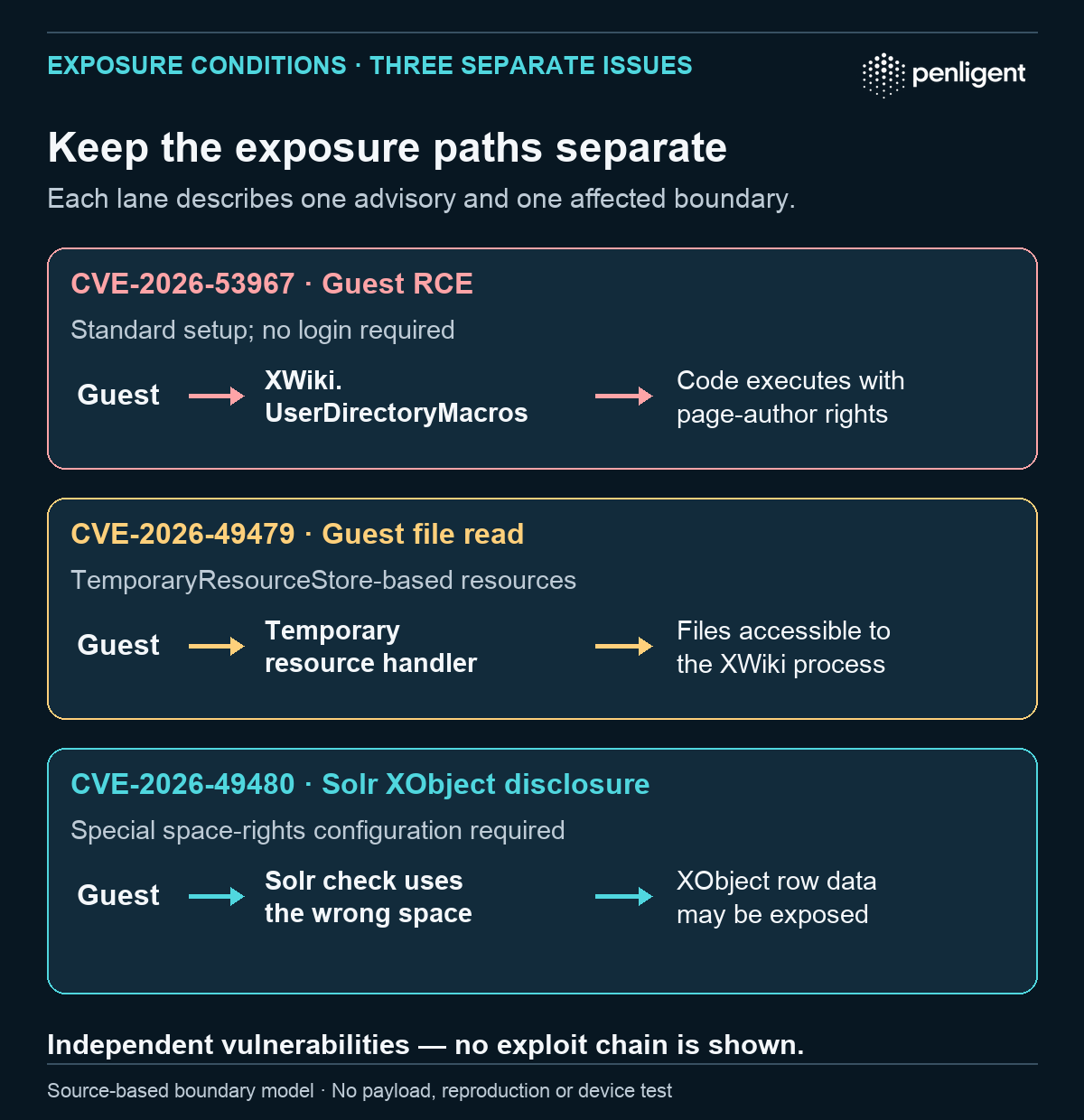
Separate the three guest-access conditions
| Issue | What the advisory establishes | Condition to preserve in the assessment |
|---|---|---|
| CVE-2026-53967 | A crafted page name can cause wiki content to execute with the rights of the XWiki.UserDirectoryMacros page author. | The advisory describes guest access in a standard setup, without credentials or user interaction. |
| CVE-2026-49479 | A guest can read files through endpoints backed by TemporaryResourceStore, including the temporary-resource endpoint. | Readable files are bounded by the XWiki process’s filesystem permissions. The advisory does not describe file writing. |
| CVE-2026-49480 | Solr can expose XObject content from view-restricted pages because access is checked against the wrong space. | The advisory requires a special rights configuration involving permissions set on spaces. Do not assume every installation has it. |
These distinctions affect both urgency and evidence. A successful login restriction on one page does not demonstrate that every guest-facing resource is protected. Conversely, the Solr configuration prerequisite should not be silently applied to the other two issues. Record the installed components, relevant permissions and exposed routes separately.
Use the complete branch matrix
The following versions are transcribed from the three linked advisories. The last column is a derived comparison: the highest listed fix point needed to cover all three on that row. It is not a statement that each branch remains supported today or a substitute for the release’s upgrade instructions.
| Release line | 53967: UserDirectoryMacros | 49479: temporary resources | 49480: Solr objects | Combined listed fix point |
|---|---|---|---|---|
| 16.10 | 16.10.18 | 16.10.18 | 16.10.18 | 16.10.18 |
| 17.10 | 17.10.10 | 17.10.10 | 17.10.9 | 17.10.10 |
| 18.4 | 18.4.1 | 18.4.1 | 18.4.4 | 18.4.4 |
| 18.5 release candidate | 18.5.0-rc-1 | 18.5.0-rc-1 | 18.5.0-rc-1 | 18.5.0-rc-1 — prerelease |
The 17.10 row demonstrates the opposite trap from 18.4: reaching the Solr fix at 17.10.9 does not reach the listed fixes for the other two. Keep the release-candidate qualifier intact as well. 18.5.0-rc-1 is not the same identifier as a stable 18.5.0 release, and its presence in an advisory is not a recommendation to move production onto a prerelease. Select an appropriate maintained release and verify that it includes all required fixes.
When a deployment uses vendor backports or locally modified packages, a version comparison alone may be inconclusive. Obtain the provider’s patch evidence for each issue. For branches absent from this table, establish a supported upgrade route rather than inventing a matching patch number.
A page workaround covers only the RCE finding
ה UserDirectoryMacros advisory permits applying the specified changes to that wiki page on an impacted instance. Its referenced upstream commit changes the customization messages and link construction, including how translation content and dynamic values are rendered. This is a specific vendor-provided alternative for CVE-2026-53967.
Keep the changed page content, any local customizations and the reviewed upstream difference in the maintenance record. Verify that the deployed wiki contains the intended change and that the user directory still works. Do not turn this into an improvised patch for the Java temporary-resource component or the Solr implementation. Their advisories list no known workaround other than updating.
Patch inspection reveals two different completion checks
For the traversal issue, the initial upstream change introduces normalized path handling and containment checks. The advisory also references a follow-up change that adjusts the temporary-directory handling and adds further checks. For a backport review, checking only the first commit would leave out part of the vendor-linked evidence. Prefer the complete released correction; do not copy isolated code fragments into production.
ה Solr patch changes object metadata construction and includes a migration intended to have existing object-bearing documents reindexed. That makes upgrade completion relevant to the review: check the migration and indexing steps applicable to the deployed release, including any errors. The observation comes from reading upstream code; it is not a claim that an index migration was executed in a Penligent test.
Do not interpret the migration code as an instruction to issue manual index-deletion queries. Follow the release-specific upgrade process and keep its completion evidence. A newly installed package and an unexplained migration failure should not be recorded as the same outcome.
Verify intended access with harmless content
Start with an inventory of the active XWiki release, component builds, customized user-directory pages and the rights model used by the affected wiki. Identify the approved guest-access paths through proxies and application routes. Keep the assessment within the operator’s scope; there is no need to execute server commands or attempt to retrieve real system files to perform this configuration and patch review.
For an authorized staging check of search permissions, use a synthetic page and XObject containing harmless marker text, with a rights setup representative of the deployment. Compare the intended reader’s access with an anonymous session, and confirm that normal authorized search still works after the upgrade. This is a proposed validation method, not a published reproduction of CVE-2026-49480. A negative result in one rights arrangement does not prove that every arrangement is safe.
| Finding | Evidence needed for closure |
|---|---|
| UserDirectoryMacros RCE | Corrected component/release or the exact documented page change; active page content; functional user-directory checks. |
| Temporary-resource file disclosure | Corrected release or complete backport evidence, including the referenced follow-up; active component confirmation; normal temporary-resource behavior. |
| Solr XObject disclosure | Corrected release; relevant upgrade/indexing completion; recorded rights configuration; harmless authorized-versus-guest checks. |
Restricting an external route can reduce tested reachability, but it does not prove the underlying component is corrected. Retain the three findings separately if only one has been patched, one mitigated and one left unresolved. A single “XWiki updated” checkbox cannot express those outcomes.
When using Penligent during an authorized application assessment, keep those distinct source and deployment records attached to the assessment conclusion. No automatic coverage of these specific CVEs is asserted here. The Penligent 3.0 video below is a general workflow demonstration, not evidence of an XWiki exploit chain or a tested fix.
Method: this analysis used AI assistance to reconcile XWiki’s official advisories and inspect their linked commits on November 27, 2026. The combined fix points and verification plan are derived analysis. No XWiki instance was tested, and no exploitation or compromise was observed in this work.
 Hebrew
 English
 German
 French
 Spanish
 Portuguese
 Japanese
 Korean
 Hindi
 Arabic
 Turkish