
CVE-2026-129483 is a critical authentication bypass in the SRP server mechanism of Cyrus SASL through version 2.1.28. A remote client can supply an invalid public value that causes the server’s shared secret to become predictable, allowing authentication as an existing user without that user’s password. The affected component is the SRP mechanism, so the immediate operational task is to establish whether an exposed service actually loads and permits SRP. The CVE record assigns CVSS 4.0 severity 9.3 and CVSS 3.1 severity 9.1.
The remediation detail is easy to miss: the November 12 upstream change removes the SRP plugin and its supporting build integration. It does not introduce a new validated SRP implementation. On November 17, 2026, the repository’s latest published release remained Cyrus SASL 2.1.28, released in February 2022. A remediation plan therefore needs a distribution-specific fixed package, an approved backport, or verified removal of SRP from the affected service’s effective mechanisms.
Three dates describe three different events
| Date | प्रमाण | कार्यात्मक अर्थ |
|---|---|---|
| July 31, 2026 | The original upstream security report was opened. | The technical issue was public months before CVE publication. |
| November 12, 2026 | The upstream SRP-removal commit was authored. | A code change exists; its presence in a deployed package still requires verification. |
| November 15, 2026 | CVE-2026-129483 was published. | Inventory and vendor advisories can now converge on a common identifier. |
These dates do not prove the date of any compromise. The sources reviewed establish public technical details and a remediation change. They do not establish a confirmed in-the-wild exploitation campaign.
The failed boundary is public-value validation
SRP is intended to let a client demonstrate knowledge of a password-derived secret without sending the password itself. The original report identifies a server-side check that fails to reject public values divisible by the negotiated modulus. Such a value collapses the calculation into a predictable shared secret, so a proof derived from that secret no longer demonstrates password knowledge. The CVE describes both unauthorized authentication and knowledge of session keys.
This is not evidence that every SASL mechanism has the same flaw. The identified code is plugins/srp.c, specifically the SRP server flow. Nor should an inventory match on the Cyrus SASL library alone be equated with a reachable bypass. The service must expose the affected mechanism for this path to be relevant.
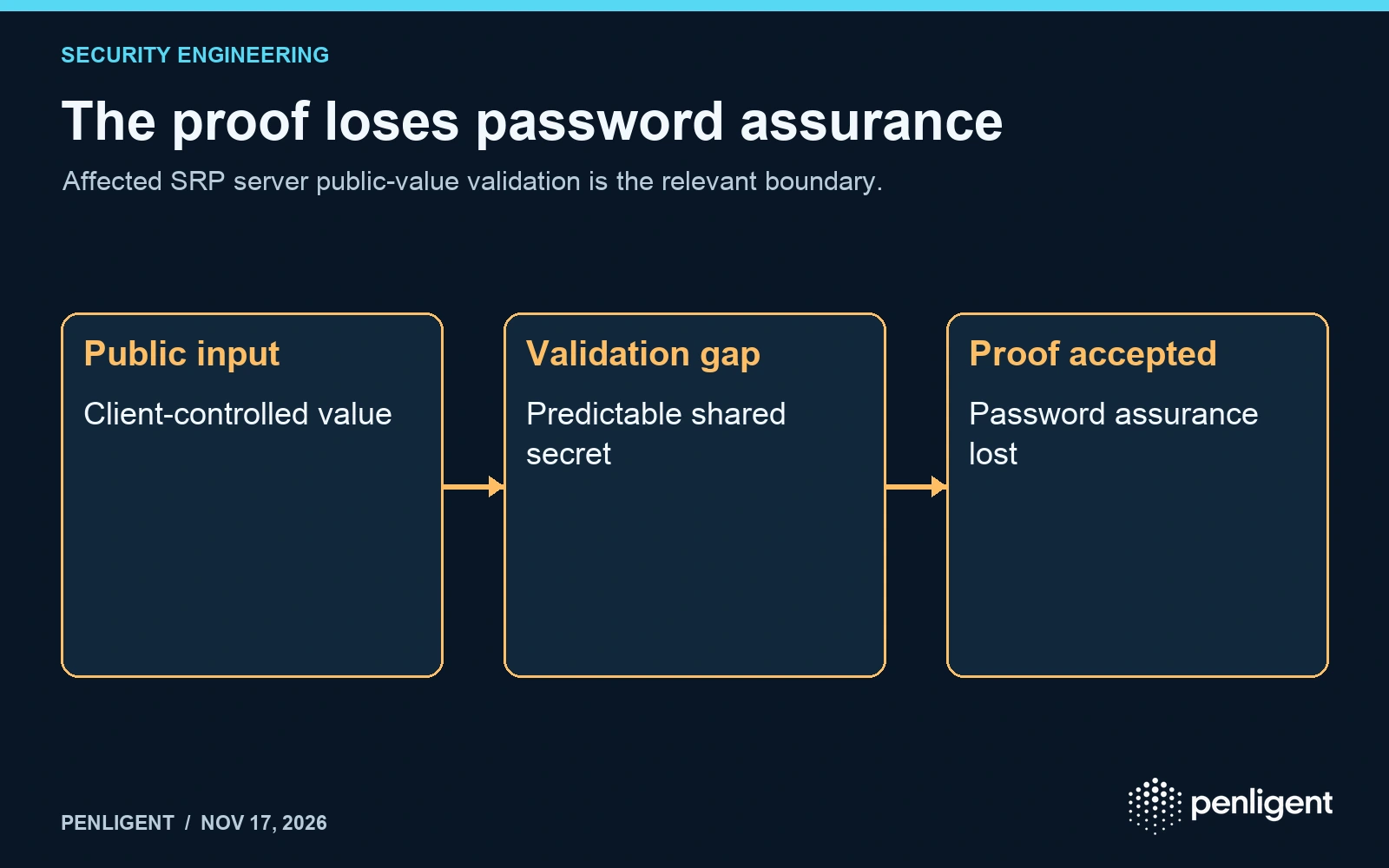
Transport encryption does not repair this validation error. As an operational inference, a TLS connection can still carry input to a vulnerable SRP mechanism after the transport is established. The required question is which authentication mechanism the server accepts on that connection. A successful TLS handshake is not evidence that the SASL authentication logic is fixed.
The upstream fix removes a feature, which changes the deployment plan
The patch deletes plugins/srp.c, the --enable-srp और --enable-srp-setpass configuration options, plugin build rules, static-plugin hooks, initialization entries, and current documentation references. Its rationale is that the SRP SASL mechanism remained an expired Internet-Draft and was never standardized as a SASL RFC. This does not mean that the underlying SRP protocol itself lacks published RFCs.
For an owner who depended on SRP, successful deployment can therefore mean that an existing client can no longer negotiate its former authentication mechanism. Treat client compatibility and security closure as separate acceptance criteria. The approved replacement must be supported by the service, clients, account-secret storage, and transport policy; the CVE does not identify one universally correct replacement for every deployment.
For an owner who never intended to use SRP, the important question is whether an optional plugin became available implicitly. The official Cyrus SASL options documentation says that mech_list restricts an application to a subset of installed mechanisms. Its default is an empty list, meaning all available plugins. That makes a deliberately maintained mechanism allowlist useful even when a package contains more mechanisms than the service requires.
Evaluate four layers instead of relying on a package name
| परत | Evidence to collect | Decision enabled |
|---|---|---|
| Build and package | Vendor advisory, package revision, build options, and whether the SRP removal or a vendor-approved fix is included. | Determine whether affected code is present in the deployed artifact. |
| Plugin availability | Dynamic plugin installation and loading, or static plugin build records. | Determine whether SRP can be supplied to the service. |
| Service policy | The actual application’s SASL configuration and effective mechanism allowlist. | Determine whether that service permits SRP. |
| Reachable authentication surface | Mechanisms offered on the authorized service endpoint in its real transport state, plus service logs or configuration evidence. | Determine whether clients can select the affected path. |
These layers answer different questions. A source tree with the removal commit does not prove that production uses its build. An absent shared plugin file is insufficient if SRP was linked statically. A correct configuration file does not prove that a long-running process has loaded it. A mechanism list collected before transport negotiation may not describe the policy after TLS. These are deployment-analysis cautions, not claims that every Cyrus SASL consumer behaves identically.
Contain the mechanism and verify the process
When immediate package replacement is unavailable, restrict the affected service to its approved mechanisms and exclude SRP using the service’s supported configuration path. In Cyrus SASL’s own configuration vocabulary, mech_list is an allowlist, not a denylist. Do not paste a universal example containing another mechanism merely to remove SRP; that could change authentication behavior beyond the intended containment.
Record the service-specific configuration location, effective mechanism list, account paths that depend on SRP, and required reload or restart procedure. After applying the change, verify the effective list again and perform a normal authorized login with the intended replacement mechanism. Where service capability advertisement is available, collect it in the same transport state that clients actually use. Pair that observation with configuration or process evidence rather than treating a single banner as definitive.
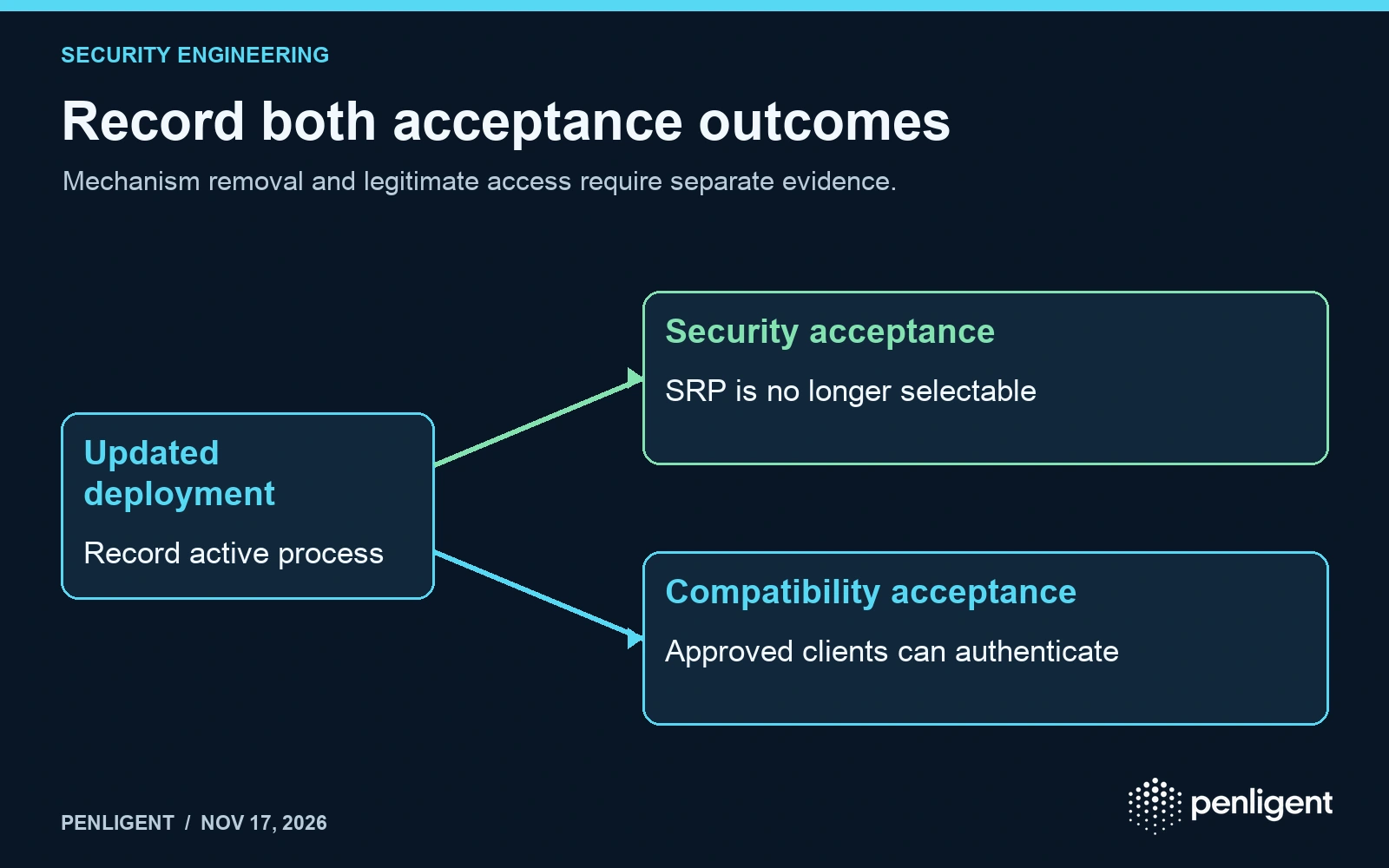
If a vendor provides a patched package while retaining the upstream 2.1.28 version string, preserve its complete package revision and advisory mapping. The version alone cannot distinguish an affected upstream build from a distribution backport. If the package removes SRP, confirm that the running service no longer loads the old plugin and that any static builds have been replaced. The upstream commit’s coverage of static hooks is the reason a shared-library-only inventory can miss part of the task.
Keep remediation evidence separate from incident evidence
Removing SRP establishes a stronger future authentication boundary, but it does not determine what happened before the change. If the vulnerable mechanism was exposed, preserve relevant authentication records and investigate unexpected account use according to the service’s logging capabilities. The reviewed sources provide no universal log signature and no reliable rule that the absence of failed logins excludes this bypass.
A defensible closure record includes the affected service and owner, the vendor or patch evidence, the before-and-after effective mechanisms, the loaded deployment revision, and a normal authentication check. Record any unavailable evidence. This is more useful than closing solely because a scanner no longer reports the library version, or because the public CVE entry lists a patch link.
For teams using पेनलिजेंट to organize authorized validation, the relevant evidence is the authentication boundary that the running service accepts. Keep configuration and package findings linked to that boundary so that an update can be retested without assuming that every service using the same library exposes the same mechanism.
The official Penligent video below demonstrates the general product workflow. It is not a reproduction or remediation test of CVE-2026-129483.
Method: This article was prepared with AI assistance and checked against the CVE record, upstream report, source-removal patch, release metadata, and Cyrus SASL configuration documentation on November 17, 2026. No authentication bypass was executed. The four-layer assessment and closure criteria are operational analysis; vendor package status and a particular service’s effective configuration must be established for that deployment.
 Hindi
 English
 German
 French
 Spanish
 Portuguese
 Japanese
 Korean
 Arabic
 Turkish
 Hebrew