
Silverstripe Framework 6.2.13 fixes eight CVEs and the separate SS-2026-004 password-reset issue. The highest-impact path, CVE-2026-91115, allows code execution through the i18nTextCollectorTask writer option: a site in development mode needed no login, while an administrator on another affected site could be induced to run the task by following a link. The official advisory identifies affected Framework versions from 6.0.0 to before 6.2.13 and explicitly says CMS 5 is not affected by this CVE.
The 6.2.13 release was published on October 28, 2026, with repository security advisories following on October 29. Their appearance in later feeds does not make them new November 17 disclosures. For an application still below the fixed release, the useful task is to verify the affected permission boundaries and the deployed package—not simply to count the CVE identifiers.
The nine fixes cross four different boundaries
The release’s fixes fall into development tasks, object authorization, rendered content, and account recovery. Each group needs a different post-update check.
| Issue | Relevant prerequisite or boundary | First fixed Framework release |
|---|---|---|
| CVE-2026-91115: development-task RCE | Writer option reaches the injector; dev mode permits unauthenticated access, or an administrator follows a crafted task link. | 6.2.13; affected range 6.0.0–6.2.12. |
| CVE-2026-91112: group privilege escalation | A user has CMS_ACCESS_SecurityAdmin but lacks ADMIN; indirect privileges through roles or parent groups matter. | 6.2.13 |
| CVE-2026-91113: record-type authorization | A GridField editor changes a record into a class they are not authorized to create or edit. | 6.2.13 |
| CVE-2026-88989: record-creation authorization | A CMS user can edit through GridField but lacks permission to create the new record. | 6.2.13 |
| CVE-2026-88987: XHTML/XML data URI XSS | A CMS author supplies content that another user views. | 6.2.13 |
| CVE-2026-88988: SVG data URI XSS | A CMS author supplies content that another user views. | 6.2.13 |
| CVE-2026-91110: control-byte URL XSS | HTML sanitization fails to remove script URLs with certain leading control bytes. | 6.2.13 |
| CVE-2026-91114: permission-field stored XSS | A user with access to the Security section stores unoffered permission codes that are rendered without escaping. | 6.2.13 |
| SS-2026-004: password-reset token account binding | The patch binds token validation to the current member and expiration. | 6.2.13, per the release changelog. |
Except for CVE-2026-91115’s explicit 6.0.0 lower bound, the referenced CVE advisories list affected versions as earlier than 6.2.13. Do not apply the statement “CMS 5 is unaffected” from the RCE advisory to the other issues. For a deployment on a different maintained branch, obtain that branch’s vendor remediation evidence rather than treating a CMS marketing version as a complete package inventory.
The RCE patch has two independent parts
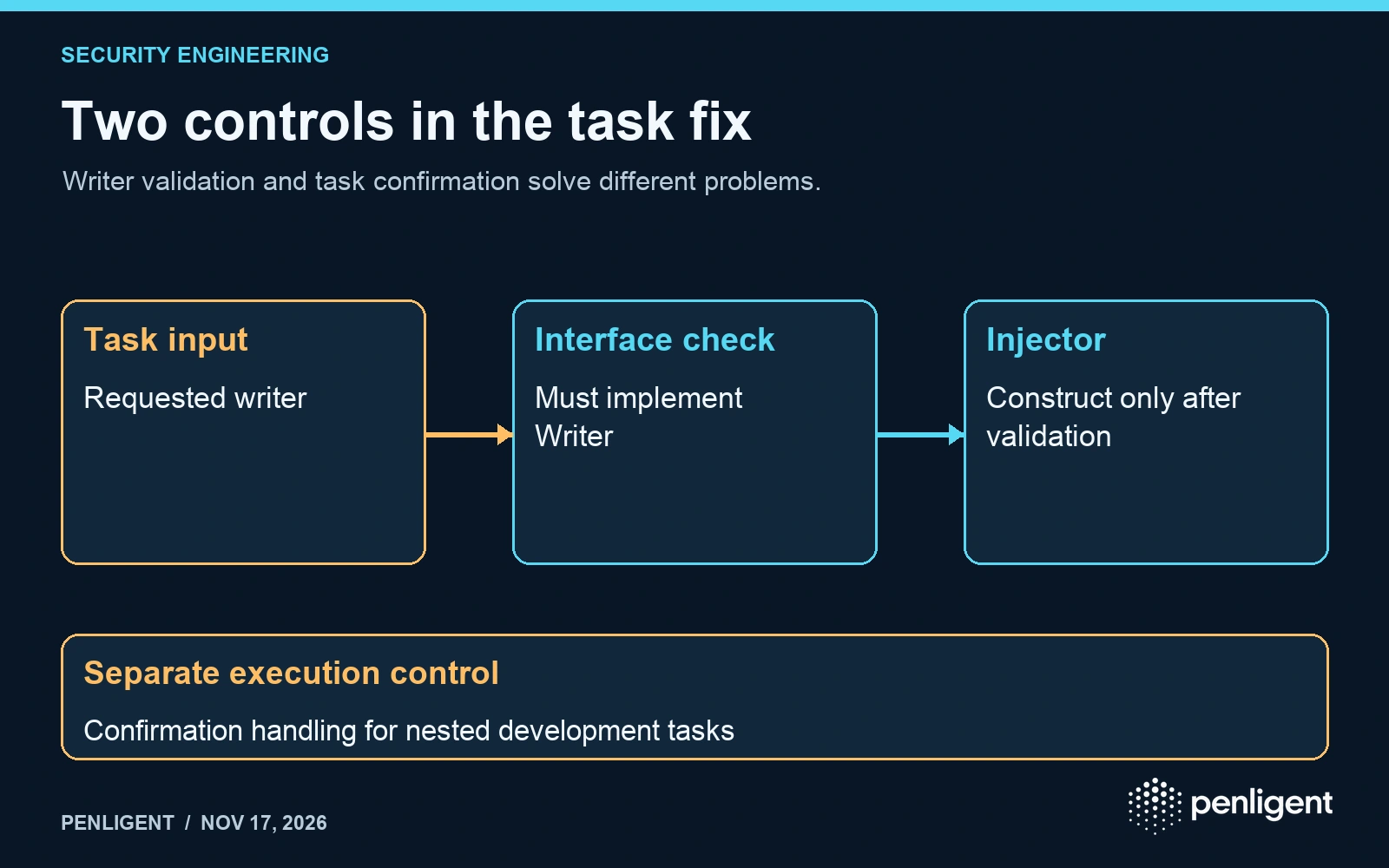
The RCE patch first checks that the requested writer class implements the expected Writer interface before passing it to the injector. Its tests reject non-writer classes and constructor-argument specifications without constructing the test object. This establishes a narrower object-creation boundary.
The same patch also corrects development-task confirmation middleware. It walks a nested task path back to its registered route when evaluating access to the confirmation flow. The two changes serve different purposes: interface validation limits what the task can construct; confirmation behavior addresses how a user can be led into running it. Verifying only the presence of a confirmation screen does not establish that writer validation is fixed.
Prioritize any production-facing deployment still in development mode, then review access to development tasks in the remaining environments. Restricting that surface is useful containment, but the other eight fixes include authenticated CMS paths that remain relevant to ordinary editors and delegated security administrators.
Permission checks must follow the object that will exist after the save
CVE-2026-88989 and CVE-2026-91113 are related in workflow but distinct in enforcement. The creation fix checks canCreate when the record has no ID. That closes a path where permission to edit through a form could be used to create a record directly.
The class-change fix constrains the requested class to the GridField list’s hierarchy and checks create and edit permission on the new type. A permission decision made only on the original record cannot authorize every type the request might turn it into.
For application-specific models, that suggests a focused staging regression matrix: editing an existing permitted record still works; creating a forbidden record fails; converting to an unrelated class fails; and a valid in-hierarchy conversion succeeds only with the target type’s required permissions. Use controlled test records and the upstream regression tests as references. Do not exercise arbitrary object construction or code execution on the live CMS to prove the update.
Effective administrator privilege includes inheritance and roles
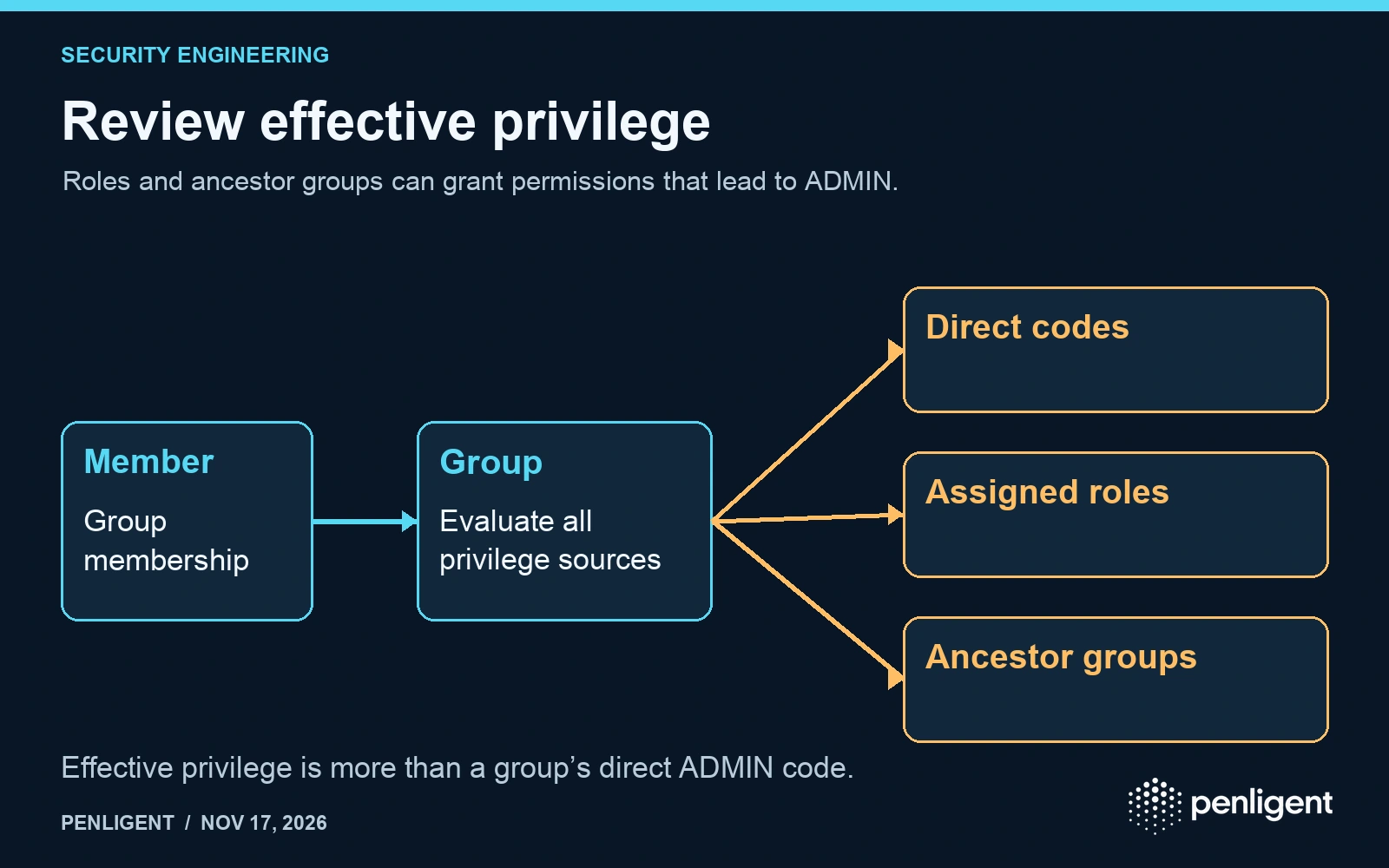
In CVE-2026-91112, checking only a group’s directly assigned ADMIN code missed other paths to equivalent privilege. The patch evaluates ancestor groups and assigned permission roles when determining whether a delegated security administrator may edit a group. Its tests also cover privileges that can lead to ADMIN, including role assignment.
Model the review as a graph: user membership, group ancestors, role assignments, and the permissions they grant. A flat list of direct group codes is incomplete evidence. Confirm that legitimate delegated administration still works for ordinary groups while groups that confer escalating permissions remain protected.
Rendering and password recovery require separate acceptance evidence
The content-sanitization advisories concern three input classes: XHTML/XML data URIs, SVG data URIs, and script URLs with control-byte prefixes. The permission-field issue is a different stored-data path because the field accepted codes it did not offer and rendered them unescaped. Verify the relevant sanitizer and field behavior in staging using the upstream regression cases and the same rendering surfaces your application uses.
The SS-2026-004 patch provides a useful account-recovery distinction. It replaces a global autologin-hash lookup with a lookup requiring the current member’s ID, the token hash, and a future expiration, and rejects a member without an ID or an empty hash. A regression test specifically covers legacy member records without salt. This is patch-derived evidence of the corrected binding; it should not be generalized into a claim that every reset token on every earlier installation could take over every account.
Verify the deployed Framework package, then its boundaries
From the actual application release directory, record the installed package and resolved dependency state:
composer show silverstripe/framework
composer audit
These are inventory inputs, not the complete acceptance test. Confirm the deployed artifact corresponds to the reviewed lockfile and that each running instance received it. For custom forks or backports, preserve the exact commits and the relevant regression results; a version banner alone cannot prove a partial patch is complete.
A concise closure record should include development-mode status and task access, a controlled editor’s create/edit/convert results, delegated group-administration results, rendering checks, and account-bound reset-token checks. Associate each result with its issue group rather than using one generic “CMS login passed” observation for all nine fixes.
Teams using पेनलिजेंट for authorized application validation can preserve these role and object boundaries as retest criteria. The evidence should show the intended denied operation and the legitimate operation that still succeeds, so a security fix is distinguishable from a broken feature.
The official Penligent video below demonstrates the general workflow. It does not demonstrate exploitation or independent verification of the Silverstripe issues described here.
Method: AI-assisted analysis checked against official Silverstripe repository advisories, release metadata, and the relevant source patches on November 17, 2026. No CMS exploit or regression suite was executed. The permission matrix and closure workflow are operational analysis of the verified changes; no active exploitation campaign is asserted.
 Hindi
 English
 German
 French
 Spanish
 Portuguese
 Japanese
 Korean
 Arabic
 Turkish
 Hebrew