
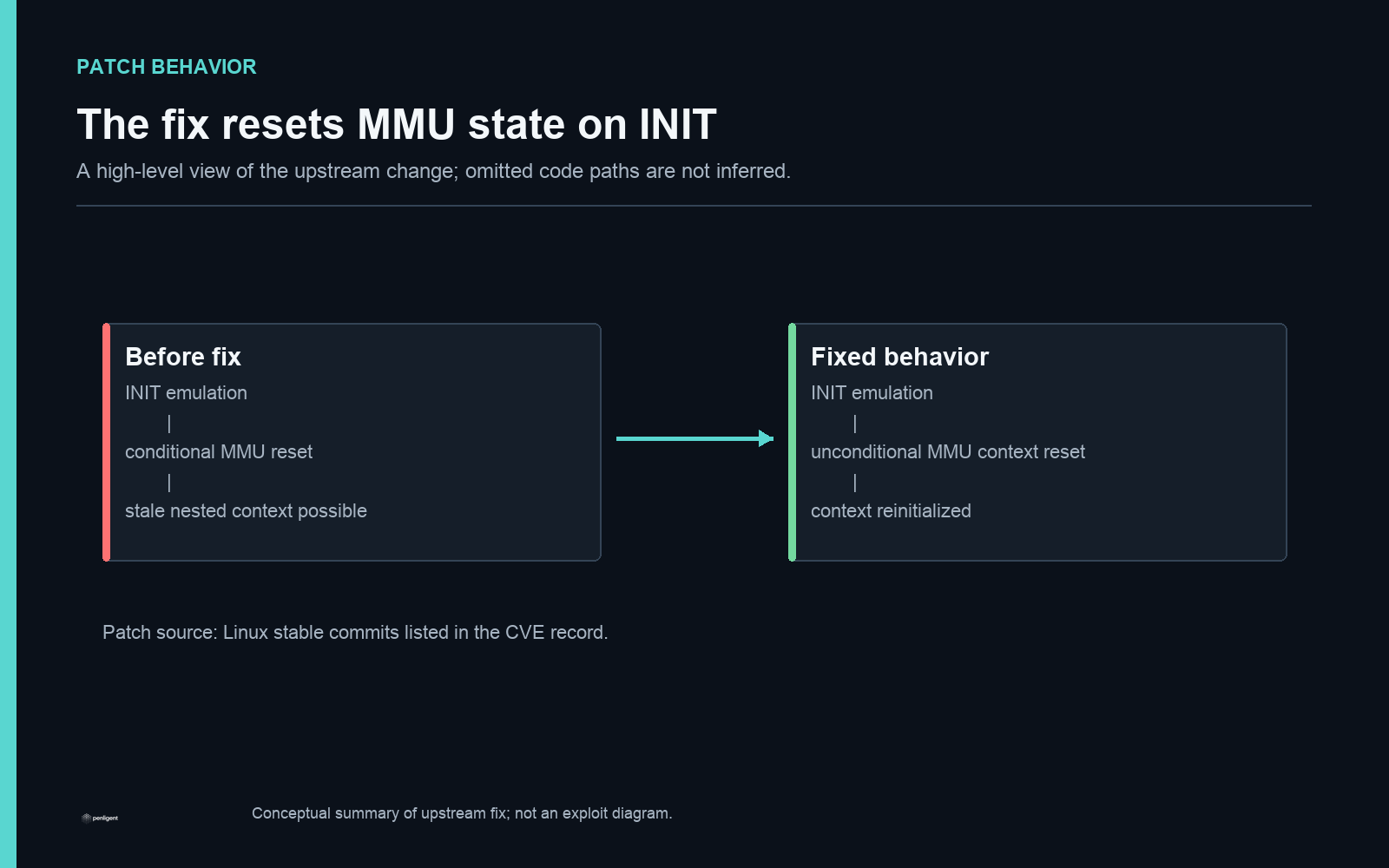
CVE-2026-99312 concerns KVM’s handling of an INIT event while emulating nested SVM. The Linux stable fix resets the MMU context unconditionally when emulating INIT. The CVE record describes stale MMU state when an L2 guest is running with paging disabled and identifies nested SVM as the relevant path. This is a host-kernel issue, so inventory and patch decisions belong to the team operating the KVM host.
Do not reduce the advisory to “every KVM guest can read host memory.” The CVE record’s technical scenario is narrower and configuration-dependent. Its CVSS 3.1 score is HIGH (8.8), but the record also describes local access requirements and a nested-virtualization path. A high score is a prioritization signal, not evidence that a particular fleet has the preconditions or has been attacked.
Scope your host inventory
Prioritize Linux systems that run KVM on AMD processors and allow nested SVM. Determine this from the host CPU and virtualization configuration plus the organization’s VM policy. A guest administrator’s ability to create and run VMs is a relevant access boundary in the CVE scenario. Keep the assessment on the host: the guest’s displayed kernel version does not tell you whether the hypervisor has the fix.
The CVE record describes the issue as specific to nested SVM. It notes that INIT is an unconditional intercept on VMX, so the same emulation path is not available for Intel VMX in the described scenario. This is a scoped statement about the recorded path, not a general conclusion that all Intel virtualization vulnerabilities are excluded.
Verify the fixed build
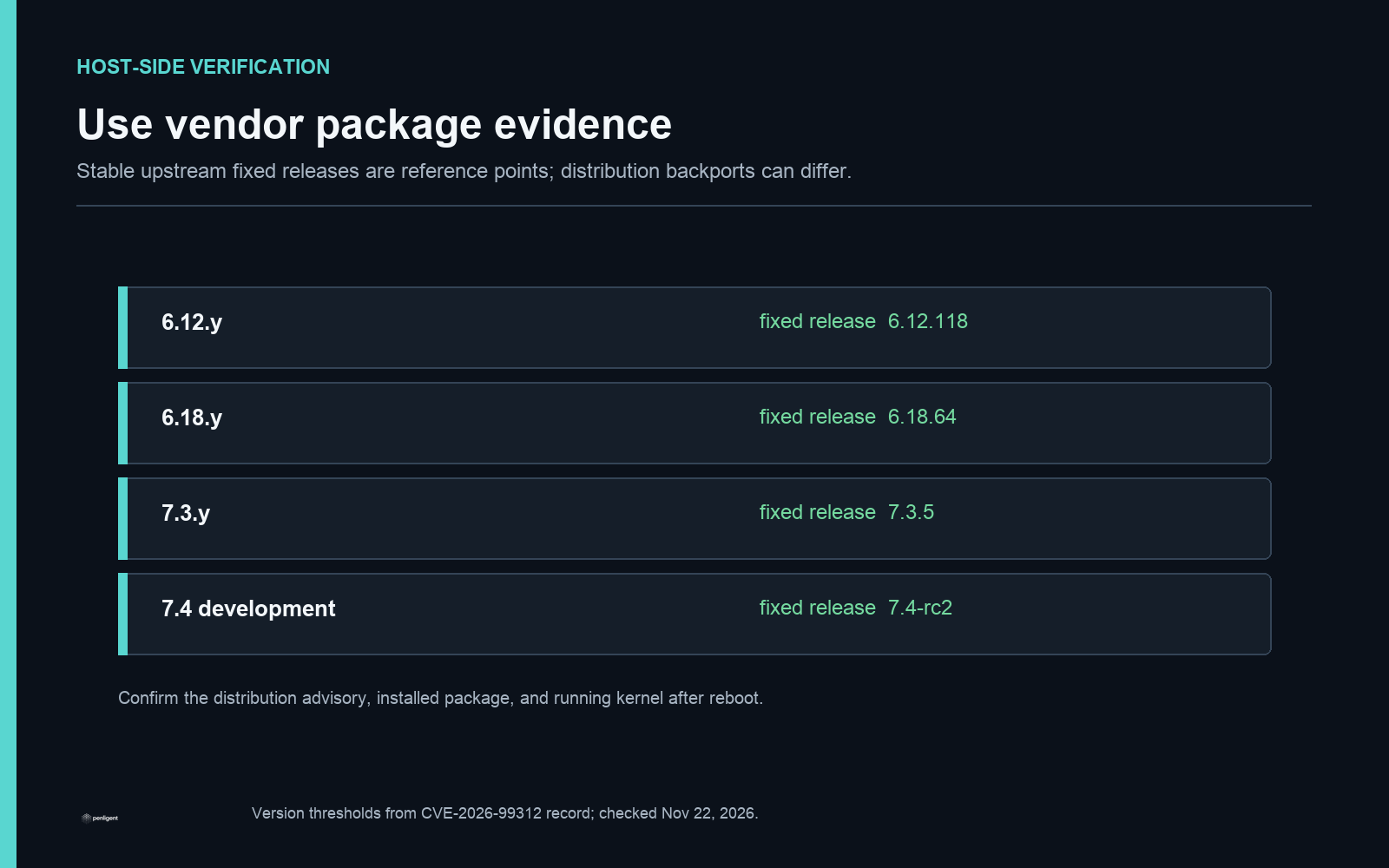
The Linux stable references list fixes in these upstream lines:
| Stable line | Fixed release listed in CVE record |
|---|---|
| 6.12.y | 6.12.118 |
| 6.18.y | 6.18.64 |
| 7.3.y | 7.3.5 |
| 7.4 development | 7.4-rc2 |
The record also includes older affected commit ranges. Do not treat this table as a universal minimum for every vendor kernel. Enterprise distributions backport fixes while retaining an older-looking base version. For each host, use the distribution security advisory or package changelog to map the installed kernel package to the relevant stable fix. Preserve the package release string and vendor reference.
On each hypervisor, record distribution, kernel package release, CPU vendor and model, KVM module state, nested-SVM policy, and whether untrusted users can create VMs. Compare the package against the distribution’s fixed build. After maintenance, reboot into the corrected kernel, confirm the running release, and verify the vendor package state. Installing a patched package without booting into it does not close exposure.
A practical decision path
| Host finding | Response |
|---|---|
| KVM is not deployed | Record the platform as out of scope for this host issue and keep the evidence date. |
| KVM is deployed, nested SVM is disabled and cannot be enabled by tenants | Patch according to normal kernel policy; document the current configuration as a temporary exposure reduction. |
| Nested SVM is enabled or tenant-controlled, and no vendor fix is verified | Prioritize the host patch and restrict untrusted VM creation until fixed. |
| Vendor backport is confirmed and the host is booted into that package | Record the advisory, package version, running kernel, and validation time. |
Disabling nested virtualization is a compensating measure, not a replacement for the kernel update. Recheck after platform changes because host policy can drift while the kernel package remains unchanged.
Sources and limits
CVE-2026-99312 record | Linux stable fix, 6.12.y | Linux stable fix, 6.18.y | Linux stable fix, 7.3.y | Linux stable fix, 7.4 development
Method: AI assisted organization of the article. Material claims were checked against the linked kernel.org stable commits and CVE record. This is source-based patch triage, not a Penligent reproduction. No exploit attempt or guest-to-host test was performed.
The video below is a general Penligent product workflow demonstration. It does not demonstrate or validate CVE-2026-99312.

 Hindi
 English
 German
 French
 Spanish
 Portuguese
 Japanese
 Korean
 Arabic
 Turkish
 Hebrew