
FreePBX 16.0.40.7 is not a CVE. It is a FreePBX 16 version that appears in Sangoma’s SNG7 PBX16 release line. The security question behind searches for “freepbx 16.0.40.7 cve” is whether that version falls below the fixed release for the critical FreePBX endpoint vulnerability now tracked as CVE-2025-57819. It does. Sangoma’s PBX16 release notes list FreePBX Version 16.0.40.7 for SNG7-PBX16-64bit-2306-1, released on February 7, 2024, while the GitHub security advisory for CVE-2025-57819 lists endpoint for FreePBX 16 as affected below 16.0.89 and patched at 16.0.89. (sangomakb.atlassian.net)
That does not mean every system running FreePBX 16.0.40.7 has been compromised. It means a FreePBX 16.0.40.7 system should be treated as a high-priority candidate for exposure if the commercial endpoint module is installed, if the FreePBX Administrator interface was reachable from the public internet or another hostile network, and if the endpoint module was not updated to a fixed version. The official FreePBX advisory says exploitation began on or before August 21, 2025, against FreePBX 16 and 17 systems directly connected to the public internet with inadequate IP filtering or ACLs, using a validation or sanitization error in the commercial endpoint module. (गिटहब)
The most important defensive distinction is simple: patching closes the known entry point, but it does not prove the host is clean. If a FreePBX system shows indicators such as a missing or recently modified /etc/freepbx.conf, a suspicious /var/www/html/.clean.sh, unusual modular.php requests in web logs, calls to extension 9998, unexpected users in the ampusers table, unknown PHP files, or suspicious task records, treat it as an incident rather than a routine patch cycle. The FreePBX community advisory and Singapore Cyber Security Agency both list several of these indicators and recommend immediate update and access restriction. (FreePBX Community Forums)
The quick answer for FreePBX 16.0.40.7
| Question | Practical answer for FreePBX 16.0.40.7 | यह क्यों मायने रखती है |
|---|---|---|
| Is 16.0.40.7 itself a CVE? | नहीं | It is a FreePBX version, not a vulnerability identifier. |
| Is it below the FreePBX 16 fixed endpoint version for CVE-2025-57819? | Yes | The patched endpoint version for FreePBX 16 is listed as 16.0.89. (गिटहब) |
| Does that automatically prove compromise? | नहीं | Version match is not the same as exploitation evidence. |
| What conditions raise risk sharply? | Endpoint module installed, admin panel exposed, no successful endpoint update | The advisory ties observed exploitation to exposed systems and the commercial endpoint module. (गिटहब) |
| What should be done first? | Restrict admin access, update modules, check endpoint version, hunt IoCs | The FreePBX community advisory recommends restricting Administrator access and running fwconsole ma upgradeall. (FreePBX Community Forums) |
| Is deleting suspicious files enough? | नहीं | A compromised PBX may contain backdoor users, altered configs, modified scheduled tasks, and stolen SIP credentials. |
| Should SIP trunks and extensions be rotated after confirmed compromise? | Yes | FreePBX’s own community restoration guidance includes rotating system, SIP trunk, user, extension, voicemail, and UCP credentials. (FreePBX Community Forums) |
What FreePBX 16.0.40.7 actually is
FreePBX is a web-based open source graphical interface for managing Asterisk PBX systems. In practice, it sits at the control plane of a phone system. It manages extensions, trunks, routing, voicemail, user access, call recording behavior, provisioning modules, and operational settings that affect how calls move through an organization. That makes it different from an ordinary web admin panel. A FreePBX compromise can become a communications compromise, a billing problem, a credential problem, and a network foothold at the same time.
The specific version 16.0.40.7 appears in Sangoma’s SNG7 PBX16 release notes under SNG7-PBX16-64bit-2306-1. Those notes list a release date of February 7, 2024, FreePBX Version 16.0.40.7, OS Version 12.7.8-2306-1.sng, CentOS Base 7.8.2003, and Asterisk versions 18.20.2 and 20.5.2. The changelog says the release updated the kernel version to 5.4.239 and updated FreePBX 16 modules. (sangomakb.atlassian.net)
FreePBX 16 itself reached general availability in October 2021. The FreePBX project described FreePBX 16 as bringing PHP 7.4 support, major API module additions with GraphQL methods, PJSIP standardization as the single SIP driver with Chan_SIP disabled by default on new installs, User Control Panel templates, firewall module changes, intrusion detection integration, responsive firewall threshold controls, HTTPS redirect configuration, SSL protocol configuration, and localhost binding for AMI on new installs. (FreePBX – Let Freedom Ring)
Those features matter because a FreePBX system is usually not a throwaway web app. It often lives for years, is administered by MSPs or telecom teams rather than AppSec teams, and may be reachable through operational shortcuts that were convenient when deployed. A PBX admin panel that was briefly exposed for support, provisioning, troubleshooting, or remote management can become the difference between a version match and a real incident.
What CVE-2025-57819 is
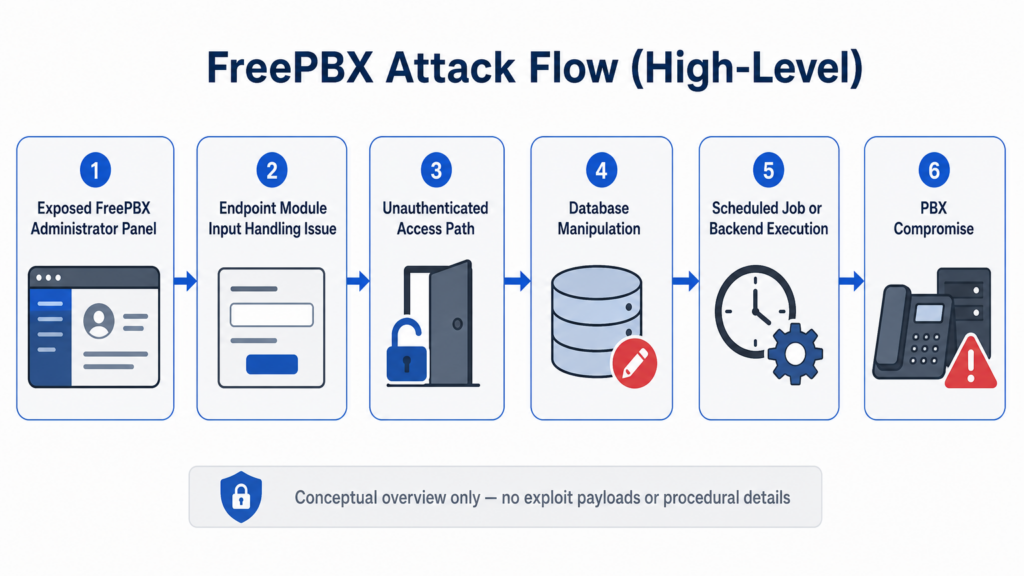
CVE-2025-57819 is a critical FreePBX vulnerability involving authentication bypass, SQL injection, and remote code execution paths. NVD describes FreePBX 15, 16, and 17 endpoints as vulnerable due to insufficiently sanitized user-supplied data, allowing unauthenticated access to FreePBX Administrator, arbitrary database manipulation, and remote code execution. NVD lists the patched endpoint versions as 15.0.66, 16.0.89, and 17.0.3. (एनवीडी)
The GitHub security advisory published by FreePBX’s security-reporting repository gives the same fixed endpoint versions. It lists the package as endpoint for FreePBX 15, 16, and 17, with affected versions below 15.0.66, below 16.0.89, and below 17.0.3. The summary says insufficiently sanitized user-supplied data allows unauthenticated access to FreePBX Administrator, leading to arbitrary database manipulation and remote code execution. (गिटहब)
The CVSS numbers reflect why this issue attracted immediate attention. NVD shows a CVSS 3.1 base score of 9.8 critical and a CNA-provided CVSS 4.0 base score of 10.0 critical. The NVD change history also shows CISA added the vulnerability to its Known Exploited Vulnerabilities data on August 29, 2025, with a required action to apply vendor mitigations or discontinue use if mitigations are unavailable. (एनवीडी)
The Canadian Centre for Cyber Security published an advisory on August 29, 2025, stating that Sangoma had published a security advisory on August 28, 2025, for FreePBX versions 15 prior to 15.0.66, 16 prior to 16.0.89, and 17 prior to 17.0.3. The Canadian advisory also noted open-source reporting that CVE-2025-57819 had been exploited. (Canadian Centre for Cyber Security)
Singapore’s Cyber Security Agency published its own alert on September 4, 2025, saying the vulnerability affected FreePBX administrator control panels if exposed to the internet, had a CVSSv3.1 score of 9.8, could allow unauthenticated privileged access and remote code execution, and was reportedly exploited in the wild. (सिंगापुर की साइबर सुरक्षा एजेंसी)
Why FreePBX 16.0.40.7 maps to the affected range
The version comparison is straightforward:
| Line | Observed version | Fixed endpoint version for CVE-2025-57819 | Candidate risk |
|---|---|---|---|
| FreePBX 15 endpoint | Any version below 15.0.66 | 15.0.66 | Affected if exposed conditions apply |
| FreePBX 16 endpoint | 16.0.40.7 | 16.0.89 | Below fixed version |
| FreePBX 17 endpoint | Any version below 17.0.3 | 17.0.3 | Affected if exposed conditions apply |
FreePBX 16.0.40.7 is lower than 16.0.89. If the endpoint module on that system is still at the vulnerable level, the system should be handled as affected. The exact exposure decision should not stop at the version string, though. The endpoint module must be checked, public or hostile-network reachability must be checked, the patch state must be confirmed from the local system, and IoCs must be hunted.
The FreePBX community advisory was clear on the immediate action path after the fix reached stable repositories: update supported systems using the Administrator Control Panel under Admin → Module Admin, or use the command-line method fwconsole ma upgradeall, then review the GitHub security advisory for CVE-2025-57819. (FreePBX Community Forums)
For a FreePBX 16.0.40.7 system, the safest operational statement is:
A FreePBX 16.0.40.7 system with the endpoint module installed and Administrator access exposed to an untrusted network should be treated as a high-risk affected system until patched, checked for compromise, and revalidated.
The attack conditions that matter
A lot of bad FreePBX risk decisions come from collapsing four different questions into one. The version is only one part of the decision.
| Condition | यह क्यों मायने रखती है | How to check |
|---|---|---|
| FreePBX version or endpoint module version below fixed release | Establishes candidate vulnerability | `fwconsole ma list |
| Endpoint module installed | The advisory identifies endpoint as the affected package | Module Admin or fwconsole ma list |
| Administrator interface reachable from the public internet or hostile network | Observed exploitation focused on directly exposed systems with inadequate filtering | External scan from an authorized network location |
| Patch successfully applied | Automatic updates can fail or be delayed | Check module version locally, not only in a portal |
| IoCs present | Indicates the question has moved from vulnerability management to incident response | File, log, database, CDR, and task checks |
| SIP and PBX credentials still trusted | Compromise may expose trunks, extensions, voicemail, UCP, and system credentials | Rotate after confirmed compromise |
The FreePBX community post states that if endpoint is not installed, the system is “probably not at risk of infection,” but still asks users to continue reading and verify. It also states that existing FreePBX 16 and 17 systems may have been impacted if they had the endpoint module installed and their FreePBX Administrator login page was directly exposed to a hostile network such as the public internet. (FreePBX Community Forums)
That wording is important. “Probably not at risk” is not the same as “ignore the system.” A defender should still confirm the module state, confirm admin exposure, update supported modules, and check for abnormal files or database records if the system was exposed during the exploitation window.
Safe local checks for FreePBX 16.0.40.7
Run the following only on systems you own or are explicitly authorized to administer.
# Confirm the FreePBX framework and module state
fwconsole --version
fwconsole ma list | egrep 'framework|endpoint'

# See whether endpoint is installed and what version is active
fwconsole ma list | grep -i endpoint

# Update all FreePBX modules using the normal module update path
fwconsole ma upgradeall

# Reload FreePBX after updates, if the update process instructs you to do so
fwconsole reload
अगर fwconsole ma list | grep -i endpoint returns nothing, endpoint may not be installed. If it returns an endpoint version below the fixed FreePBX 16 level, the module should be updated. If fwconsole fails with PHP errors, missing classes, or broken web-admin behavior, do not assume the update failed for a harmless reason. Broken FreePBX behavior was part of the public community discussion around exploitation and should trigger deeper inspection. (FreePBX Community Forums)
To check whether the admin interface is exposed, do not run intrusive exploit checks. Confirm reachability from a controlled external vantage point and from internal networks.
# From an authorized external test box, check whether the admin interface responds
curl -I https://pbx.example.com/admin/

# Identify exposed web titles and headers without exploitation
nmap -p 80,443,8080,8443 --script http-title,http-headers pbx.example.com

# From the PBX itself, list listening services
ss -ltnp
A reachable /admin/ endpoint does not prove CVE-2025-57819 exploitability. It does prove that your management plane is exposed enough to justify urgent review.
What happened technically
The official advisory gives the safest high-level technical summary: insufficiently sanitized user-supplied data allowed unauthenticated access to FreePBX Administrator, leading to arbitrary database manipulation and remote code execution. It also says the observed activity began on or before August 21, 2025, against internet-connected FreePBX version 16 and 17 systems with inadequate IP filtering or ACLs, exploiting a validation or sanitization error in user-supplied input to the commercial endpoint module. (गिटहब)
watchTowr later published a technical analysis that connected several pieces of the chain. Their analysis described how FreePBX request handling around /admin/ajax.php, module loading, PHP class_exists behavior, and FreePBX’s custom autoloader could allow certain module .php के अंतर्गत फाइलें admin/modules to be reached pre-authentication. The same analysis then connected that reachability to endpoint module SQL injection behavior and explained how database writes could be escalated into code execution through scheduled-job behavior. (watchTowr Labs)
This article does not reproduce a working exploit request. Defenders do not need a weaponized payload to make the right decision. The useful lesson is architectural: a PBX web management layer that accepts unauthenticated input, dynamically routes to modules, and stores powerful operational state in a database can turn a narrow input-sanitization bug into full administrative and system-level impact.
SANS Internet Storm Center later reported exploit activity attempting code execution by modifying FreePBX database state. The SANS diary described attempts to insert records into the cron_jobs table so that commands would run through FreePBX’s scheduled job mechanism, and it recommended reviewing the cron_jobs table for similar abuse. (SANS Internet Storm Center)
That final jump matters for defenders. If an attacker can write to a table that FreePBX later treats as operational instruction, then the security boundary is not only “can the attacker log into the web panel?” It becomes “can the attacker influence configuration, users, routes, scheduled jobs, provisioning behavior, or scripts that the PBX trusts?”
Why a PBX compromise hurts more than a normal web panel compromise
A PBX sits in a strange place in the network. It is often managed like infrastructure, exposed like a web app, trusted like an internal system, and connected to money through trunks and call routing. A compromise can create several classes of damage.
| Risk | What the attacker may want | Defensive signal |
|---|---|---|
| Toll fraud | Place expensive calls through your trunks | International call spikes, unknown outbound routes, unusual extension use |
| Credential theft | Reuse SIP trunk, extension, UCP, voicemail, or admin credentials | Unknown users, config changes, suspicious login history |
| Eavesdropping or data theft | Access call recordings, voicemail, call metadata, contact information | File access anomalies, exported recordings, abnormal archive activity |
| Vishing infrastructure | Use a trusted corporate caller identity | Calls from valid numbers to targets outside normal business patterns |
| अटलता | Add web shells, cron jobs, database users, or hidden admin users | Unknown PHP files, cron_jobs anomalies, ampusers changes |
| Lateral movement | Use the PBX as a foothold inside the network | New outbound connections, package installs, reverse shell artifacts |
| Operational disruption | Break phone service during cleanup or exploitation | Broken admin UI, failed fwconsole, abnormal Asterisk errors |
The most immediate business cost may be phone billing. The FreePBX community advisory explicitly tells affected administrators to check call detail records and the phone bill with the telco, especially international calling. (FreePBX Community Forums)
The deeper cost is trust. After a confirmed compromise, you cannot assume SIP trunk credentials, extensions, voicemail passwords, admin users, UCP credentials, or system credentials remain confidential. Rotating only the FreePBX administrator password is not enough.
Minimum indicator checks
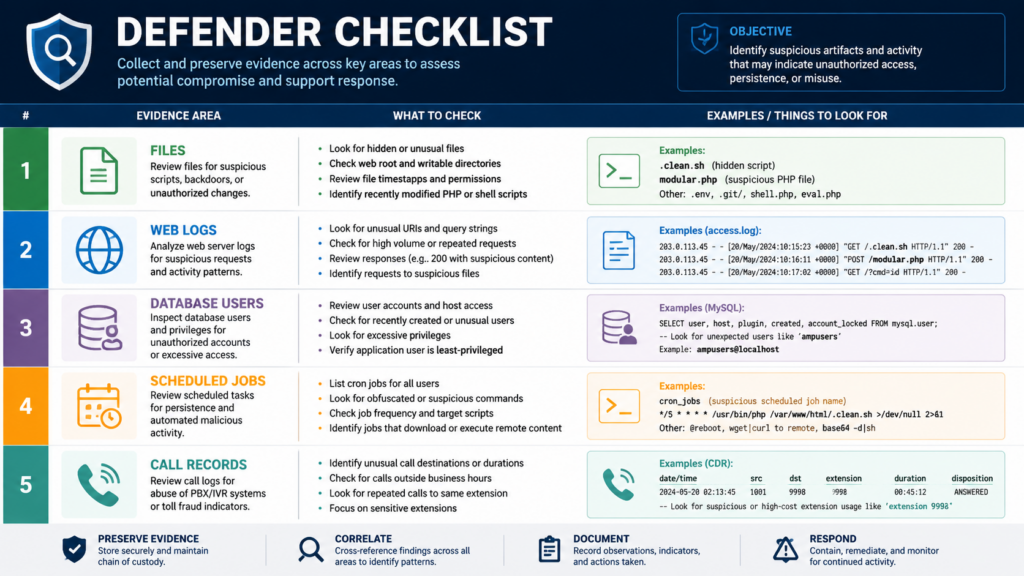
The FreePBX advisory and Singapore CSA alert overlap on several key indicators. They include recently modified or missing /etc/freepbx.conf, the presence of /var/www/html/.clean.sh, suspicious modular.php traffic, calls to extension 9998, and suspicious ampuser records or other unknown users in ampusers. (FreePBX Community Forums)
Start with a local snapshot or backup plan if you suspect compromise. If the system is production-critical, coordinate with telecom owners before making disruptive changes.
# Check whether the main FreePBX config file exists and inspect timestamps
ls -l /etc/freepbx.conf
stat /etc/freepbx.conf

# Check for a known suspicious cleanup script
ls -l /var/www/html/.clean.sh
stat /var/www/html/.clean.sh 2>/dev/null

# Search web access logs for suspicious modular.php requests
zgrep -i 'modular.php' /var/log/{httpd,apache2}/*access* 2>/dev/null

# Search Asterisk logs for unusual extension 9998 activity
grep -R '9998' /var/log/asterisk/full* 2>/dev/null

# Look for recently modified PHP files in the web root
find /var/www/html -type f -name '*.php' -mtime -30 -printf '%TY-%Tm-%Td %TH:%TM %p\n' | sort
A missing .clean.sh is not proof of safety. watchTowr’s analysis described .clean.sh as a cleanup script intended to remove evidence from many log locations and noted that web shells and related artifacts appeared across FreePBX installs with evidence dating back to August 21, 2025. (watchTowr Labs)
A normal-looking web UI is also not proof of safety. In the community thread, one participant reported evidence of exploitation on a FreePBX 17 test system that otherwise appeared to be working. (FreePBX Community Forums)
Database checks that do not modify state
Database checks should be read-only unless you are executing a planned recovery. The goal is to identify suspicious users, suspicious scheduled jobs, and unexpected configuration changes.
# List FreePBX administrator users
mysql -e "SELECT username, extension, deptname, sections FROM ampusers;" asterisk

# Look for users with suspicious names or unexpected section privileges
mysql -e "SELECT username, sections FROM ampusers;" asterisk

# Inspect FreePBX scheduled jobs for unusual commands
mysql -e "SELECT id, modulename, jobname, command, schedule, enabled FROM cron_jobs;" asterisk

# Save outputs for incident records
mysql -e "SELECT username, extension, deptname, sections FROM ampusers;" asterisk > /root/ampusers-review.txt
mysql -e "SELECT id, modulename, jobname, command, schedule, enabled FROM cron_jobs;" asterisk > /root/cron-jobs-review.txt
SANS specifically called out cron_jobs review as a good way to find similar exploit attempts because observed activity inserted scheduled-job records that caused code execution. (SANS Internet Storm Center)
When reviewing cron_jobs, look for commands that write files under web-accessible directories, invoke shells, download remote content, decode base64 blobs, alter logs, create users, or run at unusually frequent intervals. Do not delete suspicious rows before preserving evidence unless the system is actively harming business operations and you have no safer containment option.
Call detail and billing checks
A PBX incident is incomplete if it stops at web logs. Pull CDRs, trunk usage, and billing data. Look for new calling patterns, especially after August 21, 2025, the date range highlighted in the official advisory and FreePBX community checks. (गिटहब)
-- Example read-only CDR checks.
-- Table names and schemas can differ by installation.

SELECT calldate, src, dst, disposition, duration, billsec
FROM cdr
WHERE calldate >= '2025-08-21'
ORDER BY calldate DESC
LIMIT 100;

SELECT dst, COUNT(*) AS calls, SUM(billsec) AS total_billsec
FROM cdr
WHERE calldate >= '2025-08-21'
GROUP BY dst
ORDER BY calls DESC
LIMIT 50;

SELECT src, COUNT(*) AS calls, SUM(billsec) AS total_billsec
FROM cdr
WHERE calldate >= '2025-08-21'
GROUP BY src
ORDER BY calls DESC
LIMIT 50;
For toll fraud, raw call count is not enough. Check country codes, call duration, time of day, trunk, source extension, and whether the calls align with business hours and user behavior. If your provider exposes a billing portal or fraud alert API, compare local CDRs with provider-side call records because an attacker may have altered local logs.
Patch first, but do not confuse patching with recovery
The FreePBX community advisory says the stable fix was deployed for affected supported versions and tells users to update all supported systems using normal FreePBX update methods or fwconsole ma upgradeall. It also states that the fix protects future installations from infection but is not a cure for systems already compromised. (FreePBX Community Forums)
A safe sequence for a FreePBX 16.0.40.7 system looks like this:
| कदम | Action | क्यों |
|---|---|---|
| 1 | Restrict Administrator access to VPN or trusted IPs | Reduces immediate exposure before deeper work |
| 2 | Update FreePBX modules, especially endpoint | Closes the known fixed vulnerability path |
| 3 | Confirm endpoint version locally | Avoids assuming the update succeeded |
| 4 | Hunt IoCs in files, logs, DB, CDRs, and scheduled jobs | Determines whether this is vulnerability management or incident response |
| 5 | Preserve evidence if compromise is suspected | Supports forensics, insurance, legal, and provider conversations |
| 6 | Rebuild or restore from a trusted pre-compromise backup if infected | Avoids trusting a modified host |
| 7 | Rotate credentials | Removes stolen secrets from attacker control |
| 8 | Revalidate exposure and patch state | Confirms the system is no longer in the same condition |
The community restoration procedure recommends preserving backups from before infection, installing a new system with sufficient firewalling and fixed endpoint module, restoring the backup, and rotating system, SIP trunk, user, extension, voicemail, UCP, and related passwords. It also warns that cleanup without reinstall may be possible in some cases but is not advisable. (FreePBX Community Forums)
Hardening the FreePBX admin surface
The most reliable mitigation beyond patching is to stop treating the PBX Administrator interface as an internet service. Expose SIP only as required. Expose management only through VPN, a bastion, a private admin subnet, or tightly scoped IP allowlists.
For Apache, a simple access-control pattern looks like this:
# Example only. Test in a maintenance window.
# Restrict FreePBX admin access to trusted management networks.

<Location "/admin">
    Require ip 10.10.0.0/16
    Require ip 203.0.113.25
</Location>
For Nginx as a reverse proxy in front of a management path:
location /admin/ {
    allow 10.10.0.0/16;
    allow 203.0.113.25;
    deny all;

    proxy_pass http://127.0.0.1:8080/admin/;
    proxy_set_header Host $host;
    proxy_set_header X-Forwarded-For $proxy_add_x_forwarded_for;
    proxy_set_header X-Forwarded-Proto $scheme;
}
For host-level firewalling, adapt the ports to your environment. Do not blindly block SIP or RTP ports without understanding your voice topology.
# Example firewalld pattern for restricting HTTPS admin access.
# Replace source addresses and ports with your real management network.

firewall-cmd --permanent --new-zone=pbx-admin
firewall-cmd --permanent --zone=pbx-admin --add-source=203.0.113.25/32
firewall-cmd --permanent --zone=pbx-admin --add-port=443/tcp
firewall-cmd --permanent --zone=public --remove-port=443/tcp
firewall-cmd --reload
For iptables-style environments:
# Allow admin HTTPS only from a trusted admin IP.
iptables -A INPUT -p tcp -s 203.0.113.25 --dport 443 -j ACCEPT
iptables -A INPUT -p tcp --dport 443 -j DROP
FreePBX 16 included firewall and intrusion-detection-related improvements, including a Firewall module overhaul and responsive firewall threshold controls. Those controls are useful, but they should not become an excuse to expose management broadly. (FreePBX – Let Freedom Ring)
Why version matching is not enough
A version string is a signal, not a verdict. FreePBX 16.0.40.7 is below the fixed FreePBX 16 endpoint version for CVE-2025-57819, but the operational conclusion depends on module state, exposure, patch state, and evidence.
A better evidence ladder looks like this:
| Evidence level | उदाहरण | What it supports |
|---|---|---|
| Version observed | FreePBX 16.0.40.7 appears in system metadata | Candidate exposure |
| Module confirmed | endpoint module installed below fixed version | Affected component present |
| Management exposure confirmed | /admin/ reachable from untrusted network | Attack path reachable |
| Safe validation performed | Non-destructive checks confirm vulnerable state or missing patch | Strong vulnerability finding |
| IoCs found | .clean.sh, suspicious ampuser, abnormal cron_jobs, unusual CDRs | Incident response |
| Recovery verified | Rebuilt or restored host, patched module, no exposure, clean IoC sweep | Reduced residual risk |
This is also where AI-assisted security tooling can be useful when used carefully. A platform such as Penligent can help authorized teams organize discovery, CVE validation, tool execution, evidence capture, and reporting around the same target context, but the key is evidence quality rather than automation volume. Penligent’s homepage describes a workflow oriented around CVE scanning, guided execution, verified impact, operator control, and reporting; those ideas are relevant to FreePBX only when used inside an explicit authorization boundary and with non-destructive validation first. (पेनलिजेंट)
The deeper principle is that security reports should not label a FreePBX host “exploited” just because the version matches. Penligent’s technical writing on pentest agents makes the same point in a broader context: a version match does not prove reachability, configuration, authentication state, compensating controls, or exploitability. That distinction is especially important for PBX systems, where the difference between “candidate vulnerable” and “confirmed compromised” changes whether the team patches a module or rebuilds a communications server. (पेनलिजेंट)
Related FreePBX and PBX security issues worth knowing
CVE-2025-57819 is the center of this FreePBX 16.0.40.7 discussion, but it is not the only FreePBX-adjacent issue defenders should understand.
| Issue | Why it is relevant | Practical lesson |
|---|---|---|
| CVE-2025-57819 | Critical FreePBX endpoint authentication bypass, SQL injection, and RCE path | Patch endpoint, restrict admin access, hunt IoCs |
| CVE-2025-64328 | Greenbone later noted a FreePBX Endpoint Manager command injection flaw being leveraged in real-world attacks | Endpoint Manager remained a high-value attack surface after CVE-2025-57819 (Greenbone) |
| CVE-2025-55211 | watchTowr said it reported a post-authenticated command injection issue to FreePBX in May 2025, with publication concerns later discussed | Authenticated admin and module paths still deserve review, even after the pre-auth issue is fixed (watchTowr Labs) |
| CVE-2019-19006 | Older FreePBX management-plane vulnerabilities have been abused historically | PBX admin exposure is a recurring class of risk, not a one-off event (iThome) |
The pattern is more important than the table. PBX management systems combine web application risk, telecom billing risk, credential risk, and infrastructure risk. A mature response program should not wait for a perfect exploit write-up before restricting admin exposure and validating patch state.
Common mistakes during FreePBX 16.0.40.7 response
The first mistake is assuming that a working phone system is a clean phone system. Some compromises do not break calls. Some attackers want the PBX to stay operational because the value is in long-term calling, credential use, or quiet access.
The second mistake is treating the endpoint update as a cleanup tool. The FreePBX advisory distinguishes future protection from cleanup of existing compromise. If an attacker already created a web shell, changed database state, altered scheduled jobs, or stole credentials, updating endpoint will not rotate secrets or prove the filesystem is clean. (FreePBX Community Forums)
The third mistake is checking only /var/www/html/.clean.sh. That file is a useful clue, but absence is not proof. Check web logs, Asterisk logs, CDRs, ampusers, cron_jobs, recently modified PHP files, unexpected admin accounts, SSH history, package changes, outbound network traffic, and backup integrity.
The fourth mistake is restoring from a backup taken after the first exploitation date. If the backup already contains a web shell, altered database row, hidden user, or modified config, restoring it simply restores the attacker’s work. The FreePBX community guidance specifically recommends preserving backups from before infection, at least before August 21, 2025. (FreePBX Community Forums)
The fifth mistake is leaving Administrator access open after patching. Patches reduce known vulnerability exposure. They do not make public management safe. The FreePBX community advisory’s first public recommendation was to limit Administrator access to known trusted hosts using firewall controls. (FreePBX Community Forums)
A practical response workflow
For a FreePBX 16.0.40.7 system, use a workflow that separates exposure reduction, evidence collection, patching, and recovery.
Phase 1, contain the management surface
Restrict public access to the Administrator interface immediately. Use a firewall, VPN, security group, reverse proxy allowlist, or FreePBX Firewall module. Do not wait until after forensic review to remove public management exposure.
# Confirm whether the web admin is listening on all interfaces
ss -ltnp | egrep ':80|:443|:8080|:8443'

# Record current firewall state before changing it
iptables-save > /root/iptables-before-freepbx-containment.txt 2>/dev/null
firewall-cmd --list-all-zones > /root/firewalld-before-freepbx-containment.txt 2>/dev/null
Phase 2, preserve useful evidence
If suspicious signs exist, capture state before making large changes.
mkdir -p /root/freepbx-ir-$(date +%F)
IRDIR=/root/freepbx-ir-$(date +%F)

cp -a /etc/freepbx.conf "$IRDIR"/ 2>/dev/null
fwconsole ma list > "$IRDIR"/fwconsole-modules.txt 2>&1
mysql -e "SELECT username, extension, deptname, sections FROM ampusers;" asterisk > "$IRDIR"/ampusers.txt 2>&1
mysql -e "SELECT id, modulename, jobname, command, schedule, enabled FROM cron_jobs;" asterisk > "$IRDIR"/cron_jobs.txt 2>&1
find /var/www/html -type f -mtime -60 -printf '%TY-%Tm-%Td %TH:%TM %p\n' | sort > "$IRDIR"/recent-web-files.txt
Phase 3, patch
Use normal FreePBX update mechanisms and confirm endpoint version locally.
fwconsole ma upgradeall
fwconsole ma list | grep -i endpoint
fwconsole reload
The target is not “ran the update command.” The target is “endpoint is at or above the patched version for the installed FreePBX line, the admin surface is restricted, and no compromise evidence remains unexplained.”
Phase 4, decide whether this is rebuild territory
Rebuild or restore from trusted backup if you find confirmed compromise indicators such as unknown admin users, malicious PHP files, suspicious scheduled jobs, unexplained config changes, abnormal CDRs, or evidence of log tampering. Treat SIP trunk secrets and extension passwords as exposed. The FreePBX restoration guidance recommends a new system with firewalling and fixed endpoint module, restoring a backup, and rotating credentials. (FreePBX Community Forums)
Phase 5, rotate credentials and review billing
Rotate:
- FreePBX administrator accounts
- UCP user passwords
- Extension secrets
- SIP trunk credentials
- Voicemail PINs
- System users
- Any API keys or integration secrets stored on the host
- Provider portal passwords if they were accessed from the PBX host or stored nearby
Then review:
- International calls
- After-hours calls
- Calls to unusual destination prefixes
- Calls from unknown extensions
- Trunk usage spikes
- Provider fraud alerts
- New outbound routes or dial patterns
Detection logic for SIEM and log pipelines
If FreePBX logs are forwarded to a SIEM, build correlation logic around behavior, not only filenames.
| Signal | Example logic | Confidence |
|---|---|---|
| Suspicious web path | POST to modular.php or unusual module ajax paths | Medium to high |
| Unexpected cleanup script | File creation under /var/www/html/.clean.sh | उच्च |
| Unknown admin user | New ampusers record not tied to change ticket | उच्च |
| Scheduled job anomaly | New row in cron_jobs with shell commands or webroot writes | उच्च |
| Unusual extension activity | Calls to extension 9998 without business reason | Medium to high |
| Webroot PHP modification | New PHP files outside expected module updates | मध्यम |
| Admin panel exposure | External HTTP response from /admin/ | Exposure signal |
| Phone billing spike | International or premium-rate call surge | Business impact signal |
A simple Sigma-style concept can help teams translate this into SIEM rules. Adapt fields to your log format.
title: Possible FreePBX CVE-2025-57819 Web Exploitation Signal
status: experimental
description: Detects suspicious FreePBX web requests associated with public CVE-2025-57819 incident guidance.
logsource:
  category: webserver
detection:
  selection_modular:
    cs-uri-stem|contains: 'modular.php'
    cs-method: 'POST'
  selection_admin_ajax:
    cs-uri-stem|contains: '/admin/ajax.php'
    cs-uri-query|contains:
      - 'module='
      - 'endpoint'
  condition: selection_modular or selection_admin_ajax
fields:
  - src_ip
  - cs-method
  - cs-uri-stem
  - cs-uri-query
  - user_agent
falsepositives:
  - Legitimate module behavior, depending on deployment
level: medium
This is not a complete detection rule. It is a starting point. Good detections should combine web requests with local host changes, database changes, and CDR anomalies. A modular.php hit from a trusted admin IP during maintenance is different from a POST from an unknown ASN followed by a new PHP file and international calls.
Hardening beyond this CVE
After the urgent work, reduce the chance that the next PBX vulnerability becomes an emergency.
- Keep the Administrator interface off the public internet.
- Use VPN or bastion access for management.
- Separate SIP exposure from web management exposure.
- Remove modules that are not required.
- Keep commercial modules licensed and updateable if installed.
- Enable and test module updates.
- Monitor CDRs and provider billing daily.
- Forward web, Asterisk, system, and database logs to a separate log store.
- Keep immutable or offline backups.
- Test restoration before an incident.
- Document trunk, extension, and voicemail credential rotation procedures.
- Create a change-control path for PBX module updates.
- Treat PBX systems as high-trust infrastructure, not as small utility boxes.
The release history of FreePBX 16 shows it introduced meaningful security and administrative controls, including firewall and intrusion-detection improvements. Those controls help, but no product-level firewall should replace network-level management isolation. (FreePBX – Let Freedom Ring)
Useful resources for operators
The FreePBX GitHub security advisory is the canonical source for affected endpoint versions and the official vulnerability summary. It is the first page to check when deciding whether a FreePBX 15, 16, or 17 endpoint module is below the fixed version. (गिटहब)
The FreePBX community security advisory is the most practical source for immediate update commands, access restriction advice, IoC checks, and restoration guidance. It is especially useful for administrators who need commands rather than only CVE metadata. (FreePBX Community Forums)
NVD’s CVE-2025-57819 entry is useful for severity, CVSS vectors, CWE mappings, CISA KEV metadata, and vulnerability-management systems that ingest NVD data. (एनवीडी)
Singapore CSA’s alert is a concise operational summary that lists affected versions, known exploitation status, mitigation advice, and key indicators such as /etc/freepbx.conf, .clean.sh, modular.php, extension 9998, and suspicious ampuser records. (सिंगापुर की साइबर सुरक्षा एजेंसी)
SANS Internet Storm Center’s diary is useful for defenders investigating database-to-code-execution behavior, especially suspicious cron_jobs records. (SANS Internet Storm Center)
अक्सर पूछे जाने वाले प्रश्न
Is FreePBX 16.0.40.7 affected by CVE-2025-57819?
- Yes, it is below the FreePBX 16 endpoint patched version listed for CVE-2025-57819.
- The fixed endpoint version for FreePBX 16 is 16.0.89.
- Real exposure still depends on endpoint module installation, admin-panel reachability, and whether the patch was applied.
- Treat FreePBX 16.0.40.7 as a high-priority affected-version signal, not as automatic proof of compromise. (गिटहब)
Is “FreePBX 16.0.40.7 CVE” the name of a vulnerability?
- नहीं।
- FreePBX 16.0.40.7 is a product version.
- The relevant CVE for the 2025 endpoint issue is CVE-2025-57819.
- The common search phrase exists because administrators are trying to map their FreePBX version to a known CVE.
How do I check whether the endpoint module is installed?
- Run
fwconsole ma list | grep -i endpointon the PBX. - Check Module Admin in the FreePBX Administrator interface if the interface is safe and accessible.
- If endpoint is installed, confirm the local module version.
- For FreePBX 16, endpoint should be at or above the fixed version listed in the advisory.
- If the command fails with unusual PHP or framework errors, investigate compromise and broken module state before assuming it is a routine update issue.
Does patching FreePBX remove an existing compromise?
- नहीं।
- Patching closes the known vulnerability path.
- It does not remove web shells, unknown users, altered database rows, malicious scheduled jobs, stolen SIP credentials, or modified system files.
- If IoCs are present, preserve evidence, rebuild or restore from a trusted pre-compromise backup, rotate credentials, and review call billing.
What should I do if I find .clean.sh or a suspicious ampuser entry?
- Treat the system as potentially compromised.
- Preserve evidence before deleting anything.
- Restrict management access immediately.
- Check web logs, Asterisk logs, database users, scheduled jobs, recent PHP files, CDRs, and provider billing.
- Rotate PBX, SIP trunk, extension, voicemail, UCP, and system credentials.
- Prefer rebuild or restoration from a trusted backup if compromise is confirmed.
Should the FreePBX Administrator panel ever be exposed to the public internet?
- It should not be publicly reachable in normal operation.
- Use VPN, private management networks, bastion hosts, or strict IP allowlists.
- Separate SIP service exposure from web management exposure.
- The CVE-2025-57819 advisory and community guidance repeatedly tie risk reduction to locking down Administrator access. (FreePBX Community Forums)
What evidence should I collect before rebuilding a suspected compromised PBX?
- Module versions from
fwconsole ma list. /etc/freepbx.confmetadata and copy.- Web access and error logs.
- Asterisk logs and CDRs.
ampuserstable export.cron_jobstable export.- List of recently modified files under
/var/www/html. - Firewall rules and listening service output.
- Provider-side call records and billing anomalies.
How should teams prioritize this against other vulnerabilities?
- Put it near the top if the PBX admin panel is internet-facing or reachable from untrusted networks.
- Raise priority further if endpoint is installed, the version is below the fixed release, or the system handles important trunks and business phone flows.
- Raise it to incident response if IoCs appear.
- Do not prioritize by CVSS alone. Combine version, exposure, module state, known exploitation, business role, and evidence.
Closing judgment
FreePBX 16.0.40.7 should be treated as an affected-version signal for CVE-2025-57819 because it is below the FreePBX 16 endpoint fixed version. The right response is not panic and not complacency. Restrict Administrator access, update the endpoint module and all FreePBX modules, confirm the local version, search for IoCs, inspect database and call records, and rotate credentials if compromise is suspected or confirmed.
A PBX is not just another web panel. It controls communications, identity signals, trunks, calling routes, voicemail, recordings, and sometimes a trusted internal host. If a FreePBX 16.0.40.7 system was exposed with endpoint installed during the exploitation window, handle it with the seriousness of a communications-system incident, not a routine scanner finding.


 Hindi
Hindi  English
  German
  French
  Spanish
  Portuguese
  Japanese
  Korean
  Arabic
  Turkish
  Hebrew