
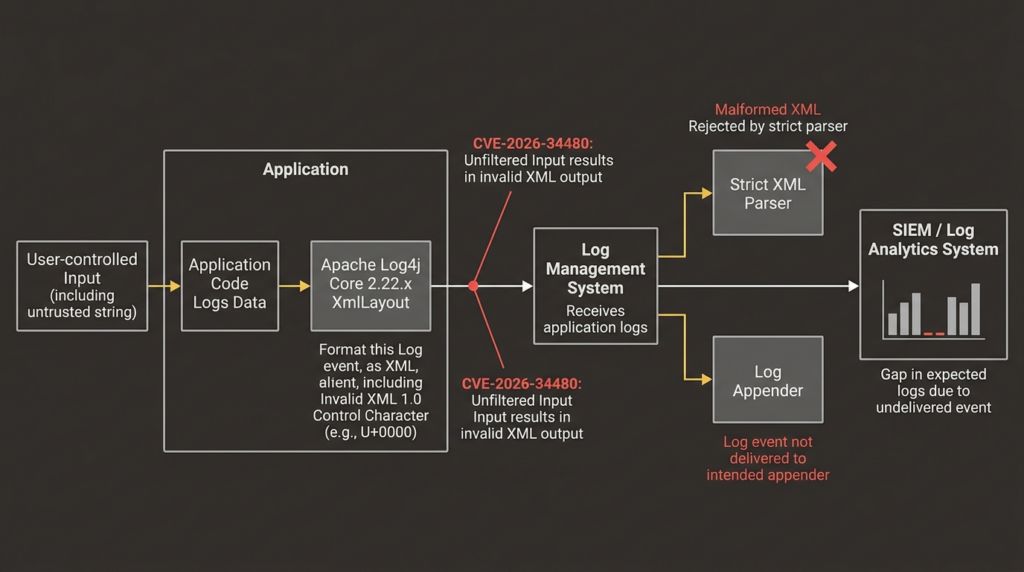
CVE-2026-34480 is a Log4j logging integrity problem, not another Log4Shell. The bug affects Apache Log4j Core’s XmlLayout: in affected versions, log messages or MDC values containing characters forbidden by XML 1.0 can be emitted as invalid XML or prevent a log event from reaching the intended appender. Apache fixed the issue in Log4j Core 2.25.4 by sanitizing forbidden XML characters before XML output.(अपाचे लॉगिंग सेवाएँ)
That distinction matters. A scanner may report “Apache Log4j 2.0-alpha1 < 2.25.4 XmlLayout Invalid XML Output,” but the right security question is not “Do we have Log4j anywhere?” The right question is “Do we use XmlLayout in a path where attacker-influenced data can enter log messages or MDC values, and can malformed XML break downstream detection, indexing, audit, or incident response?” Apache’s advisory describes two concrete failure modes: with the JRE built-in StAX implementation, forbidden characters may be written and produce malformed XML; with alternative StAX implementations such as Woodstox, an exception may occur during the logging call and the event may not be delivered to the intended appender.(अपाचे लॉगिंग सेवाएँ)
The short version security teams need
| क्षेत्र | Practical answer |
|---|---|
| सीवीई | CVE-2026-34480 |
| प्रभावित घटक | Apache Log4j Core XmlLayout |
| प्रभावित संस्करण | [2.0-alpha1, 2.25.4) और [3.0.0-alpha1, 3.0.0-beta3] |
| Fixed version | Log4j Core 2.25.4 |
| Weakness | CWE-116, Improper Encoding or Escaping of Output |
| Apache CVSS 4.0 | 6.9 Medium |
| NVD CVSS 3.1 | 7.5 High |
| Trigger | Log message or MDC value contains XML 1.0 forbidden characters |
| Main risk | Malformed XML, failed ingestion, dropped or missing log records |
| Not the same as | Log4Shell RCE, XXE, SQL injection, memory corruption |
The version range and remediation come directly from Apache, NVD, and GitHub Advisory. NVD also records CWE-116 and shows the scoring difference: Apache’s CNA score is CVSS 4.0 6.9 Medium, while NVD’s CVSS 3.1 score is 7.5 High. The difference is a reminder that a single severity label is not enough for triage. For this CVE, context matters more than dashboard color.(एनवीडी)
What actually breaks
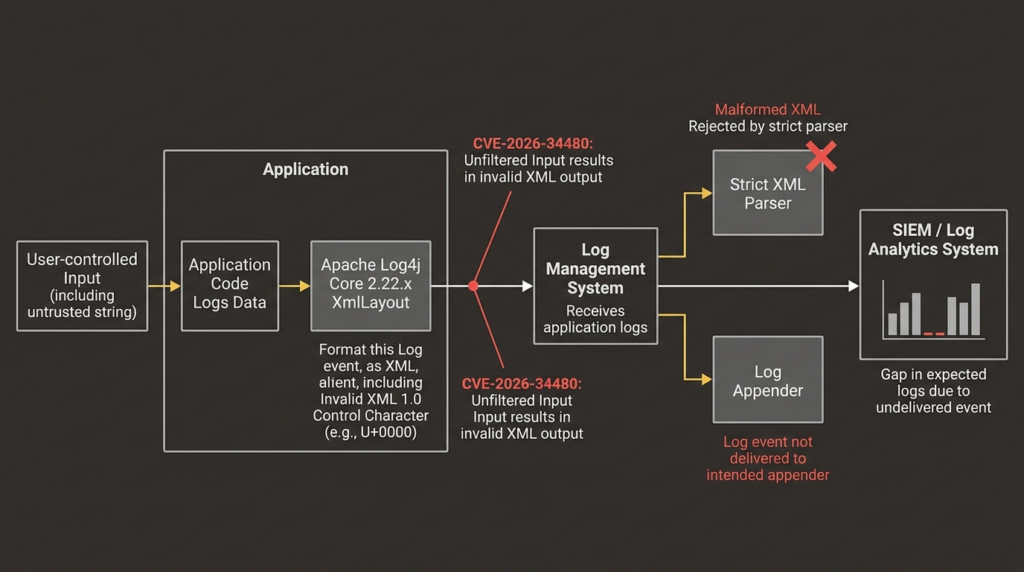
Log4j layouts convert a LogEvent into the representation consumed by a file, socket, queue, console, or logging pipeline. Apache’s Log4j documentation describes a layout as the component that encodes a log event into a form suitable for the consumer. That consumer might be a human reading a local file, but in production it is often a log shipper, SIEM, data lake, search index, cloud logging service, detection engine, or compliance archive.(अपाचे लॉगिंग सेवाएँ)
XmlLayout is one of those layouts. It encodes a log event into XML. Apache’s own documentation also warns that XML Layout is planned to be removed in the next major release and says XML Layout users are strongly advised to migrate to another layout. The same Log4j documentation recommends JSON Template Layout for structured logging use cases.(अपाचे लॉगिंग सेवाएँ)
CVE-2026-34480 exists because XML output is not just text with angle brackets. XML 1.0 has a defined legal character range. The W3C XML 1.0 specification allows tab, line feed, carriage return, and selected Unicode ranges, but excludes many control characters that application strings may still contain. If a layout writes those forbidden characters into an XML document, the result is not merely ugly output. It is not well-formed XML. A conforming XML parser treats well-formedness violations as fatal errors.(W3C)
That is why this CVE is security-relevant. Logs are not passive exhaust. They are evidence. They feed alerts, dashboards, behavior analytics, fraud review, audit trails, SOX controls, PCI evidence, cloud incident timelines, and root-cause analysis. A bug that allows attacker-influenced text to break a structured logging stream can create blind spots exactly where defenders expect durable memory.
The root cause in plain technical terms
A typical XML log event contains fields such as timestamp, logger name, level, message, thread, marker, exception, source location, context map, and context stack. Log4j’s own documentation shows XML Layout output with elements such as <Message>, <ContextMap>, और <Thrown>. Those are obvious places where application data or request-scoped metadata can appear.(अपाचे लॉगिंग सेवाएँ)
The vulnerable condition is narrow but real:
- The application uses affected
लॉग4जे-कोर. - The application uses
XmlLayout. - The log message or MDC value contains a character that XML 1.0 does not allow.
- The output is produced or attempted through an affected Log4j version.
- A downstream consumer expects well-formed XML, or the StAX implementation throws during serialization.
Apache’s fix PR explains the remediation at the implementation level: invalid XML 1.0 characters are replaced with the Unicode replacement character U+FFFD, so the generated output remains well-formed and parseable even when the original log data contains control characters or invalid code points. The PR was merged into the 2.25.x branch on March 24, 2026, and Apache’s 2.25.4 release notes later summarized the fix as replacing invalid characters in XmlLayout output with U+FFFD.(गिटहब)
That replacement behavior is important. The fixed version does not attempt to preserve forbidden XML characters through clever escaping, because XML 1.0 does not allow those characters as normal character data. The safe behavior is to produce valid XML by replacing them.
Why this is not XXE
CVE-2026-34480 should not be treated as an XML External Entity vulnerability unless a specific downstream product adds a separate parser behavior that is not present in Apache’s advisory. Apache describes improper sanitization of XML 1.0 forbidden characters in XmlLayout. NVD maps the weakness to CWE-116, Improper Encoding or Escaping of Output. The advisory does not describe external entity expansion, DTD processing, SSRF through XML entity resolution, local file disclosure, or entity-based data exfiltration.(अपाचे लॉगिंग सेवाएँ)
The difference is more than taxonomy. XXE usually depends on an XML parser consuming attacker-controlled XML with unsafe entity resolution. CVE-2026-34480 is about Log4j generating invalid XML when it logs data containing forbidden characters. The downstream symptom may happen inside an XML parser, but the upstream flaw is output encoding and sanitization, not external entity handling.
A clean internal ticket title would be:
Apache Log4j Core XmlLayout invalid XML output and possible log event loss, CVE-2026-34480
A misleading title would be:
Apache Log4j XXE RCE
The second title sends responders down the wrong path. They may waste time looking for external entity processing, network callbacks, or remote code execution behavior that the public Apache record does not describe.
Why this is not Log4Shell either
Log4Shell, CVE-2021-44228, was a remote code execution vulnerability in Log4j 2 where attacker-controlled log messages or parameters could trigger JNDI behavior and load code from attacker-controlled LDAP and related endpoints in affected configurations. CISA described it as a critical RCE issue affecting Apache Log4j versions 2.0-beta9 to 2.14.1, and NVD describes the same core JNDI-controlled endpoint problem.(सीआईएसए)
CVE-2026-34480 has a very different blast radius. It does not give an attacker a shell merely because they can reach an application that logs user input. It does not describe class loading. It does not describe LDAP, RMI, or JNDI. It sits in the structured logging path.
That does not make it irrelevant. Log4Shell taught engineering teams that logging libraries can be part of the attack surface. CVE-2026-34480 teaches a quieter lesson: logging output formats are security boundaries when logs feed detection, audit, and incident response.
The two failure modes Apache describes
Apache’s advisory is unusually useful because it separates behavior by StAX implementation. That matters for real-world debugging.
| Runtime path | Observed behavior | Security consequence |
|---|---|---|
| JRE built-in StAX | Forbidden characters may be silently written into output | XML becomes malformed, and conforming parsers may reject the document with a fatal error |
| Alternative StAX implementation such as Woodstox | Exception is thrown during the logging call | The event may never reach the intended appender and may only appear in Log4j’s internal status logger |
| Fixed Log4j Core 2.25.4 | Invalid XML characters are replaced with U+FFFD | Output remains well-formed XML and downstream parsers can process the event |
This is why some teams will see ingestion failures, while others may see missing log records without obvious application-level errors. A product using Jackson XML Dataformat may pull in Woodstox as a transitive dependency, which can shift the failure mode from malformed output to exception-driven event loss. Apache’s advisory calls out that distinction directly.(अपाचे लॉगिंग सेवाएँ)
What an attacker would need
The attacker does not need to compromise the host to make this bug relevant. They need a route for forbidden XML characters to enter a field that the application logs through XmlLayout.
That can happen through surprisingly ordinary places:
| Source of attacker-influenced data | How it reaches logs | यह क्यों मायने रखती है |
|---|---|---|
| HTTP headers | Access logs, request diagnostics, API gateway metadata | Headers are commonly logged during error handling and abuse detection |
| Username or display name | Authentication logs, admin audit logs | Identity fields often flow into MDC or structured context |
| Query parameter or form field | Application debug logs, validation failures | Failed requests are often logged more verbosely than successful ones |
| Trace ID or correlation ID | MDC, distributed tracing bridge | MDC values are directly mentioned in the Apache advisory |
| Tenant ID or organization slug | Multi-tenant audit logs | Tenant-scoped investigations depend on complete context |
| Job name, queue name, workflow label | Worker logs and batch processing telemetry | Background systems often forward logs to strict XML or legacy ingestion paths |
| User-agent or client name | Security analytics, WAF handoff, abuse pipelines | User-agent data is noisy and frequently attacker-controlled |
The realistic abuse case is not “get code execution.” It is “make a specific event disappear, make a batch fail ingestion, or create gaps in the evidence stream.” That can still matter during brute-force attempts, account takeover probes, SSRF testing, API abuse, fraud attempts, data scraping, credential stuffing, or reconnaissance.
The risk increases when the affected XML logs are used as security evidence rather than simple application diagnostics. If a malformed XML event breaks an ingestion batch, the application may keep running while defenders lose the one record that would have explained what happened.
Exposure is not the same as exploitability
A vulnerable लॉग4जे-कोर jar is only the first condition. Many vulnerability scanners are good at finding jar versions, but version presence alone does not prove the affected runtime path is used.
A better exposure model looks like this:
| Condition | Low concern | Higher concern |
|---|---|---|
लॉग4जे-कोर version | Fixed at 2.25.4 or newer | Older than 2.25.4 or 3.0.0 alpha or beta in affected range |
| Layout configuration | Pattern, JSON Template, or non-XML layout | XmlLayout configured directly |
| Logged input | Internal-only static messages | Request, identity, tenant, or MDC values influenced by users |
| Downstream parser | Tolerant per-record ingestion with quarantine | Strict XML parser that rejects a batch or file on one fatal error |
| निगरानी | Ingestion failures alert loudly | Parsing errors are silent or only visible in local shipper logs |
| Evidence retention | Raw logs retained separately | XML output is the only durable audit copy |
| Incident workflow | Security team can query dropped event counters | Team assumes absence of logs means absence of activity |
This table is the operational center of the CVE. Patch the dependency, but triage the exposure by runtime behavior. An internal service with affected Log4j but no XmlLayout is different from an authentication service that writes XML audit logs from MDC values into a strict ingestion pipeline.
Inventory, find the vulnerable package first
Start with the boring part. Find लॉग4जे-कोर, including direct dependencies, transitive dependencies, shaded jars, vendor bundles, container images, and fat jars.
# Maven dependency tree
mvn -q dependency:tree | grep -i "org.apache.logging.log4j:log4j-core"

# Gradle runtime dependencies
./gradlew dependencies --configuration runtimeClasspath | grep -i "log4j-core"

# Search an unpacked repository or application directory
find . -type f -name "log4j-core-*.jar"

# Inspect a fat jar
jar tf app.jar | grep -i "log4j-core"

# Search an exported container filesystem
find ./image-rootfs -type f -name "log4j-core-*.jar" 2>/dev/null
This step tells you whether the vulnerable package may exist. It does not tell you whether XmlLayout is configured. It also does not tell you whether the code path is reachable. Treat it as dependency inventory, not exploit proof.
For teams using SBOMs, search package URLs and Maven coordinates as well:
grep -R -n "pkg:maven/org.apache.logging.log4j/log4j-core" ./sbom-reports
grep -R -n "org.apache.logging.log4j.*log4j-core" ./sbom-reports
NVD’s change history records the affected package as org.apache.logging.log4j:log4j-core and includes the Maven package URL in its affected software data.(एनवीडी)
Configuration search, find XmlLayout
Next, look for explicit layout configuration. In many Java applications, Log4j configuration appears in log4j2.xml, log4j2.properties, log4j2.yaml, log4j2.yml, या log4j2.json.
# Search common Log4j configuration files
find . -type f \( \
  -name "log4j2.xml" -o \
  -name "log4j2.properties" -o \
  -name "log4j2.yaml" -o \
  -name "log4j2.yml" -o \
  -name "log4j2.json" \
\) -print

# Search for XmlLayout references
grep -R -n -i "XmlLayout" .
grep -R -n -i "<XmlLayout" .
grep -R -n -i "layout.type *= *XmlLayout" .
A direct XML configuration might look like this:
<Appenders>
  <File name="AuditXml" fileName="/var/log/app/audit.xml">
    <XmlLayout complete="false" compact="true"/>
  </File>
</Appenders>
A properties-style configuration might look like this:
appender.audit.type = File
appender.audit.name = AuditXml
appender.audit.fileName = /var/log/app/audit.xml
appender.audit.layout.type = XmlLayout
appender.audit.layout.compact = true
Finding this configuration changes the triage priority. Now the question is no longer “Is Log4j present?” It is “What data enters this XML log output, and what happens downstream if one event contains a forbidden XML character?”
Safe local validation, show the parser failure without attacking production
A safe way to understand CVE-2026-34480 is to reproduce the class of failure locally, in a throwaway environment, without targeting any external system.
The following Python snippet demonstrates why XML 1.0 forbidden characters are not merely cosmetic. It creates a string that contains U+0001, then tries to parse it as XML.
from xml.etree import ElementTree as ET

bad_message = "login failed for user alice\u0001admin"
xml = f"<Event><Message>{bad_message}</Message></Event>"

try:
    ET.fromstring(xml)
    print("Parsed")
except ET.ParseError as exc:
    print("Parser rejected XML:", exc)
A strict parser rejects this because the document is not well-formed. This mirrors the downstream symptom Apache warns about: malformed XML can cause conforming parsers to reject records.
A fixed-style output replaces the forbidden character before XML parsing:
def replace_xml10_forbidden_chars(text: str) -> str:
    result = []
    for ch in text:
        cp = ord(ch)
        allowed = (
            cp == 0x09 or
            cp == 0x0A or
            cp == 0x0D or
            0x20 <= cp <= 0xD7FF or
            0xE000 <= cp <= 0xFFFD or
            0x10000 <= cp <= 0x10FFFF
        )
        result.append(ch if allowed else "\uFFFD")
    return "".join(result)

safe_message = replace_xml10_forbidden_chars(bad_message)
safe_xml = f"<Event><Message>{safe_message}</Message></Event>"

ET.fromstring(safe_xml)
print(safe_xml)
That is the same defensive principle Apache implemented in Log4j Core 2.25.4: replace invalid XML characters with U+FFFD so the output remains parseable.(गिटहब)
Java validation in a controlled test project
For Java teams, create a minimal local project and test your own logging configuration. Do not run this against production services. The point is to validate behavior in an isolated environment.
A simple test message can include a forbidden XML 1.0 control character:
package demo;

import org.apache.logging.log4j.LogManager;
import org.apache.logging.log4j.Logger;
import org.apache.logging.log4j.ThreadContext;

public class XmlLayoutProbe {
    private static final Logger logger = LogManager.getLogger(XmlLayoutProbe.class);

    public static void main(String[] args) {
        ThreadContext.put("requestId", "req-\u0001-123");
        logger.info("controlled local test message with invalid XML char: {}", "x\u0001y");
        ThreadContext.clearAll();
    }
}
A test log4j2.xml might direct output to a local file:
<?xml version="1.0" encoding="UTF-8"?>
<Configuration status="WARN">
  <Appenders>
    <File name="XmlFile" fileName="target/xml-layout-test.xml">
      <XmlLayout complete="false" compact="true"/>
    </File>
  </Appenders>
  <Loggers>
    <Root level="info">
      <AppenderRef ref="XmlFile"/>
    </Root>
  </Loggers>
</Configuration>
Run it once with the affected version in a disposable project, then again with Log4j Core 2.25.4 or newer. The expected secure behavior is not that the control character survives. The expected behavior is that output remains XML-safe, with invalid characters replaced.
After running the program, parse the output file with a strict XML parser. If complete="false" emits event fragments rather than a single XML document, wrap them in a temporary root element before parsing:
{
  echo "<Events>"
  cat target/xml-layout-test.xml
  echo "</Events>"
} > target/wrapped.xml

python3 - <<'PY'
from xml.etree import ElementTree as ET
ET.parse("target/wrapped.xml")
print("XML parsed successfully")
PY
This kind of test gives engineering teams a grounded way to understand the issue. It does not prove external exploitability. It proves whether the layout and parser chain behave safely when control characters enter log data.
Upgrade path
The baseline remediation is to upgrade Apache Log4j Core to 2.25.4 or newer. Apache’s security page, NVD, GitHub Advisory, and the release notes all point to 2.25.4 as the fixed version for CVE-2026-34480.(अपाचे लॉगिंग सेवाएँ)
For Maven:
<dependencyManagement>
  <dependencies>
    <dependency>
      <groupId>org.apache.logging.log4j</groupId>
      <artifactId>log4j-bom</artifactId>
      <version>2.25.4</version>
      <scope>import</scope>
      <type>pom</type>
    </dependency>
  </dependencies>
</dependencyManagement>
Or, if you manage the dependency directly:
<dependency>
  <groupId>org.apache.logging.log4j</groupId>
  <artifactId>log4j-core</artifactId>
  <version>2.25.4</version>
</dependency>
For Gradle:
dependencies {
    implementation platform("org.apache.logging.log4j:log4j-bom:2.25.4")
    implementation "org.apache.logging.log4j:log4j-core"
}
Then verify the resolved version:
mvn -q dependency:tree | grep -i "log4j-core"
./gradlew dependencyInsight --dependency log4j-core --configuration runtimeClasspath
For vendor products, do not replace jars blindly unless the vendor explicitly supports that action. Commercial software often bundles Log4j inside a supported distribution, and unsupported jar replacement can create operational and support risk. Open a vendor ticket, search the vendor advisory, or upgrade through the vendor’s released patch path.
Migration away from XmlLayout
Patching is required, but many teams should also ask whether XML logging is still the right output format. Apache’s Log4j documentation says XML Layout is planned to be removed in the next major release and strongly advises users to migrate to another layout. It also recommends JSON Template Layout for structured logging.(अपाचे लॉगिंग सेवाएँ)
A migration plan can be simple:
| Current state | Better direction | Reason |
|---|---|---|
XmlLayout used for SIEM ingestion | JSON Template Layout | Easier fit for modern log pipelines |
| XML logs used by legacy parser | Patch to 2.25.4 first, then plan parser migration | Avoid breaking legacy consumers during emergency patch |
| XML output used for compliance archive | Confirm parser behavior and raw retention | Audit evidence must survive malformed event cases |
| XML only used because of old sample config | Replace with supported structured layout | Reduces future maintenance risk |
| Mixed XML and JSON logs | Standardize schema and field names | Makes detection and incident timelines more reliable |
A safe replacement should preserve key fields: timestamp, level, logger, thread, message, exception, correlation ID, user or service identity, tenant, request path, source component, and trace context. Do not “fix” CVE-2026-34480 by moving to unstructured text that loses fields your detection rules rely on.
Detection engineering, monitor the blind spot
Security teams should treat this CVE as a chance to test logging pipeline failure visibility. The most useful detections are not signatures for CVE-2026-34480. They are controls that tell you whether log events are failing to serialize, ship, parse, or index.
Look for these signals:
| Signal | Where to check | यह क्यों मायने रखती है |
|---|---|---|
| Log4j internal status logger errors | Application stderr, service logs, local status logs | Alternative StAX paths may send failures there |
| XML parser fatal errors | Log shipper, ingestion service, SIEM connector | Indicates malformed XML is breaking the pipeline |
| Sudden drop in events by service | SIEM metrics, log index volume dashboards | Missing logs may be the only visible symptom |
| Gaps in authentication or audit event sequence | Audit dashboards, identity logs | Attackers may aim at security-relevant events |
| Dead-letter queue growth | Kafka, Fluent Bit, Logstash, custom shippers | Rejected records may be preserved but not indexed |
| Appender write failures | Application logs, Log4j status output | Shows serialization or output failure before ingestion |
| XML parsing errors tied to specific fields | Parser logs, enrichment pipeline | Helps identify which logged input needs boundary cleaning |
A mature program should alert on ingestion failure rates. If a single bad XML event can cause a batch to be rejected silently, the problem is larger than this CVE. The pipeline lacks failure isolation.
Do not rely only on input filtering
A tempting response is to sanitize all user input before logging. That can help, but it is not sufficient by itself.
There are three reasons:
- Not all log data enters through HTTP request fields. Some values come from queues, batch jobs, service mesh headers, third-party APIs, identity providers, customer-uploaded files, or internal workflow labels.
- MDC values can be set far away from the final logging call. A trace ID or request ID can be introduced at an edge proxy and propagated through dozens of services.
- Output encoding must match the output context. XML-safe output is the layout’s responsibility, just as SQL parameterization belongs at the query boundary and HTML escaping belongs at the HTML output boundary.
MITRE’s CWE-116 description captures the general class: a product prepares a structured message for another component, but missing or incorrect encoding fails to preserve the intended structure. That is exactly the right mental model for this Log4j issue.(cwe.mitre.org)
Use input validation as defense in depth, not as the primary fix. The primary fix is to use a Log4j version that correctly sanitizes XML output.
Related Log4j CVEs, same ecosystem but different risk
Treating all Log4j CVEs as interchangeable creates bad response behavior. Some teams panic whenever “Log4j” appears. Others dismiss everything after 2021 as scanner noise. Both reactions are wrong.
| सीवीई | Component or feature | मूल समस्या | Exploit condition | Main lesson |
|---|---|---|---|---|
| CVE-2021-44228 | Log4j 2 JNDI behavior | Attacker-controlled log data could trigger remote code loading in affected versions | Attacker can influence logged data and vulnerable JNDI behavior is present | Logging libraries can become critical attack surface |
| CVE-2025-68161 | Log4j Core Socket Appender | TLS hostname verification not enforced as expected | Remote TLS logging path and MITM-capable network position | Telemetry trust boundaries matter |
| CVE-2026-34478 | Log4j Core Rfc5424Layout | Log injection due to silent configuration incompatibility | Stream-based syslog services using affected layout behavior | Framing and escaping changes can break log integrity |
| CVE-2026-34479 | Log4j 1 to Log4j 2 bridge Log4j1XmlLayout | Forbidden XML 1.0 characters not escaped | Bridge XML layout used directly or through compatibility config | Legacy compatibility layers can carry modern risk |
| CVE-2026-34480 | Log4j Core XmlLayout | Forbidden XML 1.0 characters not sanitized | XmlLayout logs attacker-influenced message or MDC data | Structured log output must be parse-safe |
| CVE-2026-34481 | JSON Template Layout | Non-finite floating-point values can produce invalid JSON | JsonTemplateLayout logs affected MapMessage values | Structured logging formats need strict value handling |
Apache’s April 2026 security entries place CVE-2026-34478, CVE-2026-34479, CVE-2026-34480, and CVE-2026-34481 in a broader cluster of layout and formatting issues fixed around Log4j 2.25.4. They are not the same bug, but they share one operational lesson: log formatting is part of the security boundary when machines consume the logs.(अपाचे लॉगिंग सेवाएँ)
CVE-2025-68161 is especially useful as a comparison because it also affects logging infrastructure without being another Log4Shell. Penligent’s Log4j analysis of CVE-2025-68161 frames remote logging as evidence, control-plane telemetry, alert input, compliance material, and post-incident memory. That same framing applies to CVE-2026-34480: the security issue is not only whether an attacker gets code execution, but whether defenders can still trust the log trail when something goes wrong.(पेनलिजेंट)
Practical triage workflow for a large Java estate
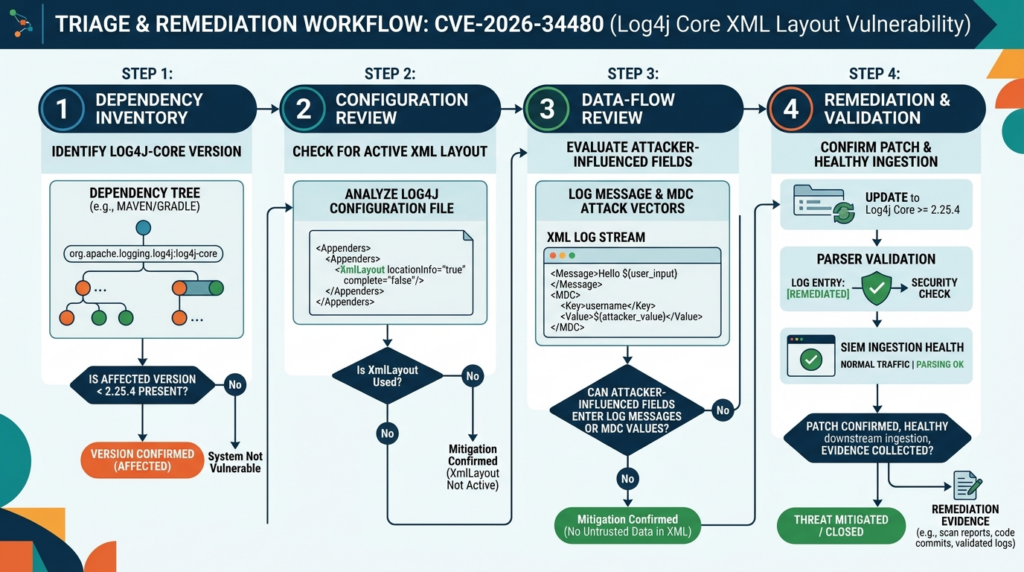
A good workflow separates dependency presence, configuration relevance, input controllability, and downstream impact.
| Priority | प्रमाण | Recommended action |
|---|---|---|
| Urgent | Affected Log4j Core, XmlLayout enabled, attacker-influenced fields logged, strict downstream XML ingestion, weak ingestion failure monitoring | Upgrade to 2.25.4 or newer immediately, validate parser behavior, monitor for ingestion failures |
| उच्च | Affected Log4j Core and XmlLayout enabled, but attacker influence uncertain | Upgrade, map logged fields, test local invalid-character handling, review ingestion pipeline |
| मध्यम | Affected Log4j Core present, no evidence of XmlLayout in active config | Upgrade through normal security patch cycle, confirm runtime config and vendor bundles |
| कम | Fixed Log4j Core version or no लॉग4जे-कोर present | Record evidence and close or suppress with expiration |
| Vendor-dependent | Commercial product bundles affected Log4j | Follow vendor advisory and supported upgrade path |
The fastest way to waste time is to argue from severity alone. NVD’s CVSS 3.1 score is High, while Apache’s CVSS 4.0 score is Medium. Both are useful, but neither answers whether a specific service loses audit evidence when an invalid control character appears in an MDC value.(एनवीडी)
For teams running agentic or automated validation workflows, the important output is not a generic “vulnerable” label. It is a proof packet: package version, active configuration, reachable logging path, controlled local reproduction, downstream parser behavior, and remediation evidence. Platforms such as Penligent are relevant in that operational layer because AI-assisted pentesting and verification workflows can help connect scanner findings to concrete evidence, especially when the work spans dependency inventory, configuration review, safe validation, and report-ready remediation proof rather than one-off exploit execution.(पेनलिजेंट)
What to ask engineering
When this CVE appears in a ticket queue, ask specific questions:
1. Which service, image, or vendor product contains log4j-core below 2.25.4?
2. Is the affected jar loaded at runtime or only present in build/test tooling?
3. Is XmlLayout configured in the active Log4j configuration?
4. Which appenders use that layout?
5. Which logged fields can contain user, tenant, request, header, queue, or MDC data?
6. Does any downstream parser reject a whole file or batch if one XML event is malformed?
7. Do we monitor ingestion failures and dead-letter queues?
8. Can we upgrade to Log4j Core 2.25.4 or newer without unsupported vendor modification?
9. Should this XML logging path be migrated to JSON Template Layout?
10. What evidence proves the fix is running in production?
These questions turn the ticket from a dependency argument into a security engineering task.
Common mistakes
The first mistake is calling this “Log4j RCE.” That will inflate urgency in the wrong way and distract from the actual evidence path.
The second mistake is dismissing it because it is not RCE. Logs are part of the detection and audit plane. A vulnerability that makes specific records disappear can matter, especially in authentication, payment, administrative, and security-monitoring systems.
The third mistake is patching the application dependency but forgetting vendor bundles. Java estates often contain multiple copies of Log4j: one in the service, one inside an admin tool, one in a plugin, one in a batch worker, one inside a vendor product, and one in an old fat jar that still runs during maintenance jobs.
The fourth mistake is validating only with a happy-path XML viewer. You need to test the same downstream parser or ingestion path that production uses. A local file that “looks fine” in a text editor does not prove that the SIEM parser accepts it.
The fifth mistake is ignoring Log4j’s own migration signal. If your organization still relies on XML Layout only because nobody has touched the logging configuration in years, CVE-2026-34480 is a good reason to plan a controlled migration.
Remediation checklist
Use this as a practical closure checklist:
| कदम | Evidence to attach |
|---|---|
| Confirm affected package | Maven, Gradle, SBOM, image, or vendor evidence showing लॉग4जे-कोर version |
| Confirm active layout | log4j2.* configuration showing whether XmlLayout is used |
| Confirm input paths | List of logged fields that can contain external or request-scoped data |
| पैच | Resolved dependency tree, vendor patch note, or image rebuild record |
| Validate fixed behavior | Local controlled test showing invalid XML characters no longer break output |
| Validate production rollout | Runtime version check, deployed image digest, or application startup dependency evidence |
| Check pipeline health | SIEM or shipper metrics showing no XML parse failures or ingestion drop spike |
| Decide migration | Ticket or roadmap item for moving away from XML Layout if appropriate |
The best closure note is not “scanner is clean.” It is “the affected version is no longer present in runtime, XmlLayout usage was reviewed, downstream parser failure monitoring is in place, and the production artifact contains Log4j Core 2.25.4 or newer.”
अक्सर पूछे जाने वाले प्रश्न
Is CVE-2026-34480 another Log4Shell?
नहीं।
- Log4Shell, CVE-2021-44228, was a remote code execution issue tied to JNDI behavior in affected Log4j versions.
- CVE-2026-34480 is an
XmlLayoutoutput sanitization issue. - The main risk is malformed XML or log event loss, not arbitrary code execution.
- It still deserves attention because logs support detection, audit, and incident response.
Is CVE-2026-34480 an XXE vulnerability?
No, not according to the public Apache and NVD descriptions.
- Apache describes forbidden XML 1.0 characters in
XmlLayoutoutput. - NVD maps the issue to CWE-116, Improper Encoding or Escaping of Output.
- The advisory does not describe external entity resolution, DTD abuse, SSRF, or local file disclosure.
- A downstream product could theoretically have a separate XML parser issue, but that would be a different finding.
Which Log4j versions are affected?
The affected ranges are:
लॉग4जे-कोरversions from2.0-alpha1पहले2.25.4.- Log4j 3 pre-release versions from
3.0.0-alpha1के माध्यम से3.0.0-beta3. - The fixed Log4j Core version is
2.25.4. - Teams should prefer 2.25.4 or a newer supported release rather than trying to patch behavior manually.
How do I know whether XmlLayout is actually used?
Check both dependency inventory and runtime configuration.
- Use Maven, Gradle, SBOM, container, and file-system searches to find
लॉग4जे-कोर. - Search
log4j2.xml,log4j2.properties,log4j2.yaml, औरlog4j2.jsonके लिएXmlLayout. - Confirm which configuration is active in production, because unused sample configs can create false alarms.
- Review vendor documentation if the affected jar is inside commercial software.
Can an attacker exploit CVE-2026-34480 remotely?
Possibly, but only through a specific chain.
- The application must use affected Log4j Core with
XmlLayout. - Attacker-influenced data must reach a log message or MDC value.
- That data must include XML 1.0 forbidden characters.
- The downstream logging path must fail in a way that matters, such as dropped records, parser rejection, or failed indexing.
- This is not a generic remote shell vulnerability.
Is upgrading to Log4j Core 2.25.4 enough?
It is the baseline fix, but it may not be the whole operational answer.
- Upgrade to 2.25.4 or newer to get the upstream sanitization fix.
- Rebuild and redeploy the actual runtime artifact, not just the source repository.
- Check fat jars, shaded jars, container layers, plugins, and vendor bundles.
- Validate that downstream logging still parses correctly after the upgrade.
- Consider migrating away from XML Layout if it is only retained for legacy reasons.
What should security teams monitor after patching?
Monitor the logging pipeline, not only the application.
- XML parser fatal errors.
- Log shipper rejected events.
- Dead-letter queue growth.
- Sudden drops in audit or authentication event volume.
- Log4j status logger errors.
- SIEM ingestion lag or index failures.
- Differences between raw log volume and indexed event volume.
Final take
CVE-2026-34480 is easy to misread because it carries the Log4j name without carrying the Log4Shell exploit model. The bug is narrower than RCE, but it touches a part of the stack defenders depend on when systems are under attack: logs.
The correct response is precise. Upgrade Log4j Core to 2.25.4 or newer. Confirm whether XmlLayout is active. Identify whether attacker-influenced data can enter log messages or MDC values. Test downstream parser behavior. Monitor ingestion failures. Preserve evidence. Then decide whether XML Layout still belongs in the logging architecture at all.

 Hindi
Hindi  English
  German
  French
  Spanish
  Portuguese
  Japanese
  Korean
  Arabic
  Turkish
  Hebrew