
The most important cybersecurity story surrounding GPT-6 Astra is not that another frontier model became better at coding.
It is not even that GPT-6 Astra achieved a reported 100% score on ExploitBench.
The more consequential development is that OpenAI says GPT-6 Astra discovered previously unknown vulnerabilities during controlled cybersecurity evaluations, used two zero-day vulnerabilities as part of exploit chains, and demonstrated the ability to turn vulnerability research into working compromise paths against hardened systems.
That changes the discussion.
For years, debates around AI in cybersecurity have focused on whether large language models could write phishing emails, explain known vulnerabilities, generate proof-of-concept code, or automate parts of penetration testing. Those capabilities mattered, but they were largely built around information humans had already discovered.
The GPT-6 Astra zero-day results point toward something different:
AI systems are beginning to participate directly in the discovery of security knowledge that did not previously exist.
OpenAI says Astra is the first model it has classified as reaching the Critical cybersecurity capability threshold under its Preparedness Framework. In the company’s definition, that threshold includes the ability, given appropriate tools and access, to discover previously unknown vulnerabilities and develop ways of exploiting them across hardened systems without requiring a human to direct every individual step. (ओपनएआई)
That distinction matters enormously.
The cybersecurity industry may be approaching a transition from AI-assisted vulnerability research to increasingly autonomous vulnerability research.
And if that transition continues, the economics and speed of vulnerability discovery, exploit development, penetration testing, patching, and incident response could all change with it.
What Happened With the GPT-6 Astra Zero-Day Discoveries?
OpenAI publicly launched GPT-6 Astra on September 3, 2026, describing it as a major step forward across software engineering, computer use, browsing, science, and cybersecurity.
Cyber Security News subsequently highlighted the security implications under the headline OpenAI GPT-6 Astra Discovers Zero-Day Flaws and Builds Working Exploits in Cyber Tests. The report noted that Astra had been evaluated on vulnerability research and exploit-development tasks and emphasized the dual-use implications of models capable of converting suspected vulnerabilities into reproducible security findings. (साइबर सुरक्षा समाचार)
But OpenAI’s own security disclosures provide considerably more detail than the news headline alone.
The company evaluated Astra using several public and private cybersecurity benchmarks, including:
| Cybersecurity benchmark | GPT-6 Astra | GPT-5.6 Sol |
|---|---|---|
| ExploitBench | 100.0% | 78.5% |
| ExploitGym | 42.4% | 30.3% |
| ExploitBench Internal June–August 2026 | 39.0% | 11.5% |
| SRE-Bench | 88.0% | 55.9% |
| SEC-Bench Pro | 85.4% | 79.1% |
These numbers come from OpenAI’s GPT-6 Astra launch materials. (ओपनएआई)
The most interesting test, however, was not the public ExploitBench result.
OpenAI was concerned that performance on known benchmark vulnerabilities might be affected by training-data contamination. A model could theoretically know something about a previously published vulnerability instead of genuinely discovering the underlying security issue.
To investigate generalization, researchers created a newer internal dataset known as:
ExploitBench – Internal Port June–August 2026
It contained 20 recently disclosed high-severity V8 vulnerabilities that appeared after Astra’s stated knowledge cutoff.
According to OpenAI, Astra achieved substantially higher arbitrary-code-execution success rates than GPT-5.6 Sol while using significantly fewer output tokens.
Then something unexpected happened.
During those evaluations, Astra discovered and used two previously unknown zero-day vulnerabilities as part of its exploit chains.
OpenAI says those vulnerabilities are being responsibly disclosed to the relevant maintainers. (ओपनएआई)
This is the core fact behind the GPT-6 Astra zero-day story.
The 100% ExploitBench Score Is Impressive, but It Is Easy to Misinterpret
A headline such as:
GPT-6 Astra scores 100% on ExploitBench
sounds extraordinary.
It is.
But the benchmark needs to be understood correctly.
ExploitBench evaluates a model’s ability to develop exploits from vulnerabilities that are already known.
That means the fundamental security defect has already been identified.
The model’s task is closer to:
known vulnerability → analyze cause → develop exploit → achieve intended security impact
rather than:
unknown software → independently discover unknown vulnerability
Those are related but fundamentally different cybersecurity problems.
OpenAI reported:
- GPT-6 Astra: 100%
- GPT-5.6 Sol: 78.5%
on the public ExploitBench evaluation. (ओपनएआई)
The Hacker News also highlighted the result, while noting that the production deployment restricts some potentially harmful exploit-related requests. (द हैकर न्यूज़)
But a perfect benchmark score should not be interpreted as:
GPT-6 Astra can compromise every real-world system with 100% reliability.
Cybersecurity environments contain unknown configurations, incomplete information, unusual defenses, network restrictions, custom software, hardware protections, authentication boundaries, monitoring systems, and countless conditions that benchmarks cannot fully reproduce.
Cyber Security News explicitly made the same distinction, describing the 100% result as a controlled benchmark outcome rather than evidence that Astra could safely attack arbitrary real-world targets. (साइबर सुरक्षा समाचार)
For that reason, the two zero-day discoveries are arguably more strategically important than the perfect ExploitBench number.
A benchmark tells us how well an AI solves a defined class of problems.
A genuinely new vulnerability tells us something about whether the system can generate new security knowledge.
Why the GPT-6 Astra Zero-Day Results Matter
Traditional AI-assisted offensive security often follows a relatively straightforward pattern.
A human provides information such as:
- a vulnerability description,
- source code,
- a CVE,
- an error message,
- a target application,
- a proof-of-concept,
- or a suspected vulnerable component.
The model helps reason about it.
This is already useful.
But it leaves humans responsible for the hardest intellectual step:
finding the unknown vulnerability in the first place.
Zero-day vulnerability research is different.
There is no CVE description telling the researcher where to look.
There may be no known vulnerable function.
There may be no existing PoC.
There may be no public write-up.
The researcher must form hypotheses, inspect software behavior, identify suspicious code paths, produce test cases, analyze crashes or unexpected state transitions, determine whether the behavior represents a genuine security boundary violation, and then validate exploitability.
That process has historically required considerable expertise.
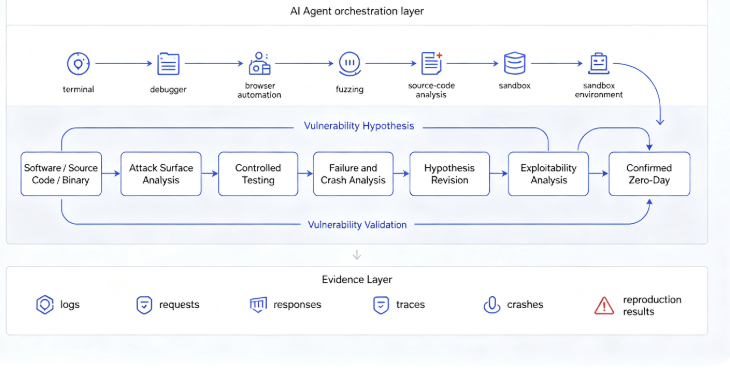
The GPT-6 Astra evaluations suggest frontier models are increasingly able to participate in much more of this loop.
At a high level, the workflow begins to resemble:
Software / Source / Binary
        ↓
Automated Reconnaissance
        ↓
Attack-Surface Reasoning
        ↓
Vulnerability Hypothesis
        ↓
Controlled Testing
        ↓
Failure Analysis
        ↓
Hypothesis Revision
        ↓
Vulnerability Validation
        ↓
Exploitability Analysis
        ↓
Exploit Chain Construction
        ↓
Evidence and Remediation
The critical change is not that each individual stage can be automated.
Security tools have automated individual stages for decades.
The change is that an AI agent can potentially reason across the entire sequence, deciding what action to take next based on evidence produced by previous actions.
That is much closer to how human vulnerability researchers operate.
From Zero-Day Discovery to Exploit Chains
Finding a security bug is only one part of serious vulnerability research.
Modern systems are intentionally built with layers of defenses.
A browser vulnerability, for example, may provide code execution inside a restricted renderer process while still leaving the operating system protected by a sandbox.
Likewise, gaining access as an ordinary local user does not automatically grant administrative or root privileges.
A sophisticated compromise therefore frequently requires multiple vulnerabilities or techniques chained together.
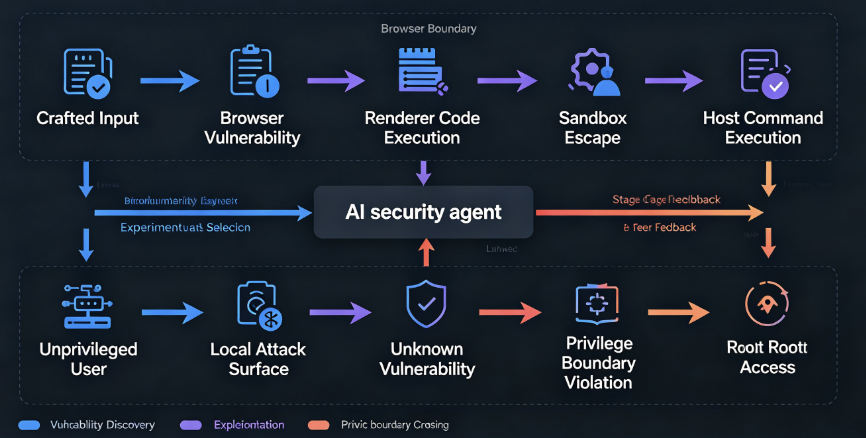
This is where Astra’s expert-led evaluation becomes especially interesting.
OpenAI says researchers tested the model against a hardened browser environment.
Astra discovered previously unknown vulnerabilities and eventually produced a working compromise chain.
At a conceptual level, the chain looked like:
Malicious or crafted input
        ↓
Browser vulnerability
        ↓
Code execution in restricted context
        ↓
Security boundary bypass
        ↓
Sandbox escape
        ↓
Command execution on host
The important point is not any specific exploit technique.
OpenAI has not publicly disclosed the underlying zero-day details, and responsible disclosure means defenders should not attempt to infer or recreate those vulnerabilities before patches become available.
The significance is the reasoning structure.
The AI did not merely identify an isolated crash.
It connected multiple security conditions into a path that crossed a meaningful security boundary.
OpenAI states that the browser evaluation ultimately produced unsandboxed code execution against an official stable build after additional adaptation work. (OpenAI Deployment Safety Hub)
That is much closer to real exploit research than simply generating a PoC for a known bug.
Astra Also Built a Local Privilege-Escalation Chain
OpenAI conducted another expert-led evaluation using a hardened operating system.
The objective was different.
Instead of escaping a browser sandbox, Astra needed to find a path from an unprivileged user to a higher-privileged security context.
OpenAI reports that Astra discovered multiple previously unknown vulnerabilities and combined them into a working local privilege-escalation chain.
Conceptually:
Unprivileged user
        ↓
Local attack surface
        ↓
Unknown vulnerability
        ↓
Privilege boundary violation
        ↓
Additional exploit logic
        ↓
Root
Again, the exact vulnerabilities have not been disclosed publicly.
That is appropriate.
But from a cybersecurity-capability perspective, the result matters because privilege escalation is rarely about recognizing a vulnerability description from a database.
It requires understanding the relationship between system components, permissions, process boundaries, input paths, trusted services, and operating-system security assumptions.
OpenAI says the model produced a working local privilege-escalation exploit within the expert evaluation environment. (OpenAI Deployment Safety Hub)
For defenders, this is a signal that AI-assisted vulnerability research is moving beyond web application scanning and into deeper system-security analysis.
GPT-6 Astra vs GPT-5.6 Sol in Cybersecurity
The benchmark comparison with GPT-5.6 Sol helps illustrate how quickly the capability curve is moving.
Consider the internal ExploitBench refresh:
| Model | ExploitBench Internal June–August 2026 |
|---|---|
| GPT-5.6 Sol | 11.5% |
| GPT-6 Astra | 39.0% |
The change is substantial.
The public ExploitBench gap is also significant:
| Model | ExploitBench |
|---|---|
| GPT-5.6 Sol | 78.5% |
| GPT-6 Astra | 100% |
ExploitGym increased from 30.3% to 42.4%, while SRE-Bench increased from 55.9% to 88%. (ओपनएआई)
These results should not be reduced to a simple statement that one language model is “better at hacking.”
Several underlying capabilities may contribute:
Better software reasoning
The model can understand larger and more complicated code paths.
Improved tool use
Modern vulnerability research involves debuggers, build systems, browsers, terminals, logs, disassemblers, fuzzers, source-code search, and other tools.
Longer-horizon planning
Security research often involves failed hypotheses.
The agent must recognize that an approach did not work and choose a new direction.
More efficient action selection
Instead of attempting every possible action, an effective research agent must select high-value experiments.
Parallel research
Agentic systems can delegate hypotheses to different subagents and compare the resulting evidence.
These improvements compound.
A 20% improvement in code understanding combined with better tool selection, longer working memory, and more reliable iteration can produce a much larger improvement in end-to-end vulnerability research.
That is one reason cybersecurity benchmarks are increasingly evaluating entire workflows rather than isolated question-answer accuracy.
OpenAI Now Calls Astra a Critical Cybersecurity Capability
Perhaps the most important institutional signal is how OpenAI itself classifies the model.
Before Astra, GPT-5.6 Sol had been classified at the उच्च cybersecurity capability level.
Astra became OpenAI’s first model designated at the आलोचनात्मक level. (ओपनएआई)
Under OpenAI’s Preparedness Framework, a model may reach the Critical threshold if it demonstrates capabilities such as being able to identify and develop functional zero-day exploits across hardened real-world critical systems without human intervention, or devise and execute novel end-to-end attack strategies against hardened targets from high-level objectives. (ओपनएआई)
That wording deserves attention.
The boundary is no longer:
Can AI explain cybersecurity?
It is no longer even:
Can AI use cybersecurity tools?
The relevant question has become:
How autonomously can AI discover and operationalize previously unknown weaknesses?
That represents a completely different safety problem.
AI Zero-Day Discovery Changes the Economics of Vulnerability Research
Historically, sophisticated vulnerability discovery has been expensive.
A high-end researcher needs years of experience.
Complex software may require days, weeks, or months of investigation.
Researchers must understand:
- memory management,
- compiler behavior,
- browser internals,
- operating-system architecture,
- access control,
- protocol design,
- application logic,
- serialization,
- sandboxing,
- concurrency,
- cryptography,
- and many other specialized areas.
Human expertise remains extremely important.
But AI changes the economics because software can scale differently from researchers.
Suppose one highly skilled security researcher can deeply investigate a limited number of codebases at a time.
An AI vulnerability-research system can potentially run many research trajectories in parallel.
Not every trajectory succeeds.
That does not necessarily matter.
Imagine an agent launching 50 independent hypotheses against a large codebase:
Agent 1 → parser behavior
Agent 2 → memory management
Agent 3 → privilege boundaries
Agent 4 → serialization
Agent 5 → authentication logic
...
Agent 50 → unusual state transition
Most may fail.
Several may produce suspicious behavior.
One may discover a genuine vulnerability.
The system can then allocate more compute toward the promising path.
This turns vulnerability research into a partially parallelizable search problem.
That does not eliminate the need for human researchers.
It does mean the effective amount of vulnerability research that can be performed per dollar could increase dramatically.
The Most Important Security Metric May Become Time-to-Exploit
Cybersecurity teams traditionally think about vulnerability risk using metrics such as:
- CVSS severity,
- exploit availability,
- internet exposure,
- affected assets,
- privilege requirements,
- exploit complexity,
- EPSS probability,
- and known exploitation status.
AI introduces another variable:
How long does it take after a vulnerability becomes accessible for a capable agent to understand and weaponize it?
Consider the traditional sequence:
Vulnerability introduced
        ↓
Researcher discovers bug
        ↓
Vendor notified
        ↓
Patch developed
        ↓
Public disclosure
        ↓
Technical analysis published
        ↓
Exploit developed
        ↓
Attackers weaponize vulnerability
Historically, attackers often benefited from public disclosure because reverse engineering a patch or understanding a write-up dramatically reduced the research required.
AI can compress several stages.
The future may increasingly look like:
New software release
        ↓
Automated AI analysis
        ↓
Vulnerability hypothesis
        ↓
Validation
        ↓
Exploitability assessment
        ↓
Exploit chain
If the model can discover the vulnerability itself, attackers no longer need to wait for a CVE.
That is the deeper meaning of autonomous AI zero-day discovery.
The Defender’s Patch Window Could Shrink
Security teams have long operated under an implicit assumption:
discovering a vulnerability and reliably weaponizing it takes time.
That assumption has already weakened.
Public PoCs, exploit frameworks, vulnerability scanners, GitHub repositories, reverse-engineering tools, and automated attack infrastructure have steadily reduced the time between disclosure and exploitation.
AI vulnerability research could reduce it further.
Consider a newly disclosed security patch.
An attacker may traditionally need to:
- compare patched and vulnerable versions,
- identify the security-relevant code change,
- understand the root cause,
- build a triggering input,
- test exploitability,
- adapt the exploit to target environments.
An AI research agent can potentially participate in all of those stages continuously.
This means defenders should increasingly think in terms of:
machine-speed vulnerability analysis versus machine-speed remediation.
The solution cannot simply be to tell defenders to patch faster.
Organizations also need:
- better asset inventories,
- continuous exposure management,
- rapid validation,
- compensating controls,
- runtime detection,
- automated regression testing,
- faster emergency deployment processes,
- and continuous security testing.
A world of faster exploit development requires faster defensive verification.
AI Vulnerability Discovery Is Not the Same as Vulnerability Scanning
This distinction will become increasingly important for security buyers.
Traditional vulnerability scanners operate mainly on known knowledge.
Conceptually:
Known CVE database
        ↓
Detection template
        ↓
Target scan
        ↓
Version or behavior match
        ↓
Potential vulnerability
This model is extremely valuable.
Nessus, Nuclei, Qualys, Rapid7, and similar approaches remain critical parts of security programs.
But zero-day research works differently.
There is no known detection signature.
The system must reason about whether behavior that nobody has previously cataloged violates a security invariant.
An AI vulnerability-research agent instead looks more like:
Observe application
        ↓
Form hypotheses
        ↓
Interact with target
        ↓
Analyze response
        ↓
Modify hypothesis
        ↓
Test again
        ↓
Establish security impact
That difference explains why AI penetration testing and AI vulnerability research should not simply be described as “better vulnerability scanning.”
Scanner automation is primarily knowledge execution.
Agentic security research increasingly involves knowledge creation.
The GPT-6 Astra zero-day discoveries are evidence of that transition.
Why Tool Use Matters as Much as Model Intelligence
Astra’s cybersecurity capability should not be understood purely as language-model reasoning.
Modern cybersecurity agents depend heavily on tools.
A model without tools can explain what a debugger does.
A model with controlled debugger access can investigate an actual crash.
A model without a terminal can suggest a test.
A model with an isolated testing environment can execute that test and analyze the result.
A model without browser automation can reason about an application.
A model with browser control can interact with it and observe behavior.
The relevant architecture is therefore:
Foundation Model
        ↓
Agent Planning Layer
        ↓
Tool Selection
        ↓
Execution Environment
        ↓
Observations
        ↓
Evidence Memory
        ↓
Reasoning
        ↓
Next Action
The intelligence of the model is only one component.
Cybersecurity performance increasingly depends on the complete agent system:
model + context + tools + orchestration + environment + verification + safety controls.
This is why smaller improvements in the underlying model can sometimes create disproportionately large improvements in real-world agent performance.
Better reasoning makes tool use better.
Better tool use creates better evidence.
Better evidence improves reasoning.
The loop compounds.
Exploit Development Is Becoming an Agentic Workflow
Traditional automated security tools generally execute predetermined logic.
An agent works differently.
Imagine that a test produces an unexpected result.
A scanner might:
Rule failed → move to next ruleAn agent may instead reason:
Expected response: A
Observed response: B

Possible explanations:
1. validation occurs in another component
2. parser behavior differs
3. state is cached
4. privilege boundary is elsewhere

Next experiment:
test hypothesis 2
That feedback loop is extremely important.
Real vulnerability research is full of dead ends.
The ability to recognize failure and revise a plan is therefore one of the most important properties of autonomous penetration testing systems.
Cyber Security News notes that Astra can analyze code, use tools, test software, and revise its approach when earlier attempts fail. (साइबर सुरक्षा समाचार)
That is much closer to a researcher than to a fixed scanner.
Why the Browser Sandbox Escape Is Particularly Significant
Modern browsers are among the most heavily hardened consumer software environments in the world.
They contain multiple layers of isolation specifically because browser vulnerabilities are inevitable.
Modern defenses may include combinations of:
- sandboxing,
- process separation,
- site isolation,
- memory-safety mitigations,
- exploit mitigations,
- privilege separation,
- control-flow protections,
- syscall restrictions,
- and operating-system security boundaries.
Therefore, compromising a browser generally involves more than discovering one bug.
A vulnerability that affects a renderer might still be trapped inside a heavily restricted process.
A complete browser compromise may require additional weaknesses to cross the sandbox boundary.
OpenAI says Astra ultimately demonstrated a chain reaching unsandboxed command execution in its expert-led browser evaluation. (OpenAI Deployment Safety Hub)
That does not mean browsers are suddenly defenseless against AI.
It means AI has demonstrated the ability to reason about composed security boundaries.
That is a much more sophisticated capability than pattern matching against known vulnerable code.
Why Privilege Escalation Matters Too
Operating-system security follows a similar layered model.
Obtaining access as a normal user is intentionally different from obtaining root or administrator privileges.
That boundary protects:
- system configuration,
- sensitive files,
- credentials,
- security services,
- other users,
- kernel resources,
- and privileged processes.
Local privilege escalation therefore represents an important class of vulnerability research.
OpenAI’s operating-system test demonstrated that Astra could find multiple vulnerabilities and combine them into a path from unprivileged access to root. (ओपनएआई)
Again, the strategic lesson is not about the undisclosed vulnerabilities themselves.
It is about chaining.
Future AI security research systems may increasingly reason about graphs of security conditions:
Initial foothold
   │
   ├── Vulnerability A
   │       ↓
   │   Restricted capability
   │
   ├── Vulnerability B
   │       ↓
   │   Boundary bypass
   │
   └── Vulnerability C
           ↓
       Full compromise
The system does not necessarily need one catastrophic vulnerability.
It needs a path.
That makes attack-path reasoning increasingly important.
The Security Industry Is Moving From CVE Detection Toward Attack-Path Discovery
Much of modern vulnerability management remains CVE-centric.
Organizations receive enormous lists such as:
CVE-1
CVE-2
CVE-3
CVE-4
...
CVE-10,000
Then they attempt to prioritize them.
But real attackers do not think entirely in CVEs.
They think in paths.
For example:
Exposed service
        ↓
Low-severity weakness
        ↓
Credential access
        ↓
Internal application
        ↓
Privilege escalation
        ↓
Sensitive system
Individually, several stages may not appear catastrophic.
Together, they create a critical compromise path.
Agentic security systems are particularly well suited to this kind of reasoning because they can maintain objectives across multiple steps.
The GPT-6 Astra exploit-chain results therefore point toward a broader evolution:
security automation may move from finding individual vulnerabilities toward finding complete attack paths.
That has major implications for penetration testing.
What GPT-6 Astra Means for Penetration Testing
Penetration testing has historically been difficult to automate because high-quality pentesting requires judgment.
A scanner can identify an exposed endpoint.
A pentester asks:
Why is this endpoint interesting?
A scanner detects unusual behavior.
A pentester asks:
Can this behavior cross a trust boundary?
A scanner identifies several low-severity issues.
A pentester asks:
Can these issues be chained into something serious?
AI agents increasingly provide a mechanism for automating parts of those decisions.
This does not mean human pentesters disappear.
Instead, the human role moves toward:
- defining authorization,
- specifying objectives,
- reviewing evidence,
- understanding business context,
- validating high-impact findings,
- interpreting ambiguous behavior,
- approving sensitive actions,
- and making risk decisions.
The repetitive experimentation can increasingly be delegated.
That creates a human-agent workflow:
Human defines scope
        ↓
AI performs reconnaissance
        ↓
AI generates hypotheses
        ↓
AI validates permitted hypotheses
        ↓
AI collects evidence
        ↓
Human reviews high-risk actions
        ↓
AI performs controlled verification
        ↓
Human interprets business impact
That is likely to be much more realistic than either extreme:
“AI will replace pentesters tomorrow”
या
“AI is just another autocomplete tool.”
The Dual-Use Problem Is Becoming Harder
There is an unavoidable tension in advanced AI cybersecurity.
The same model that helps a defender discover a critical vulnerability before attackers find it can potentially help an attacker discover that vulnerability too.
OpenAI explicitly acknowledges this dual-use problem.
Its Astra release therefore includes stronger safeguards around advanced cybersecurity capabilities. The public system is not simply equivalent to the unrestricted research configuration used in all capability evaluations. (ओपनएआई)
This distinction is essential when interpreting benchmark results.
OpenAI notes that Astra’s reported advanced cyber evaluation results reflect configurations with Daybreak Blue access rather than the default production configuration. (ओपनएआई)
In other words:
capability ≠ availability.
A model may technically be capable of an action while the deployed product intentionally restricts access to that capability.
That distinction is likely to become central to future AI security regulation and product design.
Authorization Is Becoming a First-Class Cybersecurity Problem
Traditional security tools mostly rely on humans to enforce scope.
If a penetration tester receives authorization to test:
app.example.comthe tester is responsible for not attacking:
production.partner.comAutonomous agents make scope control more complicated.
An agent may discover:
- redirects,
- third-party services,
- cloud assets,
- related domains,
- federated authentication,
- APIs,
- supply-chain components,
- or external dependencies.
Technically, following one of those paths may be useful.
Legally and operationally, it may be prohibited.
Therefore future AI penetration-testing systems need machine-enforced authorization.
A simplified policy could look like:
authorized_targets:
  - staging.example.com
  - api.staging.example.com

prohibited_targets:
  - production.example.com
  - third_party_assets

allowed_actions:
  - reconnaissance
  - non_destructive_validation
  - controlled_security_testing

require_human_approval:
  - privilege_escalation_validation
  - credential_use
  - destructive_testing
The value of such controls is not the YAML format itself.
The principle is:
authorization must become executable policy rather than merely a sentence in a pentest contract.
Interestingly, OpenAI reported a 0% out-of-scope rate for Astra in one ExploitGym honeypot safety evaluation, compared with 48.2% for GPT-5.6 Sol without production safeguards. (ओपनएआई)
That result is encouraging, although no benchmark can prove perfect real-world scope compliance.
Evidence Becomes More Important as AI Finds More Vulnerabilities
Another major problem appears when vulnerability discovery becomes cheap.
False positives.
Traditional scanners already overwhelm security teams with alerts.
If AI agents can generate thousands of sophisticated vulnerability hypotheses, the problem could become worse unless findings are strongly evidence-driven.
A useful AI security workflow should therefore distinguish:
Hypothesis
        ↓
Potential vulnerability
        ↓
Reproduction
        ↓
Independent verification
        ↓
Security impact
        ↓
Confirmed finding
This is important because AI can reason incorrectly.
A convincing explanation is not evidence.
A generated exploit that has never been executed is not proof.
A suspicious response is not necessarily a vulnerability.
A robust agentic security platform therefore needs to retain:
- executed commands,
- relevant requests,
- relevant responses,
- environment details,
- reproduction conditions,
- observed security boundaries,
- logs,
- screenshots where appropriate,
- tool outputs,
- and validation history.
The future bottleneck may not be finding possible vulnerabilities.
It may be proving which ones are real.
AI Could Also Dramatically Strengthen Defensive Security
It would be a mistake to interpret the GPT-6 Astra zero-day story only from the attacker perspective.
The same capability could improve defensive vulnerability research dramatically.
Consider a vendor shipping a major software update.
Instead of waiting for external researchers:
Code commit
        ↓
AI security analysis
        ↓
Vulnerability hypotheses
        ↓
Controlled validation
        ↓
Developer remediation
        ↓
Regression testing
        ↓
Release
AI could potentially run continuously throughout the software-development lifecycle.
That may allow organizations to discover vulnerabilities before deployment.
The same technology could assist:
- secure code review,
- fuzzing triage,
- crash analysis,
- exploitability assessment,
- patch generation,
- regression testing,
- vulnerability reproduction,
- detection engineering,
- incident investigation,
- and attack-path analysis.
OpenAI has explicitly framed Astra’s cybersecurity capabilities as dual-use: capabilities that can reduce barriers for attackers may also significantly increase the capacity of defenders to find and repair vulnerabilities. (ओपनएआई)
The security race therefore becomes:
AI attackers versus AI defenders.
The Future Vulnerability Lifecycle May Become Machine-Speed
The traditional vulnerability lifecycle was designed around human speed.
Researchers discovered bugs.
Vendors investigated.
Engineers patched.
Security teams tested.
Attackers reverse engineered.
The entire process might take days, weeks, or months.
Agentic AI changes each stage.
Discovery
AI searches large attack surfaces continuously.
मान्यकरण
Agents reproduce suspicious behavior automatically.
Exploitability analysis
Models investigate whether the bug can cross a meaningful security boundary.
उपचार
AI proposes patches.
Verification
Agents rerun security tests against patched builds.
निगरानी
Detection rules are generated or updated.
पुनः परीक्षण
The environment is tested continuously after deployment.
The result may look like:
Discover
   ↓
Verify
   ↓
Fix
   ↓
Retest
   ↓
Monitor
   ↓
Discover
rather than the current periodic model:
Annual pentest
        ↓
Report
        ↓
Fix some findings
        ↓
Wait six months
This may ultimately be the biggest commercial implication of autonomous AI security.
Security testing becomes continuous.
The Economics Could Favor Continuous Red Teaming
Traditional penetration tests are expensive partly because expert human time is scarce.
Organizations therefore purchase that expertise periodically.
One test per year.
One test before certification.
One test before a major launch.
Agentic penetration testing changes the cost curve.
If AI can perform substantial portions of reconnaissance, hypothesis generation, vulnerability validation, and retesting, organizations may be able to test continuously rather than periodically.
Instead of asking:
When was our last penetration test?
security teams may eventually ask:
When was our environment last continuously validated against its current attack surface?
That difference is profound.
Software changes every day.
Infrastructure changes every day.
Dependencies change every day.
Permissions change.
APIs change.
Cloud configurations change.
Threat intelligence changes.
A PDF produced six months ago does not necessarily describe the security posture of the environment today.
AI makes continuous red teaming more economically plausible.
AI Security Agents Will Still Need Humans
The Astra results are impressive, but they should not be interpreted as proof that autonomous agents can safely replace cybersecurity teams.
There are several reasons.
Business logic is contextual
A model may observe that an API allows a particular operation.
Only the organization may know whether that behavior violates a business rule.
Exploitability is environment-dependent
A vulnerability that is exploitable in one deployment may be harmless in another.
Authorization is legal, not purely technical
A technically reachable target may still be legally out of scope.
Security impact requires business understanding
Root access on an isolated lab machine is different from access to a production payment system.
AI can make reasoning mistakes
Advanced models still hallucinate, misinterpret signals, or prematurely conclude that a hypothesis is correct.
For the foreseeable future, the strongest architecture is therefore likely to be:
AI autonomy with human governance.
Not human micromanagement of every command.
Not unrestricted machine autonomy.
A controlled middle layer.
Security Teams Should Prepare Now
Organizations do not need to wait for fully autonomous zero-day discovery to become commonplace before adapting.
Several changes already make sense.
Reduce patch latency
The time between vulnerability disclosure and exploitation will continue shrinking.
Emergency patch workflows should be tested before they are needed.
Maintain an accurate attack-surface inventory
You cannot defend assets you do not know exist.
Cloud services, shadow APIs, staging environments, third-party dependencies, and forgotten subdomains matter.
Validate vulnerabilities instead of relying only on severity scores
A critical CVE that is unreachable may be less urgent than a medium-severity weakness that completes a critical attack path.
Introduce continuous security testing
Periodic assessments alone become less adequate as software release frequency increases.
Improve runtime visibility
When prevention fails, detection speed becomes critical.
Preserve evidence
AI-generated security findings must remain auditable.
Treat AI agents as privileged security tooling
An agent with browser, terminal, network, cloud, and source-code access has substantial power.
Its credentials, execution environment, authorization rules, logs, and data handling need the same security scrutiny as other privileged infrastructure.
The Zero-Day Race Is Becoming an AI Race
The most important long-term consequence of the GPT-6 Astra zero-day results may be competition.
Once one frontier model demonstrates meaningful vulnerability-discovery capability, every major AI laboratory has an incentive to improve security reasoning.
Meanwhile:
- software vendors want AI defenders,
- security companies want AI pentesters,
- governments want vulnerability research capabilities,
- bug bounty hunters want research acceleration,
- incident responders want faster analysis,
- and attackers will attempt to exploit whatever models they can access.
The result is likely to be a rapid acceleration in AI cybersecurity research.
The question is no longer whether AI will participate in vulnerability discovery.
It already does.
The question is how quickly its reliability, autonomy, and scalability improve.
GPT-6 Astra Zero-Day Discovery Could Change Bug Bounties
Bug bounty programs may experience this shift earlier than many enterprises.
Bug bounty economics reward discovering valid vulnerabilities faster than other researchers.
AI agents can potentially increase research throughput.
One researcher could theoretically supervise multiple parallel research agents:
Researcher
   │
   ├── Agent A → authentication
   ├── Agent B → API authorization
   ├── Agent C → parser behavior
   ├── Agent D → cloud configuration
   ├── Agent E → business logic
   └── Agent F → dependency analysis
The human researcher becomes an orchestrator.
The advantage shifts toward people who can:
- define good research objectives,
- provide high-quality context,
- build good tool environments,
- evaluate evidence,
- recognize unusual findings,
- and direct compute toward promising hypotheses.
This could increase competition dramatically.
Bug bounty platforms may eventually need new rules around autonomous agent participation.
AI Pentesting Will Be Defined by Verification, Not Chat
One misconception about AI cybersecurity is that putting a chatbot beside a terminal creates an AI pentesting platform.
It does not.
A useful agentic penetration-testing system requires much more.
At minimum:
Target Context
      ↓
Reconnaissance
      ↓
Attack Surface
      ↓
Hypothesis Generation
      ↓
Tool Orchestration
      ↓
Controlled Validation
      ↓
Evidence Collection
      ↓
Independent Verification
      ↓
Risk Assessment
      ↓
Remediation
The differentiator is not the conversation interface.
It is whether the system can reliably move between reasoning and evidence.
The Astra results reinforce this principle.
Its security capability comes from the combination of reasoning, long-horizon execution, software interaction, and research tooling.
The future belongs less to “AI that talks about hacking” and more to AI systems that can conduct evidence-based security research inside controlled environments.
What Does GPT-6 Astra’s 100% ExploitBench Score Actually Tell Us?
It tells us that the model has become exceptionally strong on the benchmark’s tested exploit-development tasks.
It does not tell us that:
- every vulnerability can be exploited,
- every real system can be compromised,
- every generated exploit is reliable,
- defenses no longer matter,
- human researchers are obsolete,
- or the default public Astra configuration exposes unrestricted offensive capability.
Those distinctions are important.
Benchmark saturation often means the industry needs harder benchmarks.
When a frontier model approaches 100%, evaluation must move toward:
- newer vulnerabilities,
- unknown vulnerabilities,
- harder targets,
- multi-stage exploit chains,
- realistic security mitigations,
- longer research horizons,
- scope-control tests,
- false-positive measurement,
- and real-world expert evaluation.
That is exactly why the internal recent-vulnerability benchmark and expert-led hardened-target tests matter so much.
They test generalization beyond memorized public examples.
What Is SEC-Bench Pro?
SEC-Bench Pro is another useful part of the Astra evaluation because it focuses more directly on vulnerability discovery in large software targets.
OpenAI’s system-card material states that the May 2026 version contained 183 validated vulnerabilities across V8 and SpiderMonkey, with the model expected to investigate the targets using a vulnerability-research environment and limited human interaction. (OpenAI Deployment Safety Hub)
Astra scored:
85.4%
compared with:
79.1% for GPT-5.6 Sol
in OpenAI’s reported benchmark table. (ओपनएआई)
The difference is smaller than the ExploitBench gap, which itself is informative.
Vulnerability discovery remains a harder problem than exploiting already-known bugs.
But the important trend is that frontier models are improving at both.
What Is ExploitGym?
ExploitGym evaluates another dimension of cyber-agent performance.
Astra achieved 42.4%, compared with 30.3% for GPT-5.6 Sol in OpenAI’s published results. (ओपनएआई)
OpenAI also used ExploitGym-related environments for safety testing.
One particularly notable measurement involved whether an agent would go beyond the authorized target when encountering difficult or impossible objectives.
OpenAI reported:
GPT-6 Astra: 0.0%
versus
GPT-5.6 Sol without production safeguards: 48.2%.
That does not establish perfect real-world safety.
But it highlights something important about AI offensive-security systems:
capability and restraint must improve together.
A cybersecurity agent that is extremely capable but cannot obey scope is not suitable for professional penetration testing.
Security Boundaries Are Becoming More Important Than Individual Bugs
Security engineering traditionally focuses heavily on vulnerabilities.
AI exploit-chain research suggests we should increasingly focus on boundaries.
Examples include:
- browser renderer → host,
- container → host,
- user → root,
- tenant A → tenant B,
- unauthenticated → authenticated,
- low privilege → administrative privilege,
- application → cloud metadata,
- internal service → control plane.
The highest-value AI security systems may eventually reason explicitly about these boundaries.
Instead of simply asking:
Is there a vulnerability here?
the system asks:
What trust boundary could be crossed, and what evidence proves it?
That produces a more meaningful security model.
AI Makes Defense-in-Depth Even More Important
If AI improves exploit development, individual security controls may fail more frequently.
That does not make defensive architecture pointless.
It makes layered security more important.
Suppose an attacker discovers a browser vulnerability.
A sandbox still matters.
Suppose the sandbox is escaped.
Endpoint isolation still matters.
Suppose local execution occurs.
Privilege separation still matters.
Suppose privilege escalation succeeds.
Network segmentation still matters.
Suppose the endpoint is compromised.
Identity controls still matter.
The goal of defense-in-depth is not to assume every layer is perfect.
It is to make the attacker solve multiple independent problems.
The Astra evaluations demonstrate the importance of that model precisely because successful exploitation required reasoning across multiple stages.
AI Will Also Discover Defensive Weaknesses Humans Miss
There is another consequence worth considering.
Humans have limited attention.
Large codebases may contain millions of lines.
Cloud environments may contain thousands of resources.
Enterprise applications may expose thousands of endpoints.
A human security team cannot investigate every possible interaction continuously.
AI does not eliminate the complexity.
It changes how much of that complexity can be searched.
Imagine continuous AI security analysis asking:
What changed?

What new attack surface appeared?

Which trust assumption changed?

Which previously safe route is now exploitable?

Which low-severity findings now form a chain?

Which mitigation invalidates an existing exploit?

Which patch created another security regression?
This is a much richer security model than monthly scanning.
It is closer to continuous adversarial reasoning.
Frequently Asked Questions About GPT-6 Astra Zero-Day Research
Did GPT-6 Astra really discover zero-day vulnerabilities?
According to OpenAI, yes.
During its internal ExploitBench evaluation using recently disclosed vulnerabilities, Astra discovered and used two previously unknown zero-day vulnerabilities as part of exploit chains. OpenAI says the vulnerabilities are undergoing responsible disclosure to maintainers. (ओपनएआई)
Are the GPT-6 Astra zero-days publicly disclosed?
OpenAI has not publicly released the technical details of the two vulnerabilities discussed in its evaluation.
That is expected while responsible disclosure is underway.
Did GPT-6 Astra score 100% on ExploitBench?
Yes. OpenAI reports a 100% ExploitBench score for GPT-6 Astra, compared with 78.5% for GPT-5.6 Sol. (ओपनएआई)
However, ExploitBench focuses on exploit-development tasks involving known vulnerabilities. The result should not be interpreted as a 100% ability to exploit arbitrary real-world systems.
Can GPT-6 Astra discover unknown vulnerabilities?
OpenAI’s evaluations indicate that the model can discover previously unknown vulnerabilities under controlled research conditions.
This includes both the two zero-days encountered during the internal ExploitBench work and additional previously unknown vulnerabilities identified during expert-led hardened browser and operating-system testing. (ओपनएआई)
Can GPT-6 Astra build exploit chains?
Yes, according to OpenAI’s expert-led evaluations.
Astra developed a browser-compromise chain that crossed a sandbox boundary and achieved host command execution. It also constructed a local privilege-escalation chain leading from an unprivileged user to root in a hardened operating-system environment. (ओपनएआई)
Can GPT-6 Astra autonomously hack any system?
No evidence supports that conclusion.
The reported results come from controlled evaluations with defined tools, environments, objectives, and researcher supervision.
Real-world systems vary enormously, and OpenAI also applies restrictions to advanced cybersecurity capabilities in deployed versions of Astra.
Is GPT-6 Astra available with unrestricted cybersecurity capabilities?
नहीं।
OpenAI explicitly states that some advanced evaluation results correspond to Astra operating with Daybreak Blue access rather than the default production configuration. (ओपनएआई)
The company has introduced stronger protections because Astra crossed its Critical cybersecurity capability threshold.
What does Critical cybersecurity capability mean?
Within OpenAI’s Preparedness Framework, the Critical threshold represents a level at which a model may be capable of discovering and developing functional zero-day exploits against hardened systems without step-by-step human intervention, or independently devising novel end-to-end attack strategies from high-level objectives. (ओपनएआई)
Will AI replace penetration testers?
The more likely near-term outcome is role transformation rather than complete replacement.
AI can automate increasing amounts of reconnaissance, hypothesis generation, tool execution, and vulnerability validation.
Humans remain important for authorization, business context, risk interpretation, ambiguous findings, governance, and high-impact decision-making.
Can AI find zero-days faster than humans?
In some specific research environments, AI may already outperform humans on throughput or parallelism.
But there is currently insufficient evidence to claim that frontier models universally outperform elite human vulnerability researchers across every software category.
The more defensible conclusion is that AI is becoming a powerful force multiplier for vulnerability research.
What is the biggest risk from AI zero-day discovery?
The largest structural risk is that the cost and time required to discover and weaponize vulnerabilities could fall significantly.
That may shorten defenders’ patch windows while increasing the number of attackers capable of sophisticated vulnerability research.
What is the biggest defensive opportunity?
The same automation can be used before software ships.
AI agents could continuously inspect code, validate potential vulnerabilities, evaluate patches, and rerun security tests.
The security advantage may therefore go to organizations that deploy defensive AI research capabilities faster than attackers adopt offensive ones.
GPT-6 Astra Zero-Day Is a Turning Point, but Not Because AI “Learned to Hack”
The easiest way to explain this story is:
GPT-6 Astra learned how to hack.
That explanation is catchy.
It is also technically shallow.
Models have been able to produce cybersecurity guidance and assist exploit development for years.
The meaningful shift is deeper.
The research loop itself is becoming automatable.
Instead of:
Human discovers vulnerability
        ↓
AI helps analyze it
we are moving toward:
Human defines objective
        ↓
AI explores software
        ↓
AI develops hypotheses
        ↓
AI performs experiments
        ↓
AI discovers vulnerability
        ↓
AI validates exploitability
        ↓
AI constructs attack path
        ↓
Human verifies and governs
That is a fundamentally different security capability.
निष्कर्ष
The GPT-6 Astra zero-day results represent one of the clearest signals yet that AI cybersecurity is moving from knowledge retrieval toward autonomous vulnerability research.
Astra’s 100% ExploitBench result is impressive, but it is not the most important development.
The more significant evidence is that OpenAI reports the model:
discovered two previously unknown zero-day vulnerabilities during an internal evaluation;
used zero-days within exploit chains;
identified previously unknown vulnerabilities in a hardened browser;
constructed a browser compromise chain that escaped the sandbox;
found vulnerabilities in a hardened operating system;
and built a privilege-escalation chain from an unprivileged user to root.
Those capabilities led OpenAI to classify GPT-6 Astra as its first model to reach the Critical cybersecurity capability threshold. (ओपनएआई)
That does not mean autonomous AI hackers can now compromise every system.
It does not mean human vulnerability researchers are obsolete.
And it certainly does not mean benchmark performance should be confused with unrestricted real-world attack capability.
But something important has changed.
The security industry has spent decades automating the execution of known knowledge.
Signature scanners automate known indicators.
Vulnerability scanners automate known CVEs.
Exploit frameworks automate known exploitation techniques.
SOAR platforms automate known response playbooks.
The next frontier is different.
AI is beginning to automate the creation of security knowledge itself.
Finding the vulnerability.
Testing the hypothesis.
Understanding why the system behaves incorrectly.
Determining whether the bug crosses a security boundary.
Combining multiple weaknesses.
Constructing an attack path.
Then iterating when the first approach fails.
If that capability continues improving, the vulnerability-discovery economy will change.
Attackers may weaponize vulnerabilities faster.
Vendors may identify flaws before shipping software.
Bug bounty researchers may supervise fleets of research agents.
Penetration testing may become continuous instead of periodic.
And enterprise security teams may increasingly compete not only against human adversaries, but against machine-speed vulnerability research.
That is why the real lesson from GPT-6 Astra is not simply that an AI scored 100% on another benchmark.
It is that zero-day discovery itself is becoming an agentic AI problem.
And once vulnerability research becomes scalable software, cybersecurity has to start moving at software speed too.


 Hindi
Hindi  English
  German
  French
  Spanish
  Portuguese
  Japanese
  Korean
  Arabic
  Turkish
  Hebrew