
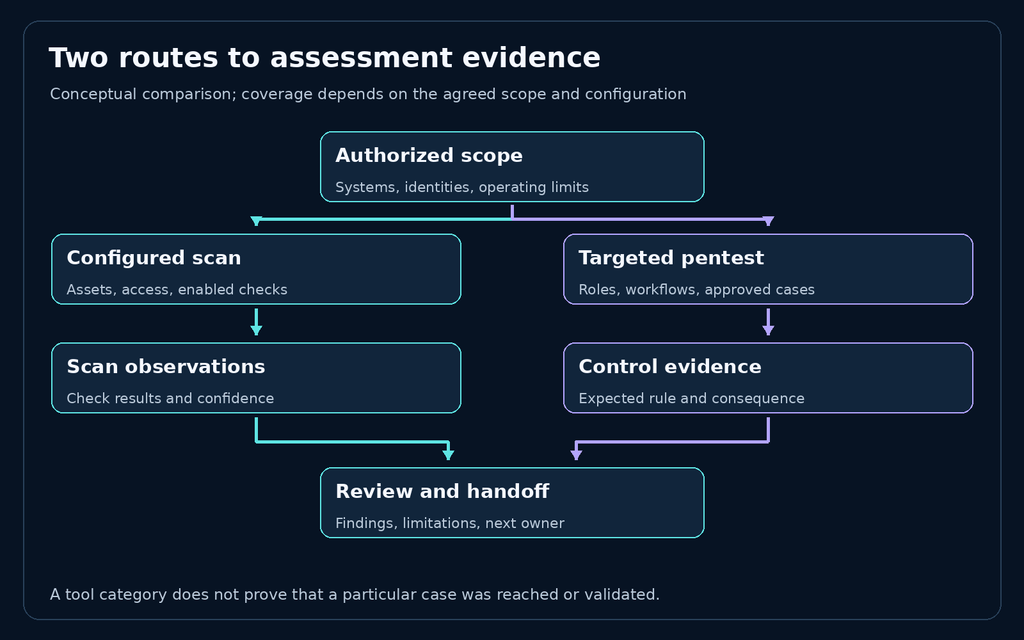
Vulnerability scanning identifies possible weaknesses across an agreed surface. Penetration testing investigates whether security controls can be defeated and what consequence can be demonstrated within the authorized scope. Use scanning to maintain recurring visibility; buy a pentest when a release, sensitive workflow, or unresolved finding needs deeper validation. The two can be parts of the same assessment.
The distinction follows NIST’s vulnerability-scanning definition and its penetration-testing definitions. It does not mean scanners only compare version strings or that every pentest proves an end-to-end compromise. Tools and services overlap. Read the proposal for the work it commits to perform and the evidence it promises to deliver.
Penetration testing vs vulnerability scanning at a glance
| Decision | Vulnerability scanning | Penetration testing |
|---|---|---|
| Main purpose | Identify conditions that match configured checks | Investigate control failures and validate their consequence |
| Scope to specify | Assets, scan type, credentials, enabled checks, and exclusions | Systems, roles, workflows, starting conditions, and permitted actions |
| Evidence to expect | Asset identity, check logic, observation, and confidence | Preconditions, expected control, observed behavior, impact, and reproduction evidence |
| Ongoing work | Maintain access, update checks, interpret results, and track repairs | Prepare context, investigate selected cases, review findings, and verify repairs |
| Common blind spot | A feature or workflow the configured run never reached | Components and paths outside the agreed investigation |
| Acceptance question | What was checked, and what does each result establish? | Which security question was resolved, and which cases remain untested? |
A clean scan and a pentest with no findings both describe the tested conditions. Interpret either result against the coverage record. Ask both providers to distinguish a completed check from a blocked login, unavailable system, or missing fixture. A failed prerequisite is not evidence that the protected feature is secure.
Both methods need permission and operating limits. एनआईएसटी एसपी 800-115 discusses assessment planning, scanning limitations, and the effect of credentials and network position. The 2008 publication provides a planning reference, rather than a benchmark for current products. Establish what the assessment can reach and how it may operate. “Automated” does not mean an active check cannot disrupt a service.
Two examples show why the evidence matters
An old version number does not settle patch status
Suppose a scan identifies an apparently outdated component. Before accepting or dismissing the alert, identify the deployed package, supplier, build, and applicable advisory. Red Hat’s backporting guidance explains that a supplier can apply a security fix to an older package version. The upstream version string alone can therefore misrepresent its security state.
Package verification may be enough to resolve this particular alert. A relevant vendor advisory and an installed fixed package can resolve the version-based concern. Conversely, an unfamiliar version string is no reason to close the issue without checking the actual deployment. Attach the advisory, installed-package record, and relevant deployment identity to the disposition.
This example does not establish that a particular scanner produces false positives. A credentialed check may already inspect the relevant package information. Inspect how the reported result was derived before buying an additional service to repeat work your existing process already performs.
A refund workflow needs an explicit business rule
Now consider a fictional commerce application. A support user may prepare a refund, while a separate manager must approve it before processing. The security question is whether that separation holds throughout the workflow. All accounts, orders, and amounts in this example are synthetic; no real payment operation is required.
The assessor needs both roles, an agreed expected policy, and a controlled way to observe the final state. Test the ordinary approved path as well as the prohibited transition. A response saying “accepted” is insufficient by itself: establish whether the operation only created a pending request or actually bypassed approval.
OWASP’s authorization-testing guidance covers permission boundaries, while its business-logic testing guidance includes workflow circumvention. The refund scenario is an original application of those concerns. It illustrates why the expected business rule belongs in the test brief.
A configured scanner or automated test can exercise such a case when it has the necessary context and procedure. A pentester can also miss it when the roles or workflow are excluded. Ask who will design and maintain that test, and what evidence will show that it ran against the intended state.
Turn findings into a usable handoff
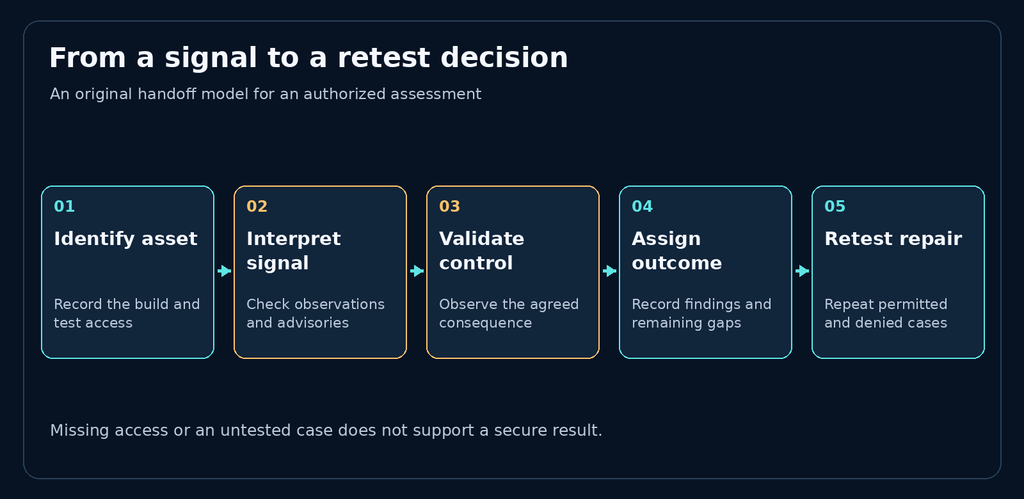
A scan alert should arrive with enough context to decide what happens next. Preserve the asset, environment, observation, check identity, access used, and any vendor guidance that changes its interpretation. If validation is still needed, assign that work explicitly instead of presenting the alert as a demonstrated attack.
A validated finding needs the additional connection between the expected control and observed consequence. For the fictional refund workflow, that means identifying the acting role, approval state, permitted test action, and resulting state. Use the smallest sufficient synthetic proof. An engineering team should be able to understand and reproduce the issue without reconstructing the assessor’s entire session.
Give each candidate issue a clear disposition:
- Potential issue: a relevant signal exists, but the consequence still needs validation.
- Confirmed issue: the agreed control failure and consequence have adequate supporting evidence.
- Unresolved: the test encountered a condition that prevents a reliable conclusion.
- Not tested: the case was excluded or never exercised.
An investigated case can also meet its expected control; record that observed result. These are proposed handoff categories, not a vendor standard or a formula for calculating organization-wide risk. The receiving engineer should be able to distinguish a candidate alert from a verified finding and see exactly what further work remains.
After a repair, preserve the deployment identity and repeat the relevant case. Include legitimate behavior as a control: disabling the entire refund feature would stop the prohibited action without proving that the intended approval policy works. If access expires during verification, leave the result unresolved until the repaired path can actually be tested.
Compare the work included in the quote
There is no universal scanner-to-pentest price conversion. Compare the responsibilities funded by the proposal: asset discovery, credential setup, case design, investigation, result review, reporting, and retesting. A software subscription and a professional engagement may leave different portions of that work with your team.
For recurring patch visibility across a known estate, evaluate whether the scanning workflow reliably reaches the assets, produces interpretable results, and supports remediation follow-up. For a new approval model or a sensitive application release, add the targeted investigation needed to examine those changed controls. If both requirements matter, request both deliverables and identify the handoff between them.
Before accepting a quote, settle five points:
- Which assets, identities, and workflows must be reached?
- What context and preparation will your team supply?
- Which observations count as sufficient evidence?
- How will blocked and untested cases be reported?
- What repair verification is included, and who accepts the final report?
If a customer or assessment recipient needs a particular report, confirm its scope and acceptance criteria before purchasing. An exported scan report does not automatically become a penetration-test report because its cover uses that name. Equally, a pentest label does not guarantee that a specific recipient’s requirements have been met.
Apply the same standard to AI pentesting
Evaluate an AI workflow against the evidence required for the same security question. When evaluating Penligent or another AI pentesting workflow, use an authorized case with a known expected outcome. Inspect the underlying observations, reproduction path, incomplete cases, and review effort before accepting the generated report.
Keep the responsibilities clear. Someone must approve the scope, maintain test access, review ambiguous results, and own remediation. This article reports no comparative product test, supplier price benchmark, or measured speed advantage. The examples support a purchasing method, rather than a performance ranking.
Buy the answer your team needs next
Keep recurring scanning when it provides useful visibility into the estate you operate. Add penetration testing where a control, workflow, or suspected consequence needs investigation your current process does not supply. Define the case and acceptance evidence first, then compare proposals against that job. A smaller assessment with a complete handoff can be a better purchase than a broader label with unresolved coverage.


 Hindi
 English
 German
 French
 Spanish
 Portuguese
 Japanese
 Korean
 Arabic
 Turkish
 Hebrew