
CVE-2026-101296 is an Apache Tomcat authentication bypass in a narrow but high-impact configuration path. The affected application must rely on Tomcat’s JNDIRealm for LDAP-backed authentication, and the Realm must be configured with a non-GSSAPI SASL authentication mechanism. In that state, the operation intended to validate a username and password could complete without proving that the supplied password was correct. Apache classifies the issue as Important. The published CVE record includes a CISA ADP CVSS v4.0 score of 9.1 Critical, while also recording no known exploitation at the October 20, 2026 enrichment timestamp.
The practical response is not to treat every Tomcat process as compromised. Teams should identify where container-managed authentication is actually used, find JNDIRealm declarations, determine the configured LDAP authentication mechanism, map the running Tomcat branch, and upgrade to a fixed release. Apache names 11.0.27, 10.1.61, and 9.0.123 as the first fixed releases for the supported branches. Tomcat 8.5 and 7 were already end of life when the CVE was published and are known to be affected; those deployments require migration to a supported branch rather than a search for a new maintenance release.
The authoritative CVE Record describes the weakness as CWE-304, Missing Critical Step in Authentication. Apache’s Tomcat 11 security page identifies the fixing commit and records that the issue was reported on September 14, 2026 and disclosed on October 20, 2026. The fix is concise but decisive: when JNDIRealm validates a user-provided name and password by binding as that user, Tomcat now always selects LDAP simple authentication for that validation operation and restores the configured environment afterward.
Immediate decision table
| Question | Why it changes risk | Required action |
|---|---|---|
| Does the application use a Tomcat Realm for authentication? | Applications that authenticate entirely in their own framework may not reach JNDIRealm | Confirm the security constraints, Realm, and login path before declaring exposure |
| Is the Realm class JNDIRealm? | The CVE is specific to the LDAP-backed Tomcat Realm | Search server.xml, context.xml, packaged configuration, and runtime management data |
| Is a non-GSSAPI SASL mechanism configured? | This is the vulnerable condition named by Apache | Record the exact authentication attribute and JNDI provider behavior |
| Is the running version at or below 11.0.26, 10.1.60, or 9.0.122? | Supported affected branches contain the vulnerable logic | Upgrade to at least 11.0.27, 10.1.61, or 9.0.123 |
| Is the deployment on Tomcat 8.5 or 7? | Those branches were end of life and are known affected | Migrate to a supported branch and retest authentication |
| Can an untrusted user reach a form, BASIC, API, or programmatic login backed by the Realm? | Reachability determines whether the flawed validation path can be exercised | Restrict access during remediation and prioritize internet-facing systems |
| Does a wrong password still produce a successful authenticated session? | That is the security property the patch must restore | Test only with a dedicated lab account and a controlled negative case |
What the vulnerability does and does not mean
The short description can be misread in two opposite directions. One interpretation is too broad: any Tomcat server is remotely bypassable. The other is too narrow: the bug matters only to teams that intentionally use unusual LDAP features. Both are incomplete.
Tomcat is an HTTP server and Servlet container. It can host applications that perform authentication in many ways. A Spring Security application may authenticate users through application code. A custom servlet may call an identity service. A reverse proxy may establish identity before traffic reaches Tomcat. None of those patterns automatically uses JNDIRealm. Conversely, older enterprise applications frequently depend on container-managed security, Realm configuration, LDAP groups, role mappings, and servlet security constraints. Those deployments may have accumulated configuration over many years and may not have a current owner who understands the exact bind mode.
The CVE applies when the authentication decision reaches JNDIRealm and the LDAP context is configured with a non-GSSAPI SASL authentication mechanism. SASL is a framework, not one protocol. RFC 4422 defines how application protocols can negotiate authentication mechanisms. LDAP can use SASL mechanisms as described by the LDAP authentication framework in RFC 4513. The existence of a SASL mechanism does not, by itself, prove that a password supplied by a web user was checked. That proof depends on which credentials the directory bind actually uses.
The issue also does not mean that LDAP simple bind is universally the best connection mode for all directory traffic. The patch uses simple bind for a specific purpose: validating the username and password presented for the application login. Transport protection remains essential because a simple bind sends credentials in a form that relies on the LDAP transport for confidentiality. Production deployments should use LDAPS or StartTLS according to their directory architecture, certificate policy, and vendor guidance. The security correction is about making the credential validation step explicit, not downgrading the security of the persistent service connection.
How CVE-2026-101296 differs from CVE-2026-55957
CVE-2026-55957 is an earlier Tomcat JNDIRealm authentication flaw associated with GSSAPI. The two records affect the same broad component and the same security property, but they are not interchangeable.
CVE-2026-55957 addressed a condition in which GSSAPI could remain active while Tomcat was supposed to validate credentials supplied through a password login. The correction removed GSSAPI from that validation operation so the user-provided credentials would be evaluated. CVE-2026-101296 showed that excluding one named mechanism was not a complete invariant. Other SASL mechanisms could still control the bind behavior. The later fix therefore chooses the required validation mode directly: simple bind.
This progression is an important secure-engineering lesson. A blacklist answers the question, “Which currently known mechanism must not be used here?” A positive security invariant answers, “Which mechanism is required to prove the property we need?” The latter remains correct when new providers, defaults, or mechanisms enter the environment. In this case the intended property is straightforward: the bind that validates a web login must use the distinguished name found for that user and the password the user supplied. Selecting simple authentication for that operation is more robust than attempting to remove every mechanism that could satisfy the directory context through different credentials.
Operators investigating GSSAPI should check the earlier record’s affected versions and fix. CVE-2026-101296 covers the later non-GSSAPI SASL condition and the newer fixed releases. Check both records when reconstructing the patch history of an old Tomcat image.
How JNDIRealm connects a web login to LDAP
Tomcat Realms provide a bridge between a web application’s container-managed security model and an identity store. The Tomcat 11 Realm configuration reference describes JNDIRealm as a Realm that accesses an LDAP directory through a JNDI provider. Users, passwords, and roles can be represented through directory entries and attributes, while web applications declare protected resources and roles through standard Servlet mechanisms.
A common flow has two logically separate operations. First, the Realm uses a service identity or anonymous search to locate the directory entry for a username. It may build or retrieve the user’s distinguished name and collect attributes needed for role mapping. Second, the Realm validates the presented credential. Depending on configuration, it may retrieve a password attribute and compare it, or it may attempt a directory bind as the user. The CVE concerns the bind-as-user validation path.
The distinction between the connection identity and the application user is central. A directory context can already be authenticated as a service principal, through a SASL mechanism, or with credentials configured for directory searches. That authentication allows Tomcat to search the directory. It must not silently stand in for proof that the application user knows the password entered at the login prompt. The search connection and the user credential check answer different questions.
Tomcat’s JNDIRealm API documentation exposes the component’s many configuration options because real directories vary widely. The Realm can search for users, construct distinguished names, retrieve roles, follow referrals, pool contexts, and select JNDI environment properties. Flexibility is useful, but every additional authentication state increases the need for explicit transitions. When the code moves from “service connection used for search” to “bind that proves the user’s password,” the authentication mechanism and credentials must be set to the values required for the second task.
SASL mechanisms and the missing validation step
SASL separates an application protocol from authentication mechanisms. A directory client can set the JNDI security authentication property to a mechanism supported by its provider and directory. The provider may then perform a challenge-response exchange, use an existing credential source, or negotiate security layers. That behavior can be correct for the service connection while being wrong for a password verification step.
Before the CVE-2026-101296 fix, the JNDIRealm bind-as-user method preserved the existing environment, inserted the user’s distinguished name and submitted credentials, and handled GSSAPI as a special case. If the configured authentication value was exactly GSSAPI, the code removed that value so the bind would not authenticate using GSSAPI. That defense was tailored to the earlier finding. For a different SASL mechanism, the context could retain the configured authentication method. A successful operation could therefore reflect the mechanism’s credentials or state rather than validation of the password supplied by the web user.
Apache’s fixing commit e43453fc makes the invariant visible in code. It introduces a constant for simple authentication and sets the context’s security authentication property to simple during bind-as-user. The finally block restores the previously configured authentication mechanism after the attempt and removes the temporary user credentials. The associated changelog says a simple bind is always used when the JNDI Realm binds using the user-provided name and password to authenticate the user.
The patch does not add a complicated new authorization policy. It ensures the critical authentication step occurs in the intended mode. This is why CWE-304 is an accurate classification. The system had the data needed for validation, but a state inherited from the surrounding connection could cause the validation to succeed without proving the submitted secret.
Defensive mechanism diagram in words
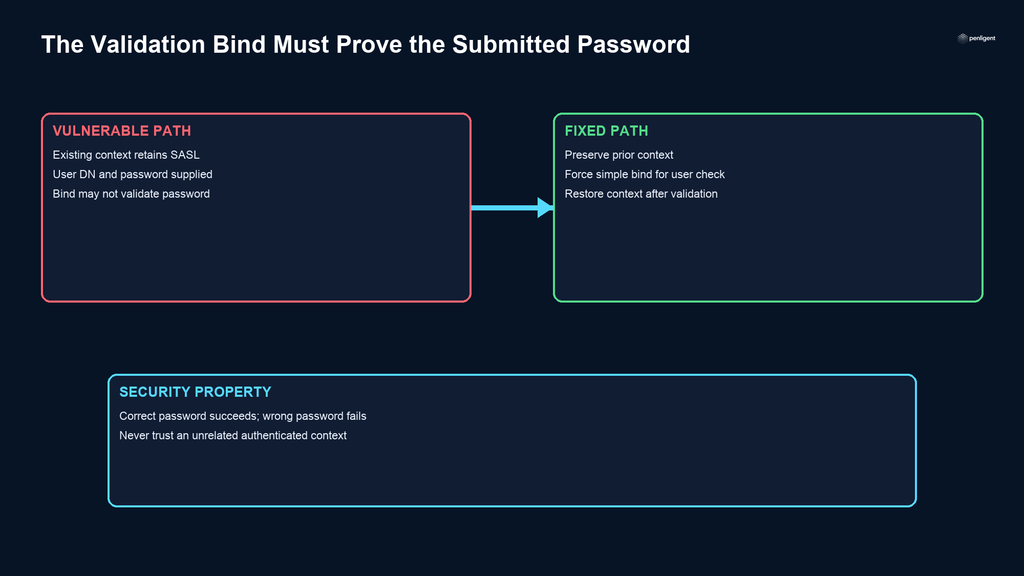
The vulnerable and fixed flows can be modeled without a live directory or a weaponized payload.
Vulnerable state:
- Tomcat opens or reuses a directory context configured with a non-GSSAPI SASL mechanism.
- JNDIRealm searches for the user and obtains a distinguished name.
- The application supplies a username and password to the container login path.
- JNDIRealm places the user values into the context but leaves the SASL authentication mechanism active.
- The provider completes authentication using the retained mechanism or associated state.
- Tomcat treats the successful bind operation as proof that the submitted password was correct.
Fixed state:
- Tomcat preserves the directory context's existing environment.
- JNDIRealm sets the user's distinguished name and the submitted password.
- JNDIRealm explicitly sets the authentication mode to simple for the validation bind.
- The directory accepts or rejects the exact credentials being tested.
- Tomcat maps only a successful user credential check to an authenticated principal.
- The Realm restores the prior environment before returning the context to other work.
This model deliberately omits provider-specific mechanism names and exploitation procedures. Defenders do not need a recipe for constructing a production bypass. They need a reliable way to determine whether the wrong password is rejected before and after the update, and evidence that the running process contains the corrected logic.
Affected and fixed versions
Apache’s CVE record lists broad affected ranges. The branch security pages provide the matching fixed releases. Operators should compare the actual runtime version, not only a package file left on disk.
| Tomcat branch | Affected range | First fixed release | Support decision |
|---|---|---|---|
| 11.0 | 11.0.0-M1 through 11.0.26 | 11.0.27 | Upgrade within Tomcat 11 and restart all instances |
| 10.1 | 10.1.0-M1 through 10.1.60 | 10.1.61 | Upgrade within Tomcat 10.1 and restart all instances |
| 9.0 | 9.0.0.M1 through 9.0.122 | 9.0.123 | Upgrade within Tomcat 9 and restart all instances |
| 8.5 | 8.5.0 through 8.5.100 | No supported fixed release named | Migrate to a supported major branch |
| 7.0 | 7.0.0 through 7.0.109 | No supported fixed release named | Migrate to a supported major branch |
The Tomcat 10 security page और Tomcat 9 security page should be kept with the change ticket for branch-specific evidence. The CVE record warns that other unsupported versions may also be affected. Absence from the explicit list is not a safe-harbor statement for an obsolete fork or vendor bundle.
Version inventory can be deceptive in containerized and packaged environments. A base image may contain one Tomcat distribution while the application image copies another into a custom directory. A host package manager may report a fixed package while a manually installed service points to an older CATALINA_HOME. A Kubernetes Deployment may be updated while old ReplicaSets or rollback images retain the vulnerable layer. A Windows service may reference a directory different from the one an administrator inspected. A vendor product may embed Tomcat and expose only the vendor’s product version.
For every instance, record the startup command, service definition, CATALINA_BASE, CATALINA_HOME, package or image digest, Java process start time, and reported server version. Then follow the vendor’s supported update path. Direct replacement of JAR files inside a commercial product can invalidate support and leave inconsistent libraries.
Determine whether the application reaches JNDIRealm
The fastest useful triage starts with architecture, not a network scanner. Ask which component decides that a username is valid. Review the web application’s deployment descriptor, annotations, framework configuration, reverse-proxy identity headers, and Tomcat Realm configuration. Container-managed security often appears through security constraints, login configuration, role declarations, request authentication methods, and calls such as programmatic login.
Search likely configuration locations on an owned system:
grep -R "org.apache.catalina.realm.JNDIRealm" "$CATALINA_BASE/conf" 2>/dev/null
grep -R "<Realm" "$CATALINA_BASE/conf" 2>/dev/null
grep -R "auth-method|security-constraint|security-role" /path/to/owned/application 2>/dev/null
These commands are inventory aids, not proof. Configuration may be generated at deployment time, injected through a container secret, mounted from a ConfigMap, supplied through system properties, or embedded by a product. A Realm can be declared at Engine, Host, or Context scope. A context-specific configuration may live outside the main server.xml. Runtime configuration management, immutable image manifests, and the process command line should be included in the review.
If no JNDIRealm is present and the application does not instantiate an equivalent Tomcat component, CVE-2026-101296 is not the authentication path in use. Document that conclusion with the evidence reviewed. Do not stop at a banner or a dependency scanner result, because scanners typically identify the Tomcat version but cannot know whether the vulnerable Realm and mechanism are configured.
If JNDIRealm is present, capture the authentication attribute, connection settings, user search pattern, password mode, role mapping, TLS settings, and where secrets are supplied. Redact credentials from tickets and logs. The Tomcat 10 Realm reference और Tomcat 9 Realm reference help map branch-specific attributes, but the live configuration remains the source of truth.
Identify non-GSSAPI SASL exposure without guessing
The exact authentication string may be obvious in XML, or it may be supplied through JNDI environment properties and provider configuration. Record the literal value and the directory/provider combination. Do not create a list of supposedly vulnerable mechanism names from memory and mark everything else safe. Apache’s description is deliberately categorical: non-GSSAPI SASL mechanisms.
Three checks are useful.
First, inspect the Realm’s authentication attribute and any environment entries passed to the initial directory context. Values such as none and simple are not SASL mechanism names in the same sense as provider-specific mechanisms, although their security properties still require review. The vulnerable case named by Apache is a non-GSSAPI SASL mechanism retained when the user bind should have been a simple bind.
Second, inspect directory-side authentication logs for the test account in a staging environment. The goal is not to expose credentials or reverse engineer the mechanism. The goal is to confirm which bind mode the directory records when Tomcat validates a password. After the patch, the user validation operation should appear as the expected simple bind over a protected transport, while the service connection may continue using its configured mechanism.
Third, perform a negative authentication test. A dedicated user with a known valid password should authenticate successfully. The same user with a deliberately wrong password must fail. Use a non-privileged account, a maintenance window, and a staging or isolated environment whenever possible. Do not repeatedly test production accounts in a way that triggers lockout, alert fatigue, or denial of service.
Attack prerequisites and realistic reachability
The CVSS v4.0 vector published by the CISA ADP container is CVSS:4.0/AV:N/AC:L/AT:P/PR:N/UI:N/VC:H/VI:H/VA:N/SC:N/SI:N/SA:N. The attack requirement present field is important. Exploitation depends on the application and Realm configuration reaching the flawed path. The network attack vector reflects that an attacker can interact with a reachable application login rather than requiring local access to the server.
An exposed login form is not the only possible entry point. Servlet BASIC authentication, form authentication, an API that invokes container login, management applications protected by the Realm, or a vendor product’s administrative portal may all route credentials through the same component. The authorization impact then depends on the roles assigned to the impersonated directory user and the protected functions available in the application.
The flaw can be serious even when Tomcat is not internet-facing. Internal applications often protect financial operations, build systems, source repositories, observability platforms, customer data, or administrative workflows. A compromised workstation, malicious insider, adjacent workload, or unauthorized VPN user may reach the login surface. “Internal only” changes exposure priority but does not repair missing authentication.
Conversely, an internet-facing Tomcat process that serves only public content and delegates authentication to an independent identity proxy may not be practically exposed to this CVE. Verify the trust boundary. If the proxy passes an identity header, confirm Tomcat cannot be reached directly in a way that bypasses the proxy. If the application also exposes a fallback container login, include that path in testing.
Why the impact can be high without code execution
Authentication bypass is sometimes ranked below remote code execution by habit. That shortcut can be misleading. The value of an authenticated identity depends on the application. An administrator role may upload content, change integrations, run jobs, manage users, view secrets, alter access policies, or invoke functions that reach operating-system commands. Even a normal user role may expose regulated records or allow transactions under another person’s identity.
The CVE record assigns high confidentiality and integrity impact to the vulnerable system and no direct availability impact in the CVSS v4.0 scoring. That is a reasonable generic model: the primary outcome is unauthorized access and action. A particular application’s business impact could still include operational disruption if an authenticated role can delete data, disable services, or change configuration. Risk owners should map the bypass to application capabilities rather than repeat the base score as the complete assessment.
Role retrieval is part of the JNDIRealm design. After authentication, Tomcat may obtain groups or role attributes from LDAP and expose them to authorization checks. If the wrong password is accepted for a high-value directory identity, the attacker may inherit the roles mapped to that identity. Review role mappings, nested groups, administrative group membership, and application-specific permissions as part of impact analysis.
Patch planning for Tomcat 11, 10.1, and 9
Use the smallest supported update that crosses the fixed boundary, then plan ordinary lifecycle upgrades separately. Security remediation should not be delayed because a larger framework migration is difficult. At the same time, avoid replacing binaries blindly without testing connector, Jakarta namespace, JVM, native library, and application compatibility.
For Tomcat 11, move to 11.0.27 or later. For Tomcat 10.1, move to 10.1.61 or later. For Tomcat 9, move to 9.0.123 or later. The Tomcat version guidance can help identify current supported releases, but the security boundary is the first fixed version named by Apache. A later maintained release is normally preferable because it also includes subsequent corrections.
A controlled rollout should include:
- Back up configuration, keystores, truststores, Realm XML, context files, and application deployment descriptors.
- Record the current server version, Java version, native library version, image digest, and startup options.
- Rebuild from a trusted upstream or vendor package rather than editing a running container.
- Review release notes between the installed and target versions.
- Deploy to staging with the same directory provider and authentication mechanism.
- Test correct-password success, wrong-password failure, role mapping, logout, session expiration, and account lockout behavior.
- Roll through production instances while preserving capacity and rollback artifacts.
- Restart every JVM and prove that old processes are gone.
- Verify the runtime version and negative authentication result.
Tomcat’s migration guides are particularly important when an end-of-life branch must move across a major version. Tomcat 9 uses the Java EE javax namespace, while Tomcat 10 and later use Jakarta EE package names. That can make an 8.5 or 9 to 10.1 move an application migration rather than a binary swap. An organization unable to complete that immediately should reduce exposure, engage the product vendor, and set a time-bound exception. It should not label the obsolete branch patched.
Container and orchestration considerations
Container tags are convenient identifiers, not immutable evidence. A mutable tag may point to a rebuilt image, and a deployment specification may differ from the image actually running on a node. Capture the image digest and inspect the live pod.
For an owned Kubernetes cluster, defensive inventory may include:
kubectl get pods -A -o custom-columns=NAMESPACE:.metadata.namespace,NAME:.metadata.name,IMAGES:.spec.containers[*].imageThen map images to deployments, owners, and exposed services. Do not assume an image named after the application lacks embedded Tomcat. Software composition analysis can find Tomcat JARs, but configuration review is still required to establish JNDIRealm reachability.
When rebuilding, pin a fixed base image by digest, generate an SBOM, and store provenance for the artifact promoted to production. Confirm that the image entrypoint uses the intended Tomcat directory. A multi-stage Dockerfile can accidentally copy an older distribution from a builder stage. A volume mount can replace patched configuration or libraries with host content. A sidecar or init container may place files into a shared volume at startup.
After rollout, list old ReplicaSets, stopped containers, rollback artifacts, and disaster-recovery images. A successful primary deployment does not remove the vulnerable copy that an operator may restore during an incident. Update runbooks so rollback goes to the last known-good fixed image, not the pre-patch image.
Safe validation without a live bypass exploit
The most valuable test is a controlled authentication invariant, not an exploit kit. Use a dedicated lab account and a directory environment that mirrors the relevant provider and mechanism. The test has four assertions:
- The correct username and password authenticate.
- The correct username and an incorrect password fail.
- The expected roles are present only after successful authentication.
- Directory logs show the intended user credential validation mode.
Do not use a privileged production identity. Do not automate guesses against many users. Do not disable lockout controls to increase test volume. One positive case and one deliberately negative case are sufficient to prove the basic property when the environment and logs are observable.
If staging cannot reproduce the directory mechanism, use a local model to teach reviewers what “fail open” means. The toy program included with this package represents a directory context with a configured mechanism and a password database. The vulnerable function returns success when the retained mechanism authenticates the context, even if the submitted password is wrong. The fixed function forces a password comparison for the validation step and restores the prior mechanism afterward. It does not connect to LDAP, Tomcat, or a network.
This boundary matters. A production proof of concept that demonstrates how to bypass a real JNDI provider could be reused against exposed applications. The defensive question can be answered through configuration, official patch evidence, version verification, controlled negative testing, and directory logs.
Patch verification is a separate task
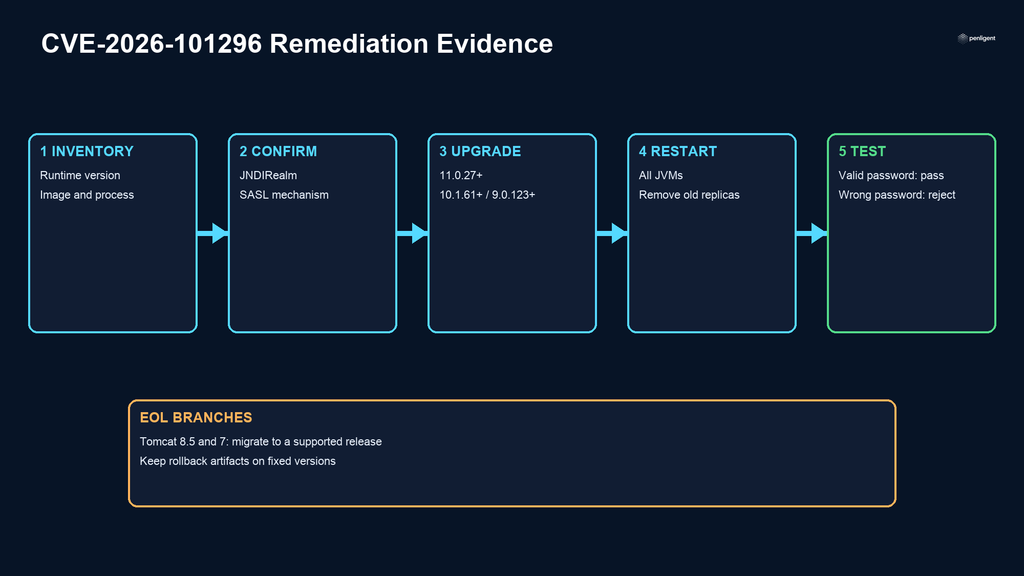
Installing a package is an action. Remediation evidence must show the running service and the security property changed.
Start with process identity. Record the executable path, CATALINA_HOME, CATALINA_BASE, command line, process start time, and listener ports. Query the application or approved management interface for the server version if available. Avoid exposing detailed version banners publicly just to make inventory easier.
Next, verify artifact identity. Record package versions, hashes, container digests, deployment revisions, and the source repository or registry. Ensure the files belong to the active installation. On systems with multiple instances, repeat the check for each service account and base directory.
Then verify process replacement. The JVM must have restarted after the fixed files were installed. In a cluster, every member must be on a fixed release. Remove or drain old pods. Confirm health checks, session behavior, and directory connectivity.
Finally, verify authentication behavior. With the dedicated test account, prove that the correct password succeeds and a wrong password fails. Check role mapping after success. Review directory and application logs for the test timestamps. Store sanitized evidence with the change record.
| Verification layer | प्रमाण | Common false confidence |
|---|---|---|
| Configuration | JNDIRealm and authentication mode inventory | Assuming no Realm because server.xml lacks one entry |
| पुरातात्विक अवशेष | Fixed package or image digest | Checking a file tree that the service does not use |
| Process | Restarted JVM reports fixed branch | Leaving one cluster node or old pod running |
| Security property | Wrong password is rejected | Testing only a successful login |
| Authorization | Expected roles only after valid auth | Confirming identity but not role mapping |
| Recovery | Rollback image is also fixed | Keeping the vulnerable image as the default rollback |
A localhost toy model of fail-open validation
The following pseudocode demonstrates the design error without implementing Tomcat, LDAP, SASL, or a network protocol.
class ToyDirectoryContext:
    mechanism = "EXTERNAL_MECHANISM"
    mechanism_authenticated = True
    passwords = {"alice": "correct-horse"}
def vulnerable_validate(context, username, submitted_password):
if context.mechanism_authenticated:
return True
return context.passwords.get(username) == submitted_passworddef fixed_validate(context, username, submitted_password):
previous = context.mechanism
try:
context.mechanism = "simple"
return context.passwords.get(username) == submitted_password
finally:
context.mechanism = previousIn the vulnerable model, alice with a wrong password can receive True because the surrounding context is already authenticated through another mechanism. In the fixed model, the validation operation selects the rule that directly checks alice’s submitted password. After the check, the context returns to its previous mechanism for unrelated operations.
The executable toy file in this package runs three assertions: valid password succeeds, invalid password fails in the fixed function, and the previous mechanism is restored. It also shows the vulnerable function returning an unsafe result for comparison. The program accepts no input, opens no sockets, imports no security libraries, and contains no real credentials.
Detection and incident review
The public record did not claim active exploitation at disclosure. CISA’s ADP enrichment marked exploitation as none at its October 20, 2026 timestamp. That should prevent sensational language, not reduce patch priority. Authentication bypasses may leave ordinary successful-login events because the application believes the identity was valid.
Review evidence from multiple layers:
- Application access logs for successful sessions that do not align with expected user activity.
- Authentication logs for unusual success after failed passwords, impossible travel, new clients, or abnormal user agents.
- Directory bind logs around suspicious sessions, including mechanism, bind identity, result, and source where available.
- Tomcat logs for Realm errors, login calls, session creation, and role retrieval.
- Administrative audit logs for changes made by affected identities.
- Reverse-proxy, WAF, load balancer, and identity-provider logs that establish the network path.
- Endpoint and database logs for actions performed after authentication.
Logging sensitivity requires care. Never enable a debug mode that records plaintext passwords. Redact directory connection secrets, bind credentials, session identifiers, and personal data when exporting evidence. Synchronize clocks and retain original timestamps so application and directory events can be correlated.
If suspicious access is credible, patching is only containment of the software flaw. Terminate sessions, rotate relevant application and directory credentials, review role assignments, inspect changes made by the identity, and determine whether downstream tokens or secrets were issued. Preserve images and logs according to the incident-response process before destructive cleanup.
Compensating controls while an upgrade is prepared
No configuration workaround is equivalent to the Apache fix. Still, teams may need a short maintenance window or vendor release. Temporary controls should reduce exposure and be documented with an expiration date.
Restrict the affected login surface to trusted networks or an identity-aware proxy when business requirements allow it. Ensure Tomcat cannot be reached directly around that proxy. Apply rate limits and anomaly detection, recognizing that the flaw is not a brute-force problem. Disable unused applications and management interfaces. Reduce the roles assigned through the affected Realm. Separate administrative authentication from ordinary user authentication where possible.
If the application supports a tested alternative authentication path that does not invoke JNDIRealm, a controlled switch may reduce risk. Such a change can be operationally larger than the point update and must be validated for fail-open behavior, header spoofing, session handling, logout, and role mapping. Do not improvise a proxy header as an emergency identity system.
Network encryption is mandatory for LDAP simple bind, but adding TLS alone does not repair the vulnerable decision. Likewise, hiding the Tomcat version, changing the login URL, or adding a CAPTCHA does not ensure the submitted password is validated. These controls may affect reconnaissance or abuse volume; they do not restore the missing authentication step.
End-of-life Tomcat requires a migration decision
The CVE record explicitly lists Tomcat 8.5.0 through 8.5.100 and 7.0.0 through 7.0.109 as known affected and states that these versions were end of life when the CVE was created. Unsupported versions may also be affected. This is an ownership problem as much as a patching problem.
An organization may discover an old branch inside a vendor appliance, a legacy WAR, a build agent, an internal reporting system, or a forgotten Windows service. Assign an application owner and a business owner. Determine whether the application can move to Tomcat 9 as an interim supported branch or must move to the Jakarta namespace used by Tomcat 10.1 and 11. Review JVM support, native connectors, authentication libraries, deployment descriptors, and vendor certification.
If migration cannot be completed immediately, isolate the service, reduce roles, restrict the login surface, increase monitoring, and obtain a vendor-supported fix plan. Record the exception against a firm date. Do not download an unofficial binary described as “Tomcat 8.5.101” unless it comes from a trusted vendor that assumes responsibility for the backport. Apache’s published support state is the relevant baseline.
Decommissioned systems should be removed from DNS, load balancers, monitoring exceptions, backup restoration catalogs, and identity groups. A stopped virtual machine that can be restored with the same vulnerable credentials remains a latent risk.
Authentication tests that belong in regression suites
The vulnerability shows why authentication testing must include negative cases and configuration variants. A healthy regression suite for an LDAP-backed Realm should cover:
- Correct username and correct password.
- Correct username and wrong password.
- Unknown username and arbitrary password.
- Disabled or expired directory account.
- Locked account.
- User with no application role.
- User whose group membership changes during an active session.
- Directory unavailable or TLS validation failure.
- Referral or alternate directory behavior, if enabled.
- Programmatic login as well as form or BASIC authentication when the application uses both.
- Session invalidation after password or role changes according to policy.
The expected failure mode matters. Directory timeout, certificate failure, provider exception, or unsupported mechanism must not become an authenticated session. “Fail closed” should be asserted at the application boundary, not inferred from a stack trace.
Where feasible, run the tests against the same directory product and JNDI provider used in production. A mock directory can validate application logic but may not reproduce SASL negotiation or environment behavior. Protect the test directory and use synthetic identities.
Configuration hygiene after the emergency update
Patching closes the known code path. Configuration cleanup reduces the chance that a future issue has the same reach.
Inventory every Realm and remove declarations for retired applications. Scope Realms to the smallest Host or Context that needs them instead of placing a broad Realm at Engine scope without review. Separate directory search credentials from user identities. Store connection secrets in an approved secret system rather than source control or image layers. Use protected LDAP transport and validate directory certificates. Restrict outbound network access from Tomcat to the required directory endpoints.
Review role mappings and group search filters. Broad groups can turn an authentication flaw into administrative compromise. Avoid mapping general corporate groups to powerful application roles. Use dedicated groups with change auditing and periodic access review.
Document the authentication attribute and why it is required. Provider-specific mechanisms are often copied from old examples without a current dependency. If the mechanism is unnecessary, simplify the design during a planned change. If it is necessary for the service connection, keep it but rely on the fixed Tomcat behavior for the user credential bind.
Distinguishing version findings from exploitable configuration
Security tools usually answer a narrow question: which package or library version can they identify? CVE-2026-101296 requires a second layer of analysis because the vulnerable code is a component inside a configurable authentication system. A dependency scanner can correctly flag Tomcat 10.1.60 and still be unable to determine whether the service uses JNDIRealm. Conversely, a clean scan can miss an application-server bundle that unpacks Tomcat at runtime or a vendor product that reports a product-level version.
Use three separate labels in a vulnerability record:
- Version present: an affected Tomcat build is part of the deployed artifact or active runtime.
- Configuration applicable: the authentication path uses JNDIRealm with a non-GSSAPI SASL mechanism and performs bind-as-user validation.
- Reachable and consequential: an attacker can reach that login path and the impersonated identity has meaningful application permissions.
Keeping these claims separate prevents both underreaction and overstatement. A finding can be urgent even when exploitation prerequisites require configuration review. A finding can also be not applicable to one service while remaining relevant to another Tomcat instance on the same host. Record each result at the workload or application level, not just at the node level.
When data is incomplete, preserve uncertainty explicitly. For example: “Tomcat 10.1.58 detected in image digest X; Realm configuration is generated at startup and not yet reviewed; external login endpoint is reachable.” That statement is more operationally useful than either “critical exposure confirmed” or “false positive” before the Realm has been inspected.
Change control for shared directory services
The Tomcat code change is small, but the directory environment may be shared by multiple application generations. A change can expose latent assumptions about LDAP referrals, service-account permissions, TLS trust, password policy, and account lockout. Before production rollout, identify whether the Realm shares a pooled JNDI context, how concurrent binds are isolated, and which directory events are expected during login bursts.
Coordinate with the directory team so that test binds can be distinguished from user activity. Use a dedicated test account in a non-privileged group. Confirm that the account is not excluded by policy, that the directory’s audit logs record authentication method, and that the staging provider configuration matches production. A synthetic account with an expired password or an interactive MFA requirement may behave differently from the ordinary user path and should not be the sole test case.
During rollout, watch authentication failure rates and directory bind latency. A rise in failures after an upgrade can indicate that the application was relying on an unintended mechanism state, but it can also indicate unrelated TLS or account-policy drift. Do not respond by reverting to the vulnerable build as the default remedy. Use the fixed release, inspect provider and Realm configuration, and make any compatibility exception narrowly scoped and time limited.
For clustered applications, maintain a deployment ledger containing instance identity, node or pod, artifact digest, start time, branch version, Realm configuration revision, and test result. This makes partial rollout visible and creates an audit trail that can be reconciled with directory logs. Preserve one known-good, fixed rollback artifact and remove the vulnerable image from automated rollback policies.
Evidence for vulnerability management and auditors
A scanner finding should move through four states: detected component, configuration applicability, remediation, and verified security property.
For detected component, retain the software inventory record, runtime version, package or image identity, and owning application. For applicability, retain the relevant Realm configuration and a sanitized description of the authentication mechanism. For remediation, retain the change ticket, fixed version, artifact provenance, deployment revision, and restart evidence. For verification, retain the controlled wrong-password rejection, successful valid login, role check, and relevant directory log excerpt.
If the CVE is not applicable because JNDIRealm is absent, document how authentication is performed and which configuration locations were reviewed. Avoid a bare “false positive” label. If JNDIRealm exists but a non-GSSAPI SASL mechanism is not configured, record the actual mode and how it was verified. Reassess after configuration changes.
For fleets, report coverage by application instance rather than host count alone. One host can run multiple Tomcat bases with different configuration and versions. One Kubernetes workload can have multiple images and old revisions. Evidence should identify the service consumers actually use.
Common mistakes during remediation
The first mistake is patching the wrong Tomcat directory. Verify the service definition and live process.
The second is updating files without restarting the JVM. A Java process continues using loaded classes until replaced.
The third is checking only the positive login. The CVE is about an invalid password being accepted, so a negative test is essential.
The fourth is assuming all LDAP authentication is vulnerable. Applicability requires JNDIRealm and the configured non-GSSAPI SASL condition.
The fifth is assuming all non-GSSAPI configurations are safe after a network control is added. Network restriction reduces reachability; it does not repair validation.
The sixth is treating EOL branches as patched because a Linux distribution package shows no pending updates. Confirm whether the distributor or product vendor has published a supported backport with explicit CVE coverage. Otherwise migrate.
The seventh is exposing real credentials or production bind details in a proof of concept. Use a toy model and a synthetic lab account.
The eighth is rolling back to the vulnerable image after an unrelated post-patch failure. Update rollback artifacts and runbooks.
Where security validation fits
An authorized security review can help connect component findings to application risk. The reviewer should identify the login endpoints backed by container-managed security, trace the authentication call to the Realm, confirm the configured mechanism, inspect the fixed version, and run a minimal negative credential test with a dedicated account. The work should produce evidence, not a reusable bypass tool.
Penligent’s AI pentesting workflow can be relevant when teams need repeatable, authorized evidence collection across application versions, but automation must remain bounded to owned targets and synthetic credentials. The authoritative remediation decision still comes from Apache’s fixed releases and the application’s observed authentication behavior.
A good report separates facts from inference. “Tomcat 10.1.58 is present” is a component fact. “JNDIRealm with a non-GSSAPI SASL mechanism protects the administrative portal” is a configuration fact. “A wrong password was rejected after upgrade to 10.1.61” is validation evidence. “No compromise occurred” is a much stronger incident conclusion and requires log coverage, retention, and investigation.
अक्सर पूछे जाने वाले प्रश्न
Is every Apache Tomcat server affected by CVE-2026-101296?
- No. The vulnerable path requires JNDIRealm and a non-GSSAPI SASL authentication mechanism.
- Version scanners can identify an affected Tomcat release but cannot prove the Realm is used.
- Internet exposure increases urgency, but internal applications can also carry high-value roles.
What versions fix CVE-2026-101296?
- Apache names Tomcat 11.0.27, 10.1.61, and 9.0.123 as the first fixed supported releases.
- Tomcat 8.5 and 7 are known affected and were end of life at disclosure.
- Use the vendor-supported update path for products that embed Tomcat.
What is the difference between this CVE and CVE-2026-55957?
- CVE-2026-55957 concerned GSSAPI remaining active during password validation.
- CVE-2026-101296 covers non-GSSAPI SASL mechanisms and shows that excluding GSSAPI alone was insufficient.
- The later fix positively selects simple bind for the user credential validation step.
Does the patch make all LDAP traffic use simple bind?
- No. The fixing commit changes the bind-as-user operation used to validate the submitted name and password.
- The previous environment is restored afterward.
- Service connection authentication can continue according to the configured design.
Is simple bind safe?
- Simple bind must be protected by a secure LDAP transport such as LDAPS or correctly validated StartTLS.
- The patch's purpose is to ensure the submitted password is actually checked.
- Transport security, certificate validation, secret handling, and directory policy remain separate requirements.
How can we validate safely?
- Use a synthetic, non-privileged account in staging or an isolated environment.
- Confirm correct-password success and wrong-password failure.
- Review directory logs for the expected validation bind and do not collect plaintext credentials.
- Use the included local toy model for education rather than a production bypass script.
Was CVE-2026-101296 actively exploited?
- The CISA ADP enrichment in the published record marked exploitation as none at the October 20, 2026 timestamp.
- That is not proof that exploitation is impossible or that private incidents do not exist.
- Prioritize based on exposure, role value, and patch availability without claiming unverified attacks.
What should we do if a vendor appliance embeds an affected Tomcat?
- Contact the vendor for a supported product update and explicit CVE statement.
- Restrict the affected login surface and reduce privileges while waiting.
- Do not replace internal Tomcat libraries unless the vendor supports that action.
- Verify the appliance's runtime version and negative authentication behavior after the vendor update.
Final remediation sequence
CVE-2026-101296 is a precise authentication failure with a broad version range. The safest sequence is equally precise:
- Find the applications that use container-managed authentication.
- Confirm whether JNDIRealm is configured.
- Record the authentication mechanism and directory provider.
- Map every running instance to its actual Tomcat branch and artifact.
- Restrict high-risk login surfaces during the change window.
- Upgrade to at least 11.0.27, 10.1.61, or 9.0.123, or migrate from an end-of-life branch.
- Restart every JVM and remove old replicas.
- Prove that a correct password succeeds and a wrong password fails.
- Confirm expected roles and directory bind behavior.
- Preserve evidence and investigate suspicious authenticated actions when warranted.
The core lesson is larger than one Realm. Authentication code must explicitly prove the credential property it claims to validate. A surrounding connection can be authenticated for one purpose while remaining unsuitable evidence for another user’s password. Apache’s fix turns that principle into a direct invariant: the user-provided name and password are checked with the bind mode intended to validate them.
 Hindi
 English
 German
 French
 Spanish
 Portuguese
 Japanese
 Korean
 Arabic
 Turkish
 Hebrew