
Agentic AI security testing must evaluate how a system converts observations into plans, permissions and real-world effects. A model can produce harmless text in one context and trigger email, code, cloud or financial actions in another. The security boundary is the delegated authority around the agent.
Map the agent control loop
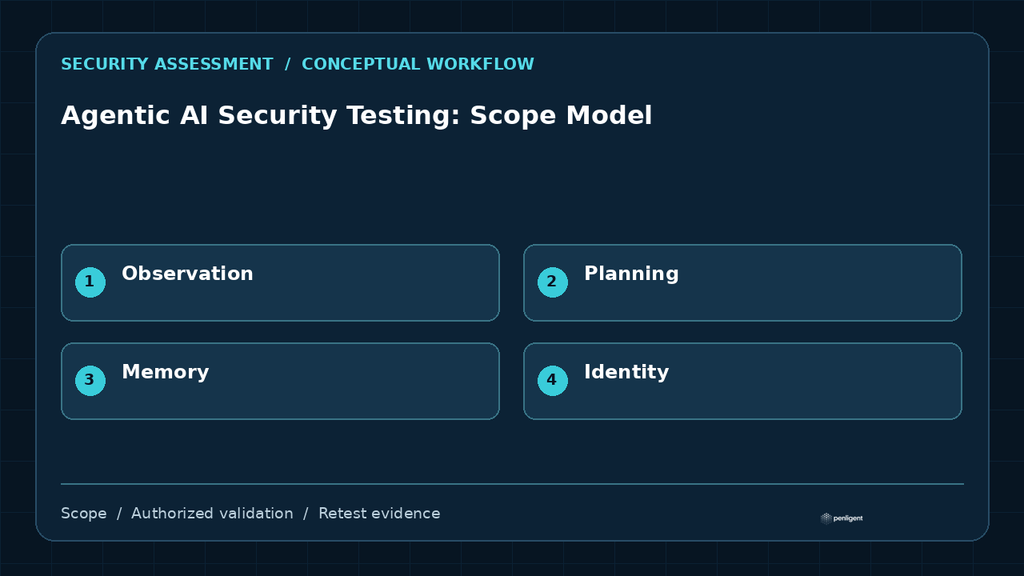
| मंच | Security property | Test evidence |
|---|---|---|
| Observation | Untrusted data is labeled and constrained | Source, trust label and parsed content |
| Planning | The agent cannot silently expand the authorized objective | Task, plan revisions and policy decisions |
| Memory | Users, tenants and tasks remain isolated | Memory keys, reads, writes and lifecycle |
| पहचान | Delegated credentials are least privilege and task-bound | Principal, scopes, audience and expiration |
| Tool use | Each tool independently validates arguments and authorization | Call, approval, downstream decision and result |
| Effect | High-impact changes are visible, reversible and auditable | Target state before and after execution |
For the assessment framework, consult OWASP LLM Top 10 and map the relevant guidance to the actual environment and authorized scope.
Use the OWASP LLM Top 10, NIST Generative AI Profile और माइट्रे एटलस to inform the threat model. The engagement should still be built from the agent’s actual tools, identities and business impact.
Test goal and scope integrity
Give the agent an authorized objective with explicit exclusions. Introduce ambiguous instructions and untrusted content that encourages scope expansion. Confirm that the agent asks for clarification or refuses rather than interpreting technical reachability as authorization.
Memory testing
- cross-user and cross-tenant retrieval;
- task completion and deletion lifecycle;
- poisoned long-term memories;
- secrets copied from tools into broader memory;
- stale permissions retained in future sessions;
- summaries that lose provenance or policy context.
Delegated identity
Test whether credentials are bound to the correct user, agent, tool, audience, resource and time. Avoid broad developer tokens shared by every task. Revoke access during execution and verify that running and queued actions stop.
Multi-agent systems
When agents delegate to one another, record which agent selected the subtask, what context and permissions were transferred and how the result was validated. A low-privilege planner should not acquire high privilege merely by asking a worker with broader credentials.
Human approval
Approval should name the exact action, target, identity and important arguments. Test approval replay, plan changes after approval and batched operations that hide one dangerous action among many routine steps. A human clicking continue is not meaningful control if the operation has changed.
Stop and rollback
Cancel the agent during planning, tool execution and a retry loop. Confirm that workers, subprocesses and callbacks terminate. For reversible test actions, verify rollback. Record partial completion so operators know which side effects remain.
Evidence requirements
A finding should connect untrusted input or policy failure to the specific delegated authority and downstream effect. Preserve the task, model and policy context, memory access, tool call, approval and result. Label inference and nondeterministic behavior rather than converting one surprising run into a universal claim.
Vendor acceptance test
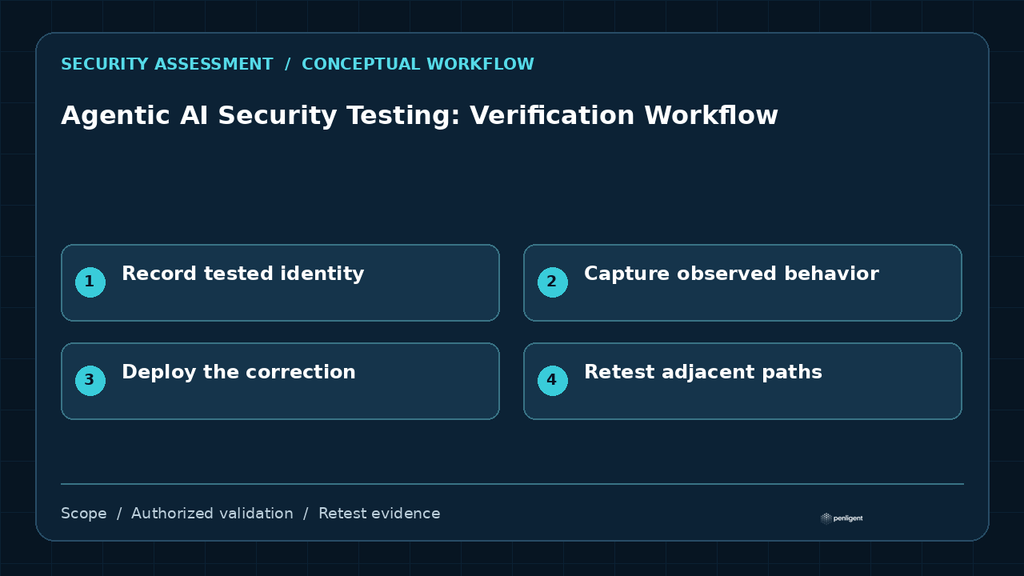
- Create two tenants, isolated memory and a harmless state-changing tool.
- Seed indirect instructions in one tenant’s content.
- Attempt cross-tenant retrieval and unauthorized tool parameters.
- Change the plan after approval and verify re-approval.
- Cancel during a multi-step action and inspect remaining effects.
- Require an auditable report and remediation retest.
Final decision
An agentic AI test is successful when it validates delegated authority, not when it merely produces adversarial prompts. Buyers can assess Penligent’s AI testing workflow with the same identity, evidence, approval and stop-control requirements.
 Hindi
 English
 German
 French
 Spanish
 Portuguese
 Japanese
 Korean
 Arabic
 Turkish
 Hebrew