
A SaaS penetration testing service should test the system’s tenant, identity and business boundaries—not only its public endpoints. The most damaging SaaS failures often require valid accounts, multiple roles, changing subscription state or a sequence of legitimate actions. They are easy to miss when a provider treats the engagement as an unauthenticated web scan.
Define the SaaS security model
Before requesting proposals, document the actors, objects and state transitions that must remain protected. Include customer users, tenant administrators, support operators, platform administrators, service accounts, integrations and background workers.
For the assessment framework, consult OWASP ASVS and map the relevant guidance to the actual environment and authorized scope.
| Boundary | Example security property | Required test setup |
|---|---|---|
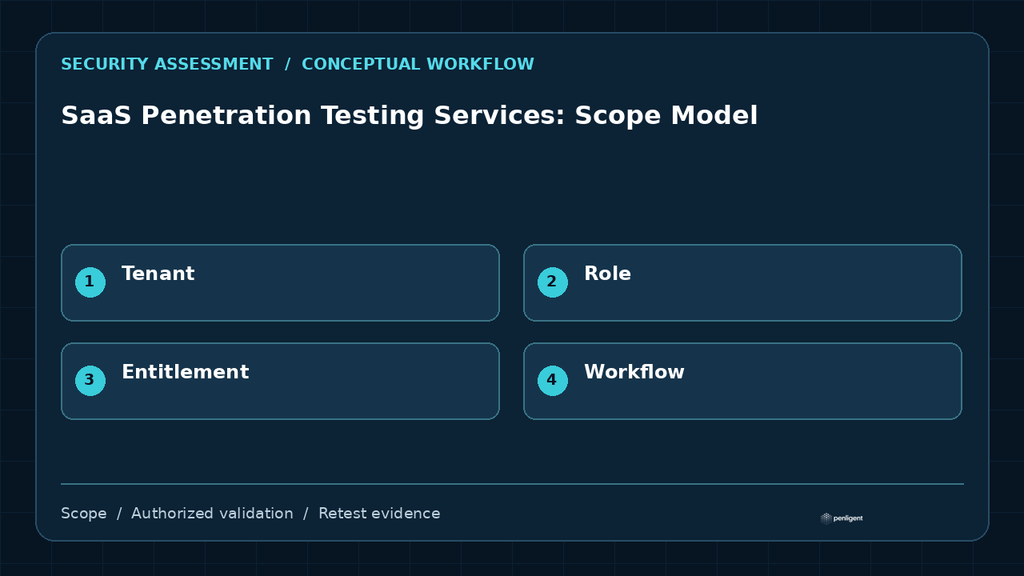
| Tenant | Tenant A cannot access Tenant B objects, exports or jobs | At least two synthetic tenants with equivalent roles |
| Role | A member cannot perform owner or billing-administrator actions | Accounts across the complete role hierarchy |
| Entitlement | Downgraded or canceled accounts lose server-side access | Trial, paid, downgraded and canceled states |
| Workflow | Replay or reordering cannot bypass approval or create value | Repeatable transactions with isolated test data |
| Integration | OAuth, webhook and API credentials have least privilege | Test integrations and revocable credentials |
| Support | Impersonation and recovery actions are authorized and audited | Documented support paths and audit access |
What the service should cover
- registration, invitation, SSO, MFA, recovery and session lifecycle;
- object-level and function-level authorization across UI and API;
- tenant-scoped search, exports, analytics and asynchronous jobs;
- subscription, quota, credit, refund and billing state;
- approval, delegation, revocation and audit workflows;
- file processing, notifications, webhooks and third-party integrations;
- cloud storage, secrets, service identities and deployment boundaries;
- administrative and customer-support functions.
The OWASP ASVS, OWASP WSTG और OWASP API Security Top 10 provide useful baselines. They do not replace a product-specific model of tenants, roles and business rules.
Ask vendors to demonstrate workflow reasoning
Use one representative workflow during the sales process. For example, an invitation may be created by an administrator, delivered by email, accepted under a different identity, mapped to a tenant, assigned a role and processed by a background job. Ask the vendor how it will test token binding, expiration, replay, role assignment, tenant selection and audit events.
A credible answer identifies the accounts and states required, the invariant being tested and the evidence that will support a conclusion. A list of generic injection payloads is not a SaaS test plan.
Evidence requirements
| Finding element | Acceptance standard |
|---|---|
| पहचान | Roles, tenant and authentication state are explicit |
| Object | Ownership and sensitivity of the affected resource are clear |
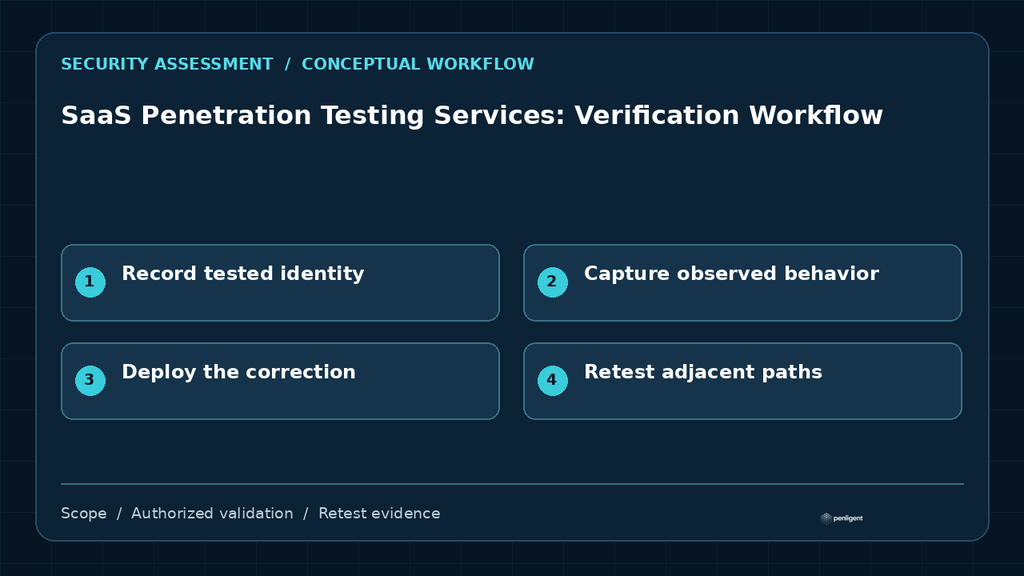
| Request sequence | All material steps and preconditions can be reproduced |
| Expected behavior | The violated authorization or workflow rule is stated |
| Observed behavior | Response, state change and impact are separated from inference |
| उपचार | Guidance addresses the decision point, not only the visible endpoint |
| Retest | The original invariant is repeated across relevant roles and paths |
Production versus staging
Use a staging environment that matches production authorization and integration behavior closely enough for meaningful testing. Populate it with synthetic tenants and transactions. Production testing may still be useful for configuration and exposure validation, but define lower rates, prohibited actions, emergency contacts and data-handling rules.
If a vendor insists that all meaningful testing must occur in production, ask how it will avoid destructive billing, notification, export and background-job side effects. If it tests only a simplified staging build, ask which production controls and integrations remain unverified.
Evaluate the provider
- Give the provider a role and tenant matrix and ask for a concrete test design.
- Ask for a redacted finding that includes a multi-step workflow and developer-ready evidence.
- Confirm who validates automated or AI-generated findings.
- Test scope enforcement and emergency-stop behavior.
- Define retest output, not merely the number of included retests.
- Confirm how credentials, customer-like records and HTTP bodies are retained and deleted.
- Require exportable findings, attachments and audit history.
Price the actual service
Ask whether the quote is based on applications, domains, endpoints, roles, days, tests or usage. Clarify whether APIs, mobile clients, cloud configuration, integrations, business logic and retesting are included. A low application count can still represent a complex assessment when the product has many roles, tenants and workflows.
A practical acceptance test
Seed an isolated staging environment with three known conditions: one missing server-side role check, one cross-tenant object reference and one workflow replay defect. Add a negative control that resembles a vulnerability but is correctly protected. Measure which conditions the service finds, whether it explains the violated invariant, whether it stays within scope and whether engineers can reproduce the evidence.
Final decision
Select a SaaS penetration testing provider based on its ability to understand state, identity and business impact. The service should convert complex workflows into reproducible findings and verified fixes. Penligent’s AI-assisted testing workflow should be evaluated against the same standard.
 Hindi
 English
 German
 French
 Spanish
 Portuguese
 Japanese
 Korean
 Arabic
 Turkish
 Hebrew