
Last updated: November 4, 2026.
Azure penetration testing should connect Microsoft Entra ID decisions to the workloads, applications and data those identities can reach. Subscription boundaries alone do not describe the attack surface: federation, managed identities, service principals, CI/CD credentials and application roles may cross resource groups and environments.
Microsoft publishes rules of engagement for cloud penetration testing. Confirm the current rules before work begins, obtain authorization for every tenant and subscription in scope, and identify third-party services that require separate permission.
For the assessment framework, consult Microsoft Cloud Penetration Testing Rules of Engagement and map the relevant guidance to the actual environment and authorized scope.
Map tenants, subscriptions and identities
Record the tenant, subscriptions, management groups, environments and resource owners. Then identify human and workload identities, privileged roles, conditional access, federation and application registrations.
| परत | उदाहरण | Question |
|---|---|---|
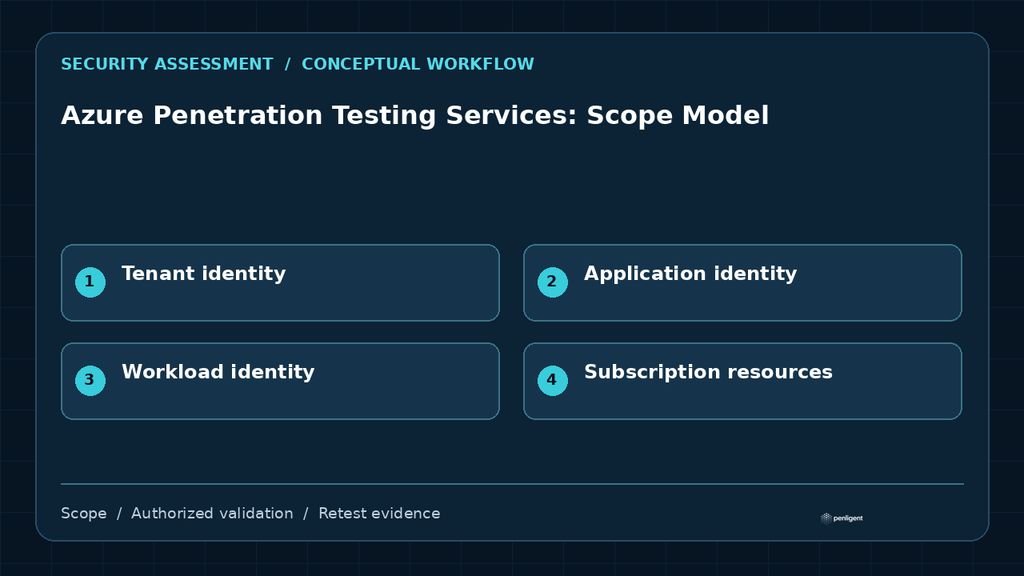
| Tenant identity | Users, groups, roles, guests and federation | Can identity policy be bypassed or privilege expanded? |
| Application identity | Service principals, app roles and consent | Can an app obtain unintended access? |
| Workload identity | Managed identities and automation credentials | Can a workload reach higher-trust resources? |
| Subscription resources | Compute, containers, functions and databases | Does configuration enforce the intended boundary? |
| Data and network | Storage, Key Vault, private links and VNets | Can a principal or path reach restricted data? |
Turn the scope into testable evidence
Define an authorized target, validate meaningful attack paths, and keep the evidence connected to remediation and retesting.
Test effective privilege, not only assigned roles
Evaluate role assignments, inherited permissions, custom roles, resource policies and identity trust. A small permission may become material when it allows credential access, role assignment, deployment changes or control of an application used by a more privileged identity.
Include application and API authorization
Cloud configuration testing should not replace authenticated application testing. Web applications, APIs and business workflows may expose tenant or role boundaries even when the underlying Azure resources are configured correctly. Keep infrastructure and application owners visible in the same attack chain.
Preserve Azure-native evidence
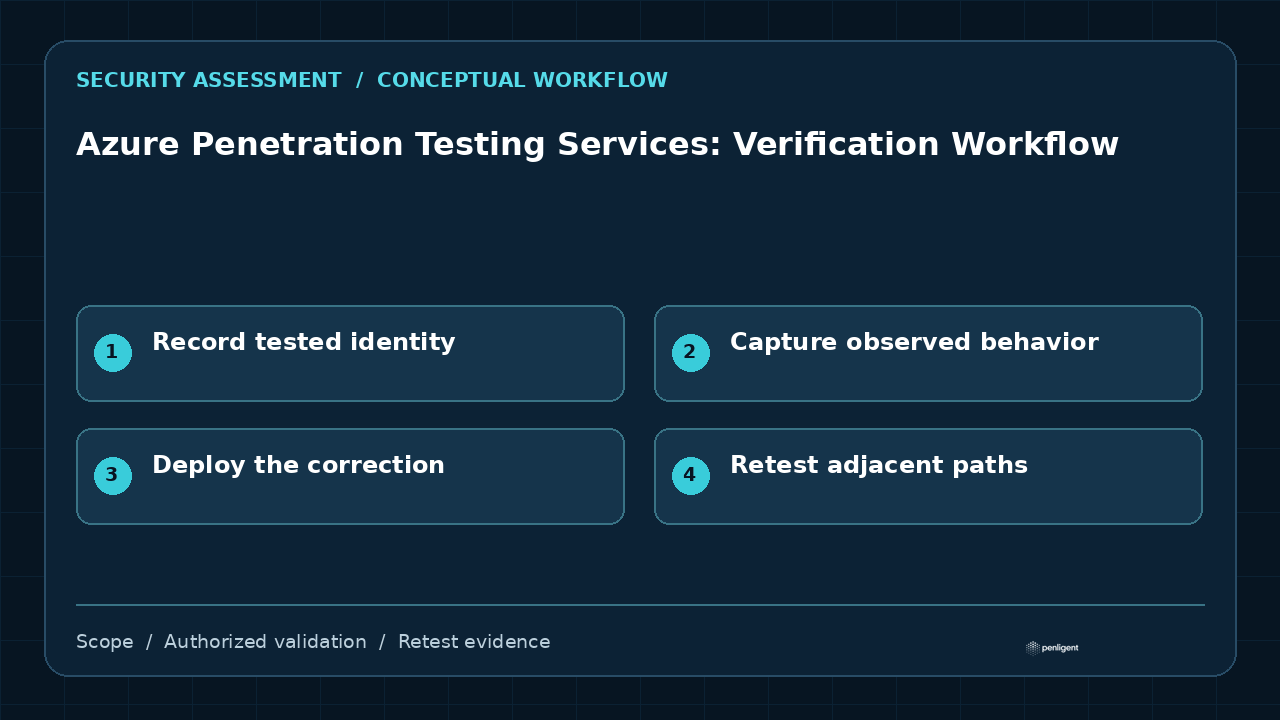
Record tenant and subscription identifiers, tested principal, affected resource ID, relevant role or configuration, sanitized request and logging evidence. Retest the corrected effective permission and adjacent inheritance paths after remediation.
Turn the scope into testable evidence
Define an authorized target, validate meaningful attack paths, and keep the evidence connected to remediation and retesting.
Questions buyers should ask
- Which tenants, subscriptions, guests and third parties are authorized?
- Are Entra ID, app registrations and managed identities included?
- Does the test cover application authorization as well as Azure configuration?
- How will activity logs and resource identifiers be preserved in the report?
निष्कर्ष
A useful Azure pentest shows how identity and resource decisions combine into a real access path. Scope the tenant and subscriptions explicitly, follow Microsoft’s current rules, and require evidence that the corrected effective permission or application control is active.
Sources and standards
- Microsoft Cloud Penetration Testing Rules of Engagement
- Microsoft Azure security documentation
- एनआईएसटी एसपी 800-115
 Hindi
 English
 German
 French
 Spanish
 Portuguese
 Japanese
 Korean
 Arabic
 Turkish
 Hebrew