
Last updated: November 4, 2026.
IoT penetration testing should follow trust from the physical device through firmware, local communications, mobile applications and cloud services. Testing only one layer can miss the control that actually owns identity or authorization. A strong engagement records how a device is provisioned, paired, updated, transferred and retired.
Safety and repeatability require dedicated test devices, recovery procedures and an approved network. Destructive hardware work, radio transmission and testing of third-party infrastructure may need separate permission and specialized facilities.
For the assessment framework, consult OWASP IoT Security Testing Guide and map the relevant guidance to the actual environment and authorized scope.
Create a device-to-cloud scope map
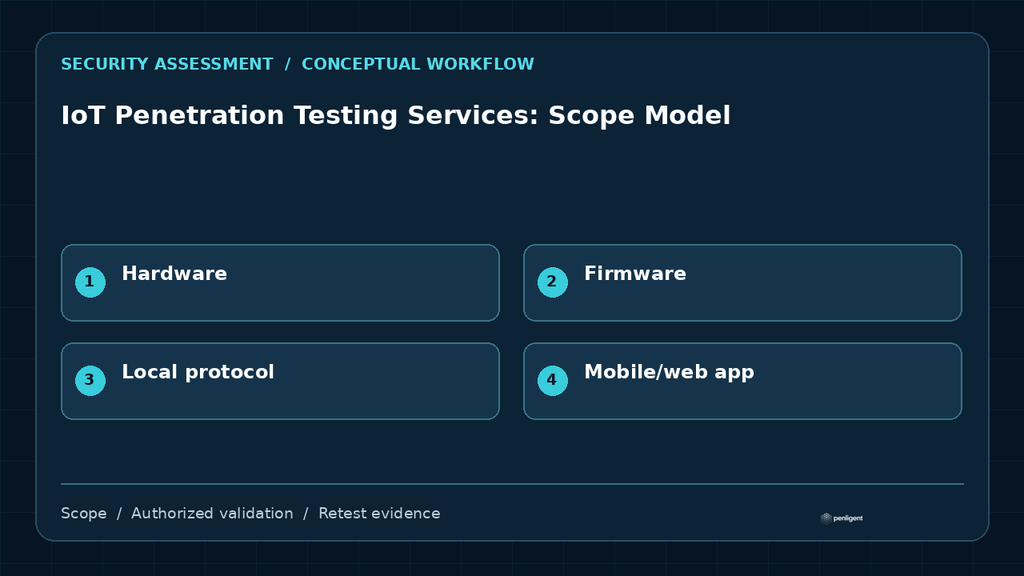
List hardware revisions, firmware builds, boot and update paths, debug interfaces, local protocols, companion applications, cloud APIs, administrative portals and manufacturing or support systems.
| परत | Security question | प्रमाण |
|---|---|---|
| Hardware | Can debug or storage interfaces bypass the intended trust boundary? | Board revision and interface behavior |
| Firmware | Are secrets, validation and privilege boundaries protected? | Build hash and controlled analysis |
| Local protocol | Can an unauthorized party discover, pair or command the device? | Identity, message and state evidence |
| Mobile/web app | Can one account control another device or tenant? | Role/device matrix and API response |
| Cloud/update | Are device identity and update authenticity enforced? | Certificate, package and service result |
Turn the scope into testable evidence
Define an authorized target, validate meaningful attack paths, and keep the evidence connected to remediation and retesting.
Test lifecycle and ownership changes
Provisioning, factory reset, resale, user transfer and decommissioning frequently expose persistent identity or data. Verify whether old owners, tokens or cloud associations retain access and whether reset behavior removes sensitive state.
Protect devices and environments during testing
Define spare devices, restore images, electrical and radio constraints, forbidden commands and stop conditions. Use synthetic accounts and isolated cloud tenants. Avoid testing production fleets or shared radio environments without explicit operational control.
Retest across the updated system
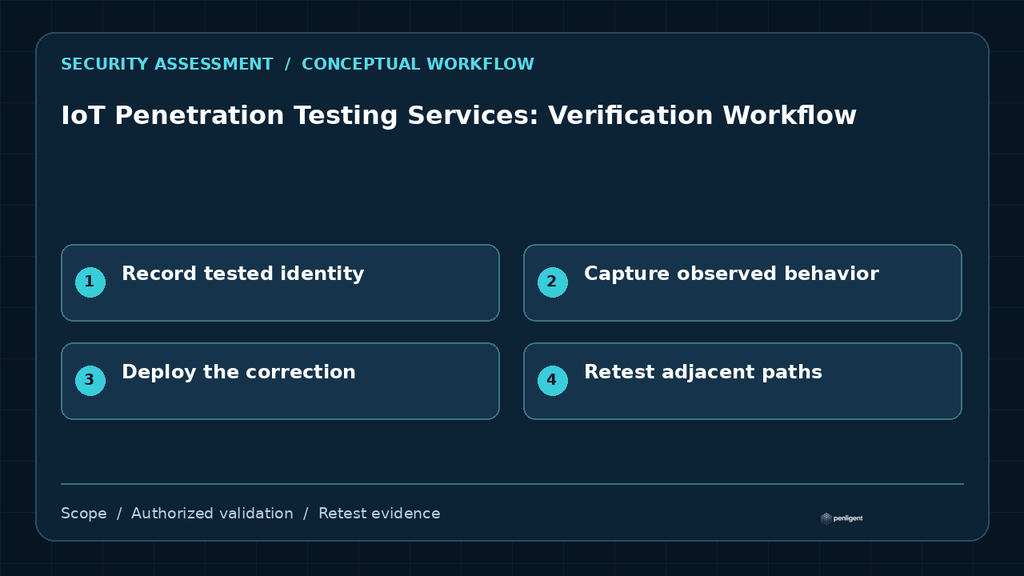
A firmware fix may require a bootloader or cloud change, and a cloud authorization fix may leave older devices exposed. Retest the exact hardware and firmware combination, update path, app version and cloud behavior.
Turn the scope into testable evidence
Define an authorized target, validate meaningful attack paths, and keep the evidence connected to remediation and retesting.
Questions buyers should ask
- Which hardware and firmware revisions are supported?
- Are mobile apps, cloud APIs and provisioning systems included?
- What recovery and stop procedures protect the devices?
- Can the retest cover the delivered firmware and update channel?
निष्कर्ष
IoT security is an end-to-end lifecycle problem. Scope the device, firmware, communications, applications and cloud identity together, use recoverable test equipment and retain evidence tied to exact hardware and software versions.
Sources and standards
- OWASP IoT Security Testing Guide
- NISTIR 8259 IoT Device Cybersecurity Capability Core Baseline
- ETSI EN 303 645
 Hindi
 English
 German
 French
 Spanish
 Portuguese
 Japanese
 Korean
 Arabic
 Turkish
 Hebrew