
An AI pentest agent should be evaluated by the security decisions it improves, not by how many tools it can launch. For a SaaS company, the important questions are whether the system can stay inside an authorized scope, reason across roles and workflows, produce reproducible evidence, stop safely, and deliver a report that engineers can use.
वाक्यांश pentest agent is used for several different product categories. Some tools assist a human operator. Some orchestrate scanners and command-line utilities. Others attempt multi-step autonomous testing. Before comparing vendors or open-source projects, define the operating model you are buying.
Penligent’s November 3 product demonstration is useful for seeing one autonomous testing workflow and the questions raised during a live session. Treat it as vendor-supplied evidence of demonstrated behavior, not independent validation of coverage, safety or comparative performance. Apply the acceptance tests in this article to the exact product tier and deployment model under consideration.
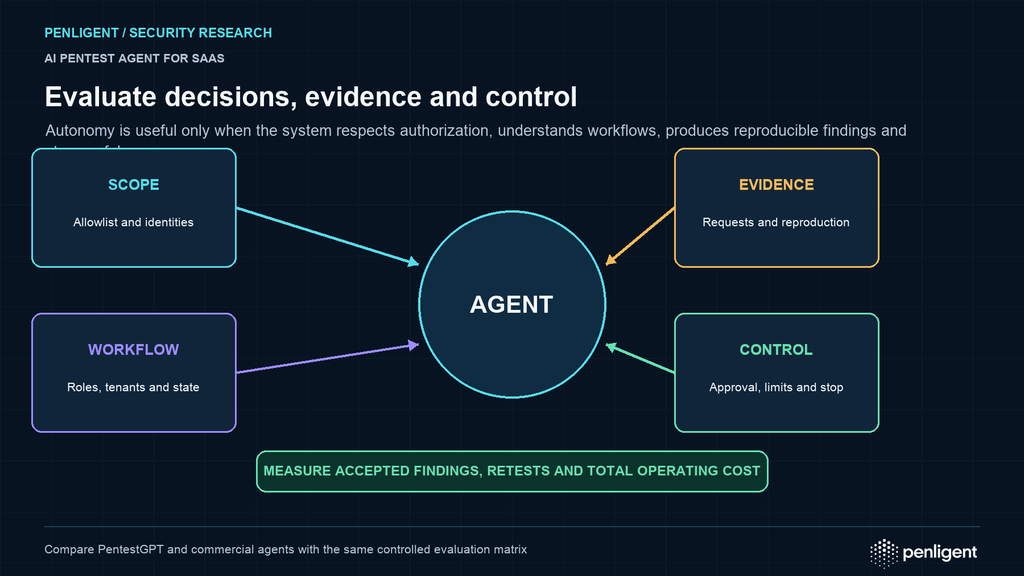
Evaluate AI pentesting with your own SaaS workflows
Review Penligent as one candidate and apply the same authorization, evidence, cost and retest criteria described in this guide.
PentestGPT vs the AI pentest agent category
पेंटस्टजीपीटी is a specific open-source project. Its current documentation describes an autonomous multi-stage pipeline, session persistence, local installation and Docker workflows, plus a separate interactive legacy mode. The repository is MIT-licensed, and the original research was published at USENIX Security 2024. Those facts make PentestGPT a useful technical reference and an evaluation candidate; they do not make it equivalent to every commercial service described as an AI pentest agent.
| Evaluation area | PentestGPT or another self-operated project | Commercial or managed agent |
|---|---|---|
| License and acquisition | Inspect the repository license, dependencies and supported runtime | Inspect contract, entitlement, usage limits and included services |
| Operation | Your team owns installation, model access, updates and execution environment | Responsibility is divided between customer, platform and service team |
| प्रमाण | Validate what the current code exports and what analysts must assemble | Validate report, ticket, replay and retest artifacts in the purchased tier |
| Control | Review and test source-level scope, approval, rate and stop behavior | Test configured controls and contractual escalation or support paths |
| Data handling | Trace local workers, model providers, telemetry and stored sessions | Trace hosted control plane, model subprocessors, retention and region |
| Total cost | Infrastructure, model usage, maintenance and analyst review | Subscription or engagement cost plus setup and internal review |
Do not compare an open-source repository with a managed service using license price alone. Compare the cost and quality of an accepted finding, including setup, false-positive rejection, evidence repair, developer reproduction and retesting.
What counts as an AI pentest agent
| श्रेणी | Typical behavior | What it does not prove |
|---|---|---|
| Security copilot | Explains findings, drafts commands or helps plan a test | That it can safely execute an end-to-end assessment |
| Scanner with AI summaries | Runs predetermined checks and rewrites results | That it can reason about stateful business workflows |
| Tool-orchestrating agent | Selects tools, adapts steps and tracks intermediate results | That its conclusions are accurate or its scope controls are sufficient |
| Managed AI-assisted pentest | Combines automation, platform workflow and human review | That every test is autonomous or every product layer is covered |
A useful comparison therefore starts with the test objective, not the label. If the objective is to validate cross-tenant authorization, subscription entitlements or an approval workflow, a high scanner count is irrelevant unless the system can create the required identities, maintain state, recognize the security invariant and preserve evidence.
The SaaS test matrix
Build the evaluation around a small but representative staging environment. Use synthetic tenants and test data. Define the expected security property for each workflow before the agent runs.
| Workflow | Required identities or state | Security property | Useful evidence |
|---|---|---|---|
| Tenant isolation | Two organizations with users at the same role | A user in Tenant A cannot read or mutate Tenant B objects | Requests, identity context, object ownership and the response difference |
| Invitations | Inviter, invited user, expired and reused tokens | Tokens are bound to the intended tenant, identity and lifecycle | Token state, replay attempt, resulting membership and audit events |
| Role changes | Owner, administrator, member and removed user | Privilege changes take effect consistently across UI, API and background jobs | Before-and-after permission matrix and endpoint results |
| Subscription entitlements | Free, trial, paid, downgraded and canceled accounts | Server-side authorization matches the current entitlement | Plan state, request, decision point and resulting resource access |
| Refunds and credits | Completed, partial, repeated and concurrent operations | Value cannot be created through replay, race or state desynchronization | Transaction identifiers, state transition and ledger result |
| Approvals | Requester, approver, delegated approver and revoked user | The correct actor approves the correct immutable operation | Workflow state, actor identity, approval event and final action |
The agent does not need to exploit every path to be useful. It does need to show how it reached a conclusion. A negative result such as “no cross-tenant access observed” should identify the roles, endpoints, object types and state transitions tested. Otherwise it is only a confidence statement.
Score evidence before vulnerability count
Finding count is easy to game. One product may split a single root cause into dozens of alerts, while another consolidates related evidence. Use a quality rubric for every accepted finding:
- Scope identity: which authorized target, tenant and account were used?
- Reproduction: can an engineer repeat the observation with the supplied steps?
- State: what preconditions and workflow state are required?
- Boundary: what security property was crossed?
- Impact: what data or action became available?
- Attribution: which endpoint, component or policy made the decision?
- Safety: did the test avoid destructive changes and unrelated data?
- Retest: can the same evidence model verify the fix?
Reject reports that rely on screenshots without request context, generic CVSS language without demonstrated impact, or tool output pasted without interpretation. An AI-generated explanation can be helpful, but it cannot substitute for a traceable observation.
Human control must be testable
“Human in the loop” can mean anything from an initial start button to approval before every consequential action. Ask the provider to demonstrate the control points.
| Control | Acceptance test |
|---|---|
| Target allowlist | Attempt to reference an out-of-scope hostname or IP and verify that execution is blocked |
| Identity limits | Verify that the agent can use only the supplied test accounts and cannot silently create broader access |
| Action approval | Require approval before state-changing, high-volume or potentially disruptive steps |
| Rate and concurrency limits | Measure whether configured ceilings are enforced across workers and retries |
| Emergency stop | Stop a live test and verify that queued jobs, child processes and callbacks terminate |
| Audit trail | Export the plan, prompts or decisions, tool calls, timestamps, identities and results needed for review |
Use an isolated, authorized staging target for these tests. Do not evaluate stopping behavior by pointing an unknown agent at production and hoping its interpretation of scope matches yours.
Test business logic, not only endpoints
A SaaS workflow rarely fits into one request. An invitation might create an identity, assign a tenant, activate an entitlement and enqueue a background job. The same operation may be reachable through a web UI, public API, mobile endpoint or administrative integration.
During a trial, ask the agent to maintain a state model:
- actors and their roles;
- objects and tenant ownership;
- allowed state transitions;
- one-time tokens and expiration;
- server-side entitlement decisions;
- asynchronous jobs and eventual consistency;
- audit records expected after important actions.
Then deliberately introduce one known authorization defect in staging. Measure whether the system finds it, explains the violated invariant, avoids unrelated tenant data and produces a retestable finding. A benchmark built entirely from known CVEs or obvious injection flaws will not answer whether the product understands your SaaS.
Deployment and data-governance questions
An agent can process URLs, credentials, request bodies, source code, logs and vulnerability evidence. Map where each data class goes.
- Is execution local, vendor-hosted or hybrid?
- Which model providers receive data?
- Are prompts, responses or tool output retained?
- Can sensitive fields be redacted before model submission?
- How are credentials stored, rotated and deleted?
- Can the customer select a region or private model endpoint?
- What audit evidence is available after an employee or vendor operator accesses a test?
- How are subprocesses, browser sessions and downloaded artifacts isolated?
Ask for answers that correspond to the exact deployment tier being purchased. A self-hosted execution worker does not necessarily mean that no data reaches a hosted control plane or model API.
Compare total operating cost
Open-source agents can be valuable, but “free” describes the license, not the operating model. Commercial platforms also vary in what is included. Compare the full cost of producing an accepted, retested finding.
| Cost category | Questions |
|---|---|
| Infrastructure | What workers, browsers, containers, storage and network controls are required? |
| Model usage | Who pays token or subscription costs, and what happens when a run loops? |
| स्थापित करना | How long does authentication, scope configuration and workflow modeling take? |
| Review | How many analyst hours are required to reject false positives and repair evidence? |
| Maintenance | Who updates tools, prompts, models, dependencies and integrations? |
| Reporting and retest | Are developer-ready reports, ticket integrations and verification runs included? |
A practical metric is cost per accepted finding, accompanied by time to reproduce and time to retest. Keep severity separate: one well-supported authorization finding can be more valuable than many low-confidence observations.
A 30-day evaluation plan
- Week 1 — scope and controls: configure the staging environment, identities, allowlists, secrets and stop conditions.
- Week 2 — known cases: run a balanced set of known positive and negative tests across web, API and business workflows.
- Week 3 — blind assessment: let the system evaluate selected workflows without disclosing the seeded defects.
- Week 4 — engineering handoff: ask developers to reproduce findings, fix two issues and run retests.
Track precision, recall against the seeded cases, unsupported claims, escaped scope attempts, analyst review time, developer reproduction success, retest success and total operating cost. Document product limitations instead of converting an untested category into a zero-finding result.
Final decision
The best AI pentest agent is not the one that appears most autonomous in a demonstration. It is the one that can operate inside your authorization model, test the workflows that create real SaaS risk, provide evidence engineers accept, expose its uncertainty, and stop when the environment or task leaves the approved boundary.
Teams evaluating AI-assisted validation can also review Penligent’s AI pentesting workflow as one candidate, using the same scorecard rather than relying on vendor-specific claims.
 Hindi
 English
 German
 French
 Spanish
 Portuguese
 Japanese
 Korean
 Arabic
 Turkish
 Hebrew