
Status checked November 29, 2026: Upstream maintenance patches are available for the Cacti profile-setting flaw linked to 4HTTP2ROOT/4HTTP2SHELL. Current sensor data records exploitation attempts, not confirmed compromises. Review anonymous Guest access and authenticated-user permissions while applying the upstream remediation.
Check both access paths
Start by establishing whether an anonymous visitor is mapped to an enabled Cacti Guest account. The Cacti user-management documentation says anonymous access is disabled by default from version 0.8.7 onward. It requires an enabled Guest user and a Guest assignment in Authentication Settings. The default Guest user can view all graphs unless permissions are narrowed. Check the effective settings on each instance.
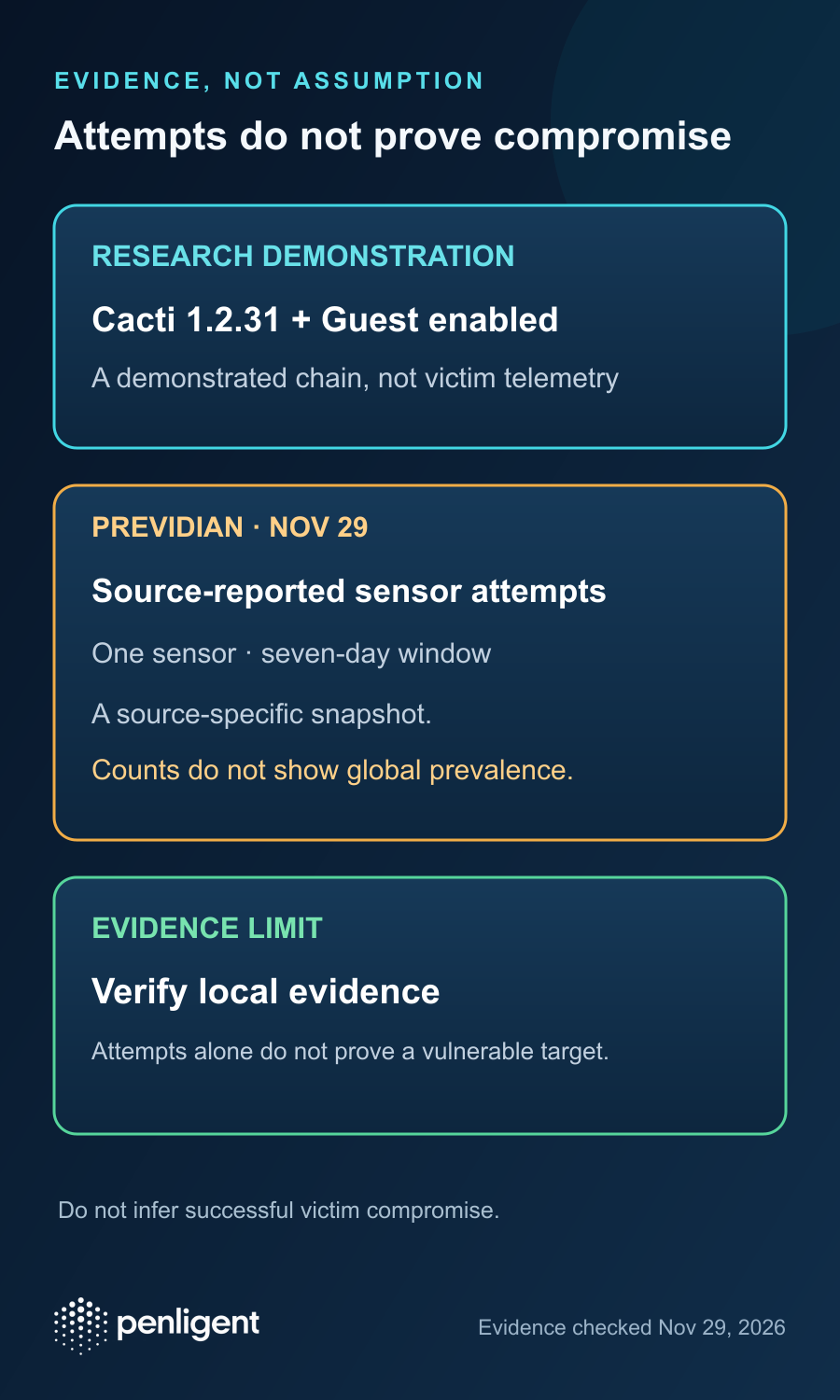
The public 4HTTP2ROOT/4HTTP2SHELL research demonstrated an unauthenticated chain against Cacti Core 1.2.31 with Guest access enabled. That is the demonstrated anonymous scenario, not proof that every deployment exposes the same path.
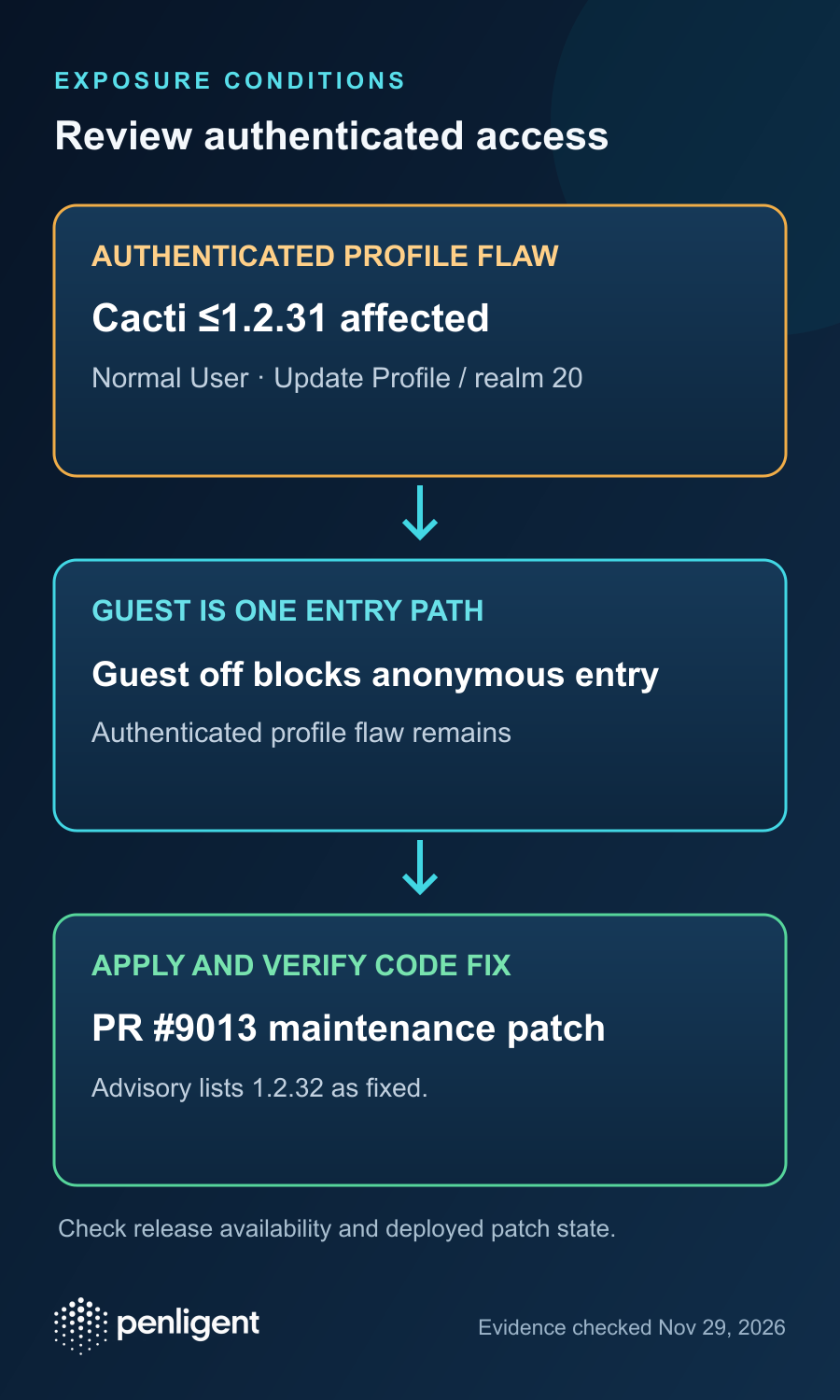
The new Cacti advisory also describes an authenticated route: a Normal User with View Graphs, realm 7, और Update Profile, realm 20, can exploit stored profile input through SQL injection to gain administrator permissions and reach intended command-execution features. Disabling Guest does not remove that route. Temporarily restrict profile-update access for untrusted users when patching must wait. The advisory’s High / CVSS 8.8 rating covers the authenticated finding, not the complete anonymous chain. It lists no known CVE.
For the anonymous path, inspect both Guest controls, then test from a fresh unauthenticated browser session that protected views require authentication. For the authenticated path, review who retains profile-update and administrative permissions. Record the instance, time, observed result, and change reference. Perform these checks only on systems you administer.
Apply the maintenance fix, not just a version-label check
The advisory lists versions through 1.2.31 as affected और 1.2.32 as patched. द public release listing still shows 1.2.31 as the latest release at this check. These statements describe different artifacts: a release number and a source-maintenance fix.
Cacti’s maintenance PR #9013 was merged into its 1.2.31 branch on November 28. It states that the patch applies to the original 1.2.31 release tag. The merged fix is available at commit 8910e2a. Follow the maintainer’s applicable patch or update guidance and your distribution’s packaging process; verify the installed code includes the fix. The unmodified 1.2.31 release and a patched 1.2.31 maintenance checkout are different states. A version banner alone cannot establish which one is deployed.
Do not confuse this with CVE-2026-39893, the earlier rfilter/RLIKE SQL injection fixed in the original 1.2.31 release. Installing that original release alone is not evidence that the newly disclosed profile-setting issue is fixed.
Separate exploitation reports from a finding on your host
Previdian’s November 29 sensor panel reports 552 attempts over the prior seven days, from 35 IPs across 13 countries, at one sensor. These are attempts, not a count of compromised servers. Previdian explicitly says its sensor attempts do not show that a target was vulnerable or that an attempt succeeded. Its AI-generated analyst summary and older dated panels should not be added to this current snapshot.
Use the sensor counts to prioritize exposure review, not to calculate a compromise rate or infer how many organizations were breached. Activity observed by one provider does not replace investigation of your own host and application evidence.
Prioritize by access and patch evidence
Record whether the UI is reachable from untrusted networks and which accounts run Cacti’s web and poller processes. Command impact depends on the privileges available to those processes; a root result in a lab does not mean every installation runs commands as root.
| Observed state | Response |
|---|---|
| Guest enabled, UI reachable from an untrusted network, and patch not verified | Highest priority: disable unnecessary Guest access, restrict UI access, and apply the applicable upstream fix. |
| Guest disabled, but untrusted authenticated users retain profile-update permission | Restrict that permission while patching; Guest disablement alone does not address the authenticated route. |
| UI limited to a management network, but patch not verified | Patch and review permitted users and systems. Internal access reduces reachability without repairing the flaw. |
| Maintenance fix verified | Recheck permissions and effective anonymous access, then review the period before remediation for suspicious activity. |
| Unexpected poller configuration, child process, or related log event | Preserve host and application evidence and use the incident-response process; one anomaly alone does not confirm exploitation. |
Keep before-and-after configuration, patch provenance, package or source revision, and verification results. Run web and poller processes with only the privileges they need. Access restrictions and least privilege limit exposure or impact; they do not substitute for the upstream code fix.
If you find suspicious activity
Compare poller configuration with a known-good baseline. Investigate unexpected command entries, newly created files owned by an application or poller account, and unusual child processes. Preserve relevant application logs and host evidence before cleanup. These are investigation leads rather than stand-alone proof of this exploit.
Cacti may hold SNMP community strings and other credentials used to monitor network devices. If compromise is plausible, identify which secrets the instance could access, assess their use, and rotate affected credentials under your incident plan. Patching prevents further use of the repaired path; it does not undo changes an attacker may already have made.
Current evidence boundaries
| Question | Evidence checked November 29, 2026 |
|---|---|
| Original anonymous demonstration | Cacti Core 1.2.31 with Guest enabled |
| Official affected range | Through 1.2.31 for the profile-setting advisory |
| CVE and severity | No CVE assigned in the advisory; its 8.8 score covers the authenticated finding |
| Remediation artifact | Maintenance patch available for the original 1.2.31 release; advisory names 1.2.32 as patched, while the release listing still shows 1.2.31 |
| Exploitation evidence | Previdian: one-sensor attempt telemetry, not proof of successful compromise or a global victim count |
The video below is a general Penligent 3.0 workflow demonstration. It is not evidence that Penligent detected, exploited, or remediated Cacti 4HTTP2ROOT.
Method and scope
Prepared with AI assistance from Cacti’s advisory, maintenance PR and commit, documentation and releases; watchTowr’s historical public research for the original demonstration; and Previdian’s current telemetry record. The official status and sensor data were checked November 29, 2026. No exploit was run, no Cacti instance was tested, and the patch was not independently executed or validated for this article. Recheck upstream guidance and your package provider’s status before remediation.
 Hindi
 English
 German
 French
 Spanish
 Portuguese
 Japanese
 Korean
 Arabic
 Turkish
 Hebrew