
CVE-2026-41709 is a VMware ESX logging vulnerability with an unusual risk profile. Broadcom rates it Low with a CVSS 3.1 base score of 2.7 and describes a malicious administrator who can perform certain operations without those operations being logged. That description is short, and the public record does not identify a safe, reproducible list of omitted commands or a production-ready way to trigger the condition. The responsible response is therefore precise: patch the affected ESX-based stack, improve evidence collection outside the hypervisor trust boundary, and investigate historical activity without inventing an attack path.
The low score reflects the privilege required and the limited direct impact published by the vendor. It does not make the issue irrelevant to a security operations team. A missing audit record can make it harder to determine who changed a virtual network, altered a host setting, accessed a sensitive management function, or prepared a later intrusion. A log-integrity weakness may not grant a new privilege, but it can reduce the quality of the evidence used to detect and contain a privileged account compromise.
Threat intelligence changed the urgency. Broadcom’s initial advisory material was followed by a CrowdStrike report on the 2026 legal threat landscape that linked CVE-2026-41709 to WARP PANDA activity against ESXi environments and described the issue as a command-logging bypass zero-day. The Cybersecurity and Infrastructure Security Agency later listed the CVE in its Known Exploited Vulnerabilities Catalog. Those sources do not add a public exploit recipe, and they do not change the vendor’s technical description into remote code execution. They do establish that patching and forensic readiness deserve attention even when the CVSS label is Low.
What CVE-2026-41709 actually says
The canonical CVE record for CVE-2026-41709 और NIST National Vulnerability Database entry identify an insufficient-logging issue in VMware ESX. Broadcom’s advisory assigns CWE-778, Missing Required Logging, and a CVSS 3.1 score of 2.7. The published vector is AV:N/AC:L/PR:H/UI:N/S:U/C:N/I:L/A:N. In plain language, the documented attacker already has a high-privilege administrative position; the direct security impact described is limited integrity impact through incomplete records, with no stated confidentiality or availability impact.
The vendor’s wording is deliberately narrower than many headlines. It says that a malicious administrator can execute certain operations without them being logged. It does not say that an attacker can become an administrator, escape a virtual machine, execute arbitrary code on the hypervisor, delete every log, or suppress all telemetry. It does not name every affected log file or publish a safe test request. Those boundaries matter because an investigation should distinguish confirmed facts from reasonable but unproven hypotheses.
| Question | Publicly supported answer | Operational implication |
|---|---|---|
| What kind of flaw? | Insufficient logging, mapped to CWE-778. | Investigate evidence completeness and patch the hypervisor stack. |
| What privilege is required? | Broadcom’s CVSS vector requires high privileges. | Prioritize privileged-account controls and management-plane review. |
| Does it provide RCE? | That is not stated in the vendor description. | Do not describe it as code execution without independent evidence. |
| Does it stop all ESXi logging? | No such broad claim is made in the advisory. | Review relevant sources; do not treat every missing event as this CVE. |
| Is it exploited? | CrowdStrike reported activity associated with WARP PANDA; CISA later listed the CVE in KEV. | Move it up the remediation queue and preserve external evidence. |
| Can an old missing event be reconstructed? | Not necessarily. A patch cannot recreate a record that was never generated. | Use independent sources and label uncertainty in the timeline. |
Broadcom’s security advisory is the primary source for affected products and fixed builds. Advisory pages can be revised as products, release branches, or threat intelligence change. Save the revision date and the exact build mapping used by the vulnerability ticket. A later update can change a patch target without changing the CVE number.
Timeline, threat intelligence, and evidence quality
Broadcom published VMSA-2026-0006 on July 29, 2026, with CVE-2026-41709 listed among the addressed issues. The CVE record was assigned shortly afterward. An August VMware Cloud Foundation FAQ stated that there was no information at that time indicating in-the-wild exploitation. Later reporting changed the available public picture: CrowdStrike’s 2026 Legal Threat Landscape report described WARP PANDA using ESXi command-logging bypass capabilities in activity that occurred in early 2026, and the CISA KEV catalog subsequently included the CVE. The correct interpretation is a changing evidence timeline, not a contradiction that allows the patch to be ignored.
Security teams often receive three different kinds of statement in this sequence. A vendor advisory tells administrators what product and version to update. A CVE record gives a canonical identifier and baseline description. Threat intelligence adds context about observed or attributed activity. A government catalog can turn exploitation knowledge into a prioritization signal for federal agencies and other organizations that use it as a reference. None of those statements automatically supplies the details absent from the others.
For example, CrowdStrike’s report can support a conclusion that the issue was used in a real intrusion campaign. It should not be used to fill in an invented command name, log file, API request, or sequence of operations when the report does not publish one. CISA KEV status can support accelerated remediation. It should not be rewritten as “CISA confirmed remote code execution” when the catalog entry does not say that. A defensible article keeps the provenance of each claim visible.
The CISA Known Exploited Vulnerabilities Catalog is especially useful when the security queue is large. A KEV entry means CISA has identified exploitation in the wild according to its inclusion process. It does not replace asset-specific exposure analysis. A host on an isolated management network and a multi-tenant cloud host with broad administrative exposure may share a CVE but have very different urgency and evidence needs.
A threat-intelligence report can also cover activity that began before a vendor publication. That is normal for a zero-day. It means that organizations should examine historical records around the activity window if they have reliable external telemetry, while recognizing that a logging flaw may reduce visibility exactly where the team wants certainty. The response should preserve what exists, identify the gap, and avoid declaring either innocence or compromise solely because a local log is empty.
Use a confidence label for each incident finding. “Observed” means a source contains a direct record, such as a vCenter event or a PAM session. “Correlated” means two or more sources align in time and identity. “Inferred” means the available facts support a hypothesis but do not prove it. “Unknown” means the relevant source is missing or unreliable. This vocabulary is more useful than forcing every event into a yes-or-no exploitation decision.
Maintain an evidence timeline in UTC and preserve the local time zone as metadata. ESXi hosts, vCenter, identity providers, bastion hosts, network devices, and SIEM pipelines can use different clock settings or have different ingestion delays. A timeline built from unnormalized timestamps can create a false sequence, especially around a host restart or a management change. Time synchronization evidence is part of forensic readiness, not a decorative field.
Why logging completeness matters in a virtual infrastructure
Logs are often described as a troubleshooting tool, but a virtualization platform makes them a security control. A small number of administrators can change host configuration, networking, storage presentation, authentication, virtual switch behavior, and the placement of many workloads. The records of those actions support authorization review, change management, incident response, recovery, and compliance. When a privileged action is absent from the expected log, a defender may not know whether a control was bypassed, an account was abused, a change failed, or the evidence pipeline itself was incomplete.
That does not mean every ESXi event belongs in one file or that vCenter events duplicate host records perfectly. The layers have different purposes. A vCenter task can show that a management operation was requested or completed through vCenter. A host log can show service behavior or a local action. An identity provider or privileged-access-management record can show which human account obtained access. A network record can show a connection path. A remote collector can preserve a copy outside the host. Correlation works because the sources are different; redundancy is useful precisely because no single source is complete.
Broadcom’s public CVE description does not say which exact ESXi log component is affected. ESXi environments commonly include hostd, vpxa, vmkernel, shell, authentication, system, and summary logs, but the existence of those files does not establish that CVE-2026-41709 affects all of them. Administrators should use the vendor advisory and current product documentation to determine what to review. A diagram or article should label these sources as evidence layers, not claim that one named file is the vulnerable component without support.
vCenter Tasks and Events are also not a universal audit ledger. They can record management activity performed through vCenter, but they may not represent every local or alternate management path. A privileged access gateway can record session identity and duration without capturing every hypervisor operation. Network telemetry can prove that a connection occurred without proving what the user did. The right response is to preserve and correlate the records, then state what each source can and cannot establish.
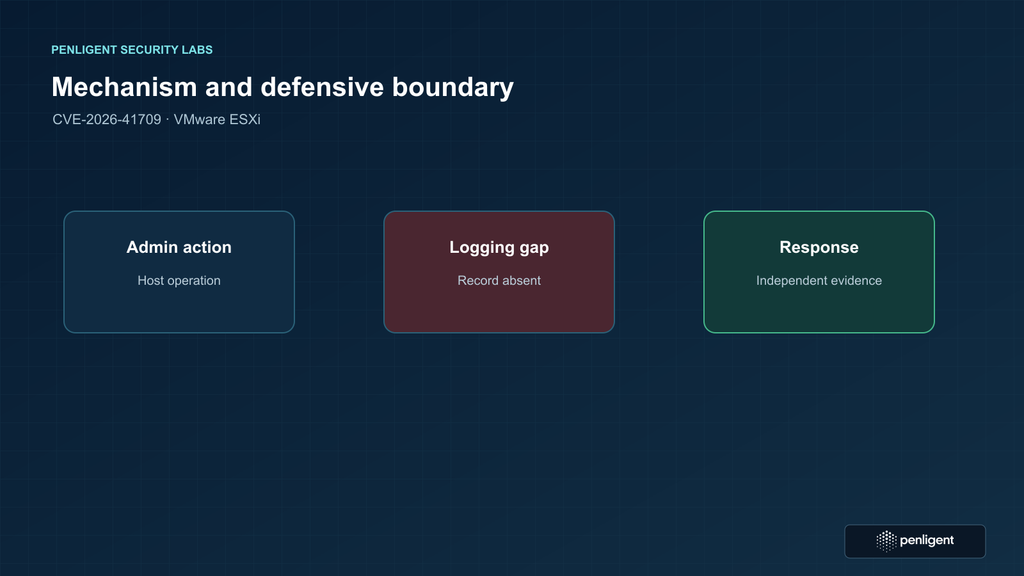
Remote syslog reduces a particular risk: a local event can be lost when a host restarts, rotates a file, or becomes unavailable. An external collector can also improve retention, search, access control, and alerting. It cannot create an event that the source never generated. If the CVE allows some operation to escape local logging, a collector receiving that local stream may also miss the operation. This is why external logs should be combined with independent management, identity, and network sources rather than treated as a complete answer.
Logging quality has several dimensions:
| आयाम | Question | Example evidence |
|---|---|---|
| Generation | Did the component create an event for the operation? | Documented event behavior, host and vCenter records. |
| Transmission | Did the event reach the collector? | Collector receipt, transport status, sequence or gap monitoring. |
| Storage | Was the event retained for the required period? | Retention policy, immutable archive, capacity alerts. |
| पहचान | Can the action be linked to a person, service, or session? | PAM, IdP, MFA, bastion, and management records. |
| समय | Can events from different systems be ordered reliably? | NTP status, clock offsets, UTC-normalized timestamps. |
| Integrity | Can unauthorized changes be detected? | Access controls, write-once storage, hashes, audit logs. |
| Analysis | Will a gap or anomaly generate a review? | SIEM rules, ingestion monitoring, analyst playbooks. |
CVE-2026-41709 sits primarily in the generation dimension, as described by CWE-778. The response should strengthen the other dimensions without claiming they cure the source defect. A collector with perfect retention cannot prove that a missing event was never generated. A file hash can prove that a snapshot did not change after collection; it cannot prove that the original host produced every relevant record. Being precise about these limits makes the resulting evidence more credible.
Affected products and fixed builds
Broadcom’s advisory lists fixed builds across the VMware ESX branches used in VMware Cloud Foundation and related products. The published mappings include ESXi 8.0 build ESXi80U3j-25429389, ESXi 9.0 build ESXi-9.0.2.0100-25595025, and ESXi 9.1 build ESXi-9.1.0.0-25370933. Broadcom lists VMware Cloud Foundation 5.x fixed in 5.2.4 and directs Telco Cloud Platform 5.0.x and 5.1.x customers to the referenced KB449886 process. Use the current advisory for the exact matrix and any later revisions.
| Stack or branch | Broadcom-listed target | कार्यप्रणाली संबंधी सूचना |
|---|---|---|
| ESXi 8.0 | ESXi80U3j-25429389 | Confirm the host’s actual build and hardware compatibility. |
| ESXi 9.0 | ESXi-9.0.2.0100-25595025 | Use the supported lifecycle and image workflow for the cluster. |
| ESXi 9.1 | ESXi-9.1.0.0-25370933 | Check current advisory revisions and management compatibility. |
| VMware Cloud Foundation 5.x | 5.2.4 | Follow the VCF asynchronous patch guidance rather than treating one host as an isolated appliance. |
| Telco Cloud Platform 5.0.x/5.1.x | KB449886 workflow | Use the product-specific KB and maintenance sequence. |
The table is a starting point, not permission to install a build blindly. A VMware integrated stack can constrain host images, vCenter versions, vSAN behavior, driver packages, firmware, and lifecycle manager baselines. A single ESXi host may be compatible with a build that is not yet approved for the cluster’s VCF bill of materials. Conversely, a VCF release may require an asynchronous security patch procedure that is not equivalent to a standalone host update.
Record the source build ID and the observed build ID separately. The source is the Broadcom advisory or KB; the observation is the host or management system output at a specific time. A vulnerability ticket should not say “patched” because an image is available in a repository. It should say which host or cluster reached which build and how that fact was verified. If a host is in maintenance mode, disconnected, or awaiting a reboot, keep the status open.
Support branches can change. A security team that copied a fixed version into a long-lived spreadsheet may miss an advisory revision, an end-of-support transition, or a product-specific replacement. Review the current Broadcom security advisory and lifecycle documentation at the time of the change. The Broadcom Software Security Center is the appropriate starting point for current VMware security material, while the advisory itself controls the CVE-specific mapping.
Do not infer that an unlisted VMware product is unaffected. The advisory names the products and branches it evaluated. If a platform contains ESX as a component, such as a cloud foundation or telecom stack, use the product-specific guidance. If the product or build is not covered, open a vendor support question or consult the latest advisory rather than extrapolating from a nearby branch.
Non-destructive exposure assessment
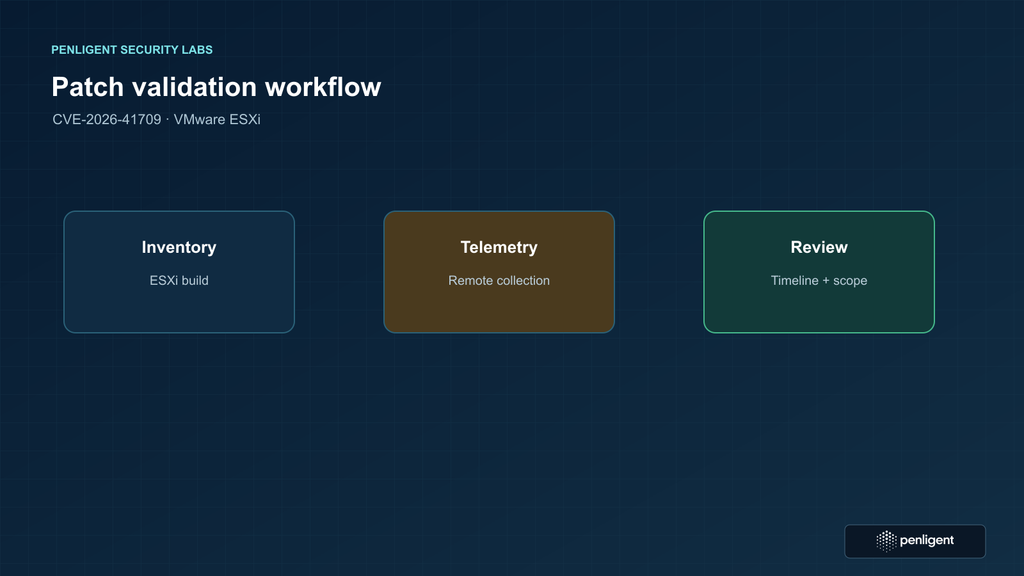
Start with an inventory that reflects the real virtualization estate rather than only the hosts that appear in a favorite dashboard. Include standalone ESXi, vCenter-managed clusters, VCF workload domains, disaster-recovery sites, service-provider environments, and laboratory hosts that can reach production management networks. Capture the host identity, product and build, cluster, vCenter, VCF or Telco Cloud relationship, management addresses, ownership, maintenance status, and external logging destination. A CVE response fails quickly when a disconnected or temporary host is missing from the list.
Use the management plane and host evidence together. A vCenter view can show the intended lifecycle baseline, but the host’s observed build is the fact that determines whether the code is running. A host can be disconnected, in maintenance mode, or waiting for a reboot after a staged update. Record those states explicitly. If a host cannot be queried safely, mark its version unknown and assign a follow-up instead of treating it as current.
Map the trust boundaries around management access. Identify the management network, vCenter, ESXi host interfaces, out-of-band console, jump server, privileged-access gateway, identity provider, and SIEM or syslog collector. Note which paths are reachable from administrator workstations, automation, partner networks, or the Internet. CVE-2026-41709 requires high privileges according to Broadcom’s score, so the protection of those paths and identities is central to the risk assessment.
Check whether logs leave the host and where they go. Broadcom’s documentation describes configuring ESXi syslog to a remote server; the receiving server controls its own retention and access. Verify that the configured destination actually receives events, that the source identity is retained, and that collectors have capacity and alerting. A configuration line alone is not proof of receipt. Compare a controlled, ordinary administrative event with the collector record while avoiding any action that changes production state beyond the approved test.
Keep the test event simple and authorized. For example, use a documented read-only inventory request or a normal management login that the platform team already performs, then verify whether the expected record appears in the approved sources. This checks the evidence path, not the CVE. A successful test message does not prove that every privileged operation is logged, and a missing test record requires investigation before the pipeline is trusted.
Review time synchronization at the same time. Capture NTP configuration, synchronization status, last successful update, and any known offset. If the host clock is wrong, a vCenter event and an identity-provider event can appear out of order even when both are genuine. A collector may stamp arrival time, but that does not replace the source timestamp. Preserve both when building an incident timeline.
Take a read-only configuration snapshot before remediation when an incident is possible. Protect the original file, redact secrets in an analysis copy, compute a cryptographic hash, and record the collector and operator. A hash proves that the copy was not altered after collection; it does not prove that the source log was complete. That limitation should be written into the evidence notes so an audit does not overstate what the control provides.
Classify each host using clear states:
| State | Meaning | Next action |
|---|---|---|
| Fixed and verified | Observed build meets the current Broadcom target and evidence collection is working. | Retain proof and continue normal monitoring. |
| Affected, exposed | Observed build is below target and the management plane or relevant services are reachable through a risk path. | Prioritize supported patching and preserve external evidence. |
| Affected, isolated | Observed build is below target but network and administrative exposure are constrained. | Schedule patching; validate the isolation assumptions. |
| Unknown | Build, product relationship, or evidence path cannot be confirmed. | Assign an owner and do not close the finding. |
| Exception | A documented technical or business constraint delays remediation. | Apply compensating controls, owner, and expiry date. |
“Isolated” should be evidence-based. A host on a private IP is not necessarily isolated if a compromised management workstation, partner tunnel, automation account, or shared jump host can reach it. Review routes, firewall policy, privileged access, and monitoring. The exposure decision belongs to the actual path that a high-privilege account or an attacker using that account could take.
Forensic response when logging is incomplete
The first response principle is preservation. When a suspicious administrative event is suspected, collect the external sources before rotating or deleting anything. Preserve the remote collector, vCenter database or exported tasks and events, identity-provider and PAM records, jump-host logs, network flow data, backup-management logs, and relevant endpoint records. These sources can show who had a session, where it came from, and what management path was used even when the ESXi record is incomplete.
Do not begin by asking the host to generate a large amount of new activity. Extra commands can overwrite volatile records, change the timing of the incident, or make an analyst look like the source of a later action. Use the minimum read-only collection needed to preserve state. If a vendor or incident-response team requires a diagnostic bundle, follow the approved collection procedure and record the time and tool version.
Build the timeline from outside in. Start with identity and privileged-access records that establish session times and account use. Add network telemetry to show the path to vCenter or the host. Add vCenter Tasks and Events to identify management operations performed through that plane. Add ESXi logs and the remote collector to fill in host behavior. Add change tickets and automation logs to distinguish approved work. When a source is missing, mark a gap instead of smoothing the timeline with an assumption.
Compare identities carefully. An administrator account may be used through a PAM checkout, an automation service, a local host account, or a shared emergency credential. A username in vCenter is not automatically a person. Correlate the account with PAM session identity, IdP authentication, MFA result, source address, workstation, ticket, and automation job. If the chain stops at a shared account, record the attribution limit.
Look for independent consequences of a privileged action. A virtual switch change can appear in network telemetry; a datastore operation can have storage-side evidence; a VM power change can appear in vCenter and guest monitoring; an authentication-policy change can create IdP or directory events. These consequences do not prove which command was issued, but they can confirm that a meaningful state change occurred during a session whose local log is incomplete.
When a host has restarted, preserve the reload reason, crash data, boot-time records, and monitoring history. A restart is not a published outcome of every CVE-2026-41709 scenario, and a reload can have unrelated causes. Use it as a timeline marker. Correlate with power, hardware, maintenance, cluster, and management events before associating it with exploitation.
Apply credentials and session controls if an administrator account may be compromised. Revoke active sessions through the identity and PAM systems, rotate credentials from a clean endpoint, review API tokens and keys, and confirm least privilege. These are general incident-response actions; they do not imply that CVE-2026-41709 bypasses authentication. If the evidence suggests only a logging gap without account compromise, document that distinction and avoid unnecessary disruptive changes.
Contact Broadcom or an incident-response provider when the evidence requires vendor interpretation. Share the minimum necessary data: product and build, advisory reference, timeline, crash or diagnostic information, redacted configuration, and the exact observation that triggered the question. Do not publish private logs or credentials while seeking help. A support case can also clarify whether a later advisory revision changes the affected branch or log component.
Remote logging and forensic architecture
Remote syslog is a foundation, not a guarantee. Configure ESXi hosts to send the supported logs to a controlled collector outside the host’s administrative trust boundary. Broadcom’s ESXi syslog configuration article explains that the host can forward logs to a remote server and that retention, rotation, and splitting on the receiver are controlled by that receiver. Confirm the collector accepts the source, preserves the host identity, uses synchronized time, and retains records for the required period. Monitor ingestion health and capacity. A collector that silently drops messages, loses source metadata, or fills its disk creates a second evidence gap.
Protect the collector like a security control. Restrict write access, separate analyst read access from administrator change access, retain access logs, and use immutable or write-once storage where the platform supports it. Encrypt transport when supported and appropriate for the product and network. If a collector must accept messages over a legacy protocol, compensate with network isolation, source allowlists, and integrity monitoring. The exact transport setting should follow Broadcom product documentation and organizational policy.
Capture source and arrival timestamps. Collector arrival time helps detect delays and gaps, while the source time helps order events across systems. Keep the time zone and offset metadata. A Broadcom knowledge-base article on ESXi events appearing out of chronological order describes how transport behavior and timestamp parsing can affect ordering. Alert on a host that stops sending logs, changes its destination, changes its clock, or sends an unexpected volume. These alerts do not identify CVE exploitation; they identify conditions in which forensic confidence is reduced.
Separate operational logs from security audit records. A high-volume vmkernel or performance stream can be valuable for context but may not answer who performed an administrative action. vCenter events, authentication records, PAM sessions, and host command or shell logs can answer different questions. Maintain a source matrix that states what each stream records, its retention, its owner, and its known gaps.
Use protected copies for important investigations. Export the relevant time window to an evidence store with a manifest containing source, collection time, time zone, tool, operator, hash, and access history. Preserve the original collector records under retention policy. An analyst working copy can be normalized or enriched, but the original should remain immutable or access-controlled so later reviewers can reproduce the conclusion.
Run collection-health exercises. In a lab, use a controlled test host and an approved change to simulate a syslog destination interruption; create an approved low-risk administrative event and verify that the monitoring system detects the missing receipt. Restore the destination and verify recovery. Broadcom has documented intermittent ESXi syslog message-loss scenarios in a separate product context, which is a reminder that missing collector data can have causes other than this CVE. This exercise tests the pipeline’s ability to detect collection failure; it does not test CVE-2026-41709 and should not be advertised as an exploit validation.
Test time and identity correlation during an exercise too. Create a documented management action with an approved account, confirm its IdP and PAM records, observe the vCenter event, and locate the corresponding collector message. Record the expected delay and any fields that differ. This establishes a baseline for an investigation without using hidden commands or attempting to suppress logs.
Centralization should be accompanied by least privilege and separation of duties. The people who administer ESXi should not be able to erase the only copy of the audit data. The people who manage the collector should not be able to change the hypervisor. The people who investigate should have read access and a controlled export path. These are general controls for audit integrity, not a claim that any one control removes the CVE.
Supported patching in ESXi, VCF, and Telco Cloud
Patch the product stack through its supported lifecycle path. A standalone ESXi host may use a lifecycle image or vendor-approved update process. An ESXi cluster managed by vCenter may have baselines, images, drivers, firmware, vSAN constraints, and DRS behavior. VMware Cloud Foundation adds a bill of materials and asynchronous patch procedure. Telco Cloud adds product-specific orchestration and service requirements. Broadcom’s NIST SP 800-40 Rev. 4 reference provides general enterprise patch-management guidance; the vendor advisory and the product’s supported lifecycle process still determine the actual fixed build and sequence. The objective is the Broadcom fixed build, reached through a supported path that preserves cluster health.
Before a change, capture cluster and workload state. Record host maintenance status, DRS and HA configuration, vSAN health, datastore accessibility, network uplinks, management connectivity, vCenter health, and out-of-band access. Confirm that workloads can migrate or that an approved outage exists. A vulnerability window should not begin while the team is still discovering whether a host can be evacuated.
Validate the target image and compatibility. Check the Broadcom advisory, lifecycle manager or VCF target, hardware compatibility, driver and firmware requirements, and management-plane support. A build that fixes CVE-2026-41709 may still require a sequence of vCenter or VCF updates. Keep the security source and the compatibility source in the change record.
Patch a representative non-production host first when the deployment permits. Verify boot, management connection, cluster admission, storage, network, workload migration, and log receipt. A canary does not eliminate risk, but it exposes image and orchestration problems before the production ring. If the environment has no spare host, define a tighter rollback boundary and use the out-of-band console.
For each production host, confirm the observed build after reboot and reconnection. Do not infer success from a completed task in vCenter. Check that the host’s actual version matches the target, that the cluster sees the host as healthy, and that remote logging is receiving new records. If the host remains disconnected or a log stream does not resume, keep it in a remediation state.
VCF customers should follow the asynchronous patch instructions associated with the fixed VCF release. Do not treat a VCF workload domain as a set of independent ESXi hosts. A single-host update outside the supported bill of materials can create drift that the next lifecycle operation cannot reconcile. Telco Cloud customers should use the KB449886 process named by Broadcom and coordinate with the service provider’s maintenance requirements.
After the patch, perform ordinary operational checks and one approved evidence-path test. Confirm a normal administrative event appears in the expected management and remote collector sources. Document that the test checks the pipeline, not the vulnerability. If the event is absent, investigate the collector, time, permissions, and source configuration before declaring the host remediated.
Build a source map before an incident
A forensic source map turns a vague instruction to “check the logs” into a repeatable investigation. For each source, document who owns it, which identities it contains, how it is collected, what the timestamp means, how long it is retained, whether an administrator can modify it, and how an analyst obtains a protected copy. Review the map with platform operations, identity engineering, networking, security operations, and the team responsible for backups. Those teams often hold separate parts of a single management session.
| स्रोत | Potential investigative value | Important limitation |
|---|---|---|
| ESXi host logs | Host services, authentication and system activity, and local operational context. | CVE-2026-41709 is an insufficient-logging issue; absence is not proof that an action did not occur. |
| vCenter Tasks and Events | Management-plane operations initiated or tracked through vCenter. | Does not necessarily cover every local, alternate, or external management path. |
| IdP and MFA | Account authentication, challenge outcomes, source and session context. | Authentication evidence does not show every operation performed after login. |
| PAM and bastion | Credential checkout, session brokering, approvals, and sometimes session capture. | Shared accounts or incomplete session capture can limit human attribution. |
| Network and firewall telemetry | Management connections, source zones, routes, and connection timing. | Flow records generally do not disclose the administrative action itself. |
| Backup and configuration systems | Configuration state over time and administrative access to backups. | A snapshot shows state, not necessarily who performed every intermediate change. |
| Remote log collector | Independent retention, ingestion timing, searches, and alerting. | It cannot preserve events that the source did not generate or transmit. |
Map source dependencies too. If vCenter, the identity provider, and the SIEM all depend on the same virtual infrastructure, one platform incident can affect all three. An “external” collector is not meaningfully independent if it runs on the same host cluster, uses the same administrator credentials, and shares the same storage and recovery path. Risk reduction requires a trust boundary that is operationally separate enough to survive the event being investigated.
Document alternate paths that are easy to forget: local console, remote management controller, host client, automation API, service account, scripted lifecycle job, and emergency access. The goal is not to assume these paths are used maliciously; it is to know which records each path should produce. During a tabletop exercise, ask responders to identify the evidence for a normal approved change through each path. If a source cannot answer the question, record the gap and decide whether to change the architecture.
Use a retention schedule that reflects investigation needs. Short-lived local host logs may be useful for immediate diagnosis, while the central collector and identity systems may need longer retention. The correct duration depends on the organization’s threat model, contractual and legal requirements, data-protection obligations, and storage budget. NIST’s SP 800-92 Guide to Computer Security Log Management provides a program-level foundation for log generation, infrastructure, and processes. It is older guidance, so combine it with current platform documentation and current organizational requirements.
CISA and partner agencies’ Best Practices for Event Logging and Threat Detection gives organizations a modern reference for security logging and threat detection program design. Use such guidance to establish ownership and objectives, not as a substitute for VMware-specific configuration instructions. The host vendor determines supported logging mechanics; the organization determines what retention, access, and response capabilities it needs.
Threat hunting without a vendor-published signature
The public material does not provide a universal event identifier, exploit string, or reliable single-log signature for CVE-2026-41709. A hunt should therefore be hypothesis-led and scoped. Start with the threat-intelligence reporting, the timeframe relevant to your environment, and assets that ran affected builds. Then correlate privileged access, management-plane activity, configuration changes, host behavior, and network paths. Avoid broad searches for invented strings or command names that are not present in authoritative reporting.
Useful questions include: Did an administrator account connect from an unexpected source? Was the session preceded by suspicious authentication or MFA activity? Did vCenter record a change that has no matching change ticket? Did a host configuration snapshot change without a corresponding approved workflow? Did a privileged session occur while external logging was unhealthy? Did the relevant host or cluster receive a fixed build only after a period of exposure? Each answer adds evidence, but none alone proves CVE exploitation.
Prioritize systems according to their role and evidence conditions. A hypervisor hosting identity, management, backup, or security workloads can have a larger consequence than a lab cluster. A host with weak management-plane segmentation and no external log copy presents a larger investigative challenge than one with isolated admin paths and robust independent records. These are operational risk factors, not additional CVSS metrics.
Look for inconsistencies rather than a specific missing event. A vCenter configuration change that appears in an audit system but not in the expected host evidence deserves review. A host log that stops arriving shortly before an administrative session may indicate a collector or network failure, but it may also be routine maintenance. A subsequent configuration difference can help scope the action, but it does not identify the actor by itself. The analyst should preserve the raw sources, write down the hypothesis, and test alternative explanations.
Negative evidence needs special care. If an external collector contains no matching record, determine whether the host was configured to forward that class of event, whether the collector was healthy, whether clocks aligned, and whether the source stream is expected to record the operation. “No record found” is meaningful only after these checks. Under a vulnerability whose published description is insufficient logging, the absence of a local event is especially weak as a standalone conclusion.
Do not force a full incident declaration solely because a device matches the CVE. Use the organization’s incident criteria, observed evidence, and affected asset criticality. A confirmed vulnerable build plus active exploitation intelligence may justify immediate patching even when there is no evidence of compromise. Patching urgency and incident attribution are separate decisions.
Privileged-access controls that reduce investigative uncertainty
CVE-2026-41709’s high-privilege requirement makes privileged-access hygiene particularly relevant. Inventory human and machine accounts that can administer ESXi, vCenter, or the VCF management plane. Remove stale entitlements, separate routine operator roles from emergency administrator roles, and assign service accounts only the rights needed for their automation. Review local accounts as well as directory-backed identities.
Require strong authentication for management access and store privileged credentials in a controlled system. Where feasible, use unique per-person identities, phishing-resistant MFA, privileged session brokering, approval workflows for sensitive operations, and short-lived access. These measures do not fix the logging defect, but they can improve prevention, containment, and attribution. Avoid shared credentials when the platform and operating model support individual accountability.
Protect automation identities with the same discipline as human administrators. A service account may have high privileges and run unattended. Track its owner, purpose, execution hosts, secret rotation, API token scope, and change schedule. Ensure automation jobs emit independent run records and preserve the versioned inputs and outputs. If an automation account is abused, the job system can provide context even when the hypervisor record is incomplete.
Separate change approval from execution where practical. A reviewed change ticket can provide intent, scope, and authorized timing; the management logs provide what the system recorded; the PAM session provides who had access. Together these sources make a stronger record than any one source. Emergency changes should still be traceable after the fact, with an approver and reason added as soon as possible.
Exercise credential revocation. In a tabletop or lab, confirm that the incident team can disable a human account, revoke sessions or tokens, rotate a service credential, and retain access to the management plane through an independent emergency procedure. This is important because investigations may identify a compromised administrator. The exercise should not use production credentials or perform unapproved changes to a live cluster.
Communicating severity and uncertainty
Explain the vulnerability to leadership in two sentences: Broadcom rates it Low because the documented attacker already needs high privileges and the direct impact is limited; later intelligence indicates real-world use and CISA has listed it as known exploited, so patching and evidence preservation should be prioritized. This avoids both extremes: overstating the flaw as a remote takeover and understating it because of a small CVSS number.
Keep technical severity, exposure, exploitation evidence, and business impact in distinct fields. CVSS answers a standardized question about technical characteristics. KEV status informs whether exploitation is known. Asset exposure describes whether a particular deployment matches the affected conditions. Business impact describes what the affected system supports. Combining these factors is a risk decision, not a change to the CVSS score.
When reporting an investigation, state the evidence limitations plainly. For example: “The host ran an affected build during the period. The remote collector and vCenter records show the approved change window. A local host record expected by the baseline was not available, and because the CVE concerns insufficient logging, we cannot use that absence to exclude unlogged activity. We found no independent evidence of unauthorized change.” That conclusion is stronger than either “no compromise” or “attacker erased logs” when the facts do not support those claims.
Separate remediation closure from incident closure. A host can be patched even while a historical investigation remains open. Conversely, an investigation can find no evidence of exploitation while the vulnerable host still needs its fixed build. Track both workflows, their owners, and their evidence requirements independently.
Do not use the word “tampering” as a synonym for missing data unless there is evidence that a record was changed or removed. Insufficient logging can mean that an operation was never recorded. It is not the same technical claim as deletion after the fact. The distinction affects legal, compliance, and personnel conclusions and should be respected.
Turn the response into an enduring control
After emergency remediation, convert the one-time CVE response into a control that continues to work. Assign an owner for the hypervisor build inventory, an owner for logging configuration, an owner for collector operations, and an incident-response owner for evidence retention. A spreadsheet with no owner or review cycle will drift. Put the source URLs and advisory revision in the system of record so that a future team can understand why the version target was chosen.
Set a periodic control test that is separate from exploit testing. A benign administrative event in a test environment can verify that identity, management, host, collector, and SIEM records arrive as expected. Repeat the test after changes to the vCenter version, host image, collector, network segmentation, or identity provider. Record the expected lag and the source-specific fields that analysts rely on. If the normal change is not traceable, fix the pipeline before a real incident depends on it.
Keep a gap register. It should include unavailable log types, hosts that cannot forward data, systems with short retention, clock offsets, shared accounts, and collectors without independent recovery. Assign each gap a risk owner and a compensating control. This makes uncertainty visible to incident commanders and auditors. It also helps avoid claims such as “all admin actions are logged” when the architecture has not been tested to that standard.
Review privileged activity at an appropriate cadence. The process might look for accounts with broad host rights, infrequently used emergency credentials, new service accounts, API tokens with no owner, and management sessions outside normal maintenance windows. A review can identify excessive access before it becomes an incident. It should be based on approved records and avoid an assumption that every unusual time or source is malicious.
Use threat-informed tabletop exercises. Give responders a scenario where a privileged administrator performs an unplanned change and one expected host record is missing. Ask them to preserve the collector, identify the relevant IdP and PAM session, search vCenter events, establish the network path, query configuration backups, and explain what remains unknown. The exercise is successful when the team can state the limits of its evidence and still make a sound containment decision, not when it finds a hidden exploit command.
Include recovery dependencies in the exercise. Can the team reach the management plane if the cluster hosting its identity provider is unavailable? Are console credentials stored somewhere independent? Can it restore vCenter or the collector without relying on the potentially affected hosts? Are the backups protected from the same administrative identities? These questions concern resilience and forensic independence, not the specific mechanism of CVE-2026-41709, but they determine whether the response can proceed.
Measure what is useful. Possible indicators include percentage of hosts with a verified fixed build, percentage sending expected logs to an independent collector, time to detect collector silence, percentage of privileged sessions linked to unique identities, and time to assemble a cross-source timeline during an exercise. Avoid a metric that counts configured destinations without checking receipt or one that rewards closing tickets while evidence remains unknown.
Apply data minimization and access controls. Hypervisor logs and management records can contain usernames, addresses, object names, and operational details. Retain enough context for security and legal needs while restricting access to authorized investigators. Define a secure export workflow, immutable retention period, redaction rules for working copies, and deletion procedure after the retention period. A highly protected logging program still needs privacy and data-governance boundaries.
Finally, rehearse advisory intake. The July vendor notice, later threat-intelligence reporting, and subsequent KEV listing arrived at different times and served different purposes. A mature process records the first source, re-checks the advisory when exploitation status changes, updates asset priority, and notifies the owners. It does not wait for a single severity number to summarize every operational fact.
Frequently asked questions
What is CVE-2026-41709?
- It is an insufficient-logging vulnerability affecting specified VMware ESX releases.
- Broadcom says a malicious administrator can perform certain operations without those operations being logged.
- The public description does not enumerate a safe test or every affected log component, so investigations should avoid assumptions beyond the advisory.
Why does a CVSS 2.7 vulnerability appear in CISA KEV?
- CVSS measures technical severity under a standardized model, while KEV communicates known exploitation in the wild.
- A low score and confirmed exploitation can coexist, especially when the attacker already needs high privileges but the weakness impairs investigation or accountability.
- Use the KEV status to prioritize action, not to rewrite the technical impact as RCE.
Does this CVE give an attacker root, remote code execution, or VM escape?
- Those impacts are not stated in Broadcom’s published description.
- The advisory describes an already privileged malicious administrator who can cause certain operations to go unlogged.
- Any stronger claim requires separate authoritative evidence.
Which builds should be installed?
- Broadcom lists fixed ESXi 8.0, 9.0, and 9.1 builds, VCF 5.2.4 for applicable 5.x environments, and a KB449886 process for Telco Cloud Platform 5.0.x and 5.1.x.
- Use the current advisory and product-specific lifecycle instructions because integrated stacks can have additional compatibility and ordering requirements.
- Confirm the host’s actual running build after the upgrade.
Will remote syslog make the issue harmless?
- No. Remote syslog can preserve transmitted records outside the host, improve retention, and make collector failures visible.
- It cannot store an event that the source never generated or sent.
- Combine the collector with vCenter, identity, PAM, network, backup, and configuration evidence.
How can a team check exposure safely?
- Inventory exact builds, product stack, management paths, and logging destinations using approved read-only views.
- Review current Broadcom affected/fixed mappings and preserve the evidence source and capture time.
- Do not attempt to reproduce an undocumented log-bypass operation on a production hypervisor.
Can an empty ESXi log prove that an operation did not happen?
- No. An empty record may reflect no event, a collection gap, a time mismatch, retention, or the insufficient-logging condition.
- Check whether that source is expected to record the operation and correlate with independent identity, management, network, and configuration data.
- Label the result as unknown when the evidence cannot distinguish the possibilities.
Does patching restore records that may have been missing?
- No. A patch addresses future exposure; it cannot recreate an event that was never recorded.
- Preserve available external records and document the period and sources with incomplete coverage.
- Use the gap to improve retention and collection architecture, without claiming the gap proves exploitation.
How should teams describe a possible incident?
- Separate observed facts, correlated evidence, inference, and unknowns.
- A vulnerable version or an unexpected configuration change can justify investigation, but neither alone proves exploitation of this CVE.
- Record the sources consulted, clock limitations, missing evidence, and remediation status.
निष्कर्ष
CVE-2026-41709 should be treated as a low-scored vulnerability with an elevated operational priority because later threat intelligence and CISA’s KEV listing indicate real-world exploitation. Its direct published impact remains narrow: a malicious administrator may perform certain operations without adequate logging. The distinction is important. The problem can weaken accountability and incident reconstruction, but the available evidence does not justify describing it as a remote takeover or claiming that all ESXi logs are suppressed.
Patch each affected host or integrated product stack using Broadcom’s current fixed-build and lifecycle guidance. At the same time, verify that relevant records are forwarded to a protected collector, that ingestion and clocks are monitored, and that independent identity, vCenter, PAM, network, and configuration sources can be correlated. A remote copy improves retention but cannot prove that the source generated every event.
If suspicious activity is under review, preserve the original evidence, use a disciplined UTC timeline, and label the confidence of every conclusion. A missing record is an evidence gap, not proof of an attacker’s action or proof that no action occurred. Fix the code, improve the evidence chain, and be exact about what the investigation can establish.
 Hindi
 English
 German
 French
 Spanish
 Portuguese
 Japanese
 Korean
 Arabic
 Turkish
 Hebrew