
CVE-2026-64600, commonly called RefluXFS, is a Linux kernel race condition in the XFS reflink copy-on-write path. Under the right conditions, an ordinary local process can write to its own reflink clone while the kernel mistakenly sends one of those writes to a physical block that now belongs only to the original source file. The attacker does not need ordinary write permission to that source. Read access, a writable destination on the same reflink-enabled XFS filesystem, local execution, and an unpatched kernel can be enough.
That boundary failure is what makes RefluXFS dangerous. The problem is not simply that two writes happen at the same time. XFS temporarily releases an inode lock while obtaining transaction resources, another writer changes the file’s extent mapping during that interval, and the first writer continues with a physical-block mapping captured before the lock was released. The kernel then asks the right question about the wrong block: whether the stale physical block is still shared. If the answer appears to be no, direct I/O can proceed with the obsolete mapping and overwrite data belonging to the reflink source.
Qualys demonstrated that the primitive can be converted into local privilege escalation on affected Fedora Server and RHEL environments. Its disclosure states that the resulting disk modification can survive reboot, avoid kernel log output, and leave the target inode’s ordinary metadata unchanged. The upstream Linux fix was merged on July 16, 2026, and coordinated public disclosure followed on July 22. The NVD record was added on July 23 and initially contained no NVD CVSS assessment. (क्वालिस)
RefluXFS should receive urgent attention on shared CI runners, multi-user servers, container hosts that expose relevant XFS paths, build infrastructure, notebook platforms, plugin execution environments, and application servers where a separate vulnerability could first provide low-privileged code execution. It should not, however, be treated as a remote pre-authentication vulnerability or as proof that every machine running XFS is immediately exploitable.
CVE-2026-64600 at a Glance
| क्षेत्र | Current understanding |
|---|---|
| संवेदनशीलता | CVE-2026-64600, RefluXFS |
| प्रभावित घटक | Linux kernel XFS reflink and direct-I/O copy-on-write handling |
| Security boundary | A write to an attacker-owned reflink clone can be redirected to a physical block belonging to the readable source file |
| Attack vector | Local |
| Starting privilege | Ordinary unprivileged local execution |
| Required filesystem | XFS with reflink=1 |
| Additional condition | A readable target and an attacker-writable destination must be available on the same XFS filesystem |
| Core bug | A data-fork extent mapping becomes stale while XFS drops and reacquires ILOCK |
| Introduced by | Upstream commit 3c68d44a2b49, associated with Linux 4.11 |
| Mainline fix | Commit 2f4acd0fcd862e22eab45690ec2c08c80b6ef2e7 |
| Potential impact | Persistent protected-file modification and local privilege escalation to root |
| Reliable remediation | Install a vendor-fixed kernel, reboot, and verify the running kernel |
| NVD scoring status on July 23, 2026 | No NVD CVSS assessment had yet been provided |
The absence of an initial NVD score is not evidence of low severity. It means the NVD enrichment process had not yet assigned a vector. Organizations should not invent a score, copy an unverified number from an aggregator, or defer action until a number appears. The technical conditions and the role of the affected host are more useful for immediate prioritization. (एनवीडी)
The Security Boundary RefluXFS Breaks
Unix file permissions are normally evaluated against a file object. A process that opens a protected file for writing should need the corresponding write permission or a privilege that overrides the access check. RefluXFS does not grant the attacker a normal writable file descriptor to the protected source. Instead, it exploits the relationship between two files that temporarily share physical storage.
XFS reflink cloning allows a destination file to refer to the same physical extents as a source file. The clone is cheap because the filesystem does not immediately duplicate all of the data. Both files point to the same blocks, and XFS tracks the number of owners through its reference-count metadata. When either file is changed, copy-on-write is supposed to allocate private storage for the writer before allowing the modification.
The Linux FICLONE operation normally requires read permission on the source and write permission on the destination. The source and destination must also reside on a filesystem capable of supporting the clone operation, generally the same mounted filesystem for the XFS scenario described here. These semantics are intentional. A user who can read a large file is allowed to create a space-efficient private copy without modifying the source.
The security promise is simple:
A process may share the source’s physical blocks while the files are logically identical, but any later write to the clone must be redirected to private storage before it can alter the source.
CVE-2026-64600 violates that promise in a narrow but powerful concurrency path. The attacker writes to a file they own, yet a stale physical mapping can make the block layer direct the write backward into the source. Qualys chose the name RefluXFS to describe this reverse flow from the clone into the original. (SecLists)
This distinction matters to defenders. An access-control log may correctly show that the attacker never opened the protected file for writing. An audit policy focused on failed write attempts may see nothing relevant. The target inode may retain its owner, mode, size, and modification time because the ordinary filesystem write path for that inode was not used. The integrity failure occurs below the abstraction that many monitoring systems treat as the final security boundary.
How XFS Reflink and Copy-on-Write Normally Work
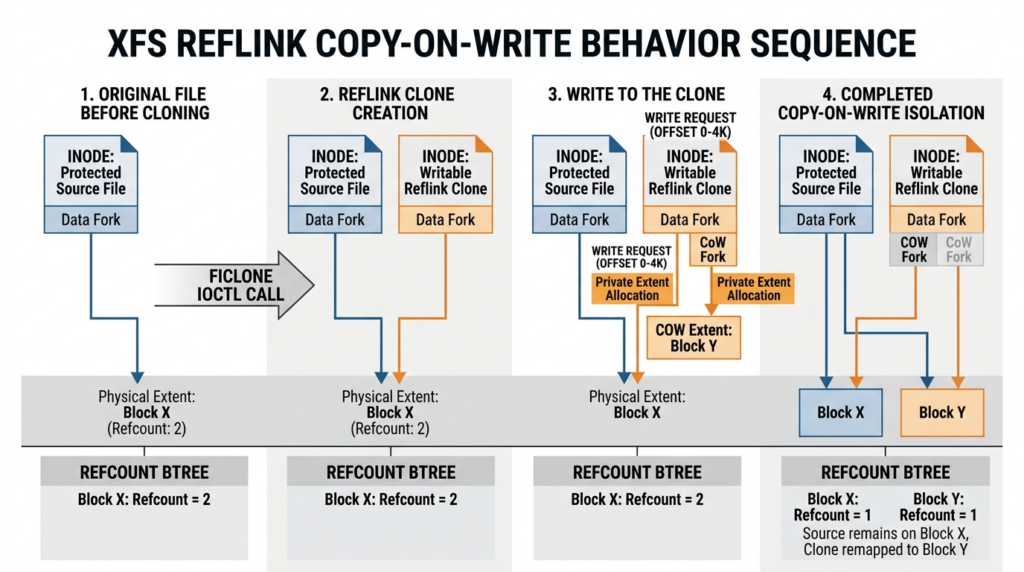
An XFS file does not merely contain a list of bytes. Its inode refers to extent maps that describe where ranges of the file reside on storage. For the RefluXFS discussion, two internal mappings are particularly important:
- The data fork describes the file’s current data extents.
- The CoW fork tracks pending copy-on-write allocations until they are committed into the file’s normal data mapping.
XFS also maintains reference-count information for physical blocks shared by reflinked files. If two files point to physical block X, the reference-count metadata records multiple owners. A write to either file cannot safely update X in place because that would silently alter the other file. XFS instead allocates a new block, writes the changed data there, updates the writing file’s data fork, and decrements the reference count for X.
Consider a simplified normal sequence.
| मंच | Source file | Clone file | Physical storage state |
|---|---|---|---|
| Before cloning | Points to block X | Does not exist | X has one owner |
| After reflink clone | Points to X | Points to X | X has two owners |
| Clone begins write | Still points to X | CoW allocation begins | X remains shared |
| CoW completes | Still points to X | Points to new block Y | X and Y each have one owner |
| Later reads | Return original bytes | Return modified bytes | Logical isolation is preserved |
This design provides major storage and performance benefits. Virtual-machine images, container layers, backups, development trees, package caches, and large data sets can be duplicated without immediately copying every block. Only changed ranges require new physical storage.
The optimization also creates a strict correctness requirement. Whenever XFS decides whether a write may happen in place, the extent mapping and sharing state must describe the same moment in time. It is unsafe to combine an old physical-block address with a new reference count. A block that belonged to the clone when the address was recorded may belong only to the source by the time the sharing check runs.
Why direct I/O changes the failure mode
Buffered I/O normally interacts with the kernel’s page cache. The kernel can coordinate cached pages, dirty state, invalidation, and filesystem mappings before data reaches storage. O_DIRECT asks the I/O stack to avoid much of the normal page-cache path. Exact behavior depends on the filesystem and alignment requirements, but direct I/O is intended to transfer data more directly between userspace buffers and storage.
In RefluXFS, that distinction is security-relevant because the direct-I/O mapping is handed to the lower I/O layer after XFS has made its sharing decision. The upstream analysis states that the path lacks a later revalidation hook that would notice that the physical mapping became obsolete. Once the stale mapping is returned as an ordinary mapped extent, the block write can be submitted to the old physical address. (SecLists)
The result is not merely an inconsistent cached view. Qualys reports an on-disk modification that persists across reboot. At the same time, the source file’s page cache may initially retain the old contents because the write passed through the clone’s address space rather than the source inode’s cached pages. This divergence between cached content, disk content, and inode metadata is one reason live detection and incident reconstruction are difficult. (SecLists)
The RefluXFS Race Step by Step
The vulnerable path can be understood without reproducing the weaponized exploit.
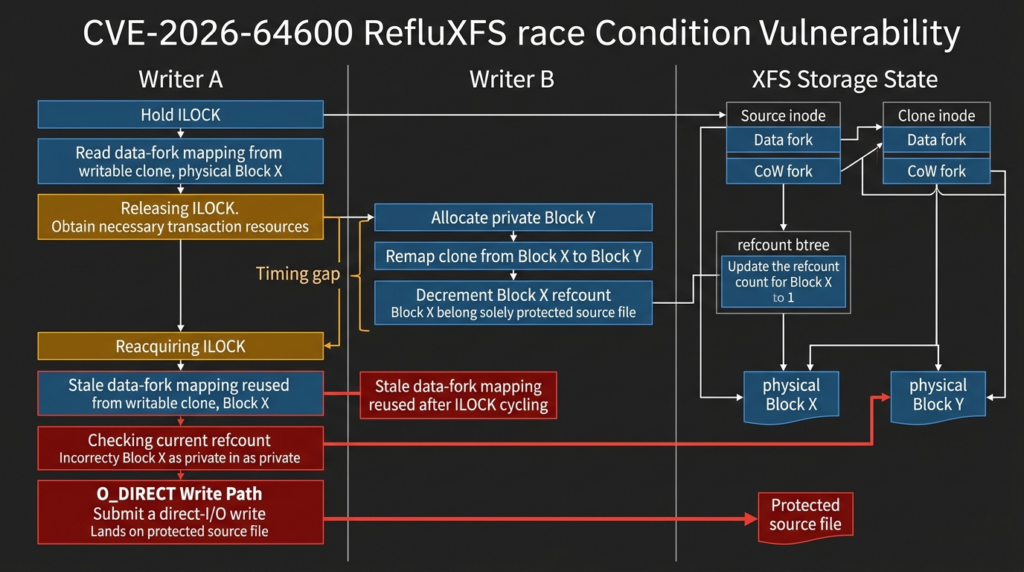
Writer A records a valid mapping
A direct write begins against a reflinked destination. XFS enters xfs_direct_write_iomap_begin() and reads the destination file’s data-fork mapping while holding the inode’s ILOCK. At that moment, the mapping is valid. Suppose the relevant file offset maps to physical block X.
XFS passes that mapping to its reflink allocation logic so it can decide whether the write requires copy-on-write.
XFS releases ILOCK to obtain a transaction
Creating and committing a CoW allocation requires an XFS transaction. Transaction allocation may have to wait for log space. Holding ILOCK during that wait could create a deadlock, so the implementation releases the lock, obtains transaction resources, and reacquires the lock.
Releasing the lock is not inherently a bug. Kernel code routinely drops locks around operations that may block. The responsibility is to recognize that any state protected by that lock may have changed before execution resumes.
Writer B changes the destination’s data fork
While Writer A is outside ILOCK, another direct writer can run against the same destination inode. Writer B can complete a legitimate copy-on-write cycle:
- It allocates a private block Y.
- It writes the destination data to Y.
- It remaps the destination’s data fork from X to Y.
- It decrements X’s reference count.
After that sequence, the destination no longer owns X. The original source file may now be X’s only owner.
Writer A returns with obsolete information
Writer A reacquires ILOCK. The old implementation refreshes information about the CoW fork, but it does not first refresh the data-fork mapping captured before the lock was released.
Writer A still holds an imap structure pointing to X, even though the destination now points to Y.
The code then queries XFS’s reference-count tree to determine whether the mapped block is shared. The reference-count tree provides a correct answer for X: it is no longer shared. The failure is that X is no longer the destination file’s current block.
A correct answer is applied to the wrong object
Because X appears private, the code allows an in-place direct write. The stale mapping is returned to the direct-I/O layer as though it still represented the destination file.
The I/O is submitted to X.
But X now belongs only to the source file.
The source is overwritten even though the process wrote through a destination file it owns and never obtained a writable descriptor to the source.
A safe conceptual timeline looks like this:
Time        Writer A                              Writer B

T0          Read destination data map
            destination offset -> block X

T1          Drop ILOCK to obtain transaction

T2                                                Read destination map -> X
T3                                                Allocate private block Y
T4                                                Remap destination X -> Y
T5                                                Decrement refcount of X
T6                                                Finish CoW

T7          Reacquire ILOCK

T8          Recheck sharing for stale block X
            X now has one owner, so it appears private

T9          Submit direct write using stale map X

T10         Write reaches block X
            Block X belongs to the source
This is a time-of-check and time-of-use failure, but that label alone does not capture the full problem. The “check” itself is current. The reference-count query accurately reports the present state of block X. The stale element is the association between the destination file and X. The code combines a pre-lock-drop mapping with post-lock-drop allocation metadata.
The upstream fix description says that xfs_reflink_fill_cow_hole and the related delalloc helper can cycle ILOCK, making their supplied mappings stale. Before the fix, XFS refreshed the CoW fork but did not refresh the data fork before asking the reference-count btree about physical blocks. (गिटहब)
Why the Upstream Fix Works
The mainline fix is commit 2f4acd0fcd862e22eab45690ec2c08c80b6ef2e7, titled xfs: resample the data fork mapping after cycling ILOCK.
The essential correction is not to hold ILOCK across transaction allocation indefinitely. Instead, the patched code determines whether the inode mapping changed while the lock was released. If the relevant sequence counter changed, XFS queries the data fork again before continuing.
That approach restores a critical invariant:
The physical block used for the sharing decision must come from the current data-fork mapping, not from a mapping captured before another writer could remap the inode.
Refreshing the data fork changes the outcome of the earlier example. When Writer A reacquires the lock, it detects that the mapping sequence changed. It reads the destination’s current mapping and sees Y rather than X. Any later reference-count decision is therefore made about the block the destination actually owns.
The fix carries a stable-kernel annotation back to version 4.11 and identifies commit 3c68d44a2b49 as the change that introduced the vulnerable behavior. The public advisory places that introduction in February 2017, with Linux 4.11 as the first relevant release line. (SecLists)
Why commit matching is not enough for enterprise Linux
A custom kernel built directly from an upstream Git tree can often be evaluated by checking whether the fixing commit, or a descendant containing it, is present:
git log --oneline --all \
  --grep='resample the data fork mapping after cycling ILOCK'

git merge-base --is-ancestor \
  2f4acd0fcd862e22eab45690ec2c08c80b6ef2e7 \
  HEAD
A zero exit code from git merge-base --is-ancestor indicates that the exact upstream commit is an ancestor of the selected source tree. That is useful for custom builds, but it is not a universal test.
Enterprise distributions routinely backport security changes without preserving the original release number or commit topology. A vendor kernel labeled 5.14 may contain thousands of fixes absent from upstream Linux 5.14, while another package with a numerically newer version may not yet include a particular backport. The correct evidence for a vendor kernel is the vendor advisory, package changelog, or source package—not a generic comparison against upstream version strings.
From Protected-File Write to Local Root
The vulnerability’s direct primitive is broader than “change a password file.” It allows an attacker to corrupt the on-disk content of a file they can read when the target and writable reflink destination satisfy the filesystem conditions.
Many root-owned files are intentionally readable:
- Executables must be readable to be loaded or executed.
- Shared libraries must be readable by processes that use them.
- Some system configuration files expose non-secret operating parameters.
- Authentication databases may separate public account data from secret password hashes.
- Service definitions, scripts, runtime files, and package metadata may be readable but not writable.
Readability is normally safe because the kernel enforces a strong distinction between observing bytes and changing them. RefluXFS turns that assumption into a possible integrity primitive.
Qualys reports that its research proof of concept converted the primitive into host root on Fedora Server 44 and RHEL 10.2. The disclosure describes modifications that persisted across reboot and did not update the target inode’s mode, ownership, timestamp, or size. It also reports no corresponding kernel warning or डीएमएसजी output during the demonstrated exploitation. (क्वालिस)
This article intentionally does not reproduce the privileged-file payload, race-amplification strategy, thread layout, or end-to-end root procedure. Those details are unnecessary for exposure management and would turn a defensive validation guide into an operational exploit recipe.
Why unchanged metadata matters
Many file-integrity systems use a combination of events and metadata:
- A process opens a protected file for writing.
- The inode’s modification time changes.
- File size changes.
- Ownership or permissions change.
- An audit rule observes a write-oriented system call.
- A package-management database reports an unexpected replacement.
RefluXFS can bypass several of those assumptions. The process writes through the clone’s file descriptor. The physical block changes underneath the source without a conventional source-inode write. If the source inode metadata is untouched, a monitor that hashes only after an inode event may never schedule a content check.
This does not make detection impossible. It means content integrity must not depend exclusively on metadata-driven triggers.
Persistence raises the incident-response cost
A transient kernel memory corruption may disappear after reboot, though it can still give an attacker enough time to obtain root. RefluXFS is different because the reported primitive modifies persistent storage. Restarting an affected host does not reverse a malicious disk change.
If credible exploitation is suspected, patching the kernel closes the vulnerability but does not restore trust in the filesystem. The attacker may already have changed authentication material, executables, service definitions, startup files, security tooling, package databases, or logs. Recovery may require a rebuild from a trusted image and credential rotation rather than an in-place package update.
The Exact Conditions Required for Exposure
The Qualys advisory describes three central conditions:
- The running kernel contains the vulnerable XFS code and lacks the fix.
- The relevant XFS filesystem has reflink enabled.
- That filesystem contains both a valuable readable target and a location writable by the unprivileged attacker.
The third condition also implies that the source and destination can participate in an XFS reflink relationship. A writable directory on a separate ext4, tmpfs, or different XFS filesystem does not automatically satisfy the same path.
| Condition | यह क्यों मायने रखती है | How to evaluate it safely |
|---|---|---|
| Vulnerable running kernel | The stale-mapping behavior must exist in the executing kernel | जाँचें uname -r, boot records, vendor advisories, and backport status |
| XFS | The vulnerable code is in the XFS reflink path | Enumerate mounts with findmnt -t xfs |
reflink=1 | Reflink cloning and shared extents must be enabled | Run xfs_info against each relevant mount |
| Local code execution | The attacker must execute operations on the host kernel | Review users, services, containers, jobs, plugins, notebooks, and build workloads |
| Readable target | FICLONE requires access to the source data | Evaluate readable privileged files within the process’s mount namespace |
| Writable destination | The process needs a file it controls | Identify writable directories on the same XFS |
| Same filesystem relationship | XFS cannot reflink arbitrary blocks across unrelated filesystems | Compare source and writable-path mounts with findmnt -T |
| Correct target extent state | The demonstrated race depends on the block’s sharing state | Do not test this on production; treat it as an exploit-reliability detail, not a safe exclusion |
| Missing vendor backport | Distribution kernels may already contain the fix | Use the applicable vendor tracker rather than upstream numbers alone |
The advisory notes that reflink has been the mkfs.xfs default since xfsprogs 5.1.0 in 2019, with Red Hat enabling the default in its RHEL 8 tooling earlier. It also states that reflink is a filesystem superblock feature fixed at creation time, not a mount option or sysctl that can simply be switched off later. (SecLists)
Root on ext4 does not end the investigation
A machine whose root filesystem is ext4 is not exposed through that root mount. It may still have other XFS filesystems containing:
- Application installations
- Shared package or build caches
- Container storage
- Home directories
- Database tooling
- Backup staging areas
- VM images
- Mounted enterprise data volumes
- Privileged scripts or executables
Each XFS mount should be evaluated separately. The question is not merely “Is / XFS?” It is “Does an untrusted process have a readable high-integrity source and a writable reflink destination on the same affected XFS?”
XFS alone is not sufficient
Older XFS filesystems can have reflink=0. Such a filesystem does not expose the reflink race because it cannot create the required shared-block relationship through this feature.
Likewise, a reflink-enabled XFS used only for isolated data owned by a single trusted service may have a different risk profile than a root XFS containing system binaries and a world-writable temporary directory. The kernel should still be patched, but remediation sequencing should reflect practical attacker access.
A target that is already reflink-shared is not a safe control
The public analysis notes that the demonstrated race has an additional extent-reference-count constraint. Existing sharing can interfere with that specific exploit attempt. Defenders should not try to “protect” files by creating extra reflink copies.
That would be fragile for several reasons:
- Files can be replaced by package updates, rotation, or rename operations.
- Different extents in one file can have different sharing states.
- An attacker may choose another readable target.
- Backup and copy behavior changes over time.
- The technique consumes operational complexity without removing the vulnerable kernel path.
Patch status remains the reliable closure criterion.
Affected Kernel and Distribution Status
The kernel.org-sourced NVD record identifies Linux versions before 4.11 as unaffected by the introducing change. It records the following upstream or stable branch fix points as of July 23, 2026. (एनवीडी)
| Kernel line | Recorded fix point | Interpretation |
|---|---|---|
| Earlier than 4.11 | Not affected by the introducing commit | Confirm that the distribution has not independently backported the vulnerable feature |
| 6.12 | 6.12.96 | Versions at or beyond the branch fix are recorded as unaffected |
| 6.18 | 6.18.39 | Versions at or beyond the branch fix are recorded as unaffected |
| 7.1 | 7.1.4 | Versions at or beyond the branch fix are recorded as unaffected |
| Mainline 7.2 development | 7.2-rc4 | Contains the mainline correction |
| Other vendor or long-term branches | Vendor-specific | Require an advisory or verified equivalent backport |
These numbers should not be transformed into a simplistic rule such as “every kernel lower than 6.12.96 is vulnerable.” The flaw was introduced into a code lineage, and stable maintainers can backport a fix to older branches. Distribution packages also have their own version syntax and patch queues.
Debian demonstrates why vendor trackers matter
The Debian Security Tracker snapshot on July 23, 2026 showed different statuses across releases and repositories:
| Debian source package snapshot | Status on July 23, 2026 |
|---|---|
Bullseye 5.10.223-1 | Vulnerable |
Bullseye security 5.10.259-1 | Vulnerable |
Bookworm 6.1.176-1 | Vulnerable |
Bookworm security 6.1.177-1 | Vulnerable |
Trixie 6.12.94-1 | Vulnerable |
Trixie security 6.12.96-1 | Fixed |
Forky 7.1.3-1 | Vulnerable |
Sid 7.1.4-1 | Fixed |
That table illustrates two important points. First, a numerically high patch release does not prove that a specific security change has been backported. Debian’s 5.10.259-1 was still marked vulnerable at that snapshot. Second, repository state changes quickly during coordinated kernel releases. A status copied into a static scanner rule can become stale within hours. (security-tracker.debian.org)
RHEL-derived systems, Oracle Linux, Amazon Linux, Fedora, SUSE, Ubuntu, Debian, and other distributions should be checked through their own security channels. Qualys listed multiple Red Hat, Rocky Linux, AlmaLinux, Fedora, and Oracle security updates in its disclosure, but package applicability depends on the product, architecture, kernel stream, real-time variant, subscription channel, and booted image. (क्वालिस)
Safe Exposure Inventory
Exposure assessment should begin with passive evidence collection. None of the following commands attempts to trigger the race.
Confirm the running kernel
uname -r
uname -a
cat /proc/version
Record the collection time. On systems using systemd, also capture boot history:
journalctl --list-boots
journalctl -b 0 -k --no-pager | head -n 80
Do not close a finding merely because the package manager shows a fixed kernel installed. A machine can continue running the old image until reboot.
Useful package commands include:
# RPM-based systems
rpm -q kernel kernel-core 2>/dev/null
dnf updateinfo list --installed 2>/dev/null | grep -i kernel

# Debian-based systems
dpkg-query -W 'linux-image-*' 2>/dev/null
apt-cache policy 'linux-image-*' 2>/dev/null
Package output must be interpreted against the vendor advisory for that distribution. Generic version scanners can identify candidates, but they cannot reliably resolve every backport.
Enumerate XFS mounts
findmnt -rn -t xfs -o TARGET,SOURCE,FSTYPE,OPTIONS
Check every returned mount:
while IFS= read -r mountpoint; do
    printf '\n== %s ==\n' "$mountpoint"
    xfs_info "$mountpoint" 2>/dev/null | grep -E 'reflink=|crc=' || true
done < <(findmnt -rn -t xfs -o TARGET)
A relevant result contains:
reflink=1
अगर xfs_info reports reflink=0, that particular filesystem does not satisfy the reflink prerequisite. If no XFS filesystems are mounted, the currently mounted system is not exposed through the XFS path, though offline images and future mounts may still require asset-management attention.
Compare source and writable paths
For any high-value path and candidate scratch directory, identify the backing mount:
findmnt -T /path/to/protected-file \
  -o TARGET,SOURCE,FSTYPE,OPTIONS

findmnt -T /path/to/writable-directory \
  -o TARGET,SOURCE,FSTYPE,OPTIONS
Do not assume /tmp या /var/tmp is on the root filesystem. Hardened systems sometimes use a separate tmpfs or dedicated partition. That separation can remove one convenient source-destination relationship, but it does not prove that no other writable directory exists on the protected XFS.
A limited defensive search for world-writable directories can be run per mount:
find /candidate/xfs/mount \
  -xdev -type d -perm -0002 \
  -printf '%m %u:%g %p\n' 2>/dev/null
This command can be expensive on large filesystems. Run it within an approved maintenance or scanning window and exclude application data where necessary.
Collect an exposure report without exploiting the host
The following script gathers basic evidence. It does not create reflinks, use direct I/O, race kernel operations, or modify protected files.
#!/usr/bin/env bash
set -euo pipefail

echo "CVE-2026-64600 passive exposure inventory"
echo "Collected: $(date --iso-8601=seconds)"
echo

echo "Running kernel:"
uname -a
echo

echo "Mounted XFS filesystems:"
mapfile -t XFS_MOUNTS < <(findmnt -rn -t xfs -o TARGET)

if ((${#XFS_MOUNTS[@]} == 0)); then
    echo "No mounted XFS filesystems found."
    exit 0
fi

for mountpoint in "${XFS_MOUNTS[@]}"; do
    echo
    echo "Mount: $mountpoint"
    findmnt -rn -T "$mountpoint" \
      -o TARGET,SOURCE,FSTYPE,OPTIONS

    if command -v xfs_info >/dev/null 2>&1; then
        xfs_info "$mountpoint" 2>/dev/null |
          grep -E 'meta-data=|data     =|reflink=' || true
    else
        echo "xfs_info is not installed."
    fi
done

echo
echo "Interpretation:"
echo "- This output does not prove exploitability."
echo "- Match the running kernel to the distribution advisory."
echo "- Investigate mounts reporting reflink=1."
echo "- Evaluate local untrusted-code paths and writable directories."
The output should be stored with the asset identifier, collection timestamp, scanner identity, and vendor-advisory reference. That evidence is far more useful than a screenshot showing only uname -r.
A Safe Validation Model
Kernel LPE validation should move from the least invasive evidence to the most controlled testing.
Level one — prove a prerequisite is absent
A host can be classified as not exposed through a particular filesystem when defensible evidence shows one of the required conditions is missing:
- No XFS mount is involved.
- The relevant XFS reports
reflink=0. - The running kernel predates the introducing code and the vendor confirms it lacks the vulnerable backport.
- The running vendor package contains the fix.
- The untrusted process cannot access a relevant source and destination on the same XFS.
The conclusion should be scoped. “Root filesystem is not affected” is not the same as “the host has no affected XFS.”
Level two — prove the running kernel is fixed
Strong closure evidence includes:
- The vendor advisory identifying the fixed package.
- Package-manager output showing that package installed.
uname -ror equivalent runtime evidence showing the fixed kernel is booted.- A reboot or immutable-image replacement record.
- A post-change scan collected after boot.
- Confirmation that old nodes and stale images have been removed from service.
A vulnerability scanner may report the installed package while missing the running image, or report the upstream version while missing a backport. Both errors are avoidable when package and runtime evidence are collected together.
Level three — validate the feature safely in a disposable lab
A normal reflink test can confirm that the representative environment supports reflink and preserves expected copy-on-write isolation. It cannot prove that the race is exploitable or fixed, because both vulnerable and patched kernels should perform normal CoW correctly in ordinary, non-racing operations.
This distinction is essential. A safe functional test answers:
- Can the filesystem create a reflink?
- Do the source and clone initially contain identical bytes?
- Does a normal write to the clone leave the source unchanged?
- Is the test environment representative of the production filesystem configuration?
It does not answer:
- Can concurrent direct writes win the vulnerable race?
- Can a protected production file be modified?
- Can root be obtained?
- Is a failed race run proof of safety?
Level four — use a controlled regression test
If a vendor provides a non-destructive regression test designed for the patched code, run it only in an isolated, disposable environment. A race test may hang, corrupt data, trigger a kernel fault, or produce misleading false negatives.
Do not download a public root exploit onto a production machine to “verify” the scanner result. The act of testing can create the same integrity incident the patch program is trying to prevent.
Safe PoC — Demonstrating Normal XFS Reflink Isolation
The following demonstration creates a disposable loopback XFS filesystem, enables reflink, clones a harmless test file, modifies the clone, and verifies that the source remains unchanged.
It is deliberately not an exploit:
- It does not use concurrent writers.
- It does not open files with
O_DIRECT. - It does not target system files.
- It does not attempt to widen a transaction window.
- It does not test privilege escalation.
- It mounts the lab with
nodevऔरnosuid. - It uses a disposable image under
/tmp.
Run it only on a Linux lab machine where you are authorized to create loop devices and mount filesystems.
#!/usr/bin/env bash
set -euo pipefail

LAB_DIR="/tmp/refluxfs-safe-demo"
IMAGE="$LAB_DIR/xfs-reflink.img"
MOUNTPOINT="$LAB_DIR/mnt"
LOOPDEV=""

cleanup() {
    set +e

    if mountpoint -q "$MOUNTPOINT"; then
        sync
        sudo umount "$MOUNTPOINT"
    fi

    if [[ -n "$LOOPDEV" ]]; then
        sudo losetup -d "$LOOPDEV" 2>/dev/null
    fi
}
trap cleanup EXIT

rm -rf "$LAB_DIR"
mkdir -p "$MOUNTPOINT"

echo "[1] Creating a disposable 1 GiB image"
truncate -s 1G "$IMAGE"

echo "[2] Attaching a loop device"
LOOPDEV="$(sudo losetup --find --show "$IMAGE")"

echo "[3] Creating XFS with reflink enabled"
sudo mkfs.xfs -f -m reflink=1 "$LOOPDEV" >/dev/null

echo "[4] Mounting with nodev and nosuid"
sudo mount -o nodev,nosuid "$LOOPDEV" "$MOUNTPOINT"
sudo chown "$(id -u):$(id -g)" "$MOUNTPOINT"

echo "[5] Confirming the filesystem feature"
xfs_info "$MOUNTPOINT" | grep 'reflink='

echo "[6] Creating harmless source data"
dd if=/dev/zero \
   of="$MOUNTPOINT/source.bin" \
   bs=4096 count=1 status=none

printf 'ORIGINAL-SOURCE-DATA\n' |
  dd of="$MOUNTPOINT/source.bin" \
     bs=1 seek=0 conv=notrunc status=none

SOURCE_HASH_BEFORE="$(
  sha256sum "$MOUNTPOINT/source.bin" | awk '{print $1}'
)"

echo "[7] Creating a reflink clone"
cp --reflink=always \
  "$MOUNTPOINT/source.bin" \
  "$MOUNTPOINT/clone.bin"

echo "[8] Modifying only the clone"
printf 'CHANGED-CLONE-DATA\n' |
  dd of="$MOUNTPOINT/clone.bin" \
     bs=1 seek=0 conv=notrunc status=none

sync

SOURCE_HASH_AFTER="$(
  sha256sum "$MOUNTPOINT/source.bin" | awk '{print $1}'
)"

CLONE_HASH="$(
  sha256sum "$MOUNTPOINT/clone.bin" | awk '{print $1}'
)"

echo
echo "Source before: $SOURCE_HASH_BEFORE"
echo "Source after:  $SOURCE_HASH_AFTER"
echo "Clone after:   $CLONE_HASH"

if [[ "$SOURCE_HASH_BEFORE" != "$SOURCE_HASH_AFTER" ]]; then
    echo "Unexpected result: source content changed."
    exit 1
fi

if [[ "$SOURCE_HASH_AFTER" == "$CLONE_HASH" ]]; then
    echo "Unexpected result: clone did not diverge."
    exit 1
fi

echo
echo "PASS: Normal copy-on-write isolation was preserved."
echo "This result does not determine CVE-2026-64600 patch status."
The expected result is that the source hash remains unchanged while the clone hash changes. That demonstrates the property RefluXFS violates only when the vulnerable concurrency path is triggered.
A vulnerable kernel can pass this safe test. A patched kernel should also pass it. Patch status still requires vendor or source evidence.
For additional visibility in the disposable lab, the system calls used by a normal clone can be observed without targeting protected files:
strace -f \
  -e trace=ioctl,openat,read,write,close \
  cp --reflink=always \
  "$MOUNTPOINT/source.bin" \
  "$MOUNTPOINT/second-clone.bin"
This is useful for understanding the legitimate FICLONE workflow. It is not an exploitation detector.
Why a Failed Exploit Is Weak Evidence
Race conditions are sensitive to:
- CPU count
- Scheduler behavior
- I/O latency
- XFS log pressure
- Filesystem geometry
- Kernel configuration
- Architecture
- Storage hardware
- Background workload
- Compiler choices
- Exploit assumptions
- Target extent layout
A public PoC that fails once, ten times, or a hundred times has proved only that one implementation did not produce its expected result under those conditions. It has not shown that the stale-mapping bug is absent.
Repeated attempts can also be destructive. A failed race might still write unintended bytes, corrupt a disposable clone, stress the XFS log, trigger an assertion, hang a test host, or leave a filesystem requiring investigation.
The correct negative evidence is code or package evidence:
- The vulnerable path was never present.
- Reflink is disabled on the relevant XFS.
- A vendor-confirmed fixed kernel is running.
- The process cannot satisfy the source-destination filesystem relationship.
Exploit reliability should affect threat prioritization, not serve as the primary patch-verification method.
Detection and Forensic Challenges
Qualys reports that its demonstrated exploitation produced no kernel warning or डीएमएसजी output and did not change the target inode’s ordinary metadata. The target’s page cache could also retain the old content until invalidated because the direct write was associated with the clone’s address space. (SecLists)
These properties create several visibility gaps.
Kernel logs may remain quiet
Many kernel exploit attempts produce a crash, warning, use-after-free report, protection fault, or suspicious module event. RefluXFS is a logical mapping error. The kernel can complete a valid-looking block write without detecting memory corruption.
The absence of a warning does not distinguish a healthy direct write from a maliciously redirected one.
Metadata-only monitoring can miss the target
Suppose a file-integrity monitor hashes a protected executable only when it observes:
IN_MODIFYIN_CLOSE_WRITE- An mtime change
- A package update
- A direct write-open against the inode
A RefluXFS write may not produce the expected source-inode event. The data on storage can change while mode, owner, size, and timestamps remain stable.
Periodic content verification against a trusted baseline is therefore more useful than metadata-only checks.
The page cache can disagree with storage
A live read can return cached bytes even after the underlying physical block has changed. That creates several possibilities:
- A security agent reads the old cached content and reports a valid hash.
- A direct or offline read sees modified disk content.
- A later cache eviction makes the changed content visible.
- A reboot exposes a modification that was not obvious before shutdown.
Defenders should not casually flush caches or reboot a suspected system before deciding how evidence will be preserved. Those actions can change what is observable.
Candidate detection signals are heuristic
| Signal | Defensive value | Major limitation |
|---|---|---|
| Unusual bursts of reflink clone operations | Can identify processes creating many same-filesystem clones | Reflink is legitimate in backups, builds, containers, and data tools |
| Repeated aligned direct writes to a newly cloned file | Closer to the vulnerable path | Databases and storage applications use direct I/O legitimately |
| Concurrent writes against one reflinked inode | Matches the race structure | Requires detailed kernel tracing and may be expensive |
| High XFS transaction or log pressure near clone activity | Could indicate attempts to influence timing | Heavy storage workloads create similar pressure |
| Content hash mismatch with unchanged inode metadata | Strong integrity anomaly | Does not by itself identify the cause |
| Package verification failure | Useful for packaged executables and libraries | Does not cover unmanaged files and can reflect legitimate customization |
| A privileged file changing without a conventional write event | High-priority investigation signal | Sensor coverage may be incomplete |
Repeated FICLONE failures or unusual scratch-file churn | May expose unsuccessful attempts | High false-positive rate in copy-heavy workloads |
No single event proves CVE-2026-64600 exploitation. A useful analytic combines process identity, source and destination mounts, reflink calls, direct-I/O activity, timing, target integrity, and asset context.
Defensive package verification
For an RPM-managed path:
TARGET="/path/to/suspect-file"
PACKAGE="$(rpm -qf "$TARGET")"

printf 'Package: %s\n' "$PACKAGE"
rpm -V "$PACKAGE"
For a Debian-managed path:
TARGET="/path/to/suspect-file"
dpkg-query -S "$TARGET"

# Replace with the package returned above
dpkg -V package-name
Verification output requires interpretation. Configuration files may be locally modified by design. Some packages do not ship checksums for every generated file. An attacker with root may also alter local package databases.
A stronger method retrieves the trusted package from a verified repository, extracts it outside the suspect host, and compares file contents from a trusted environment.
Hash critical files independently of metadata changes
A defensive baseline can be collected with:
find /usr/bin /usr/sbin /bin /sbin \
  -xdev -type f -perm /111 -print0 |
  sort -z |
  xargs -0 sha256sum > executable-baseline.sha256
The baseline must be protected from modification and tied to an approved image or package state. Generating a “baseline” after compromise simply records the attacker’s version as trusted.
Incident-response preservation
If exploitation is plausible:
- Restrict access to the host.
- Preserve volatile evidence when organizational procedures allow it.
- Avoid unnecessary cache invalidation.
- Capture running processes, open files, mounts, namespaces, and kernel version.
- Snapshot storage through a trusted platform mechanism where possible.
- Preserve relevant audit, EDR, orchestration, CI, and identity logs.
- Compare disk content from a trusted environment.
- Review neighboring workloads that shared the kernel or credentials.
- Rotate credentials available to root.
- Rebuild rather than trusting in-place cleaning when integrity cannot be established.
The specific order depends on operational impact and forensic policy. A production database node cannot be handled identically to a disposable CI runner, but neither should be declared clean solely because डीएमएसजी is quiet.
Mitigation and Remediation
Install the vendor-fixed kernel
Use the distribution’s security advisory and supported package channel. Do not substitute an arbitrary upstream kernel unless the organization already operates and validates custom kernels.
On an RPM-based system, the workflow may resemble:
sudo dnf update --security
sudo dnf update kernel kernel-core
On a Debian-based system:
sudo apt update
sudo apt full-upgrade
These examples do not prove that a fixed package is available in every repository. Review the transaction before approval and match the resulting package to the CVE advisory.
Reboot into the fixed image
After installation:
sudo systemctl reboot
Then verify:
uname -r
cat /proc/version
journalctl -b 0 -k --no-pager | head -n 50
Compare that output with the vendor’s fixed package.
An installed update without a reboot does not replace the executing kernel. Live-patching frameworks should be accepted only when the vendor explicitly states that its live patch covers CVE-2026-64600 and the relevant XFS functions. Do not assume that a generic live-patch subscription has already addressed this race.
Replace stale machine images
Patching running systems is only part of the response. Review:
- Cloud machine images
- Auto-scaling templates
- Kubernetes node images
- Bare-metal provisioning repositories
- CI runner snapshots
- Disaster-recovery images
- Developer workstation images
- Golden VM templates
- Edge-appliance firmware
- Installer media
- Offline standby nodes
Otherwise, fixed nodes may be replaced by newly launched vulnerable instances.
Prioritize systems that execute untrusted code
| Asset type | Typical priority | Reason |
|---|---|---|
| Shared CI runner | Emergency | Executes changing code and often holds source, signing, cloud, or deployment credentials |
| Multi-user shell server | Emergency | Ordinary local accounts already satisfy the initial execution requirement |
| Container worker with relevant host mounts | Emergency to high | Shared kernel plus potentially sensitive storage paths |
| Notebook or research platform | Emergency to high | Users intentionally execute arbitrary workloads |
| Internet-facing application server on reflink XFS | उच्च | An application RCE could chain into host root |
| Build or package infrastructure | उच्च | Root compromise can affect downstream artifacts |
| Single-user workstation | High to medium | Phishing, browser compromise, and local software execution remain possible |
| Locked-down appliance | मध्यम | Lower initial-access probability, but patching is still required |
| Offline archival host with no untrusted execution | Lower immediate urgency | Exploit path is less reachable, though lifecycle remediation remains necessary |
“Local” describes the starting position of the exploit. It does not measure the probability that a modern server will ever run attacker-controlled code.
Emergency compensating controls
Qualys initially characterized patching and rebooting as the only reliable general remediation. In the oss-sec discussion, a Red Hat Product Security representative later shared a SystemTap approach that intercepts the XFS reflink entry path and forces an unsupported-operation result, allowing some applications to fall back to non-CoW copying. The same message noted that disabling reflink on an already-created filesystem is not otherwise possible and that a kprobe-based approach could implement similar interception. (SecLists)
These statements are not truly contradictory when their scope is separated:
- Patching removes the defective logic.
- The SystemTap approach blocks access to the reflink operation as an emergency runtime layer.
- The workaround is not equivalent to a permanent filesystem setting or kernel fix.
Do not paste a tracing or probe script from a mailing list into production without vendor approval. Kernel probes alter runtime behavior, depend on symbols and build details, may affect supported status, and can break applications that rely on reflink semantics.
Other temporary measures can reduce exposure:
- Suspend untrusted local jobs.
- Drain shared CI runners.
- Restrict new shell access.
- Move sensitive workloads to patched nodes.
- Remove unnecessary host-path mounts.
- Separate attacker-writable storage from privileged files.
- Disable affected services until reboot.
- Increase content-integrity checks.
- Block new deployment from vulnerable images.
These are time-buying controls. They do not prove that every source-destination relationship is gone.
Why common hardening is not a substitute
Qualys reports successful testing with SELinux in Enforcing mode and explains that protections such as KASLR, SMEP, SMAP, allocator hardening, and kernel lockdown address different classes of attack. The vulnerable operation uses normal filesystem and I/O behavior rather than executing injected kernel code or corrupting a kernel pointer. (क्वालिस)
Seccomp can reduce exposure only if a workload’s policy genuinely blocks the required operations without creating an alternate path. Broadly allowing ioctl, file creation, and direct I/O does not provide a CVE-specific boundary. A seccomp profile should not be credited as a complete mitigation without an environment-specific test and a clear explanation of which required operation it prevents.
Containers and Host Exposure
Traditional Linux containers share the host kernel. A kernel vulnerability reached from inside a container can therefore matter to the node even when the process has few capabilities.
That does not mean every container on an affected XFS host can automatically overwrite host files.
The process must still reach the relevant filesystem objects:
- Can it read a privileged file visible in its mount namespace?
- Can it create a reflink destination on the same XFS?
- Does OverlayFS forward or reject the required clone operation?
- Is the container root stored on XFS directly or through another layer?
- Does it have a hostPath or bind mount?
- Are sensitive host executables visible?
- Is the writable layer on the same filesystem as the source?
- Does the runtime use a VM-isolated kernel instead of the host kernel?
A container may be able to gain root within its own filesystem view without gaining a useful host write. Another container may have a broad host mount that makes the impact much more direct. A privileged build runner that mounts the workspace, package cache, container socket, and host tools should be treated differently from a tightly isolated stateless workload.
Kubernetes priorities
Focus first on nodes that host:
- Privileged pods
- Build workloads
- Untrusted customer jobs
- Admission or deployment tooling
- HostPath volumes
- Device plugins
- Container build services
- Notebook sessions
- Security scanning jobs
- Pods with broad service-account credentials
A practical response sequence is:
- Cordon the node.
- Drain workloads where safe.
- Install the vendor-fixed kernel or replace the node image.
- Reboot or recreate the node.
- Verify the running image.
- Rejoin the node.
- Confirm that auto-scaling cannot reintroduce the old image.
- Review workloads that ran before remediation.
CI and build systems deserve special urgency
A CI runner intentionally executes code from branches, pull requests, dependencies, build scripts, test suites, and package hooks. Even when external contributions require review, a compromised dependency or stolen developer account can provide the local starting point.
Root on a build runner can expose:
- Signing keys
- Package publishing tokens
- Source repositories
- Deployment credentials
- Cloud identities
- Artifact caches
- Internal network access
- Secrets from concurrent jobs
- Container runtime control
The business impact may therefore extend far beyond one Linux host.
RefluXFS Compared With Other Linux Write-Boundary Failures
RefluXFS belongs to a broader family of Linux vulnerabilities in which a performance or data-sharing mechanism violates an expected ownership boundary.
| सीवीई | Name | Subsystem | Core failure | Persistent write focus | Main defensive lesson |
|---|---|---|---|---|---|
| CVE-2016-5195 | Dirty COW | Memory management | Race in copy-on-write handling allowed writes against a read-only mapping | Could be converted into protected-file modification | High-complexity races can become operationally reliable |
| CVE-2022-0847 | Dirty Pipe | Pipe buffers and page cache | Uninitialized pipe-buffer flags allowed writes into read-only file-backed pages | Primarily page-cache-backed file corruption | Stale state can cross a read-only boundary without a normal writable descriptor |
| CVE-2026-31431 | Copy Fail | Kernel crypto and page cache | Incorrect buffer ownership and in-place handling enabled controlled writes into file-backed data | Page-cache integrity and LPE chain | Cross-subsystem assumptions about mutable input can create a write primitive |
| CVE-2026-43284 | Dirty Frag | Networking, crypto, and shared fragments | Shared fragment ownership interacted unsafely with in-place transformation | Page-backed data integrity | Zero-copy sharing makes ownership and mutability security properties |
| CVE-2026-64600 | RefluXFS | XFS reflink and direct I/O | Stale data-fork mapping was reused after ILOCK cycling | Direct persistent block modification | Allocation metadata must be revalidated after lock-protected state changes |
Dirty COW
CVE-2016-5195 is the closest historical analogy in name and concept. Dirty COW involved a race in Linux copy-on-write memory handling that allowed a local user to write into a read-only mapping. NVD records that it was exploited in the wild in October 2016. (पेनलिजेंट)
Both vulnerabilities undermine a CoW boundary, but they do so in different layers:
- Dirty COW involved virtual-memory behavior and page mappings.
- RefluXFS involves XFS reflink extent ownership, transaction allocation, and direct I/O.
- Dirty COW raced memory-management operations.
- RefluXFS races filesystem writers across an inode-lock release.
- RefluXFS’s published primitive writes to persistent physical storage through a stale extent mapping.
Treating RefluXFS as “Dirty COW again” is useful for intuition but inadequate for detection or remediation.
Dirty Pipe
CVE-2022-0847 resulted from pipe-buffer flags that were not initialized correctly. An unprivileged local user could exploit stale flag values to write into page-cache pages backed by read-only files and escalate privileges. NVD assigned a 7.8 CVSS 3.1 base score and records the vulnerability in CISA’s Known Exploited Vulnerabilities catalog. (एनवीडी)
Dirty Pipe and RefluXFS share an important operational lesson: the absence of a writable source-file descriptor does not guarantee content integrity when kernel subsystems share pages or blocks under incorrect assumptions.
Their forensic behavior differs. Dirty Pipe is strongly associated with page-cache-backed modification. RefluXFS’s public analysis emphasizes direct physical-block writes and a target page cache that may initially remain stale.
Copy Fail and Dirty Frag
More recent Linux research has shown how ownership errors can emerge when one subsystem treats data as immutable input while another performs an in-place transformation. Copy Fail involved the kernel crypto interface and mappings that should not have been treated as safely overlapping. Dirty Frag involved shared fragment-backed data and an in-place operation that could violate the original owner’s integrity.
The pattern is larger than any one API:
- Zero-copy techniques avoid duplication.
- Shared buffers and extents improve performance.
- Reference counts track ownership.
- In-place transforms reduce allocation.
- Locks protect mappings for limited intervals.
- Security depends on every participant agreeing on who may mutate the data.
When that agreement fails, a local process can gain a write primitive without crossing the normal file-permission path.
Building an Operational Response Plan
Phase one — inventory
Collect:
- Asset owner
- Business function
- Running kernel
- Installed kernel packages
- Distribution and support stream
- XFS mounts
- Reflink status
- Local users
- Container workloads
- CI or build activity
- Writable paths
- Sensitive data reachable after root
- Reboot constraints
- Existing integrity telemetry
Do not start with a global statement such as “all Linux 4.11 and later systems are critical.” Start with candidate exposure and then identify the environments where local code execution is realistic.
Phase two — correlate authoritative fixes
For each asset:
- Identify the distribution.
- Identify the exact kernel flavor.
- Locate the vendor advisory.
- Record the fixed package.
- Confirm repository availability.
- Check whether the installed package matches.
- Check whether the running image matches.
- Document exceptions and unsupported kernels.
Avoid silently treating an unsupported custom kernel as fixed because its version appears higher than an upstream threshold.
Phase three — prioritize
A useful priority formula is:
Operational risk =
    vulnerable code
  × reflink-enabled reachable filesystem
  × probability of untrusted local execution
  × value of root-level access
  × difficulty of detecting prior corruption
This is not a numerical CVSS replacement. It is a decision model.
A shared CI runner with deployment credentials may outrank a public web server that runs the same kernel but has no relevant XFS mount. A web server with frequent plugin execution and a reflink XFS root may outrank both.
Phase four — remediate
- Drain or fail over high-availability workloads.
- Install the approved package.
- Reboot.
- Verify the running kernel.
- Replace vulnerable images.
- Re-enable workloads.
- Re-run passive inventory.
- Confirm monitoring and package integrity.
- Record evidence.
Phase five — assess possible prior compromise
The public sources cited here document researcher demonstrations. They do not by themselves establish that a particular organization was attacked.
Escalate to incident response when additional evidence exists:
- Unexpected hashes on protected files
- Package verification anomalies
- Root activity following a low-privileged compromise
- Suspicious reflink and direct-I/O behavior
- Authentication changes without normal administration
- Unknown persistent services
- Security-agent tampering
- CI credential misuse
- Cloud activity originating from the host
- Filesystem anomalies without corresponding inode events
If a host had confirmed attacker-controlled local execution while vulnerable, the investigation should consider whether root compromise was possible even when no exploit artifact remains.
Phase six — close with reproducible evidence
A defensible closure record should contain:
Asset:
Owner:
Environment:
Distribution:
Kernel flavor:
Vendor advisory:
Fixed package:
Installed package:
Running kernel:
Boot time:
XFS mounts:
Reflink state:
Remediation date:
Post-reboot validation:
Image/template status:
Integrity review:
Reviewer:
For teams already using पेनलिजेंट in authorized security workflows, automation around this CVE should focus on inventory collection, vendor-advisory correlation, evidence preservation, remediation tracking, and non-destructive post-patch validation—not unattended execution of a public root exploit on production. Penligent’s Linux CVE Hub provides broader context for evaluating kernel LPE findings, backports, container exposure, and safe validation, while final package decisions should still come from upstream and distribution advisories. (पेनलिजेंट)
Common Validation Mistakes
Checking only uname -r
uname -r identifies the running kernel but not whether a vendor backported the exact fix. It must be correlated with the vendor package record.
Checking only installed packages
A fixed package on disk does not protect a host still running the previous kernel.
Checking only the root mount
Other XFS mounts can contain privileged data and attacker-writable locations.
Assuming every XFS has reflink
Older filesystems may report reflink=0.
Assuming SELinux proves non-exploitability
Mandatory access control remains valuable, but the published research reports successful exploitation under SELinux Enforcing. Treat SELinux as defense in depth, not CVE closure.
Assuming containers are automatically vulnerable or automatically safe
The shared host kernel matters, but mount visibility and same-filesystem relationships determine what files the process can target.
Running the public exploit as a scanner
A root exploit is not an inventory check. It can corrupt a filesystem and turn vulnerability management into an incident.
Trusting unchanged timestamps
The target’s content can be the relevant signal even when inode metadata appears normal.
Declaring safety after a failed race
Race failure is not patch evidence.
Forgetting images and replacement nodes
An auto-scaling group can recreate vulnerable capacity after the visible fleet is patched.
Selected Technical Resources
- The upstream Linux fix is the primary resource for understanding the stale data-fork mapping and sequence-counter correction. (गिटहब)
- The NVD record for CVE-2026-64600 provides the kernel.org description, stable commit references, and current branch information. (एनवीडी)
- The Qualys RefluXFS advisory documents the researcher-validated impact, affected conditions, and coordinated disclosure. (क्वालिस)
- The Debian Security Tracker entry demonstrates how fixed and vulnerable package states vary by release and repository. (security-tracker.debian.org)
- The oss-sec mitigation discussion records the emergency SystemTap approach proposed by Red Hat Product Security and its limitations. (SecLists)
Frequently Asked Questions
Is CVE-2026-64600 remotely exploitable?
- Not by itself. The documented attack vector requires local code execution.
- A remote attacker could still use it as the second stage of a chain after gaining a restricted shell, compromising an application, injecting code into a CI job, or controlling a container workload.
- Internet exposure alone does not satisfy the prerequisites.
- Prioritization should consider how easily untrusted code can run on the host and what root access would expose.
Does every XFS system have the RefluXFS vulnerability?
- नहीं। The running kernel must contain the vulnerable code and lack the fix.
- The relevant XFS must have
reflink=1. - The attacker needs a readable source and writable destination that can participate in the same XFS reflink relationship.
- XFS filesystems created without reflink support do not expose this specific path.
- Vendor backports can make an older-looking kernel safe, so package advisories matter more than superficial version comparisons.
How can I check whether XFS reflink is enabled?
- Enumerate XFS mounts:
findmnt -rn -t xfs -o TARGET,SOURCE
- Check each mount:
xfs_info /mountpoint | grep 'reflink='
reflink=1means the feature is enabled.- Repeat the check for every XFS mount, not only
/. - This check establishes one prerequisite; it does not prove that the running kernel is vulnerable.
Does SELinux stop RefluXFS?
- Qualys reports successful exploitation on a system running SELinux in Enforcing mode.
- The vulnerable write occurs through filesystem allocation and direct-I/O logic rather than a conventional unauthorized write-open on the source inode.
- A highly restrictive environment-specific policy could remove a required operation, but that must be demonstrated rather than assumed.
- SELinux remains valuable for reducing initial access and post-exploitation actions.
- It should not be used as the sole reason to defer the kernel fix.
Can a container use RefluXFS to escape to the host?
- Traditional containers share the host kernel, so a reachable kernel flaw can be relevant.
- A practical host impact still depends on the container’s filesystem view, mount configuration, storage driver, and access to sensitive host-backed files.
- A container that cannot read host files or create a suitable same-XFS destination may not reproduce the published host-root scenario.
- Privileged containers, hostPath mounts, build runners, and broad bind mounts increase concern.
- Do not classify every container as exploitable or every container as safe without checking the actual storage path.
Is a failed PoC proof that the host is safe?
- नहीं। Race outcomes depend on timing, CPU scheduling, storage behavior, kernel configuration, and exploit assumptions.
- A failed run proves only that the selected PoC did not succeed during that attempt.
- Repeated attempts can damage data or destabilize the system.
- Use vendor package evidence, running-kernel verification, XFS configuration, and controlled lab regression tests.
- Never use a production protected file as the target of an LPE test.
What evidence is sufficient to close a CVE-2026-64600 finding?
- The applicable vendor advisory identifies a fixed package.
- The fixed package is installed.
- The system has rebooted into the fixed kernel.
uname -rand boot logs confirm the running image.- Cloud templates, node images, and auto-scaling sources are also updated.
- A post-remediation scan confirms the state.
- Any integrity concerns from the pre-patch period have been reviewed.
- The closure record includes commands, timestamps, package versions, and reviewer approval.
Final Assessment
CVE-2026-64600 is a serious local privilege-escalation risk because it converts ordinary reflink and direct-I/O operations into a persistent protected-file write primitive when XFS combines a stale data-fork mapping with current reference-count state.
The most important technical fact is not simply that a race exists. It is that XFS released a lock, allowed the file mapping to change, and then continued using a physical-block address that no longer described the writing file. The fix restores the required relationship between current mapping state and the sharing decision.
Defenders should identify reflink-enabled XFS filesystems, verify the running vendor kernel, prioritize systems that execute untrusted code, install the fixed package, and reboot. Detection should include content integrity rather than relying only on inode metadata or kernel warnings. Suspected compromise should be treated as a persistent host-integrity problem, not resolved merely by applying the patch.
Production exploitation is unnecessary for validation. Configuration evidence, authoritative backport information, runtime verification, disposable functional labs, and reproducible remediation records provide a safer and stronger answer.


 Hindi
Hindi  English
  German
  French
  Spanish
  Portuguese
  Japanese
  Korean
  Arabic
  Turkish
  Hebrew