
The reported Kokoro Hugging Face account takeover is a reason to verify model provenance, not evidence that public Kokoro weights were poisoned. BleepingComputer’s November 17 report says researchers registered an expired publisher domain, used account recovery to take control of the publisher account, and demonstrated altered speech output with modified weights locally. The report says the modified weights were never uploaded to Hugging Face.
The incident account below is attributed to that reporting; the researcher’s Medium post could not be directly retrieved for this review. No downstream compromise, public malicious release or completed vendor remediation is asserted here. The operational recommendations are an artifact-verification framework grounded in Hugging Face’s documentation.
Keep the demonstrated result separate from the distribution risk
The reported recovery path involved hexgrad.com, which appeared in a public project file. The local demonstration changed model behavior without changing the inference application. Those are separate observations: account control concerns publication authority, while altered weights concern behavior. Neither observation alone proves that a production deployment fetched changed files.
For a consumer, the immediate task is therefore to identify the revision and files actually loaded. A service that already uses an approved immutable artifact has a different exposure question from a build that fetches the current default branch whenever it starts. Do not discard that distinction by marking every Kokoro user compromised.
Record three identities, then attach evaluation evidence
| प्रमाण | Question it answers | What it does not establish |
|---|---|---|
| Publisher account | Who appears to control the release channel? | That ownership never changed or a specific artifact is safe. |
| Full commit revision | Which repository snapshot was selected? | That this snapshot was reviewed or contains desired behavior. |
| File digests | Which exact files were admitted and deployed? | That identical bytes behave acceptably for every input. |
| Evaluation record | How did those bytes behave on the defined test set? | A guarantee about every possible output. |
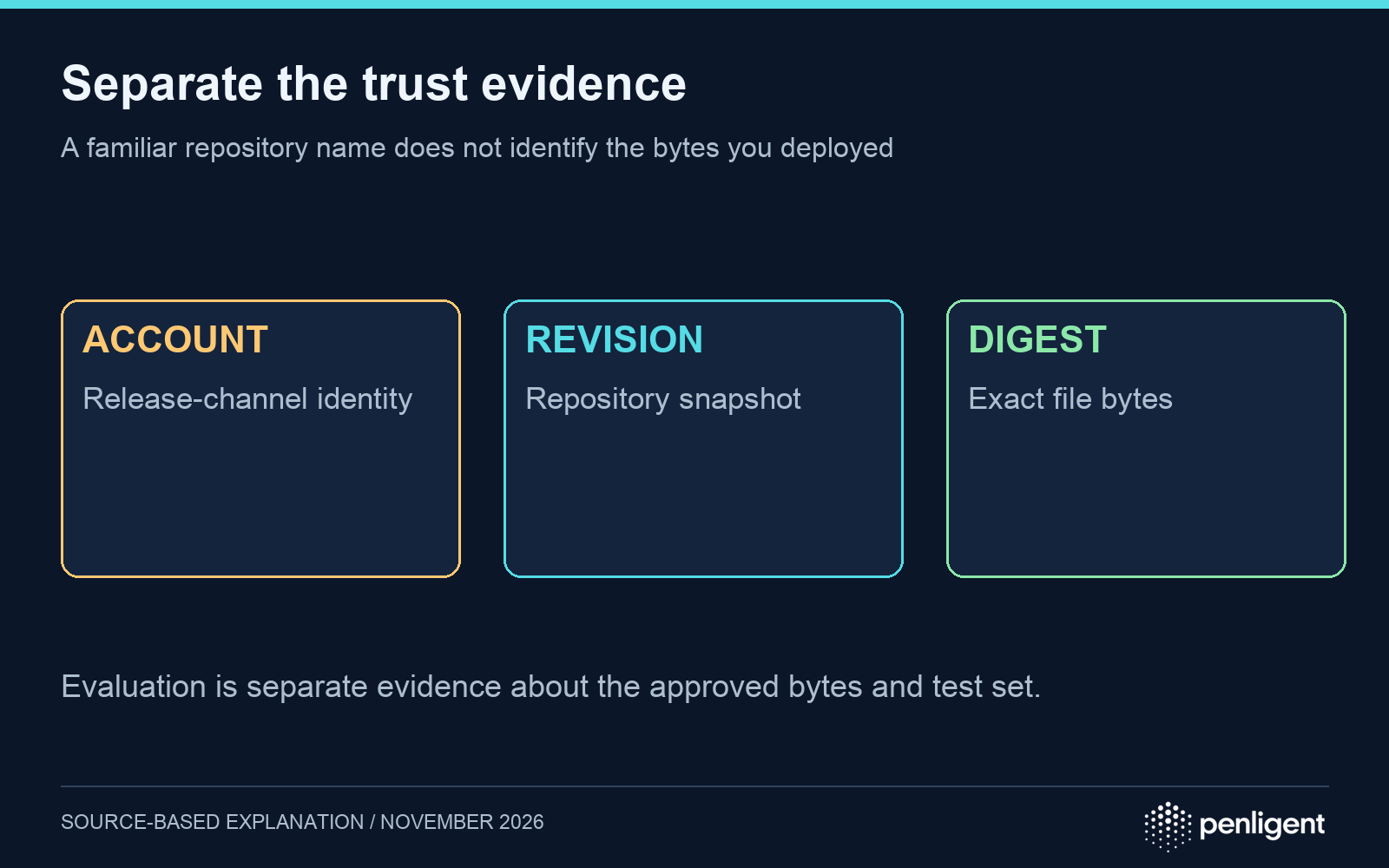
Hugging Face’s download guide supports selecting a revision and documents revision-specific cached snapshots. Use a full commit hash for an approved model snapshot rather than relying on a moving branch name. Record the resolved hash even when a deployment tool accepts a friendly tag.
An admission record that survives a publisher change
For each deployment, retain the repository identifier, full revision, filenames, digests, retrieval time, loader configuration and approving change record. Keep a controlled copy of the approved artifacts. Include the tokenizer, voice assets, configuration and other files your actual pipeline loads; recording only the largest weight file can leave the deployed bundle ambiguous.
Compute digests after retrieval and again for the deployed files. A digest mismatch should stop promotion until explained. Matching digests establish byte identity against the approved reference, not trust in the reference itself. Obtain the reference through a controlled approval process rather than simply hashing whatever the current branch serves.
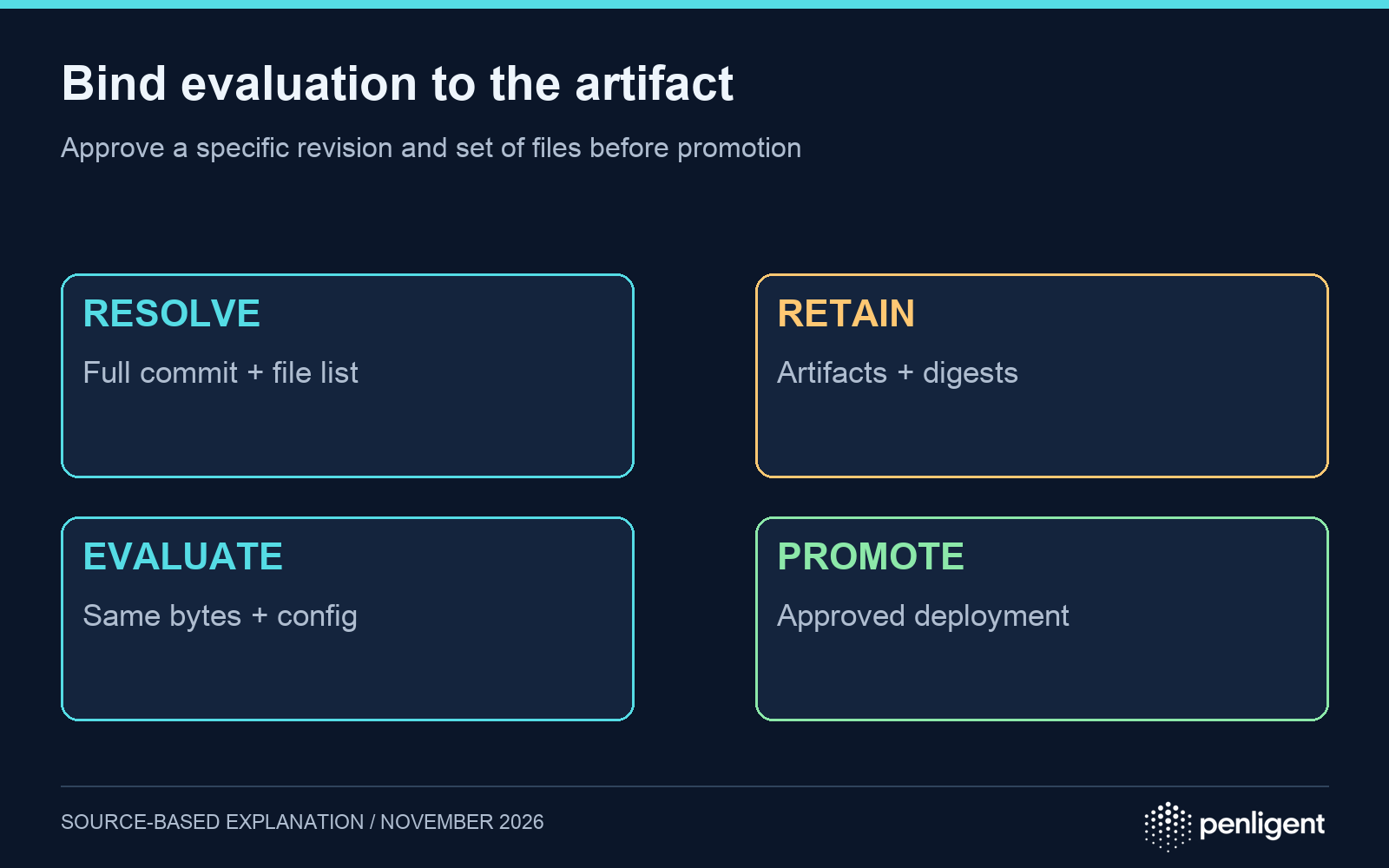
Promote a model change like a code change
- Resolve: choose the proposed full revision and enumerate the required files. Review what changed from the currently approved bundle.
- Retain: store the artifacts and digest manifest so rollback does not depend on the publisher’s current account or default branch.
- Evaluate: run the same candidate bytes in the intended inference configuration with a versioned test set. For text-to-speech, compare output meaning and wording, not only whether audio was produced.
- Promote: bind the deployment record to the reviewed revision, digests and evaluation result. Treat a newly resolved revision as a new change.
These are proposed defensive checks, not results from a Penligent Kokoro lab. A finite evaluation set cannot certify all model behavior. Pinning a revision reduces silent update drift; it cannot make an already untrusted revision trustworthy or replace sandboxing and appropriate runtime permissions.
Publisher security and consumer verification are complementary
Publishers should maintain the domains and mailboxes used for account recovery and enable Hugging Face two-factor authentication. Consumers should still retain artifact evidence: authentication protects an account, while revision and digest records identify what a deployment consumed. Neither control substitutes for the other.
Teams evaluating AI security workflows with पेनलिजेंट should carry the approved model revision and evidence record into the assessment scope. A finding is easier to reproduce when the report identifies the actual artifact and configuration rather than only the model’s marketing name.
The following Penligent 3.0 video is a general product workflow demonstration. It is not incident evidence or proof that a specific compromise was remediated.
Methodology, November 18, 2026: AI-assisted synthesis of the linked incident reporting and official Hugging Face documentation. No modified weights were downloaded, executed or published for this article.
 Hindi
 English
 German
 French
 Spanish
 Portuguese
 Japanese
 Korean
 Arabic
 Turkish
 Hebrew