
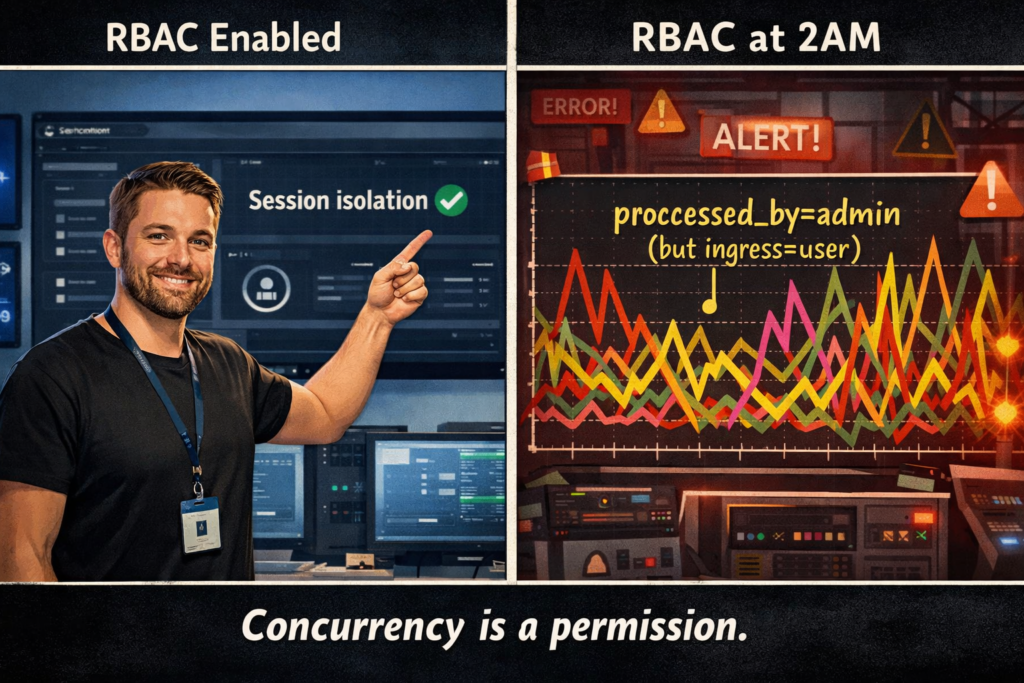
In multi-user OpenClaw deployments, the security boundary lives or dies on one invariant: the identity of the caller must remain bound to the request all the way to the privileged handler. When that binding is weak—especially under asynchronous message interleaving, reconnect churn, or shared mutable state—a standard user’s request can be evaluated using an admin session context. The result is a classic vertical escalation: RBAC “works” on paper, but collapses at runtime because the system authorizes the session rather than the caller. (CWE)
This failure mode is not a theoretical oddity. The OpenClaw community has publicly reported session isolation leakage behavior, including scenarios where “isolated” cron-job session targeting degrades over time and messages leak into the main session—exactly the kind of boundary failure that turns concurrency into a privilege problem. (GitHub)
The most important operational point is persistence: if the privileged action you can reach is “create a scheduled job,” you’re no longer debating a one-off unauthorized command. You’re dealing with a durable execution primitive that can survive incident response mistakes and run under legitimate authorization context. That is why this class of bug belongs in the same “treat the boundary as hostile” bucket as OpenClaw’s 2026-era WebSocket and file access issues (for example: gatewayUrl-driven automatic WebSocket token exposure, local unauthenticated config writes via WebSocket APIs, and file read/exfiltration via media parsing). (एनवीडी)
System Model: Where the Security Contract Breaks
A production OpenClaw deployment is not “a chatbot.” It’s an automation runtime with a gateway/control plane, session routing logic, integrations, and subsystems that can execute actions on your behalf. The repository itself describes OpenClaw as a personal AI assistant that connects to common messaging platforms and runs locally, which makes the gateway/session layer the natural choke point for identity and authorization. (GitHub)
The trust boundary you cannot hand-wave is the transition from untrusted ingress (messages/events arriving from channels, clients, or WebSocket frames) to a trusted execution context (an “active session” that carries tokens, tool permissions, and action routing). If the router uses “current active context,” channel-only keys, or shared mutable state as a proxy for identity, you’ve built a situation where concurrency can transform into authorization ambiguity.
RBAC usually fails here in a predictable way: it is implemented as a “policy check” that reads from an object representing session context, and the system assumes that object is trustworthy. But CWE-287 exists precisely to describe systems that do not sufficiently prove an identity claim, and CWE-284 covers systems that do not correctly restrict access to privileged resources. In session-bleed scenarios, you often end up with both: the caller identity is not proven at the moment of execution, and privileged handlers accept the wrong identity as authoritative. (CWE)
Vulnerability Anatomy: Session Context Bleed
What “Context Bleed” Means in Engineering Terms
A session context bleed is a mismatch between ingress identity and execution identity:
- Ingress identity: who actually sent the message/event (the ground truth).
- Execution identity: who the system thinks is acting when it evaluates permissions.
If those diverge, authorization becomes meaningless, because the handler is checking the wrong principal.
This exact boundary fragility is consistent with publicly reported OpenClaw session isolation failures (including cross-session/cross-channel leakage reports). While public issues do not necessarily confirm “admin privilege inheritance” in every deployment, they do confirm that session isolation can fail in ways that create wrong-target delivery—an essential prerequisite for privilege confusion if privileged handlers trust session context too much. (GitHub)
A Concrete Failure Path (Threat Model You Can Verify)
A realistic, testable sequence looks like this:
- An admin is active in Session A; a standard user is active in Session B.
- Both generate interleaved WebSocket or gateway traffic (common during reconnect storms and high-throughput automations).
- The router updates internal “active context” to handle Session A’s in-flight work.
- A user event arrives and is routed using cached/active context rather than a caller-bound identity token.
- A privileged handler (e.g., scheduler create/update) authorizes based on Session A’s context.
- The action executes with admin scope, even though ingress identity is the standard user.
If you can produce logs where request_user_id != execution_user_id on a privileged action, you don’t need opinions. You have evidence.
Reproduction: How to Prove It Without Guesswork
Race-adjacent failures are easy to argue about and hard to demonstrate—unless you build a deterministic harness and insist on correlation IDs and identity assertions at multiple layers.
Minimal Lab Topology
Use two principals (admin + standard), one gateway instance, and an enabled privileged subsystem (scheduler/cron). The reproduction goal is not “run an exploit,” but “catch an identity mismatch under load,” because that mismatch is the security defect.
Concurrency Harness (Python, Safe-by-Design)
This harness is designed to detect mis-binding, not weaponize it. It assumes your gateway returns (or can be made to return) a processed_by_user field or equivalent execution identity in the acknowledgement path.
# Pseudocode-style concurrency harness:
# Goal: detect mismatched (ingress_user_id != processed_by_user) under load

import asyncio
import uuid
import time

async def send_action(client, ingress_user_id, action_name):
    correlation_id = str(uuid.uuid4())
    payload = {
        "correlationId": correlation_id,
        "ingressUserId": ingress_user_id,
        "action": action_name,
        "ts": time.time(),
    }
    resp = await client.send_and_wait(payload)
    processed_by = resp.get("processed_by_user")
    return {
        "correlationId": correlation_id,
        "ingressUserId": ingress_user_id,
        "processedBy": processed_by,
        "action": action_name,
        "context_match": (processed_by == ingress_user_id),
    }

async def load_test(admin_client, user_client, n=2000):
    tasks = []
    for _ in range(n):
        tasks.append(send_action(user_client, "user_01", "list_jobs"))
        tasks.append(send_action(admin_client, "admin_01", "create_job_dry_run"))
    results = await asyncio.gather(*tasks)

    mismatches = [r for r in results if not r["context_match"]]
    return results, mismatches
What to Log
A clean logging model makes this unambiguous:
| Signal | परत | यह क्यों मायने रखती है | What “bad” looks like |
|---|---|---|---|
ingress_user_id | ingress (channel/gateway edge) | ground truth of caller | stable per client, never “becomes admin” |
session_user_id | session store/router | cached identity | equals admin while ingress is standard |
execution_user_id | privileged handler | identity used for authz | differs from ingress on privileged actions |
action_name | privileged boundary | the resource you’re protecting | scheduler create/update from non-admin ingress |
correlation_id | end-to-end | forensic linkage | missing/duplicated/cross-attributed |
Impact: Persistence Beats “One-Off”
If your “privileged action” surface includes scheduler creation or task automation, context bleed becomes a persistence engine:
A single unauthorized job can repeatedly run actions that exfiltrate data, create configuration drift, or re-establish footholds—even after the original ingress channel is locked down. This is also why attribution becomes operationally toxic: logs will often show “admin performed the action,” because the handler legitimately executed under admin scope.
Fix Patterns That Survive Concurrency
Bind Identity at the Edge (Non-Negotiable)
Do not accept “declared user id” from payloads as identity. Identity must be derived from cryptographically verifiable properties at the edge (signed tokens, verified channel sender identity, mTLS, etc.) and carried as immutable request context.
This is the direct antidote to CWE-287: the system must prove identity claims, not “assume them because the session looks right.” (CWE)
Force Re-Authorization in Privileged Handlers
Even if routing picks the right session 99.99% of the time, privileged handlers must treat context as untrusted and re-validate:
“Does this request’s caller identity have scheduler.write right now?”
This is how you stop CWE-284-style failures where privileged resources are accessible due to incorrect restriction at the wrong boundary. (CWE)
Eliminate Shared Mutable “Current Context”
If any codepath relies on “last active session,” global mutable context, or channel-only keys, it will eventually fail under load. Route by a strict tuple such as (tenant_id, channel_id, sender_id, connection_id) and design session stores to be concurrency-safe and principal-scoped.
Audit Trails That Detect Identity Mismatch
Make identity mismatch observable. Log ingress identity, execution identity, and authorization decision factors on privileged actions. If your logs cannot answer “who called” vs “who executed,” you can’t prove safety.
Verification: “Patch and Prove” Acceptance Criteria
A good fix is not “no one complained.” A good fix is measurable:
You pass only if you observe zero occurrences of (ingress_user_id != execution_user_id) on privileged actions across:
- two-user concurrency load tests,
- multi-channel concurrency tests,
- reconnect chaos scenarios,
- and long-run soak tests (because session isolation leakage has been reported to degrade over extended runtime in real deployments). (GitHub)
Why This Belongs in the 2026 OpenClaw Security Story
OpenClaw’s recent vulnerability landscape demonstrates a recurring theme: boundary failures around session routing, WebSocket control planes, and “agent can read/execute” primitives.
- CVE-2026-25253: OpenClaw obtains a
gatewayUrlfrom a query string and automatically makes a WebSocket connection without prompting, sending a token value. That is a boundary/consent failure that can be triggered via link-driven flows. (एनवीडी) - CVE-2026-25593: prior to 2026.1.20, an unauthenticated local client could use the Gateway WebSocket API to write config via
config.applyand set unsafecliPathvalues, enabling command injection as the gateway user (fixed in 2026.1.20). (एनवीडी) - CVE-2026-25475: prior to 2026.1.30, media parsing logic allows arbitrary file paths; an agent can read any file by outputting
MEDIA:/path/to/file, enabling sensitive data exfiltration (patched in 2026.1.30). (एनवीडी) - CVE-2026-25157 और CVE-2026-24763 further reinforce that execution surfaces and sandbox boundaries deserve “security kernel” treatment, not convenience-first assumptions. (एनवीडी)
In parallel, the ecosystem has faced supply-chain pressure around “skills” marketplaces, with multiple reputable outlets warning that malicious skills can trick users into running commands or expose sensitive material—raising the stakes when session or RBAC boundaries fail. (The Verge)
Defensive Operations Playbook If You Can’t Patch Today
If you must operate while waiting on a fix, reduce blast radius rather than hoping concurrency won’t happen:
Disable scheduler functionality where feasible, or gate it behind explicit allowlists that validate caller identity independently of session context. Rotate tokens if you suspect boundary failure, and add a detection rule that alerts on privileged actions where ingress identity and execution identity disagree.
If your team manages multiple OpenClaw deployments, manual concurrency validation becomes a compliance liability: it is easy to skip and hard to repeat. Penligent can make this safer by operationalizing the same “prove it” approach—running repeatable validation workflows, capturing evidence (mismatch logs, request traces, regression outputs), and generating reports that show your session isolation controls still hold after upgrades.
If you keep this integration section, keep it in engineering language: reproducibility, evidence capture, regression automation, and operational guardrails—no hype.
References
 Hindi
Hindi  English
  German
  French
  Spanish
  Portuguese
  Japanese
  Korean
  Arabic
  Turkish
  Hebrew