
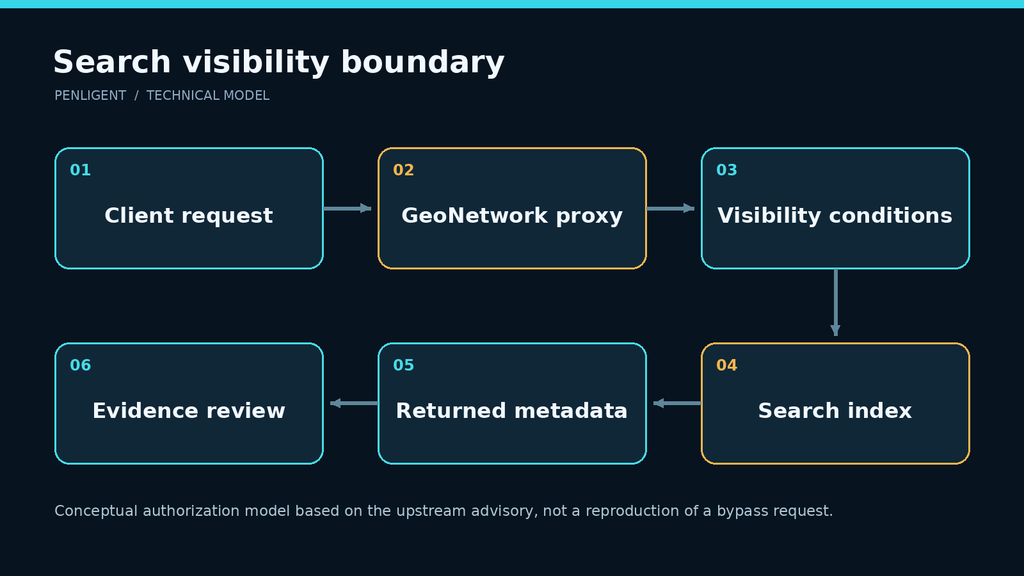
CVE-2026-46487 concerns GeoNetwork’s Elasticsearch-backed search proxy. The upstream advisory describes a path where omitting the request’s query field can skip access-control filter injection and disclose indexed metadata that should be restricted. Its published corrections are 4.2.16 and 4.4.11. The upstream GitHub advisory is dated July 1, 2026; this is a current review of an already disclosed issue, not a claim of a newly discovered zero-day. Use GeoNetwork’s original security advisory for the product facts.
The operational question is whether the deployed search path consistently applies the organization’s intended visibility rules. A package update addresses the code decision, while controlled records and identities establish what the running service returns. An administrator needs both kinds of evidence. A public search page that looks normal is not enough to establish that private metadata remains private.
Match the running branch to the published correction
| Upstream advisory range | Published corrected branch | Review requirement |
|---|---|---|
| At least 4.0.0-alpha.1 through 4.0.6-0 | No 4.0 correction listed in the advisory table | Obtain a supported migration or supplier determination |
| 4.2.0 through 4.2.15 | 4.2.16 | Verify the shipped and active artifact |
| 4.4.0 through 4.4.10-0 | 4.4.11 | Preserve the advisory’s exact version notation |
This table follows the upstream affected and patched version fields. Do not round a prerelease notation or infer an unlisted branch mapping. For a packaged or modified distribution, retain the supplier’s correction evidence and the exact build identity. A version banner alone may not describe a backport or a fork.
A historical first-fixed release is not a complete current maintenance recommendation. Select a current supported correction according to the supplier’s guidance and the organization’s change process. The response record should explain why the chosen artifact includes the needed repair, rather than simply copying a version number into an upgrade ticket.
Identify the component that actually serves the search request. A GeoNetwork application, its search backend, a reverse proxy, and a portal configuration can have different owners and deployment histories. The code correction belongs to the affected application path. Do not confuse updating Elasticsearch or changing a proxy with installing the GeoNetwork correction.
Record the active artifact and activation time for every relevant instance. A deployment can contain a corrected package while an older process continues serving requests. A standby instance or a rollback image can also retain an earlier build. The inventory should include any component that can become part of the serving path, with unverified members kept as explicit exceptions.
Separate software state from data state. Installing the correction does not independently prove that metadata visibility, ownership, or portal assignments are configured as intended. Conversely, carefully configured records do not remove the need for the code correction. Each decision needs evidence appropriate to the layer it describes.
Understand why search is an authorization boundary
A search interface can return more than a list of public titles. Depending on the application, a response can include metadata fields, counts, snippets, facets, or links to other representations. The security rule must apply to the information actually returned. Hiding a record in the browser’s normal navigation does not establish what another reachable search path may disclose.
The upstream issue is about access-control conditions applied before a query reaches the index. Its scope includes visibility rules described by the advisory. That does not establish that every response feature or downstream integration has the same defect. The additional checks proposed here are independent verification questions for an administrator’s own deployment, not new vulnerability claims.
Think of content matching and permission filtering as separate functions. A text condition selects records relevant to the user’s query. A visibility condition limits the records the caller is entitled to see. Removing or changing a text condition should not silently remove the visibility condition. A search request with fewer matching constraints still needs an authorization decision.
This distinction matters when a client supplies structured search input. An application can legitimately support several request forms while needing to apply the same access model to each. The review should ask which supported forms the deployment accepts and whether the effective visibility is consistent. It should not rely on one user-interface-generated request as the only representation of the search operation.
Use policy terms the organization can explain. Public, group-restricted, owner-only, draft, and portal-specific visibility may each mean something different in the deployed configuration. The assessment should obtain the intended rule rather than infer it from a label. A record that is surprising to a reviewer is not necessarily unauthorized if a legitimate relationship explains its visibility.
について OWASP authorization guidance provides an independent reference for explicit permission checks and regression tests. For this review, the important application is to make the expected identity-record relationship testable. The reference does not replace GeoNetwork’s product-specific advisory or the administrator’s visibility policy.

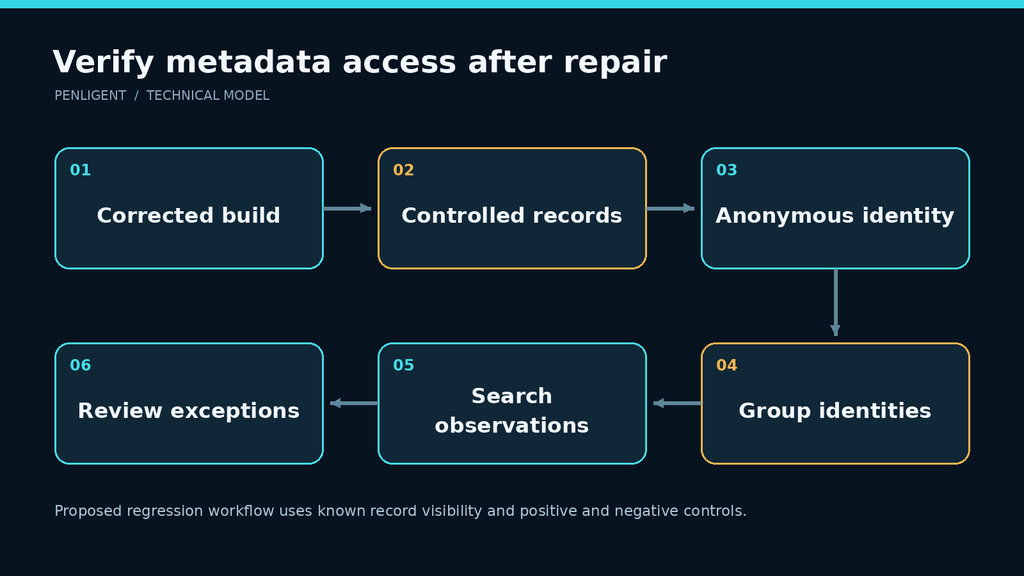
Create a controlled metadata dataset with known visibility
Prepare synthetic records before testing. Each should have a stable identifier, a unique harmless marker, an intended owner, and a documented visibility state. Use different markers for different visibility classes so that a response can be attributed to the correct fixture. Real restricted metadata is unnecessary for a controlled proof.
The following fictional dataset illustrates a review design. It is not a restatement of every GeoNetwork permission option or a prescribed production configuration. The administrator should adapt it to the actual supported access model.
| Fixture | Intended policy | 目的 |
|---|---|---|
| Public Atlas | Visible to an anonymous caller in the selected portal | Positive control for ordinary public search |
| North Survey | Visible only to the designated North group and approved owners | Group boundary |
| South Survey | Visible only to the designated South group and approved owners | Opposing group control |
| Draft Plan | Visible only under the owner’s approved draft policy | Lifecycle and ownership boundary |
| Alternate Portal Map | Excluded from the portal under test | Portal separation |
Have the administrator verify the fixtures through the supported management interface. A test record created with an incorrect public flag can make an otherwise correct search result look like a bypass. The fixture’s intended state and its configured state should agree before the assessment begins.
Keep a simple fixture ledger outside the public report. It should map the synthetic identifiers to the intended permissions and the person who approved them. If a record is edited during the assessment, retain that change and update the expected result. Otherwise two reviewers can evaluate the same response against different assumptions.
Use a dataset small enough to inspect completely. Thousands of random records may appear to provide coverage while making visibility mistakes difficult to diagnose. A handful of deliberately different records can answer the initial authorization questions more clearly. Add records only when they represent another meaningful policy state or application path.
Plan how fixtures will be retired. Their identifiers may appear in logs, caches, or exported evidence after deletion. Record the retirement time and the expected handling of those retained representations. A later reviewer should not mistake a historical fixture reference for a current protected record or an ongoing disclosure.
Prepare identities that make the policy observable
Use separate test identities for the actual permission classes. The initial matrix may include anonymous access, a North-group member, a South-group member, and a record owner. Add an administrator only for management tasks and explicitly authorized observations. An administrator account should not stand in for an ordinary user during a visibility test.
Record group membership and relevant relationships using stable identity references. A display name can be duplicated or changed, and a group name may not reveal its effective permissions. The evidence should identify which account performed the search and why the expected visibility applies to that account.
Verify a positive control for each authenticated identity. A broken login, expired session, or unexpected organization selection can make every search appear restricted. Before interpreting a denial, confirm that the account can see a fixture it is intended to access. This separates setup failures from application enforcement.
Use fresh and continuing sessions deliberately when the application’s permission model makes that distinction relevant. A membership change may not be reflected in an already active session under the same conditions as a newly established session. Define the expected refresh behavior with the administrator instead of selecting whichever session makes the result look better.
Keep the test environment and portal selection visible. A user can have different rights in another deployment or portal. A screenshot showing the correct account name but the wrong environment cannot establish the intended policy result. Capture the minimum environment and identity context needed for another reviewer to understand the observation.
Do not broaden test accounts merely to get past a setup problem. If a group member cannot reach the normal search interface, diagnose the supported access path with the owner. Giving every tester administrator rights can remove the useful contrast between authorized and prohibited record sets. The assessment should preserve the permission differences it is supposed to examine.
Use a local model to keep permission filtering independent
This network-free toy model searches a small in-memory dataset. It does not contact GeoNetwork or Elasticsearch and does not reproduce the upstream request path. It illustrates the security property that changing the text query must not change the caller’s permission boundary.
RECORDS = [
    {"id": "public", "public": True, "group": None, "text": "atlas"},
    {"id": "north", "public": False, "group": "north", "text": "atlas survey"},
    {"id": "south", "public": False, "group": "south", "text": "atlas survey"},
]

def visible(record, actor):
    return record["public"] or record["group"] in actor["groups"]

def search(query, actor):
    permitted = [r for r in RECORDS if visible(r, actor)]
    term = (query or "").lower()
    return [r["id"] for r in permitted if term in r["text"].lower()]

anonymous = {"groups": set()}
north_member = {"groups": {"north"}}
assert search(None, anonymous) == ["public"]
assert search("atlas", anonymous) == ["public"]
assert search(None, north_member) == ["public", "north"]
assert "south" not in search("atlas", north_member)
The toy’s permission rule is intentionally simpler than a real catalog’s policy. It has no drafts, ownership exceptions, portal configuration, or delegated access. Those omissions are explicit so that the example does not pretend to implement GeoNetwork. A production assessment must use the actual application rules and supported interface.
The important invariant is that an empty or absent text term does not expand the visible set beyond the caller’s entitlement. A text term can reduce matching results within that set. It cannot grant permission to records outside it. The assertions make that relationship observable without supplying a real bypass request.
Use the same discipline in deployment verification. The expected record set should be derived from the approved fixture policy, while the search input varies only the feature under examination. If identities, fixtures, portal selection, and request form all change at once, the result becomes difficult to attribute. Controlled differences produce stronger evidence.
Vary the search input while holding visibility constant
Begin with a supported normal search that returns the public fixture for an anonymous caller. Then examine the other approved request forms within the test plan. Keep the identity, portal, and fixture state unchanged so that any difference can be attributed to the search-input condition being reviewed. This is controlled verification, not an invitation to scan unrelated catalogs.
The upstream advisory identifies the missing-query condition. An authorized regression can evaluate that condition in an isolated or expressly approved environment using synthetic records. The report should describe the observed visibility result without publishing a production-ready bypass request. The objective is to establish whether the correction enforces the intended boundary.
Compare the actual returned identifiers with the expected fixture set. Do not rely only on a response status or the number of results shown in a browser. A response can contain an ordinary application shell, a public record with a similar title, or an error encoded in a successful transport response. Unique markers and stable identifiers make the application-level result clearer.
Use an input matrix with one changed dimension at a time. The matrix may include a normal text condition, a supported empty condition, and other documented forms relevant to the deployment. Avoid inventing unsupported request variants merely to increase the number of cases. A useful regression covers the application contract and the identified failure condition.
Record the rejected or unsupported cases accurately. If a request form is rejected before reaching the search operation, the observation establishes that rejection for the tested route. It does not establish how another accepted form would behave. Conversely, a supported empty search should still enforce the intended record visibility even when it matches many public records.
Keep the same method for authenticated group controls. A North member should see the approved North and public fixtures under the selected policy, while the South fixture remains outside that identity’s expected set. If a result differs, first recheck the fixture configuration and membership evidence. A controlled test should be able to distinguish a policy mistake from a genuine enforcement failure.
Evaluate fields, counts, and alternate representations on their own terms
A metadata response can reveal information at more than one level. A title may disclose that a project exists, a field may reveal a contact or classification, and a count may expose the presence of records in a category. The owner should identify which of those properties are sensitive in the actual catalog. Do not assume that every returned field has the same confidentiality requirement.
The checks in this section are broader verification questions for the owned deployment. They are not a claim that CVE-2026-46487 affects every facet, aggregation, export, or detail route. Each observed result should be described at the interface and data level actually tested.
For a field-level test, place distinct harmless markers in the synthetic fixture’s approved fields. Confirm whether the caller receives the intended representation and whether restricted fields remain absent where the policy requires that. A record’s presence and the visibility of its fields can be separate product decisions. Obtain the owner’s expectation before judging the result.
For counts or category summaries, use a small dataset whose expected contributions can be calculated. If a restricted fixture changes a supposedly public count, the administrator should determine whether that behavior is intended and whether it reveals information the policy protects. The test should not infer disclosure of a full record when it has observed only an aggregate difference.
Review links and alternate representations as separate access paths. A search result can legitimately point to a detail page that performs its own permission check. Alternatively, the search result may include data directly. The assessment should record which behavior was observed and which follow-up path was examined under the authorized scope.
Pagination needs a stable fixture state. Records created, edited, or deleted during a test can change result ordering and counts. Keep those changes controlled or explain them in the record. Otherwise an apparent missing or extra record can be a dataset transition rather than an authorization outcome.
A browser screenshot can support a finding, but retain the structured observation that identifies the returned fixture where appropriate. The reviewer should not have to guess whether a visible title corresponds to the protected synthetic record. Preserve enough context to distinguish similar names without exposing real restricted metadata.
Review portal selection as a policy input
A catalog deployment may expose different portals or views for different audiences. The review should identify which configuration selects the portal under test and which records are intended to appear there. A portal name is not a permission rule by itself; the effective configuration and application behavior determine the visible set.
Use a synthetic fixture that belongs to an alternate portal under the owner’s policy. Keep the identity constant while exercising the supported selection mechanism. The test asks whether the expected portal boundary holds for the approved request paths. It does not assume that every portal must be isolated in the same way or that cross-portal visibility is always unauthorized.
Document the default behavior when portal context is absent or invalid. The correct result depends on the application contract. It may be a default public portal, an explicit rejection, or another supported behavior. The security requirement is that the selected behavior does not silently discard the intended access rules.
Review proxy and routing configuration where it contributes to portal selection. A reverse proxy may map a public hostname or path to an application view, while a direct application route uses different defaults. The owner should identify which routes are intentionally reachable and which require separate restrictions. A verified public proxy path does not automatically establish the state of every alternate route.
Keep the expected result set attached to the selected portal and the identity. If the same fixture is deliberately public in another view, explain why that does or does not change the confidentiality question. A report should not omit a legitimate public representation when evaluating whether the test discovered previously restricted information.
Portal configuration changes should trigger a focused regression. A new view, a changed default, or a revised record assignment can invalidate earlier assumptions without changing the search code. The correction record should therefore distinguish software verification from the ongoing configuration contract.
Understand the index without treating it as the authorization policy
An index contains data used to answer searches. The application’s intended access model determines which caller may receive which part of that data. The presence of a restricted fixture in the index does not by itself establish a vulnerability, because some designs apply visibility conditions at query time. The relevant question is whether the supported serving path applies the required conditions consistently.
Likewise, an absent fixture can make a test inconclusive. If the restricted synthetic record has not been indexed, an anonymous search that does not return it has not challenged the intended boundary. Establish that the fixture is available through an authorized control before interpreting the prohibited case. This is the search equivalent of verifying that a test account can perform its legitimate operation.
Keep indexing state and permission state separate in the fixture ledger. A record can be correctly configured but not yet searchable, or searchable under an older representation while an update is propagating. Record the state relevant to the observation. Do not invent a universal propagation interval; use the deployment’s documented or measured behavior.
Do not assume that reindexing installs an authorization code fix. Rebuilding an index can be required for some application changes, but the response should follow the actual supplier instructions for the deployed release. A maintenance action at the data layer and a correction to the request-filtering logic answer different questions.
Review direct backend reachability through the platform’s supported configuration and ownership records. A search backend that is reachable outside the intended application path raises a separate access question. Keep any live verification within its own authorized scope. The GeoNetwork advisory should not be used as permission to probe unrelated Elasticsearch services.
Record the authority used by the application to reach the backend. The operational review may need to confirm that the credential or network path belongs to the intended service. That does not mean the advisory proves a credential theft or a backend compromise. The evidence should identify the configuration and the consequence actually established.
Verify caches and permission changes with controlled transitions
A cached search result can complicate a visibility test if the cache’s intended partitioning is unknown. The administrator should identify whether results are cached and what context contributes to the cache decision. Identity, group relationships, portal selection, and record state may matter to the application’s policy. This section proposes checks; it does not assert a particular GeoNetwork cache implementation.
Prepare a controlled transition. For example, the owner can change a synthetic record from a group-restricted state to a public state, or revoke a test identity’s group membership. Record the expected effective time and the supported refresh behavior. Then observe the relevant request path under the approved identities.
Use separate browser or session contexts where needed to preserve identity separation. A test that reuses an administrator session while displaying a group member’s name can produce misleading evidence. The account, membership, and selected portal should remain attributable to the actual request or application action.
If a stale representation appears, determine what it establishes. The result may reflect an intended bounded propagation behavior, a cache partitioning problem, or an incomplete test setup. The owner’s contract and the observation timeline are necessary to distinguish those possibilities. A report should not define an acceptable delay after seeing the result it wants to explain away.
Retain the original and changed fixture states in the evidence. Deleting the only record of the earlier policy can make a later observation impossible to interpret. The fixture ledger should show who changed the state, when, and why. This allows another reviewer to reconstruct the expected result without relying on memory.
When a cache-related change is part of remediation, rerun both the positive and negative controls after the final deployment. A broad cache disablement may change performance or functionality, and a cache reset may temporarily hide a persistent policy error. The verification should show the intended steady-state behavior rather than one convenient fresh-cache result.
Use a response matrix to separate evidence from assumptions
| Observation | Supported conclusion | What remains unproven |
|---|---|---|
| Anonymous caller sees the public fixture | The public positive control works for that route | Private records remain protected on other paths |
| North member sees North fixture | The authorized group control works | South or draft exclusions are enforced |
| Prohibited caller receives a unique restricted marker | A specific fixture boundary was crossed under recorded conditions | Every record or interface is affected |
| No restricted marker is returned | The tested observation did not disclose that marker | The fixture was searchable unless an authorized control proves it |
| Updated package is installed | An installation action is documented | The corrected serving process is active |
| Historical logs show no match | No match was found within the stated search coverage | No earlier unauthorized access occurred |
The matrix prevents a narrow observation from becoming a universal conclusion. It also gives the owner a precise next action. If the fixture’s searchable state is unproven, establish that control. If the serving process is unknown, obtain deployment evidence. If historical coverage is incomplete, decide how that uncertainty affects the response rather than repeating the search with more confident wording.

Use invariants to make a search regression harder to fool
A list of example requests is useful, but it can miss a relationship that should hold across many requests. An invariant states that relationship explicitly. For the toy model, every returned identifier must belong to the caller’s permitted record set. The text query can change which permitted records match; it must not create entitlement to another record.
Define the permitted set independently of the search implementation under test. If the test calculates its expected result by calling the same potentially incorrect search helper, it can reproduce the implementation’s mistake and still pass. The fixture ledger and the owner’s approved policy should provide the independent expectation.
For the small fictional dataset, enumerate the expected identifiers for each identity and portal. Then compare each controlled result with that set. A returned set can be incomplete because of text matching, pagination, or index state, but it must not contain an identifier outside the expected visibility set. The positive controls establish that the relevant fixtures are available for the cases that claim complete matching.
A second invariant concerns optional filters. If a supported filter narrows a search, adding it should not expose a record the caller was not allowed to see without it. This does not require every application filter to have identical matching semantics. It requires the permission boundary to remain valid across the supported content-selection operations.
A third invariant concerns identity changes. Granting a synthetic North relationship should affect the records the policy assigns to that relationship, while unrelated South records remain excluded. This is more informative than checking only that the total count increases. A count can change for several reasons; stable fixture identifiers reveal which relationship changed.
A fourth invariant concerns invalid input. The application should handle an unsupported or malformed search according to its contract without treating the absence of a usable content condition as permission to omit access restrictions. The precise error behavior belongs to the product. The test should observe the authorization consequence without requiring a particular presentation message.
Keep these invariants bounded to the approved test surface. They are not a reason to generate unreviewed request permutations against a live catalog. A small isolated dataset and a deliberate set of supported forms can reveal an enforcement mistake more clearly than a large uncontrolled input campaign.
Separate spatial and descriptive matching from visibility
A spatial catalog can support content selection through geographic extent, descriptive terms, categories, or other metadata. Those features answer which records match a question. The visibility policy answers which matching records the caller may receive. The review should preserve that separation even when a client combines several content conditions.
Use harmless synthetic spatial descriptions rather than sensitive real locations. A fictional North fixture and South fixture can have deliberately different category and extent labels in an isolated dataset. The test asks whether changing the content condition changes only the matching subset within the caller’s entitlement. It does not require collecting restricted geographic records.
Ranking and ordering should not be confused with access. A record can move between pages because a content condition or sort changes. That observation alone does not establish a disclosure or a denial. Compare stable identifiers and the intended record set, and record the pagination state when it affects the observation.
If the application exposes a summary or facet for the selected content, evaluate its intended confidentiality separately. The owner may allow a public category count while restricting individual records, or may consider the existence of a restricted category sensitive. The assessment needs that decision before interpreting an aggregate result. Do not assume that the same rule applies to all metadata products.
A saved search or a generated representation can introduce another policy decision. Determine whether it is evaluated for the current caller, a service identity, or a previously authorized context. These are independent review questions for the actual deployment, not additional behaviors established by the CVE advisory. Record the authority used by the supported feature and test only the agreed scope.
When a content filter produces no results, retain a positive control that proves the fixture is otherwise searchable. Without it, a negative observation can be explained by indexing or matching rather than authorization. The same discipline applies to spatial selections: first establish that the synthetic record matches the approved control condition, then evaluate its visibility under another identity.
Challenge the evidence with three alternative explanations
The wrong fixture was returned. Similar record titles, translated fields, and regenerated identifiers can make a response look more revealing than it is. Use unique synthetic markers and preserve the identifier mapping. If the evidence contains only a title, identify the limitation instead of claiming that it proves access to the full protected record.
The policy changed during the test. A group assignment, publication flag, owner relationship, or portal selection may have changed between the administration check and the search. Keep the fixture ledger and relevant change times. Reconcile the state before scoring the result. A security test should not rely on a policy assumption that no longer matched the application.
The observed response came from another context. A proxy route, cached response, browser session, or different application member can affect the result. Preserve the minimal route and identity context needed to attribute the observation. If a serving-member identifier is unavailable, say so and explain the deployment-level evidence used instead.
Alternative explanations are not excuses to dismiss a finding. They are questions that make the conclusion more defensible when answered. If the fixture, policy, and context are established and a prohibited marker still appears, the report can state the boundary failure precisely. If one remains unresolved, the report should name that missing fact.
Use an independent reviewer for consequential conclusions when the organization’s process allows it. The reviewer should receive the fixture policy and evidence record, not only the original tester’s narrative. Ask whether the same conclusion follows from the artifacts and what additional observation could falsify it. This review method can improve results produced by people or agents without relying on a tool’s confidence language.
Keep search integrations within their own authority model
A catalog can be consumed by browser clients, internal applications, or scheduled data workflows. Each integration may use a different identity and representation. Inventory the integrations relevant to the selected scope and identify which application path enforces their visibility. A normal browser result should not be generalized automatically to a service-account workflow.
A service identity may legitimately see more records than an anonymous caller. The review should determine whether its output is later published to a broader audience and which component applies the intended policy at that transition. That is a separate application-design question, not evidence that the GeoNetwork CVE compromises every integration.
Use a synthetic end-to-end fixture when an integration republishes search results. Record the source record’s intended visibility, the service identity’s authorized access, and the output audience. The result can then show whether the broader workflow honors its contract without involving real restricted data. A failure in the republishing layer should be attributed to that layer.
Coordinate changes with integration owners. Narrowing a service identity or correcting a portal configuration can change a legitimate downstream workflow. The security response should identify the required permission rather than restoring broad access simply because an integration stopped working. Keep functional and authorization acceptance visible in the handoff.
Retire unused integrations deliberately. An old service account or scheduled consumer can remain relevant after the main browser-facing application is corrected. Review its owner, credentials, destination, and continued need through the organization’s supported process. The final response should cover the actual authority connected to the catalog, with any unreviewed dependency recorded as an exception.
Review overlapping group and owner relationships
A useful first matrix keeps groups separate, but a real policy can include overlapping memberships and ownership exceptions. Add those relationships only when they exist in the deployed model and the administrator can define their intended effect. The goal is to examine the actual rule, not to make the dataset more complicated for its own sake.
In a fictional extension of the North and South dataset, one test identity belongs to both groups and another owns a draft record while holding no group role. The owner should specify which records each identity may receive in the selected portal. The expected result must be written independently of the search response. Otherwise the implementation’s current behavior can accidentally become the policy the test claims to verify.
Use a control identity that differs in only one relationship. Compare the dual-group identity with a North-only identity while keeping the fixture state and portal constant. Compare the owner with an otherwise equivalent non-owner for the draft fixture. This isolates the relationship under examination and makes a surprising result easier to diagnose.
Define how exclusions interact with grants. An application may have a portal restriction, a publication-state rule, or another condition that applies even when a group relationship exists. The test should follow the approved policy’s precedence rather than assuming that every grant combines by simple union. The toy model earlier deliberately avoids these richer semantics and should not be used as an implementation specification.
When a legitimate exception explains a returned record, preserve the exception in the evidence. A reviewer should be able to see why the account was entitled to the record instead of dismissing the result merely because the account’s name suggests a different group. Display labels are weak evidence of effective authority.
Permission changes need the same controlled approach. If a test identity is removed from one group but remains an owner or a member of another authorized group, continued visibility may be correct. A revocation test should identify the exact relationship being removed and the remaining relationships. Otherwise the test can falsely conclude that revocation failed.
Keep the final matrix readable. The administrator does not need a combinatorial list of every possible account state to perform an initial verification. Select the relationships that protect important data and the edge cases most likely to be misunderstood. Record untested policy branches as such, with a reason and a next step if they matter to the deployment.
This approach also improves repair review. A patch that blocks all non-public records may stop the demonstrated disclosure while breaking intended group or owner access. A patch that restores those functions without preserving exclusions may reopen another boundary. Positive and negative controls should therefore represent the approved effective policy, not merely the original failing request.
The handoff should identify which relationship each regression case protects. When a future administrator changes group design or ownership behavior, that mapping shows which expectations require review. Tests remain useful when their policy purpose is visible; they become fragile when they are maintained only as opaque request recordings.
Include a controlled ownership transfer where the deployed catalog supports it. First record which test identities can see the fixture, then perform the approved transfer and repeat the same observations. Distinguish a deliberate group grant that remains valid from an old owner relationship that should no longer apply. Keep expected behavior tied to the organization’s configuration rather than assuming every catalog uses identical inheritance rules.
Reset the fixture after the exercise and verify the reset. A test record accidentally left public can create a new configuration problem unrelated to the original vulnerability. Use synthetic metadata, record the intended final visibility, and retain the cleanup result with the test. That makes the exercise reproducible without leaving operational records in an unexpected access state.
Interpret a fictional disclosure without overstating its scope
Suppose an authorized staging assessment finds that an anonymous caller receives the unique marker from the North Survey fixture under one approved request condition. The administrator has already confirmed that the record is indexed, restricted to the North group, and excluded from anonymous access. That combination supports a specific authorization failure in the tested path.
The finding should name the fixture, identity, portal, application build, request condition, and returned marker. It should also state the normal public positive control and the authorized North-group control. Those controls help establish that the observation concerns the intended record and policy rather than a broken login or a mistaken fixture.
Do not expand the result into a claim that the entire catalog was downloaded. One marker demonstrates one boundary under the documented conditions. A broader impact assessment can review the relevant record classes and data fields with the owner, using configuration and indexed-data knowledge rather than collecting unrelated restricted records simply to increase the apparent scale.
Likewise, do not assume code execution or administrative access from a metadata disclosure result. The upstream issue and the observed evidence should determine the impact description. If a separate consequence is suspected, it needs its own mechanism and evidence. A severe-sounding title does not compensate for a missing causal link.
Now suppose the owner discovers that the fixture was deliberately shared through a policy exception the test plan omitted. The finding should be revised after that relationship is verified. Keep the case identifier and explain the changed conclusion. This is successful review, not a reason to conceal the original uncertainty or defend an incorrect result.
A third possible outcome is an unresolved fixture state. The administration record says the North fixture is restricted, but an approved management view shows a public assignment that may have changed during testing. Pause the conclusion and reconcile the state history. The test has identified an evidence problem; it has not yet established which policy was enforced at the time of the response.
Deploy the correction with functional and security acceptance
Use the supported upgrade process for the actual distribution and release. Retain the supplier’s correction statement, the chosen artifact, and the change record. The deployment owner should identify any application migration or service restart required by that process. Do not invent a universal command sequence or an undocumented reindexing requirement.
Before the change, establish the normal behavior the service must preserve. Public search, intended authenticated search, required portal views, and any explicitly scoped integrations can be part of the functional control set. The owner should choose representative operations that matter to the service. A successful upgrade should not be declared solely because the application starts.
After activation, rerun the security matrix using the controlled records and identities. Preserve the original failure condition where it can be tested safely, and keep the authorized control working. A corrected result should show that the prohibited record is excluded while the intended public and group results remain available.
Verify every serving member that can answer the relevant request. A load balancer can make a mixed deployment appear inconsistent, and a standby member can become active after the assessment. Record the member or serving population associated with the observation. An unverified member should remain an exception with an owner and a return-to-service condition.
Keep rollback conditions explicit. If a previous artifact reintroduces the affected logic, restoring that artifact reopens the software decision unless a separately verified restriction blocks the path. The owner should know which access restrictions or feature limitations remain in place during rollback and which tests must be rerun before normal service resumes.
Update recovery images and deployment templates after the active rollout. A later rebuild should not silently restore an earlier artifact or obsolete configuration. The correction record should be usable by an operator who was not present for the original upgrade and needs to establish the trusted serving state during an unrelated outage.
Investigate historical access on the evidence available
Patch verification does not answer whether restricted metadata was accessed earlier. If the organization needs that answer, define an investigation interval and the relevant serving components, portals, and record classes. Review the application and platform records available to the authorized response team. Keep that work distinct from the controlled regression.
Search records can be incomplete or ambiguous. A log may identify a request path without retaining the full body, a proxy may normalize fields, and a response log may omit returned record identifiers. State what each source can establish. A request that resembles a documented condition is a lead; it does not automatically prove that restricted data was returned.
Correlate with stable record and identity references where those observations exist. An anonymous caller may not have a user identifier, and a network address can represent a proxy or shared client population. Do not infer a named person or actor from an address alone. The finding’s technical validity and an incident’s attribution are separate questions.
Determine the sensitivity of potentially affected metadata with the data owner. A catalog may contain information that is intentionally public in another approved channel, information restricted by group, or fields with different handling requirements. The response should reflect the data actually involved rather than assuming every indexed field has the same consequence.
Where visibility is insufficient, document the uncertainty and the owner’s resulting action. That may include additional monitoring, a review of record classification, or another response measure under the organization’s process. It should not become an unsupported assertion that no disclosure occurred. Conversely, missing logs alone are not proof that a disclosure did occur.
Preserve investigation evidence before changes that would remove it, where doing so is feasible and consistent with the response plan. A necessary service restoration may still take priority; record the tradeoff and resulting limitation. The final report should explain what was examined and what remains unanswered.
Make visibility regression part of catalog maintenance
Permission tests should follow the catalog’s change model. New portals, changed group mappings, record lifecycle rules, and application upgrades can each invalidate an earlier assumption. Keep a small controlled dataset that represents the important visibility classes and rerun the relevant cases when those relationships change.
Version the expected results with the policy. A fixture that was intentionally made public should not continue to be treated as a restricted control in an old test. Preserve the reason for the change and update the matrix deliberately. Otherwise a test suite can alternate between false alarms and false reassurance as its dataset drifts.
Assign ownership for the tests and their interpretation. The platform team may maintain the deployment, while catalog administrators understand record visibility and data owners define sensitivity. A useful regression process joins those responsibilities without pretending one team can infer every policy decision from the software configuration.
Record unavailable cases as coverage gaps. If a portal cannot be tested during a maintenance window, do not silently inherit the result from another portal. If a group relationship cannot be reproduced safely, state which evidence was used instead. The next review should be able to identify the remaining question and its owner.
For an authorized assessment using Penligent or another application-testing workflow, use the same synthetic records and identity matrix and require reproducible observations. The tool’s name does not replace the administrator’s policy record or the deployment owner’s correction evidence. The value is in a result that can be reviewed and repeated under the documented conditions.
Questions about GeoNetwork CVE-2026-46487
Is this a newly disclosed November zero-day?
- The upstream GitHub advisory is dated July 1, 2026. A current search or remediation review does not change the original disclosure history.
- Use the source’s date and distinguish later record updates or renewed interest.
Which versions should an administrator compare?
- Use the upstream affected-range fields and the published corrected branches, preserving exact prerelease notation.
- For a fork or packaged distribution, obtain supplier evidence tied to the shipped and active build.
Does a normal public search page prove the issue is fixed?
- No. It can establish a positive control for that interface.
- Verify restricted synthetic fixtures with prohibited identities and the relevant approved request condition.
Is reindexing the same as installing the authorization fix?
- No. Index state and application request enforcement are separate decisions.
- Follow the actual supplier upgrade instructions and use indexing evidence to make the fixture tests interpretable.
Should every search response feature be declared vulnerable?
- No. The original advisory has a specific scope. Additional fields, counts, portals, and representations are separate verification questions.
- Report only the boundary and consequence established by the evidence.
Can a passing retest rule out earlier disclosure?
- A passing retest supports the current tested behavior under the recorded conditions.
- Historical access requires its own investigation and an honest statement of log coverage.
What should a repair handoff include?
- The active corrected artifact, serving population, fixture policy, identity matrix, observed results, and owned exceptions.
- Include the decision about historical review separately from current patch validation.
A defensible GeoNetwork response connects the corrected application to a known visibility policy and a controlled observed result. The administrator should be able to explain why each test identity receives its intended records and why other records remain excluded. Keep that explanation attached to the running build, the selected portal, and the fixture state. That evidence is more useful than a normal-looking search page or an upgrade ticket on its own.

 Japanese
 English
 German
 French
 Spanish
 Portuguese
 Korean
 Hindi
 Arabic
 Turkish
 Hebrew