
A patched operating-system trust store does not establish that pip or an existing virtual environment stopped trusting the affected eMudhra roots. について Python security guidance recommends certifi 2026.10.19, pip 26.2.2 and updates for other tools that ship their own certificate material. On October 21, 2026, Python released 3.15.1, 3.14.9 and 3.13.17 with pip 26.2.2. Those interpreter releases do not automatically replace every existing environment.
This is a trust-store and software-inventory task, not evidence that any particular package was malicious or that TLS checks failed for every user. Work from trusted installation media when the current package channel is suspect. Do not run pip, a bootstrap script or a newly downloaded wheel inside a host you are investigating for the separate LiteLLM supply-chain incident.
Which Python path actually verifies the certificate?
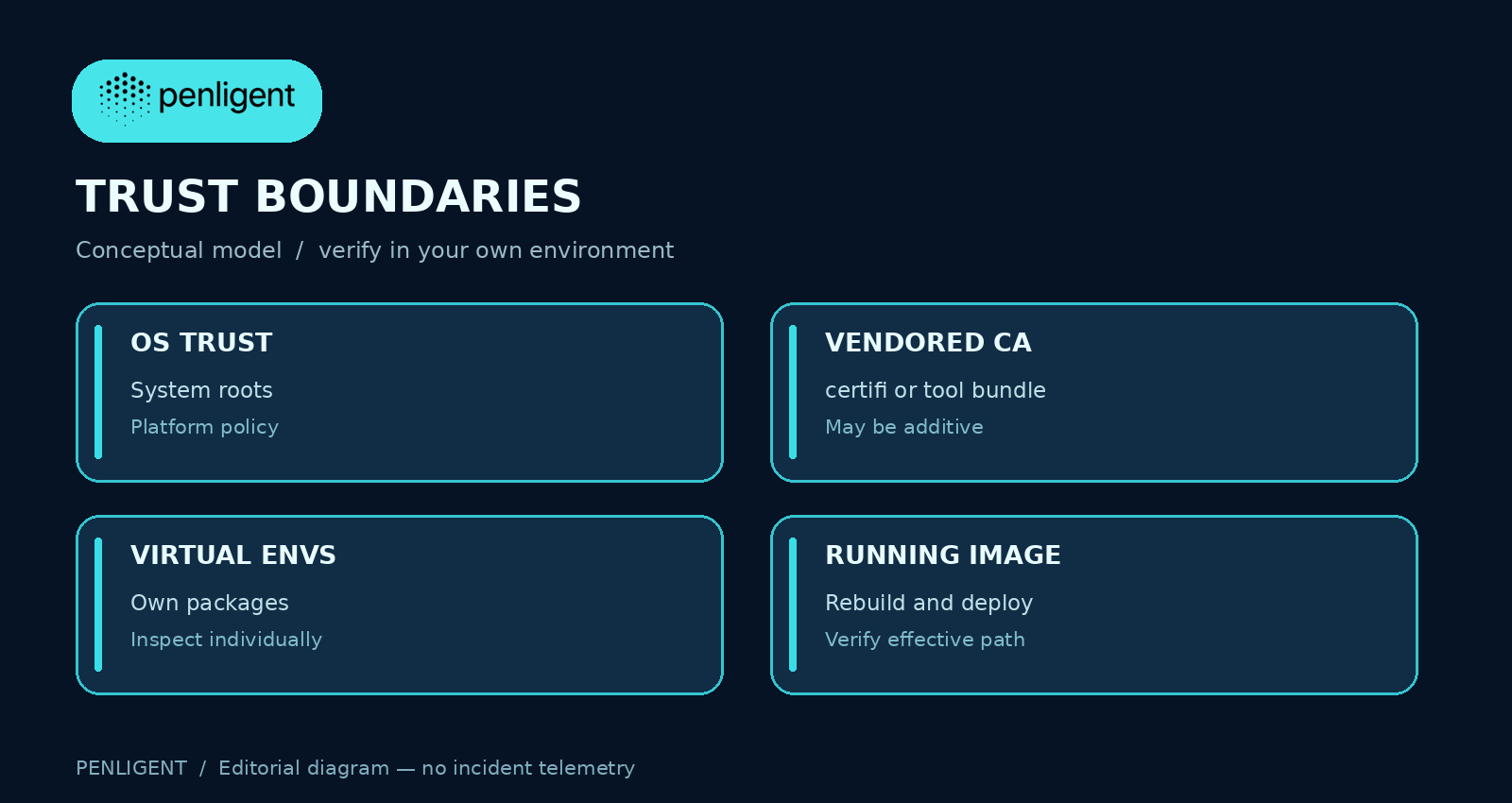
について pip documentation describes system certificates and certifi as additive in supported configurations. A system-level distrust decision therefore may not remove a bundled root from the effective trust set. An application can also use its own bundle or an explicit CA override. Determine the exact interpreter, pip instance, image and certificate configuration used by the request instead of treating the workstation settings as universal.
| レイヤー | What to inventory | What does not prove closure |
|---|---|---|
| Base Python installation | Version and bundled pip release | A new installer while old deployments keep running |
| Each virtual environment | Its pip, certifi and application dependencies | Updating only the global interpreter |
| Container and CI image | Image digest, dependency lock, rebuild and rollout | Changing a Dockerfile without replacing running images |
| Other package tools | uv, sigstore, pixi and their respective versions | A pip update in a workflow that uses another tool |
| TLS client overrides | Explicit CA bundles and client settings | OS trust setting without checking effective roots |
について venv documentation explains that environments have their own package installations. Enumerate those environments in CI, developer machines, services and ephemeral workers. A base interpreter upgrade is valuable for new environments, but it is not a migration record for existing ones.
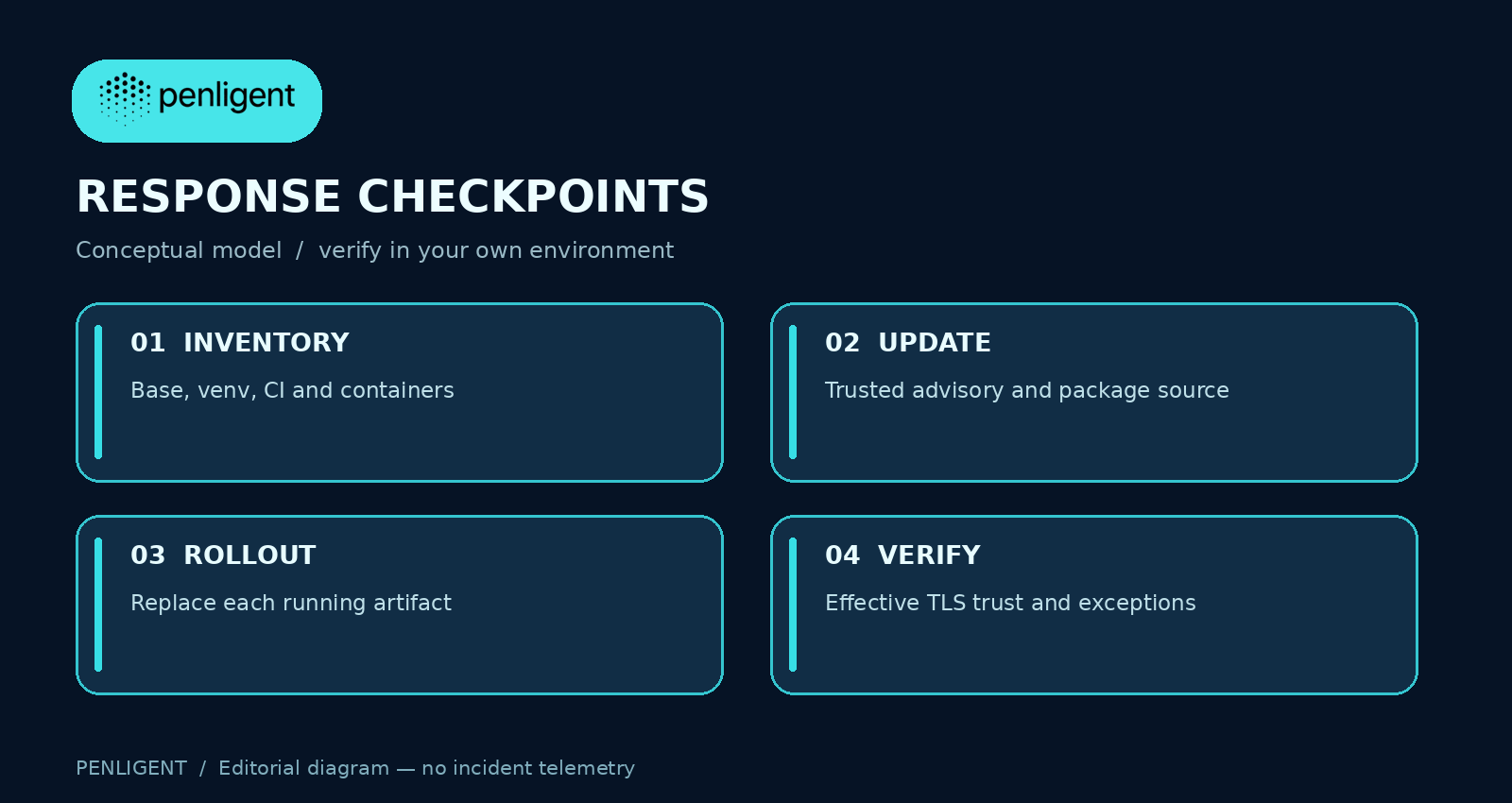
Sequence the update around a trusted distribution path
From a trusted environment, apply the guidance for the tool you actually use. The Python notice specifies minimum versions: certifi 2026.10.19, pip 26.2.2, uv 0.13.4, sigstore 4.5.1 and pixi 0.82.1. The 2026.10.18 certifi removal had compatibility issues; use the corrected 2026.10.19 release. Preserve your lockfile and build provenance so a fleet review can distinguish a requested change from an installed one.
For a pip environment, obtain the upgrade instructions and artifact hash from the official Python advisory through a separate trusted channel. The advisory includes a direct wheel route for cases where the affected trust configuration blocks a normal upgrade. Verify the cited hash before installation; never paste a wheel URL and digest from a forwarded incident message. The commands below are a read-only inventory example for a known-good environment, not a test we performed.
python -V
python -m pip --version
python -m pip show certifi
uv --version  # only if this environment uses uv
For a known-good interpreter and environment, the official advisory provides this pinned pip wheel and SHA-256 fragment. Obtain the URL and hash from that advisory independently before using the example. The commands below install packages; they are not exposure tests and were not executed for this article. Run them under your normal package-management process, without adding elevated privileges.
python -m pip install "pip @ https://files.pythonhosted.org/packages/3f/06/3e4420302363fbb71be3c7f35ce042f54bfca330e3e66b3a2e3c4cca579f/pip-26.2.2-py3-none-any.whl#sha256=fd7f4dfa8190e014013b9f08f3e973f4e4c26ffd179a204895533a7254813a70"
python -m pip install --upgrade "certifi>=2026.10.19"
# Only where uv is managed in this environment through pip:
python -m pip install --upgrade "uv>=0.13.4"
On macOS, first identify whether the service uses the python.org framework build, Homebrew Python or a virtual environment. The official notice provides explicit framework paths for standard and free-threaded python.org installations. Replace the interpreter selector only after identifying your installation; an unqualified python command can otherwise update a different environment. Record the full interpreter path alongside the result.
Apply the update to each managed environment under its change process. Rebuild base images, redeploy services and replace CI workers where appropriate. A version printed by your laptop does not demonstrate which package a running server loads. Record environment identifier, previous and new version, source artifact, rollout identity and bounded TLS operation outcome without collecting credentials or private responses.
Verify trust behavior without weakening verification
Check the intended client against a known authorized endpoint using normal certificate validation. Confirm it accepts a valid chain and rejects a deliberately untrusted chain in a controlled fixture when that test is available. Do not use an attacker-controlled host or a live compromised certificate to “prove” exposure. Keep hostname checks enabled; disabling TLS verification would erase the very control being repaired.
A failed request after a certificate update can have mundane causes: an application pins a custom bundle, a worker still runs an old image, or an internal root was excluded unintentionally. Trace the client setting and deployed artifact. Do not add an untrusted root back merely to restore a green health check.
Keep certificate repair and application security separate
After toolchain recovery, an authorized application test can check access control and exposed data with dedicated accounts. Penligent may fit that workflow when evidence and scope are reviewable, but this article does not claim Penligent audits Python trust stores or detects this certificate event.
Questions about the Python eMudhra update
Does upgrading Python fix every venv
- No. Inventory and update each existing environment and deploy its consumers.
Is an operating-system update enough
- Do not assume so. Bundled certifi and explicit CA configuration may alter the effective trust set.
Should I disable verification until pip installs
- No. Use the official trusted recovery route and validate the artifact and its digest.
Was every Python package compromised
- The advisory concerns certificate trust. It does not establish that every package or connection was attacked.
The video covers authorized application testing rather than certificate-store remediation.
The acceptance record is environment-specific: known affected trust paths updated, running artifacts replaced, valid traffic working and invalid trust rejected. Anything unobserved remains pending.


 Japanese
 English
 German
 French
 Spanish
 Portuguese
 Korean
 Hindi
 Arabic
 Turkish
 Hebrew