
Last updated: November 4, 2026.
Smart contract penetration testing should examine protocol invariants, privileged roles and integrations, not only run static analyzers against contract source. Economic behavior, upgrade controls, oracle assumptions, governance and off-chain services can turn individually valid functions into an unsafe protocol state.
Testing should use a local or forked environment with controlled accounts and assets. Mainnet interaction, market manipulation and testing of third-party protocols require explicit authorization and should not be assumed from ownership of one contract.
For the assessment framework, consult OWASP Smart Contract Top 10 and map the relevant guidance to the actual environment and authorized scope.
Define the protocol boundary
Identify deployed addresses, chains, source and compiler versions, proxies, implementation contracts, libraries, roles, multisigs, governance, oracles, bridges, frontends, indexers and backend signers.
| レイヤー | Questions | エビデンス |
|---|---|---|
| Contract code | Can state, arithmetic, call flow or authorization violate an invariant? | Source, bytecode and transaction trace |
| Protocol logic | Can valid functions be composed into an unsafe economic state? | Sequence, balances and invariant result |
| Governance and upgrades | Who can change code, parameters or emergency state? | Role and timelock evidence |
| Integrations | What assumptions are made about tokens, oracles, bridges and callbacks? | Mocked or forked interaction result |
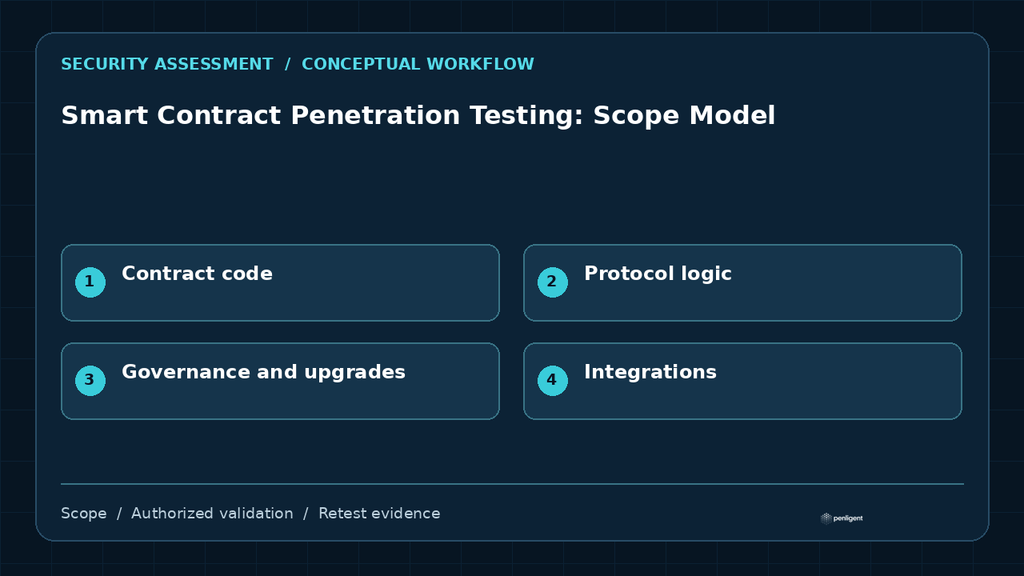
Turn the scope into testable evidence
Define an authorized target, validate meaningful attack paths, and keep the evidence connected to remediation and retesting.
Write invariants before exploit cases
State what must always remain true: conservation of value, collateral requirements, ownership, withdrawal limits, role separation or bounded price influence. Tests should show which sequence violates the invariant and under what assumptions.
Combine automated and manual analysis
Static analysis, fuzzing and invariant testing improve coverage, but manual review is needed for business intent, role design and cross-contract composition. Record tool versions and configuration so results can be reproduced.
Retest deployed bytecode and controls
Verify the corrected source, compiler settings, deployment or upgrade transaction, implementation address and effective role configuration. A patched repository is not enough when the live proxy still references older bytecode.
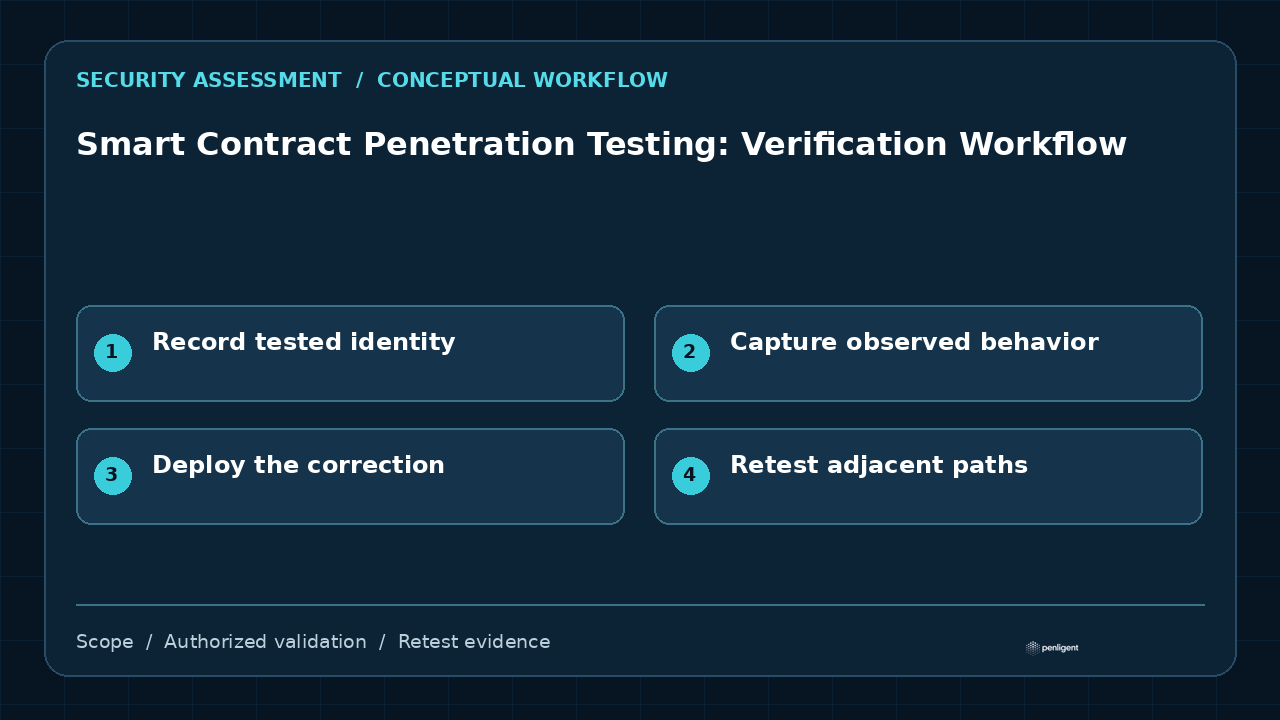
Turn the scope into testable evidence
Define an authorized target, validate meaningful attack paths, and keep the evidence connected to remediation and retesting.
Questions buyers should ask
- Which deployed contracts, proxies, roles and off-chain components are authorized?
- What protocol invariants define a secure result?
- Will testing occur on a local fork with controlled assets?
- Does the retest verify deployed bytecode and governance state?
結論
Smart contract security depends on code, composition, economics and governance. Require explicit invariants, controlled transaction evidence and a retest of the deployed contract and effective privileges before treating a finding as closed.
Sources and standards
- OWASP Smart Contract Top 10
- Ethereum Smart Contract Security Best Practices
- NIST Blockchain Technology Overview
 Japanese
 English
 German
 French
 Spanish
 Portuguese
 Korean
 Hindi
 Arabic
 Turkish
 Hebrew