
CVE-2026-58868 is a Critical Android Framework remote code execution vulnerability that does not require user interaction. について CVE Record says an out-of-bounds write in FrameDecoder.cpp can occur because of a heap buffer overflow. Successful exploitation could execute code without additional execution privileges.
Google lists the issue in the November 2026 Android Security Bulletin under Framework. The bulletin rates it Critical and identifies updated AOSP versions for Android 14, 15, 16, 16 QPR2 and 17. It was published on November 2, 2026.
The operational task is narrower than the headline. Security teams need to identify affected device cohorts, confirm the exact OEM build that includes the fix, prove that the corrected build is active, and keep unsupported or stale devices from silently remaining in service. The public record does not identify a specific media format, application, messaging protocol or network port, so those details should not be invented during triage.
Confirmed scope and current limits
| 属性 | Confirmed information | Do not assume |
|---|---|---|
| コンポーネント | Android Framework, FrameDecoder.cpp | A particular app, codec, file extension or delivery protocol |
| 弱さ | Heap buffer overflow causing a possible out-of-bounds write | That every crash is exploitable code execution |
| インパクト | Remote code execution | Persistence, data theft or a known public exploit chain |
| 特典 | No additional execution privileges required | That the resulting process has root or kernel privileges |
| User interaction | Not required | That every affected device is reachable through the same path |
| Updated AOSP versions | Android 14, 15, 16, 16 QPR2 and 17 | That an Android major version alone proves patch status |
| Known exploitation | The CISA ADP record reported no known exploitation on November 3, 2026 | That absence of public evidence proves no exploitation has occurred |
This distinction matters because the CVE description establishes a security property, not a complete attack narrative. Treat the vulnerability as urgent because it is remote, no-interaction and Critical. Keep incident claims tied to evidence from the affected device, vendor advisory and authoritative threat reporting.
Turn vulnerability findings into verified security evidence
Use Penligent to investigate application-security findings and retain reproducible evidence for remediation. For Android fleet patch closure, use the OEM build and endpoint-management records described above.
Use the correct Android patch-level boundary
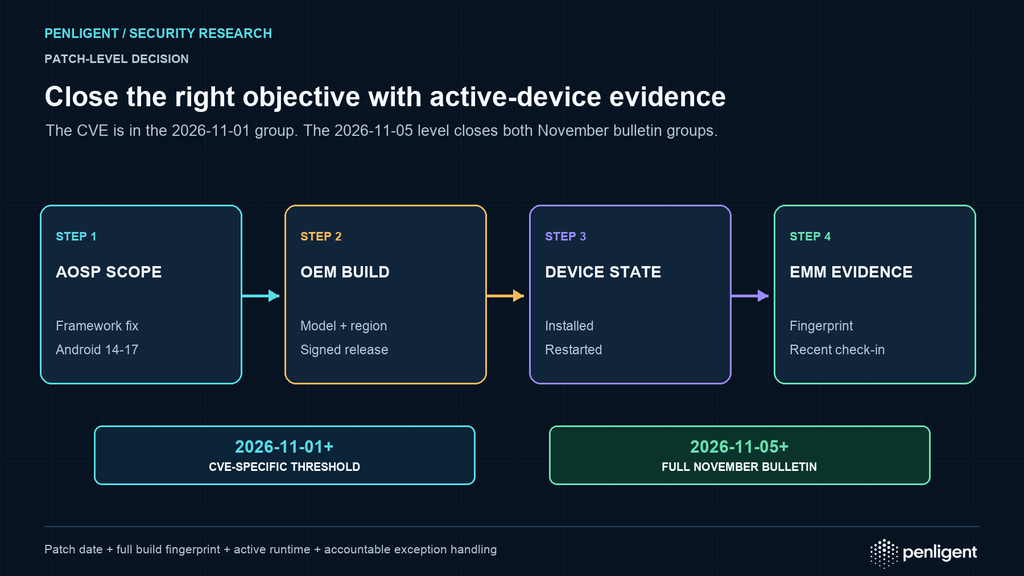
CVE-2026-58868 appears in the bulletin’s 2026-11-01 security patch level section. Google states that a device declaring 2026-11-01 or later must include the issues associated with that level and previous bulletins. A device declaring 2026-11-05 or later must include both November patch-level groups.
For this specific CVE, 2026-11-01 or later is the bulletin-level threshold. For a November 2026 fleet campaign intended to close every issue in the bulletin, use 2026-11-05 or later. Document which objective the remediation ticket uses; otherwise one team may report the CVE closed while another expects the full monthly bulletin.
AOSP fixed does not mean every device is fixed
Android remediation passes through several ownership boundaries:
- Google and AOSP: publish the bulletin and platform correction.
- Device manufacturer: integrate applicable platform and device-specific changes into a signed build.
- Carrier or enterprise release gate: test and approve the model-specific release where applicable.
- Managed endpoint: download, install and boot the corrected build.
- Inventory system: report fresh device identity, patch level and build evidence.
An update notice proves only that a release exists for some device configuration. It does not prove that a particular model, region or carrier build contains the fix, that the installation completed, or that the endpoint restarted into the new image.
Collect evidence from the active device
Use the enterprise mobility platform or another approved management channel for production inventory. On an authorized laboratory or managed device where Android Debug Bridge is permitted, the following read-only properties help identify the active build:
adb shell getprop ro.build.version.security_patch
adb shell getprop ro.build.fingerprint
adb shell getprop ro.product.manufacturer
adb shell getprop ro.product.model
adb shell getprop ro.build.version.release
adb shell getprop ro.build.version.incremental
Retain the collection time, device identifier, management source and full fingerprint. A patch date copied from a vendor webpage, a downloaded package or a laboratory handset is not evidence for a different production device.
Build a model-specific remediation matrix
| Device cohort | Decision | Required evidence |
|---|---|---|
| Corrected build installed and active | Close after functional and inventory checks | Patch level, full fingerprint, restart state and recent check-in |
| Update available but not installed | Enforce or schedule deployment | Assignment, deadline, installation result and restart confirmation |
| OEM or carrier release pending | Escalate to vendor and apply temporary controls | Vendor case, affected models, expected release date and owner |
| Unsupported device | Replace, retire or isolate from sensitive workflows | Retirement record or time-bound exception with an accountable owner |
| Inventory missing or stale | Do not claim remediation | Recovered management visibility and verified endpoint identity |
Temporary controls may reduce exposure, but the public record does not provide enough detail to claim that blocking one file type, app, service or messaging path universally prevents exploitation. Avoid brittle controls based on guessed delivery mechanisms.
Detection and incident-response boundaries
Unexpected Framework crashes, application restarts or device instability can justify investigation, but they are not specific indicators of CVE-2026-58868. Preserve crash traces, tombstones, system logs, EDR or mobile threat defense telemetry where available, installed-build evidence, network records and the device’s management history before destructive remediation.
Do not send malformed content to production devices to test the vulnerability. Safe validation confirms the corrected vendor build, verifies that the endpoint restarted into it, exercises normal business workflows, and monitors for regressions. Any exploitability test belongs in an isolated, authorized lab with a documented device image and safety controls.
Closure checklist
- Inventory Android 14, 15, 16, 16 QPR2 and 17 devices by model, region, carrier and business owner.
- Obtain the OEM build or advisory that maps the November Framework fix to each cohort.
- Deploy the corrected build and require the necessary restart.
- Collect the active security patch level and full build fingerprint from every managed cohort.
- 用途
2026-11-01or later for this CVE, or2026-11-05or later when closing the complete November bulletin. - Escalate unsupported, pending and stale devices with an owner, deadline and documented disposition.
- Preserve incident evidence separately from patch evidence; a vulnerable version is not proof of compromise.
結論
CVE-2026-58868 is a Critical, remote, no-interaction Android Framework RCE caused by a possible out-of-bounds write in FrameDecoder.cpp. The defensible response is a model-specific evidence chain: authoritative scope, OEM build mapping, installation, restart, active patch level, full fingerprint and exception handling. Avoid unsupported claims about the delivery path, exploit availability or resulting privileges until direct evidence is published.
 Japanese
 English
 German
 French
 Spanish
 Portuguese
 Korean
 Hindi
 Arabic
 Turkish
 Hebrew