
AdminNeo 5.9.1 repairs four different authentication boundaries: SQL Server connections using the web server’s Windows identity, TOTP enforcement during permanent login, the common-password policy for explicitly passwordless ClickHouse accounts, and AI SQL helpers reachable before login. The four vendor advisories identify versions below 5.9.1 as affected and 5.9.1 as patched. Their deployment prerequisites differ, so a single successful database login is insufficient evidence that an upgrade has closed all applicable paths.
について 5.9.1 release notes also list other security fixes. This page covers these four authentication and credential-use issues; it is not an exhaustive inventory of that release. Deploy the complete update, including enabled plugins, rather than copying one guard into an otherwise old installation.
Map the deployment before choosing a test
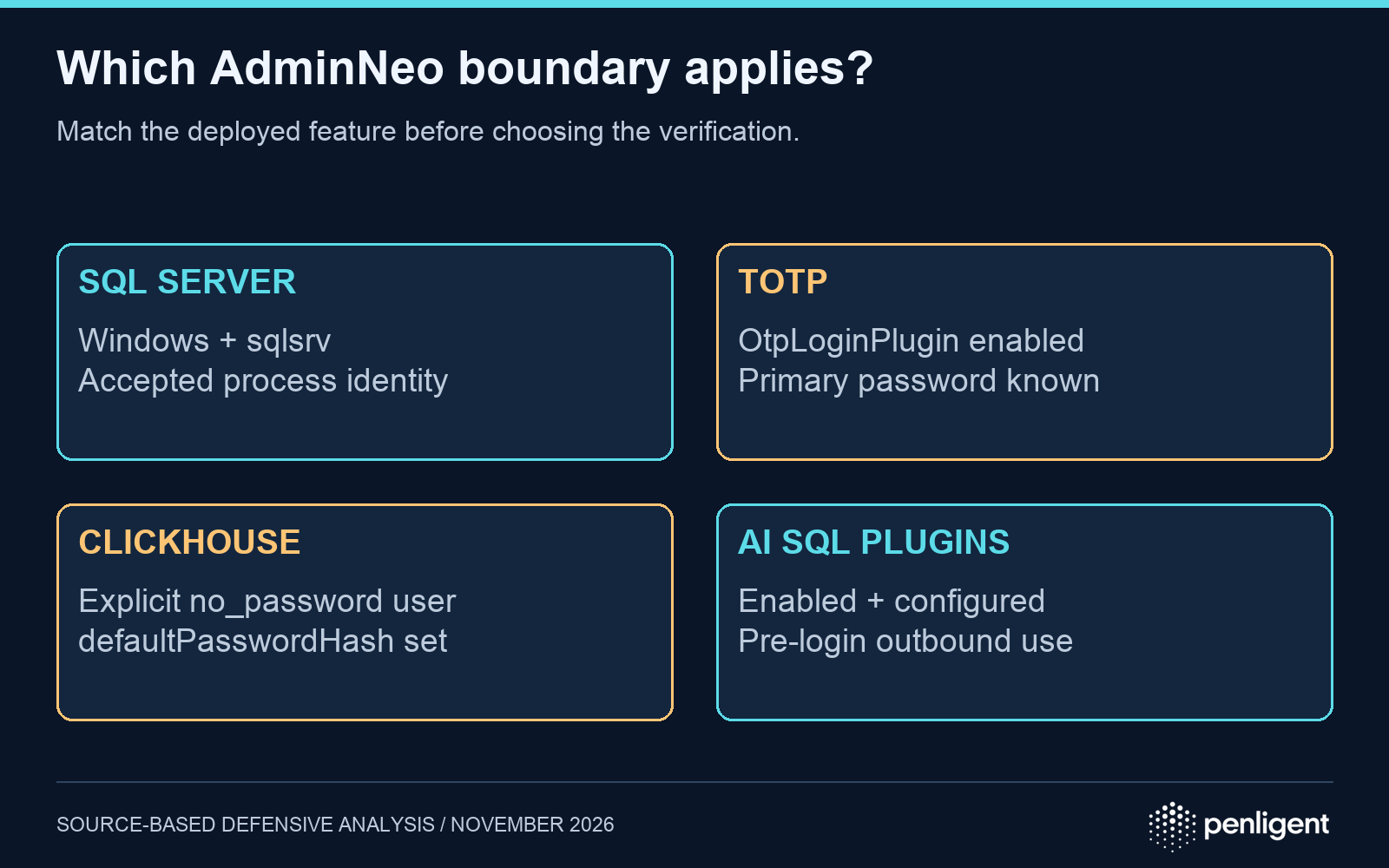
| Boundary | Relevant configuration | Acceptance evidence |
|---|---|---|
| SQL Server identity | Windows, sqlsrv extension, and a SQL Server accepting the PHP process’s Windows identity | An arbitrary password cannot authorize the empty-username integrated-authentication path |
| TOTP and permanent login | OtpLoginPlugin enabled; the reported attacker already knows the primary database password | A failed second factor cannot create a usable trusted-device login |
| ClickHouse common password | defaultPasswordHash configured and an explicitly created no_password account | The common password policy applies to that account |
| AI SQL credentials | ClaudeSqlPlugin, GeminiSqlPlugin, or OpenWebUiPlugin enabled and configured | Unauthenticated traffic cannot cause credentialed requests to the AI service |
SQL Server: verify the identity fallback, not just the form
について SQL Server advisory describes an environment-specific fallback: an empty username reaches sqlsrv_connect(), which can use Windows integrated authentication. On a qualifying deployment, SQL Server accepts the PHP process’s identity and ignores the supplied password. The report does not establish the same behavior for Linux deployments using PDO_DBLIB.
について 5.9.0-to-5.9.1 patch comparison shows a more precise fix than “all empty usernames are forbidden.” The MS SQL connection path checks the default-password policy when the username is empty and the supplied password is nonempty. Unless verifyDefaultPassword() returns true, it refuses the connection. An operator who intentionally permits integrated authentication through the configured policy should therefore verify that policy, as well as the Windows account’s database privileges.
For an isolated acceptance environment, use a disposable database and a minimally privileged service identity. Record the effective database principal for legitimate integrated authentication and confirm that a password outside the configured policy cannot establish that session. A rejection at an unrelated reverse proxy does not prove that the application guard is present.
TOTP: a trusted device can legitimately skip a new code
について OtpLoginPlugin advisory requires possession of the primary password and an enabled OTP plugin. The reported flaw issues permanent-login material before successful OTP verification, then restores access through a path where the plugin previously abstained.
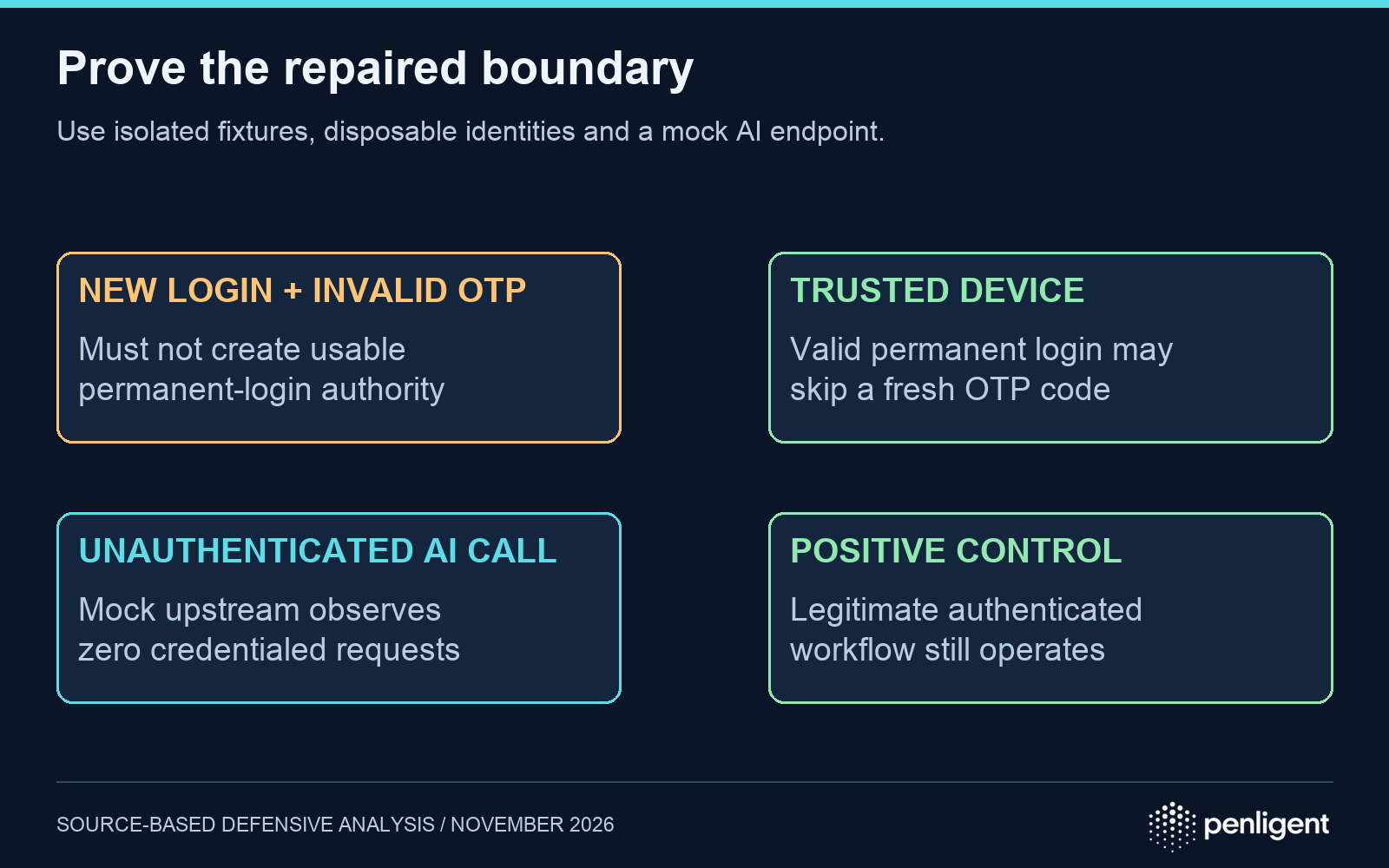
The repaired plugin explicitly treats valid permanent login as a trusted device. Its patch allows a restored, valid permanent login without a newly submitted code and binds permanent logins to the OTP secret. The release notes say permanent login is set only after successful login and expires server-side after 30 days. Consequently, “no OTP prompt on a remembered device” is not, by itself, a regression. The useful negative test is that incorrect or absent OTP during a new login cannot mint usable permanent-login authority.
Keep the successful-login control separate: a correct password and valid OTP should still allow the documented trusted-device workflow. Use disposable test factors and private cookie handling; retain outcomes and timestamps rather than cookie values. If changing the OTP secret is part of an incident response, the patched plugin’s secret binding provides a specific behavior to verify.
ClickHouse: distinguish no_password from an empty plaintext password
について ClickHouse advisory limits this issue to a configured defaultPasswordHash and an account that explicitly accepts any password through no_password authentication. It expressly excludes the stock default account described in the report, whose empty plaintext password behaves differently. A username alone does not establish exposure.
The driver patch routes connection setup through openPasswordless() instead of open(). For an isolated test account with the relevant authentication mode, confirm that a password which does not match the configured common-password hash is denied, while the intended password succeeds. Review the account’s authentication configuration directly. Do not generalize a result from the default account to every passwordless account.
AI SQL helpers: prove that unauthenticated requests stop before egress
について AI SQL plugin advisory describes handlers running while the login page is rendered. Enabled plugins could forward unauthenticated text using the operator’s configured AI credential. This is unauthorized use of a configured service; it does not establish arbitrary destination control or automatic disclosure of the raw API key.
The release comparison adds an is_authenticated() guard to all three plugin handlers. In a private acceptance instance, replace the provider connection with an instrumented mock and a dummy credential. Confirm that an unauthenticated request produces no mock-service invocation, then confirm the intended authenticated workflow still works. An HTTP 200 or a login page alone cannot establish the outbound result; pair the application response with mock-service request counts.
Close the upgrade with four kinds of evidence
Retain the deployed core and plugin versions, the configuration rows that apply, a positive and negative result for each applicable boundary, and any remaining service-account privileges. Mark absent plugins or unsupported environments as not applicable with a reason. Mark untested applicable paths as unresolved. This prevents “5.9.1 is deployed” from becoming a substitute for verifying the artifact actually serving traffic.
For authorized validation coordinated through 寡黙, keep each acceptance result tied to its configuration and expected boundary. The general product demonstration below illustrates a workflow; it does not reproduce or prove remediation of these AdminNeo issues.
Method: AI assisted the organization of this article. Material claims were checked against the linked maintainer advisories, release notes, and source comparison. The acceptance procedures are proposed defensive checks; no independent live reproduction of these vulnerabilities is claimed.
 Japanese
 English
 German
 French
 Spanish
 Portuguese
 Korean
 Hindi
 Arabic
 Turkish
 Hebrew