
AI pentesting attack defense should be measured by the application actions an unauthorized operator cannot complete. A framework name, user-agent string, or blocked request count is a weak substitute for that outcome. The stronger questions concern reachable origins, valid but overpowered identities, cross-tenant access, costly workflows, and the evidence available when a control fails.
In its November 13 report on AI penetration-testing orchestrators, Cloudflare says it observed more than 50 framework families scanning its customers over three days and a thirtyfold increase in related daily requests since October 1. These are Cloudflare’s telemetry and classification, not a census of all attackers or proof that every request succeeded. The report’s six-pillar model provides a useful starting point for a more concrete application-owner test plan.
Unit 42’s November 12 research also examines AI-enabled red-team tooling. Publicly observed tooling or exposed orchestration hosts should not be equated with confirmed victim compromise. Defenders can take the reported automation seriously while keeping deployment observations, malicious activity, and successful impact as separate evidence categories.
The assessment below focuses on systems you own or are authorized to test. It uses synthetic accounts, bounded operations, and an in-memory policy example. It does not provide evasion methods, an autonomous attack harness, or instructions to test unrelated targets.
Separate automation pressure from the application’s actual failure
Automation can change the volume and sequencing of requests, but a security finding still needs an observable unauthorized outcome. A valid account retrieving another tenant’s record is an authorization failure whether the operator is a person, a script, or an AI orchestrator. An application accepting a costly operation without an appropriate budget is a resource-policy failure. Naming the operator does not repair either boundary.
This distinction improves triage. A surge of rejected requests may show that an edge control is doing useful work. It may also conceal a smaller number of authenticated operations that deserve more attention. The incident team should be able to move from traffic classification to the identity, resource, policy decision, and business effect of a particular request. That transition requires application evidence, not only a label attached at the edge.
Keep framework attribution beside the request’s policy outcome. Attribution helps an analyst group related activity; the policy outcome establishes what the caller could accomplish. A useful investigation record retains both without letting an uncertain tool label decide access. Record, field, function, and workflow rules should remain enforceable when the request has no recognizable framework fingerprint, when attribution changes, and when the same operation is attempted through an ordinary client.
Keep impact categories narrow. Discovery of an exposed login page is not account takeover. A successful login is not permission to every object. A schema-valid request is not proof that the requested business action is allowed. A queued export is not the same as a completed download. The test plan should assert the boundary at each transition and retain the result that supports the specific conclusion.
For a business owner, the useful priority is the capability graph. Identify the public entry points, identities, APIs, background jobs, data stores, and privileged integrations that connect to a consequential action. Then ask which control limits each connection. The graph does not need to be exhaustive before work begins; it needs to make the important authority paths and unknown relationships visible enough to test.
Map the six defensive layers to concrete acceptance tests
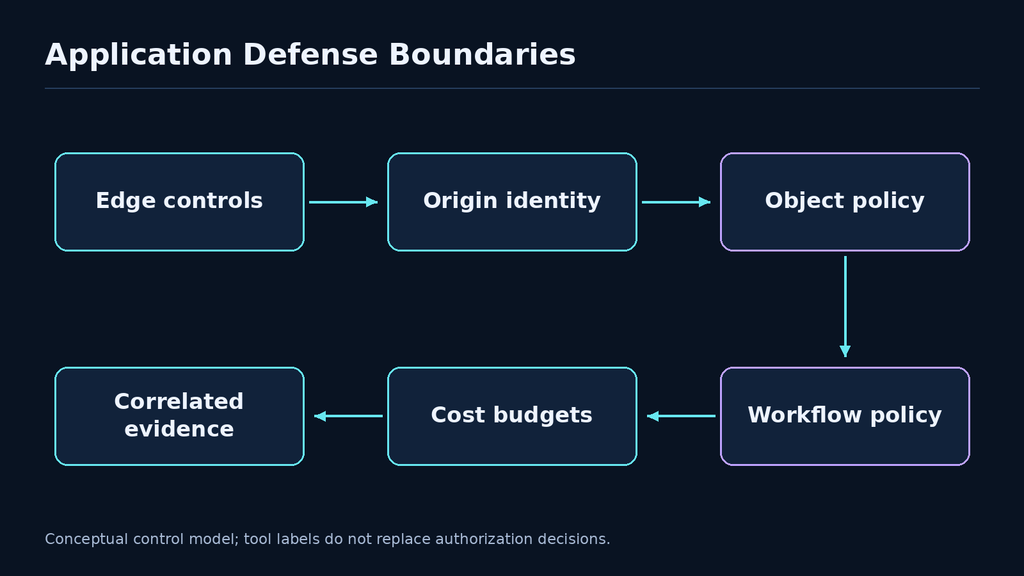
Cloudflare’s Modern Security Model recommends WAF and rate controls, anomaly detection, bot defense, identity-gated access, validated schemas and explicit controls, and threat intelligence. The model is most useful when each layer has a named protected action and a testable expected result. Buying a layer or enabling a feature is not the same as verifying its effect on the application.
| レイヤー | Application-owner question | Acceptance evidence |
|---|---|---|
| Edge filtering | Which unwanted request class is blocked before the origin? | A bounded rejected fixture and a permitted fixture |
| Origin access | Can a disallowed path reach a privileged service? | Approved and rejected vantage-point results |
| Identity | Which principal may request this operation? | Role and session-policy outcomes |
| Object and workflow policy | Which resource and transition may that principal use? | Cross-account and state-transition tests |
| Cost control | How much work may one authority cause? | Budget enforcement before expensive work |
| Observation | Can a decision be connected to its business effect? | Correlated request, policy and task records |
Assign one owner to each acceptance condition. The edge team can verify a rule match and disposition. The application team can verify object authorization and workflow state. The identity team can verify session and role behavior. The operations team can verify background-job and resource limits. A shared security objective does not eliminate those different observation points.
Test the seams between layers. A request may pass the edge because it is syntactically ordinary, then require a tenant-level rejection in the application. A request may pass authentication but fail a resource policy. A background task may execute after the initiating session changes. The seam is often where one team assumes another team already made the authorization decision. Write the expected responsibility explicitly.
Include permitted behavior in every test group. A legitimate customer should still retrieve their own approved record and complete an allowed workflow. A support operator should retain only the access required for the assigned task. Positive tests prevent a broad blocking rule from being accepted as success simply because it stops both unwanted and essential activity. The intended operating state needs to be demonstrably useful.
Document the remaining coverage gaps. A test against one API version does not cover a legacy route. A result through a public proxy does not necessarily cover direct origin access. A check with one role does not establish every support or partner role. The control map should identify those gaps and assign a next action rather than imply that a few representative requests certify the entire application.
Make the origin’s intended audience explicit
An edge policy protects only the routes that actually pass through it. For every application origin, identify the intended ingress path, the identities allowed to reach administrative functions, and the network or service controls that enforce that design. The assessment should verify those relationships from approved vantage points. It should not assume that the public hostname is the only way the service can be reached.
Inventory operational routes as well as customer routes. A maintenance interface, preview environment, partner integration, or old deployment hostname may have a different access policy. The question is not whether such routes are inherently wrong. It is whether their purpose, audience, and authority are intentional and maintained. A route with no current owner should become a review task rather than an undocumented exception.
Use a designated low-risk test function to verify origin access. The approved route should work for the intended principal. A disallowed route or identity should fail before it reaches privileged application behavior. Record the vantage point, service identity, expected result, and actual result. Avoid broad internet scanning or attempts to discover unrelated infrastructure; the owner’s inventory and authorized scope should drive the test.
Separate human administration from machine integration where the design allows it. A browser-based administrative console and a service-to-service API can have different authentication, session, and audit requirements. Giving both an undifferentiated “internal” designation hides those differences. Define the identities and operations each route needs, and test that the route cannot become a general path to all management capabilities.
Review access during maintenance and failover. A temporary route opened for troubleshooting can outlive its purpose. A disaster-recovery origin can become public when it activates. A deployment change can replace a restricted ingress with a broader default. Include these transitions in the change plan and verify the effective policy after the service is running, rather than accepting only the intended infrastructure configuration.
Do not treat a network location as a complete business authorization decision. Restricting an administrative service to a trusted path reduces exposure, but the application still needs to enforce the principal’s permitted operations. A valid integration identity should not gain every tenant’s data because it arrived through the approved ingress. The origin boundary and the application authority boundary should reinforce each other.
Preserve a controlled emergency path. If the normal identity or edge service is unavailable, operations may need a supported way to restore service. Define that path in advance with limited audience, logging, and expiry. An emergency design is safer than a rushed broad exception during an outage. Test its activation and removal in a controlled exercise so the organization knows which authority it creates.
Test authorization with two accounts and a defined business rule
The most useful application test starts with an expected policy, not a list of identifiers to try. Create two synthetic accounts with separate owned resources and, where relevant, separate tenants. Define which operations each account may perform on each fixture. Then test the allowed and denied combinations at a bounded rate. The finding should be a mismatch between the expected policy and the observed outcome.
OWASP’s Broken Object Level Authorization guidance treats record-level access checks as necessary even when the caller is authenticated. The assessment should therefore verify resource ownership or another explicit relationship at the operation being performed. A successful login should not be used as evidence that a resource request is authorized.
Use synthetic data with distinctive non-sensitive markers. If account A is denied access to account B’s fixture, the test should confirm that B’s marker is absent from the result and from any side effect. A status code alone can be ambiguous: an error response may still contain data, and a success response may represent an empty or correctly filtered result. Inspect the defined outcome, including asynchronous artifacts where relevant.
Test reads and writes separately. A caller may be permitted to view a record but not change a protected field. A support role may be allowed to update a ticket while being denied changes to account authority. Define the exact permitted field set and operation. A generic “user can access object” rule is often too broad to express the business requirement that developers actually need to enforce.
Include relationship changes. A user removed from a team, a support assignment that expires, or a transferred resource can change the correct decision without changing the caller’s identity. Test the relevant transition with approved fixtures. The expected policy should define when the change takes effect and which caches, sessions, or background tasks must respect it. Record any intentionally supported delay rather than hiding it as an unexplained inconsistency.
Review list and detail operations together. A list may correctly filter records while a detail route omits the same relationship check. The reverse can happen too: individual reads are protected while a search or export returns a broader population. A small matrix of route families and authority conditions is more useful than repeating one detail request against many arbitrary IDs.
Do not collect extra customer data to make a finding more persuasive. Once a synthetic fixture demonstrates an unauthorized outcome, stop according to the assessment plan and preserve the minimum evidence needed to reproduce it. The organization can determine broader exposure through its own inventory and logs. A proof that requires indiscriminate extraction is poorly designed for an authorized validation workflow.
Turn the confirmed mismatch into a regression test with the same policy expectation and fixtures. The repair should be assessed at the enforcing boundary, then retested through the deployed route. A unit test can verify policy logic, while an integration test verifies that the actual route invokes it. Both are useful, and neither should be presented as covering the other without evidence.
Use schemas for structure and policy for authority
A request can be perfectly shaped and still ask for an unauthorized action. Schema validation is valuable for defining the accepted operation, fields, types, and bounds, but the business policy must determine whether this principal may use those values on this resource. Keep the two decisions observable. A validation pass should not be logged or interpreted as an authorization pass.
Cloudflare’s Schema Validation documentation explains that detection does not mitigate traffic by itself until enforcement is configured. It also describes request-body validation and limitations, including response coverage. A deployment review should therefore confirm the actual enforcement action and the application’s independent data-return policy, rather than treating an uploaded schema as a completed security control.
Build a schema test from the application’s intended contract. A permitted request should use the documented fields and types. A request with an unexpected authority-bearing field should be rejected or handled according to an explicit safe policy. A syntactically valid request for another tenant’s resource should fail authorization. These three fixtures test different boundaries and make it clear which component is responsible for the result.
Review defaults and optional fields. A client that omits a tenant selector should not accidentally receive an unrestricted scope. A missing limit should not imply an unbounded export unless the product deliberately supports that behavior under appropriate authority and budgets. Define defaults in terms of the business purpose and verify them through the deployed route. The schema and implementation should agree on the result.
Response minimization requires its own test. Give the synthetic record both a permitted public field and a protected field. Assert the exact returned field set for each role. A request validator cannot, by itself, establish that a serializer omitted the protected value. The test should inspect the response and any generated artifact, with sensitive markers confined to the controlled fixture.
Keep schema changes connected to authorization regression. Adding a field or operation can change what the application is capable of doing even when the change looks small in an API specification. The review should ask whether the new capability needs a role, relationship, state, or cost rule. A schema diff becomes more useful when it triggers the policy questions associated with the changed behavior.
Budget business work rather than counting only requests
A request count is useful only in relation to the work a request can cause. Reading one small fixture and launching a large export are not equivalent costs. Define budgets around the operations the application performs, with separate limits for expensive tasks where appropriate. The policy should be enforced before significant work is committed, and its result should remain visible in the application’s evidence.
Start by identifying the scarce resource or consequential action. It may be database work, generated reports, outbound messages, third-party API spend, file processing, or access to a sensitive workflow. Then define the principal and scope that should own the budget: user, service account, tenant, resource, or another explicit business unit. An IP-only view may not express the product’s intended fairness or authority model.
Use a controlled test with a very small budget. The fixture can permit one harmless task and reject a second task after the budget is consumed. Verify both the response and the absence of a second background job or downstream action. This demonstrates enforcement without generating a load event. Record the configured test budget so the result cannot be mistaken for a production capacity benchmark.
Decide how concurrent requests share the budget. A policy that checks remaining capacity and reserves it later can behave differently under parallel operations than under a single request. Test the application’s intended reservation semantics in an isolated environment using bounded fixtures. The purpose is to confirm one consistent business rule, not to push the production service until it fails.
Handle retries deliberately. A client may repeat a request after a timeout without knowing whether the original operation completed. Define whether the operation is idempotent, whether the budget is reserved once or per attempt, and how the caller can retrieve the existing result. The test should cover the approved retry behavior with a synthetic task. This protects both security and customer experience by avoiding unintended duplicate work.
Give rejected operations an intelligible outcome. A user should know whether they need to wait, reduce the requested work, or obtain different authorization. The response should avoid exposing sensitive internal policy details, but it should be specific enough for legitimate clients to behave correctly. The application log can retain a stable reason category and correlation identifier for support and investigation.
Review budgets after role and tenant changes. A service identity should not retain an old broad allowance after its integration purpose narrows. A suspended tenant should not continue creating work through a background path that checks only an old token. Define the relevant lifecycle rule and test it. Budget authority is part of the application’s policy state, not just a static edge configuration.
Monitor accepted work as well as rejected work. A harmful pattern can remain within individual request limits while causing an unusual cumulative business effect. The useful signal may be a change in resource coverage, export volume, or costly-task creation for an identity. Establish a baseline appropriate to the product and investigate deviations with the policy context. Do not treat every burst as malicious or every low-rate sequence as harmless.
Contain valid credentials and sessions as independent authority
Defensive testing should include a valid low-privilege identity. An application that rejects anonymous probes but grants excessive authority after login still has a consequential boundary problem. Define what a compromised ordinary account could do, then verify the role, resource, workflow, and budget controls that limit that scope. This is a controlled assessment question, not a reason to use real stolen credentials.
OWASP’s Authorization Cheat Sheet recommends least privilege, default denial, and permission checks on every request. Translate those principles into a small policy matrix for the application. The matrix should make an unexpected permission visible before a test begins, and should include the relationships and state that matter beyond a role name.
Test a purpose-created session through its lifecycle. Establish a permitted session, perform a benign operation, revoke or expire it through the supported control, and verify the expected rejection afterward. Record the timing and any documented propagation delay. The test should demonstrate the service’s actual revocation behavior without replaying a real user’s captured session material.
Review the relationship between session authority and background work. A queued task may need to re-evaluate the initiating principal, use a narrowly scoped service identity, or follow another explicit policy. The correct design depends on the business operation. What matters is that the organization can state the rule and test it after revocation or role change, rather than assuming the initial request permanently authorizes every later step.
Protect sensitive administrative transitions with the controls appropriate to their consequence. Changing an account’s recovery route, adding an integration, granting a role, and requesting a routine record are different actions. A valid session should not imply that all transitions have the same assurance requirement. Use synthetic fixtures to test the transition that changes authority, including the denied case and the audit record.
During an incident, separate credential rotation from permission and trust review. A replacement secret can preserve an overbroad role. A terminated browser session can leave a service integration active. A rebuilt device can leave a cloud trust relationship unchanged. The recovery plan should identify which authority object each action changes and verify that object’s intended state through the responsible system.
Keep session material out of ordinary evidence. A test report can include the synthetic account, session identifier reference, issuance and revocation times, and observed policy result without exposing a bearer token. Use redaction and controlled evidence storage. The validation process should not create a reusable collection of authority that becomes a new incident surface.
A safe policy model demonstrates layered denial
The following educational model runs entirely in memory. It has no HTTP server, no network client, no real identity provider, and no application credentials. It does not detect AI. It demonstrates that the same action can be denied at different boundaries, and that a denied action should not consume or trigger the protected business work in this simplified design.
records = {
    "fixture-a": {"tenant": "blue"},
    "fixture-b": {"tenant": "green"},
}
cost = {"read": 1, "export": 5}

def decide(session, request, budget):
    if not request["approved_origin"]:
        return "deny_origin", budget
    if not session["active"]:
        return "deny_session", budget
    resource = records.get(request["resource"])
    if resource is None or resource["tenant"] != session["tenant"]:
        return "deny_resource", budget
    if request["action"] not in {"read", "export"}:
        return "deny_action", budget
    if request["action"] == "export" and session["role"] != "exporter":
        return "deny_role", budget
    required = cost[request["action"]]
    if required > budget:
        return "deny_budget", budget
    return "allow", budget - required

session = {"active": True, "tenant": "blue", "role": "reader"}
request = {"approved_origin": True, "resource": "fixture-a", "action": "read"}
assert decide(session, request, 2) == ("allow", 1)
assert decide(session, {**request, "resource": "fixture-b"}, 2) == ("deny_resource", 2)
assert decide({**session, "active": False}, request, 2) == ("deny_session", 2)
assert decide(session, {**request, "approved_origin": False}, 2) == ("deny_origin", 2)
assert decide(session, request, 0) == ("deny_budget", 0)
assert decide(session, {**request, "action": "export"}, 9) == ("deny_role", 9)
print("Layered policy outcomes verified with synthetic fixtures")
The assertions test outcomes rather than operator labels. A valid reader can read the owned fixture. The same identity cannot cross the tenant boundary, use a revoked session, skip the approved origin condition, exceed the test budget, or request an exporter-only action. Each rejection has a distinct reason, which makes the model’s enforcement responsibilities easy to inspect.
The model deliberately trusts its input objects because it is a teaching fixture. A real application must establish origin and session facts through supported controls, not accept client-supplied booleans as evidence. It also needs concurrency-safe budget handling, complete error behavior, and a policy for missing or malformed fields. Do not copy the toy into production as an authentication or authorization library.
Extend the exercise with a role change and an asynchronous task represented by another in-memory record. Define whether the task must recheck authority at execution and result retrieval. Then assert the intended behavior after the session is revoked or the resource changes tenants. The point is to make the business rule explicit before implementing or testing a live workflow.
A useful assessment report can use the same structure: permitted operation, denied operation, expected policy, observed result, and evidence reference. A repair is complete when the deployed application enforces the intended result, not when the operator’s framework happens to stop producing requests. This gives the organization a stable validation target even as tools, traffic patterns, and threat-intelligence labels change.
Connect request evidence to the business action
Observability should explain what authority a request exercised. A useful event model connects the request identifier, principal, tenant, resource class, operation, authorization result, policy version, task identifier, and relevant business outcome. Preserve only the fields needed for the operational question. The central event stream usually does not need the bearer token, full personal record, or complete request body to explain a denied resource access.
Keep edge and application dispositions separate. An edge event can show that a request was blocked before reaching the origin. An application event can show that a request reached a route and was denied by policy. A task event can show whether protected work was scheduled or completed. Joining these records allows the incident team to distinguish attempted access from accepted work and completed impact.
For asynchronous operations, carry a correlation reference through the task lifecycle. Record the initiating principal and the policy context needed for the operation’s defined authority model. At execution and result retrieval, retain the relevant decisions. A report that shows only task creation can miss what happened later. A report that shows only a downloaded artifact can lose the identity and purpose that initiated it.
Use stable reason categories. Denied origin, invalid session, disallowed resource, disallowed function, invalid structure, and exhausted budget are different outcomes. A generic forbidden count is difficult to act on because it does not identify the boundary doing the work. The external response can remain appropriately limited while the internal record retains enough context for authorized support and security review.
Watch collection health. A sudden drop in detections can reflect a quieter environment, an enforcement change, a logging outage, or a routing change that bypasses the observed component. The monitoring design should expose missing streams and unexpected gaps. A control cannot be evaluated from events it no longer receives. Pair security outcome reports with a statement of which components and intervals were actually observed.
Retain a small set of benign validation events as a calibration case. The team should be able to trace one permitted fixture and one denied fixture from edge to application and, where relevant, task outcome. If the join fails, repair the observability path before relying on it for a broad incident conclusion. This is a low-impact way to test the evidence system itself.
Investigate accepted unusual work with business context. An identity creating a large number of legitimate reports may be a customer’s scheduled process, a misconfigured integration, or an unauthorized use of valid authority. The response should examine the owner, purpose, resource coverage, and timing. A detector label is a lead, not a substitute for that assessment.
Run authorized validation as a bounded production change
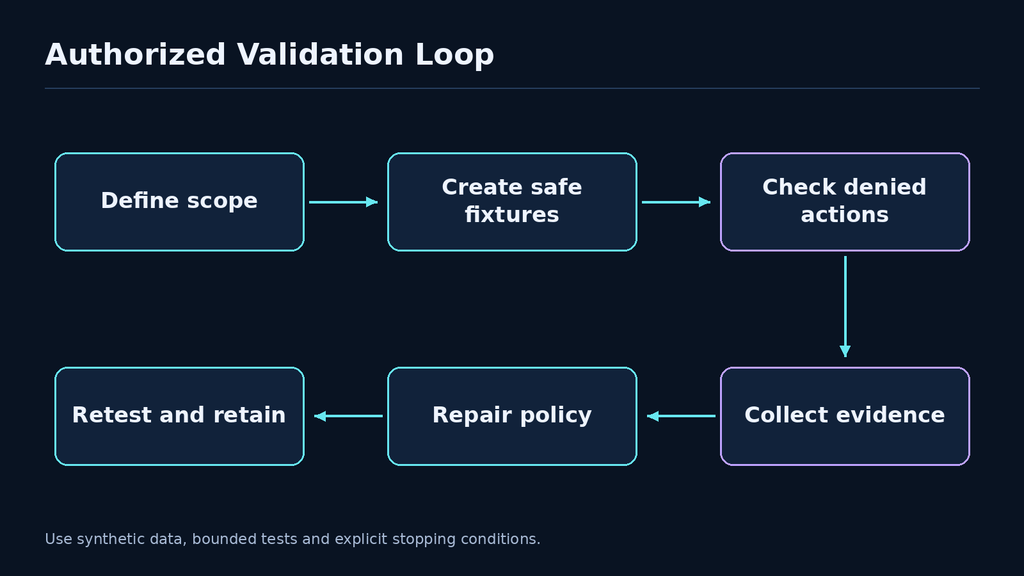
A validation plan should identify the assets, accounts, fixtures, allowed operations, rate or cost budget, observation points, and stopping conditions. The owner should understand what the test can change and how to stop it. Automation is useful when it follows that plan and produces inspectable evidence. An open-ended instruction to find every weakness does not define an acceptable operating boundary for a live business system.
Create dedicated synthetic accounts and records. Give them the minimum roles needed to exercise the policy matrix. Keep customer data out of the fixture and make cleanup straightforward. If the test requires a workflow with an external effect, use an approved sandbox or a fake dependency. The goal is to demonstrate the authorization and state behavior without sending real messages, charging a customer, or changing an unrelated record.
Define the stopping condition for a finding. Once a controlled fixture demonstrates a cross-account or disallowed-action result, preserve the minimum evidence and stop that branch. The organization can then assess broader exposure through its own records. Continuing to enumerate real resources adds risk without necessarily improving the proof. A good finding is reproducible and bounded.
Use an observation window that covers the operation’s lifecycle. A synchronous read may complete immediately, while a report or export can finish later. The plan should include task completion and result access where those are part of the protected action. Otherwise, the test can pass the request stage while missing an authorization failure in the generated artifact.
Keep a human decision point for consequential changes. The validation tool can propose or execute approved safe checks, but an expansion of scope, a destructive action, or a new external dependency needs the responsible owner’s decision. Record the change to the plan. This makes the automation’s authority inspectable and prevents a convenient tool capability from silently becoming authorization to use it.
An authorized platform such as Penligent can be used to organize scoped application checks and their evidence. The useful output is the policy expectation, the observed result, and a repeatable retest, with endpoint, cloud, or identity evidence supplied by the systems responsible for those layers. Keep the tool’s conclusion within the scope it actually observed.
After a repair, repeat the original denied fixture and its permitted counterpart. If the repair moves enforcement to another layer, verify the deployed route still invokes the intended control. Retain the old finding, the change reference, the new policy version, and the retest result. This gives the organization a durable explanation of what changed rather than a disconnected “fixed” status.
Move from observation to enforcement without losing legitimate use
A new control should have a defined protected outcome, a deployment mode, an owner, and a rollback condition. Observation mode can help establish how a rule affects legitimate traffic, but the team must know whether a detected condition is actually blocked. A dashboard showing detections should not be reported as prevention evidence when the enforcement action has not been enabled.
Start with a representative set of legitimate workflows. Include ordinary customer use, partner integration, administrative support, and relevant background work. Test the proposed rule against those fixtures and the denied cases it is meant to address. The comparison should explain both the security benefit and the operational cost. A control that blocks every request is easy to demonstrate and difficult to operate.
Give false-positive review a business owner. A support complaint should lead to a traceable request and policy result, not an immediate global bypass. The reviewer can determine whether the behavior is legitimate, whether the policy is too broad, or whether the client needs to follow the intended contract. A narrow, documented correction is easier to maintain than a growing set of unexplained exclusions.
Test exceptions with the same discipline as the main rule. An integration exception should identify the principal, route, operation, purpose, and expiry or review condition. Verify that it restores the required function without granting unrelated authority. A broad exception can become the preferred path for unwanted work, even if the original blocking rule remains enabled and continues producing reassuring statistics.
Plan for degraded operation. If an identity service, edge provider, or policy dependency is unavailable, define whether the application fails closed, permits a limited safe function, or follows another approved mode. Test the intended behavior in an isolated environment. The design should reflect the consequence of the protected action rather than use one undifferentiated fail-open decision for the entire application.
Monitor the control after deployment using both security and business outcomes. Track the denied fixture behavior, legitimate workflow success, unexplained errors, and the health of evidence collection. An increase in blocks may be useful, but it does not by itself prove reduced business risk. The stronger evidence is that the specific unauthorized action remains unavailable while the intended operation continues to work.
Keep the deployment reversible within the approved change process. A rollback should identify which security condition returns and what compensating restriction applies. Otherwise, an emergency availability fix can silently remove the control while the vulnerability ticket remains closed. Security state and service state should be recorded separately, with the responsible owners agreeing on the temporary operating condition.
Review the asynchronous and integration edges of the capability graph
Applications often express consequential authority outside the first web request. A report worker, webhook handler, export downloader, or partner integration can perform work after the original interaction. Include those edges in the policy map. The relevant question is which principal, purpose, resource scope, and state authorize the later action, and how a change to that authority is respected.
For a queued job, define the authority at creation, execution, and result retrieval. The design may preserve a narrow approved snapshot or re-evaluate current policy, depending on the business requirement. Either can be intentional, but the test plan must know which one applies. An undefined mixture makes it difficult to assess what should happen after a user loses access or a resource changes ownership.
For a webhook, identify the authenticated sender and the operations it may request. A correctly authenticated message should still be constrained to the integration’s intended purpose and resource scope. Use a sandbox or fake sender for testing, and verify both a permitted event and an out-of-scope event. Do not use another organization’s live integration credentials to make the test realistic.
For generated artifacts, test access to the result as well as access to the job record. A user who cannot view a report request should not gain its result through a different retrieval path unless the product deliberately supports an appropriately governed sharing model. The expected sharing rule should be explicit and tested with synthetic files. Avoid treating a difficult-to-guess result URL as the only authority condition.
For partner access, connect the integration identity to a named owner, approved data purpose, allowed operations, and revocation procedure. Test how the application behaves when that access is narrowed or removed. A credential rotation that preserves excessive authority does not complete the policy change. The application and the partner should have a shared understanding of which function remains available.
These tests are valuable against any automated operator because they constrain the application’s own capabilities. They also produce a more useful incident model. If a valid identity performs unexpected work, the team can identify which policy allowed it, which task executed it, and which artifact or downstream action resulted. That evidence supports a concrete repair instead of an endless effort to recognize a changing tool label.
Choose validation tools by evidence and operating limits
A tool evaluation should begin with the application’s policy matrix. Give the evaluator a small approved environment with synthetic tenants, roles, resources, and workflows. Ask the tool to demonstrate the permitted and denied outcomes that matter to the business. The result should identify what was tested, which identity and resource were used, what the policy expected, and what evidence supports the finding.
Ask how scope is enforced during execution. A declared target list is useful only if the workflow prevents unapproved expansion or requires the responsible owner’s decision. Review how the tool handles redirects, newly discovered services, external integrations, and operations with side effects. The evaluation should use controlled fixtures for those cases. Do not assume a natural-language instruction alone establishes a complete operating boundary.
Ask how budgets and stopping conditions work. The owner should be able to limit request volume, costly operations, test duration, and the kinds of actions permitted. A confirmed finding should have a defined stop rule and a clear evidence capture. The organization needs to know how to pause or terminate work and what state remains afterward. These are operational requirements, not optional presentation features.
Inspect the evidence format. A finding should preserve the minimum request and response context needed to reproduce the result, with secrets and personal data appropriately protected. It should distinguish an inferred weakness from an observed unauthorized outcome. A severity label without the policy mismatch is difficult for a developer to repair and difficult for a reviewer to verify.
Test remediation support with a deliberate fixture change. Repair the policy in the approved environment, rerun the relevant case, and compare the permitted and denied results. The tool should help the team understand the difference without claiming that an unrelated clean scan proves the original issue fixed. A stable finding identifier and retest record make this workflow easier to assess.
Review how the tool handles authentication and secrets. Use purpose-created test credentials, define where they may be stored, and verify how they are removed or revoked after the evaluation. The report should not expose reusable session material. If the tool needs broader authority for a particular case, the evaluator should be able to explain why and obtain a deliberate scope decision.
Evaluate failure reporting as well as successful demonstrations. A timed-out test, unsupported workflow, missing observation, or blocked authentication step should remain visible. An evaluation that silently skips hard cases can appear comprehensive while covering only the easiest routes. The buyer needs an accurate boundary around the result, including which important business policies still require another method.
Finally, compare tools against the same fixtures and acceptance criteria. Different interfaces and agent architectures may be useful, but they should not change the business rule being tested. A fair evaluation focuses on reliable findings, bounded execution, reproducible evidence, and useful retesting. Avoid turning a framework popularity list or an unsupported speed claim into a substitute for those demonstrated properties.
Measure denied outcomes with a defensible denominator
A control program needs a denominator that corresponds to the protected application. Count the in-scope route families, roles, tenant relationships, sensitive operations, and lifecycle transitions that the test plan actually covers. A large number of requests against one public endpoint is not broad policy coverage. The report should make it clear which combinations were tested and which remain unknown.
Use separate metrics for prevention, detection, and response. Prevention evidence shows that a disallowed action did not occur under a defined test. Detection evidence shows that the relevant event was observed and routed. Response evidence shows that an owner investigated or contained it within the organization’s process. A blocked request count cannot establish all three, and an alert cannot prove prevention if the action already completed.
Measure legitimate workflow success alongside denial. A useful control permits the intended operation while rejecting the defined unauthorized variant. Report both results for the same policy case. If a rule blocks the valid fixture too, the security outcome may be real but the deployment is not yet acceptable. This keeps availability and customer experience connected to the acceptance decision.
Preserve the policy version and test fixture identity. When a result changes, the team should know whether the application changed, the expected policy changed, the fixture changed, or the observation method changed. Without that context, a trend line can mix different questions and make improvement difficult to interpret. A small stable regression set is often more informative than a growing collection of unrelated scans.
Track unresolved gaps explicitly. An unsupported export workflow, an untested partner role, or an origin route without a verified owner should remain a named item with a next action. The organization can prioritize those gaps by consequence. Excluding them from the report to produce a cleaner score deprives decision-makers of the information they need to allocate engineering work.
Do not translate telemetry attribution into an efficacy claim without evidence. If a provider classifies traffic as an AI orchestrator family, that can describe its observation. It does not establish that the organization would have been compromised without one particular control or that another control is unnecessary. Use the application’s own accepted and denied outcomes to evaluate the deployed defense.
Review the program after significant changes. A new API version, identity migration, partner integration, background job, or deployment route can alter the capability graph. The change process should identify which existing tests remain relevant and which new policy cases are required. The security program then follows the application’s evolving authority rather than a static list of tool signatures.
Give a reviewer outside the original test team one completed case. They should be able to identify the policy, fixture, execution scope, observed result, evidence limit, repair, and retest. If they cannot, improve the record before expanding the automation. Evidence that another engineer can inspect is more durable than a dramatic demonstration whose assumptions exist only in the operator’s memory.
Exercise a valid-credential incident with synthetic data
A tabletop exercise can test the entire control model without deploying an offensive framework. Use a fictional application with two tenants, one ordinary user, one support role, one export worker, and a partner integration. Give each team the records it normally sees. Ask them to explain which actions were allowed, which were denied, and what evidence would justify containment or restoration.
In the first case, the edge rejects many malformed requests while one valid account performs an unexpected export. The team should follow the accepted action through authorization, task creation, execution, and result access. It should not conclude that the application was protected merely because the block count was high. The exercise tests whether the evidence model can find consequential work among ordinary-looking traffic.
In the second case, a user loses tenant access after creating a report job. Give the team the product’s intended policy for execution and retrieval. Ask whether the worker and download route enforce it, and which logs establish the result. If the policy itself is undefined, that is an engineering decision to resolve before a tool can meaningfully classify the behavior as permitted or unauthorized.
In the third case, a partner integration exception restores a business workflow but also permits an unrelated operation. The team should narrow the exception and retest both outcomes. Removing the entire control is an availability shortcut with a security consequence; leaving the partner broken is an operational failure. The desired result is a specific, maintainable permission that serves the approved purpose.
In the fourth case, a purpose-created session remains usable after the expected revocation interval. The team should identify the supported revocation mechanism, policy propagation, and any dependent task authority. It should preserve the failed test and assign a repair. Repeating a password reset without understanding the authority model does not make the result more convincing.
In the fifth case, the test tool cannot observe whether a generated artifact was downloaded. The correct report preserves that limit and routes the question to the system that can observe it. The team should not infer a completed exfiltration from artifact creation, nor infer safety from the absence of a download event in a system that never collected it. The exercise rewards accurate boundaries rather than confident storytelling.
Use the exercise to improve ownership. Each unresolved question should have a policy owner, an enforcing component, an evidence source, and a next test. The incident lead coordinates those responsibilities but does not replace them. The final output is a small set of concrete engineering and operating changes that can be verified with the same synthetic fixtures.
Frequently asked questions about AI pentesting attack defense
Must a defender identify the exact AI framework?
- Framework identification can provide context, but application authorization and resource controls should hold regardless of the caller’s label.
- Measure whether a defined unauthorized action succeeds, not only whether a request matches a tool fingerprint.
Does a WAF replace application authorization?
- No. A structurally ordinary authenticated request can still be outside the caller’s permitted resource or workflow scope.
- Test the edge and application policy as separate boundaries with permitted and denied fixtures.
Does schema detection automatically block a request?
- Confirm the actual enforcement mode. Cloudflare’s documentation distinguishes detection from mitigation.
- Also verify response minimization and business authorization, which are separate from request structure.
Does MFA eliminate the need to test valid sessions?
- No. The application still needs to constrain what an established identity may do and how its authority changes after revocation or role changes.
- Use purpose-created sessions and supported controls for the test.
How should an authorized automated test stop?
- Define scope, operation and cost limits, a human escalation point, and a stop condition when a fixture demonstrates a finding.
- Preserve minimum evidence and avoid expanding into real customer data.
What should a useful finding contain?
- Include the expected policy, synthetic principal and resource, observed unauthorized outcome, evidence reference, limits, repair, and retest.
- Keep secrets and unnecessary personal data out of ordinary reports.
What is the strongest success metric?
- A defined unauthorized action remains denied while its legitimate counterpart works across the tested lifecycle.
- State the tested population and remaining gaps. No finite test set proves universal security.
The durable defense is an application whose authority is explicit and testable. Edge controls reduce unwanted traffic; origin, identity, resource, workflow, and cost policies constrain what accepted traffic can accomplish. Correlated evidence and bounded retesting show whether those controls hold as the application changes. That gives defenders a stable operating target while automation tools and their names continue to evolve.
Assign every remaining policy gap an owner, a protected outcome, and a reproducible next test.

 Japanese
 English
 German
 French
 Spanish
 Portuguese
 Korean
 Hindi
 Arabic
 Turkish
 Hebrew