
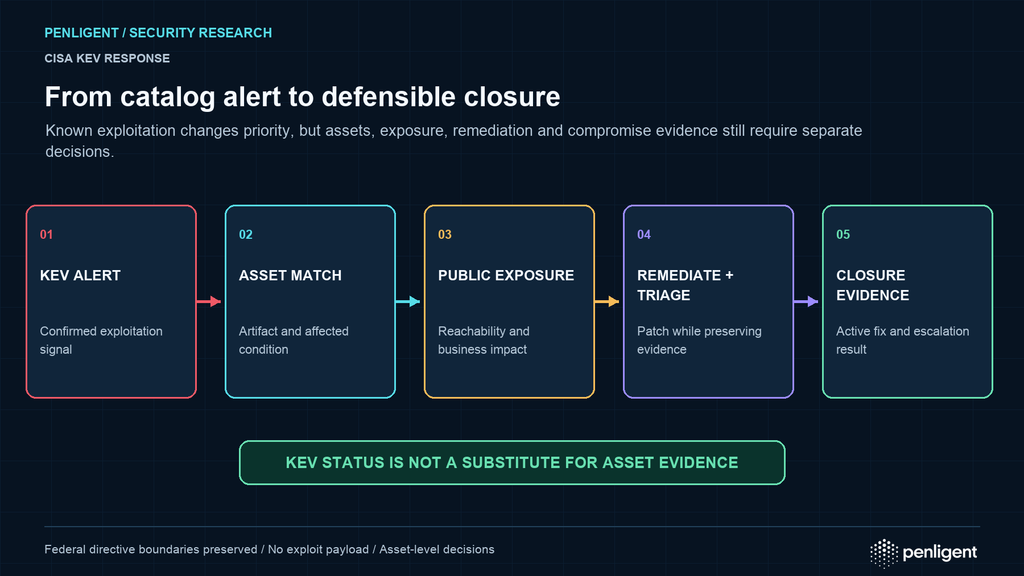
A CISA Known Exploited Vulnerabilities entry should start an asset-specific response, not a ticket that merely repeats the CVE number. KEV inclusion establishes that exploitation has been observed. It does not establish which systems in your environment are affected, which instances are publicly exposed, whether the vulnerable code is active, whether a vendor mitigation is sufficient, or whether compromise already occurred.
CISA’s Binding Operational Directive 26-04 uses KEV status together with asset exposure, adversary automation and technical impact to prioritize remediation. Its mandatory requirements apply to covered U.S. federal civilian executive branch agencies. Other organizations can use the same decision structure without presenting federal deadlines as universal legal obligations.
The useful workflow connects six records: the authoritative vulnerability facts, the deployed asset, the exposure path, the chosen response, the active post-change state and any evidence from the earlier exposure window.
KEV, CVSS and EPSS answer different questions
| 信号 | Question it helps answer | What it cannot establish alone |
|---|---|---|
| CVE | Which disclosed vulnerability are teams discussing? | Severity, exploitation, deployed exposure or remediation |
| CVSS | What are the principal technical severity characteristics? | Whether exploitation is occurring or the asset is reachable |
| EPSS | What is the modelled probability of exploitation activity in the next 30 days? | That a specific asset was attacked or that the model covers every environment |
| CISA KEV | Has CISA determined that the vulnerability is known to be exploited? | Which internal assets contain the vulnerable condition |
| Public exposure | Can unauthenticated or untrusted entities reach the asset through a public network? | That exploitation succeeded |
| Business context | What mission, safety, data or operational consequence does the asset carry? | The technical mechanism or patch state |
について FIRST CVSS documentation describes CVSS as a way to capture vulnerability characteristics and produce a severity score. The Exploit Prediction Scoring System produces a probability estimate for exploitation activity. KEV is a confirmed-exploitation prioritization signal. Treating one field as a replacement for all the others discards useful context.
Explore Penligent for authorized security testing
Create a KEV intake record that can join to assets
Ingest the CISA KEV catalog through a controlled feed and preserve the fields that drive action: CVE ID, vendor and product, vulnerability name, date added, required action, due date when applicable, ransomware-use status, forensic-triage requirement and Notes links. Keep the raw source record or a hash-addressed snapshot so later reviewers can see what the catalog said when the response began.
Do not stop at product-name matching. A useful internal record adds:
- asset identifier and accountable owner;
- installed package, firmware, runtime, image or service identity;
- affected-condition evidence, including configuration and feature state;
- public, partner, employee, management and lateral network paths;
- business service and recovery priority;
- available patch, mitigation, decommission or isolation option;
- telemetry and evidence sources for the prior exposure window;
- response deadline, exception owner and next review time.
Unknown inventory should remain an urgent unknown. It should not be converted into an unaffected result merely because the scanner did not return a version.
Validate the affected condition before clearing or escalating an asset
Version matching is a starting point. Vendors may backport fixes without changing the upstream version, bundle a vulnerable library into an application, limit exposure to an optional feature, or publish different corrections for appliances, cloud services and self-managed products. Confirm the actual artifact and the configuration that makes the vulnerability reachable.
For each candidate asset, answer:
- Does the installed artifact fall inside the vendor’s affected scope?
- Is the vulnerable component present and active?
- Can an untrusted party reach the relevant interface, parser, workflow or management plane?
- Does a proxy, VPN, identity gateway or segmentation control materially change that path?
- What logs, process telemetry or cloud audit records cover the exposure window?
Record the evidence used to answer each question. A scanner status such as “fixed” or “not vulnerable” is not sufficient when the scanner inspected a package database but the workload uses a container, static binary, alternate runtime or managed service.
Decide whether evidence collection must precede patching
CISA’s BOD 26-04 implementation guidance separates rapid evidence preservation from critical patching and stabilization. Patching can change files, memory, logs, process state and timestamps. When a KEV entry or its Notes field requires forensic triage, establish a response plan before the change window.
The operational sequence depends on risk. If exploitation is suspected and the asset is stable enough to collect scoped evidence, preserve volatile and relevant persistent artifacts first. If the system is actively harming operations or exposing more assets, containment and stabilization may take precedence. Document the tradeoff and the person who approved it.
| 状況 | First priority | Evidence to retain |
|---|---|---|
| Publicly exposed KEV, no compromise indicators yet | Scope, collect essential evidence, remediate rapidly | Exposure path, version/artifact, logs, process state, change record |
| Credible compromise indicators | Activate incident response and preserve evidence | Volatile data, authentication events, processes, network activity, persistence |
| Service instability or active operational impact | Contain and stabilize with an approved evidence tradeoff | Available logs, snapshots, timeline and containment actions |
| Unsupported or unpatchable system | Remove exposure, isolate, replace or decommission | Exception, owner, compensating controls and retirement plan |
Run remediation and triage as parallel workstreams
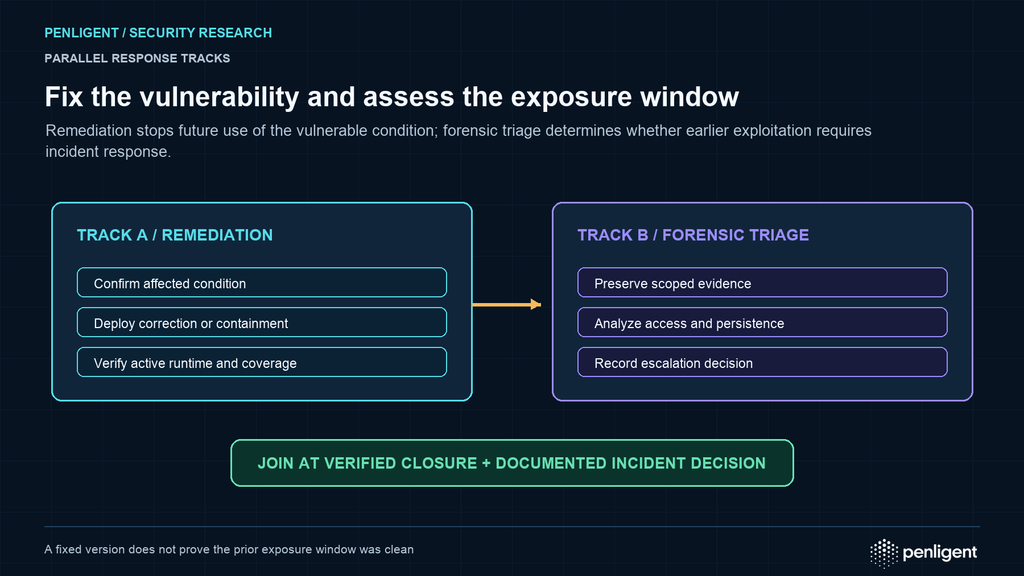
Eliminating the vulnerable condition and determining whether exploitation occurred are different outcomes. A patch can stop future exploitation while leaving persistence, stolen credentials or modified data untouched. Conversely, an investigation that finds no evidence of compromise does not make an unpatched KEV safe.
CISA’s implementation guidance organizes forensic triage into six stages:
- Scope. Identify the affected boundary, systems, services and response team.
- Preserve and collect. Acquire relevant volatile and persistent evidence with a collection log.
- Patch and stabilize. Apply critical corrections after necessary evidence is protected.
- Contain and control. Isolate affected or suspected systems and document the action.
- Analyze. Determine whether unauthorized access, actor presence, lateral movement, persistence or data staging occurred.
- Decide escalation. Produce a triage report and move to full incident response when compromise is confirmed or remains credibly suspected.
CISA explicitly describes the guide’s target timelines as recommended best practices, rather than required step-by-step deadlines. The directive requires adequate forensic triage where applicable; entry-specific KEV guidance can add requirements. A private organization can adopt the sequence while setting its own accountable service levels based on exposure, impact, contractual commitments and incident-response capability.
Verify remediation at the active instance
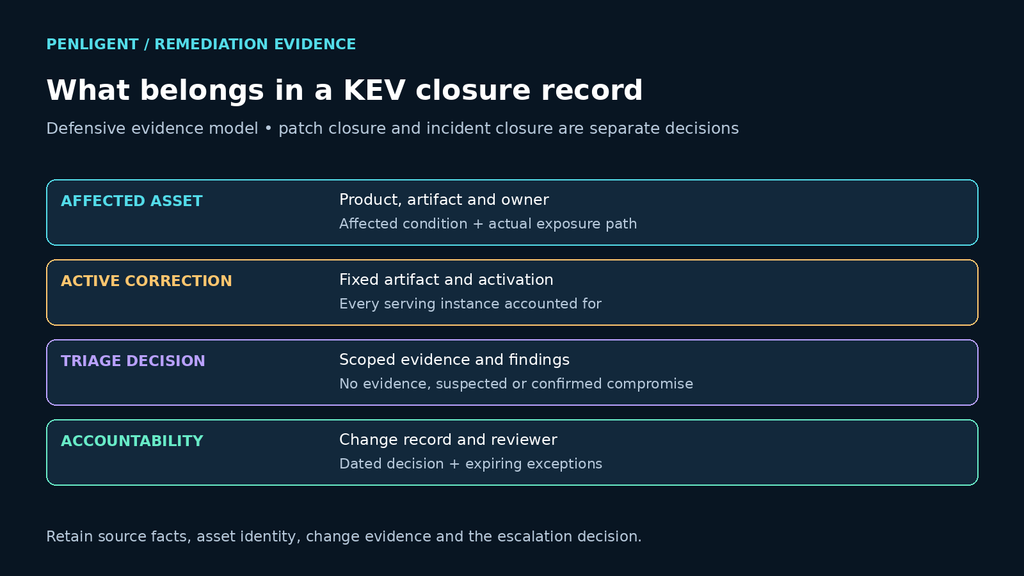
A downloaded patch is not closure. Verify the installed artifact, activation event and every serving instance. For a traditional host, this may require a package identity and process restart. For containers, verify the replacement image digest and active replicas. For firmware, confirm the running device build. For a SaaS product, obtain provider evidence that the affected service was corrected and identify any customer-side action.
| Closure layer | Example evidence |
|---|---|
| スコープ | Complete list of affected and cleared assets with owners |
| Artifact | Fixed package, firmware, runtime, build or image digest |
| Activation | Restart, reboot, rollout, function deployment or provider confirmation |
| Exposure | Updated route, ACL, gateway, VPN or isolation state |
| 機能 | Critical business workflow and health checks pass |
| Triage | Evidence reviewed, result documented and escalation decision recorded |
| Retest | Safe vendor-supported validation confirms the vulnerable condition is absent |
Explore Penligent for authorized security testing
Manage exceptions as expiring operational decisions
An exception should state why remediation cannot occur, the asset owner, business consequence, interim controls, detection coverage, expiration time and approved replacement path. “Vendor patch pending” is a status, not a compensating control. Remove unnecessary public exposure, restrict management paths, disable the vulnerable feature where supported and increase monitoring while waiting.
Recalculate priority when facts change. A system can become publicly exposed through a new proxy, cloud rule or remote-access route. A CVE can enter KEV after the initial finding. A workaround can be withdrawn or a patch can become available. The queue should react to those events rather than preserve the original due date indefinitely.
Measure outcomes instead of ticket volume
Useful program metrics include time from KEV addition to asset scoping, percentage of candidate assets with verified affected-condition evidence, time to remove public exposure, time to active remediation, percentage of instances with runtime proof, forensic-triage completion and exception age. Report unknown inventory separately; hiding it inside a denominator produces false confidence.
The most important record is an asset-level decision that another responder can reproduce. It should explain what was affected, how it was reachable, what changed, whether the fix is active, what evidence was reviewed and whether incident response is required.
Close the asset decision with reproducible evidence
CISA KEV is a high-value exploitation signal, but the catalog becomes operational only when it joins to assets, exposure and evidence. Build a repeatable intake process, validate the affected condition, preserve evidence when required, remediate every active instance, and keep forensic triage separate from patch completion. The result should be more than a closed ticket: it should be a defensible record that the vulnerable condition is gone and the earlier exposure window received an appropriate investigation.
The following Penligent overview shows a general authorized security-testing workflow. It is not evidence that the systems discussed here were tested by Penligent.
 Japanese
 English
 German
 French
 Spanish
 Portuguese
 Korean
 Hindi
 Arabic
 Turkish
 Hebrew