
Claude CVP is Anthropic’s Cyber Verification Program, an access program for eligible security work. The October 6 program expansion introduced Defense Access, Red Team Access and Specialized Access. The important operational distinction is between being admitted to a provider’s program and being authorized to test a particular system. One does not establish the other.
For a security team, the useful question is not simply whether an account has fewer interruptions. It is whether the right person, organization, workspace, target and tool action are connected by explicit permission. A model can assist a legitimate task while the surrounding workflow still mishandles a customer’s data, uses the wrong credentials or acts outside the agreed scope.
This guide uses primary documentation checked November 14, 2026, and proposes a deployment and evaluation method. It does not claim that CVP launched today, that an application will be approved or that Penligent holds a particular Anthropic program grant. No application, identity verification or customer test was performed for this article.
Work categories and access tiers
Anthropic’s tier announcement distinguishes defensive analysis and validation from authorized red-team work and a more restricted category involving especially consequential systems. Individual researchers can apply for Defense Access; the higher tiers are for organizations. These are provider-defined categories, not a universal certification of competence or authorization.
Define the task in operational terms before choosing a tier. “Review a patch in an owned repository” is different from “conduct an authorized adversarial assessment of a customer application.” A purchase decision based only on a model name can hide that distinction until a project is already underway.
Write down the inputs, intended outputs and actions required for the work. Will the model read source supplied by the user, analyze a synthetic trace, invoke a local test runner or operate tools against a staging application? Which actions can change data? Who will review the result? The category should follow the actual workflow rather than its marketing label.
First determine which parts of the workflow already fit generally available capabilities. The announcement includes ordinary code review and known-issue patching among those uses. This lets the application focus on the specific remaining requirement, with a concrete task and environment. Asking for a broader grant becomes a reasoned capability decision rather than a proxy for choosing the newest model.
Avoid treating a model refusal as proof that a task belongs in a particular tier. A refusal can arise from several conditions, including the request, product configuration or applicable safeguards. Diagnose the actual situation and consult the provider’s current program description. Rephrasing a request repeatedly to defeat a safeguard is not a sound access strategy.
The same caution applies to successful responses. A model answering a question does not certify that the user may test the named target. Authorization comes from the relevant owner and rules, not from the absence of a block. The organization operating the tools remains responsible for its own scope and decisions.
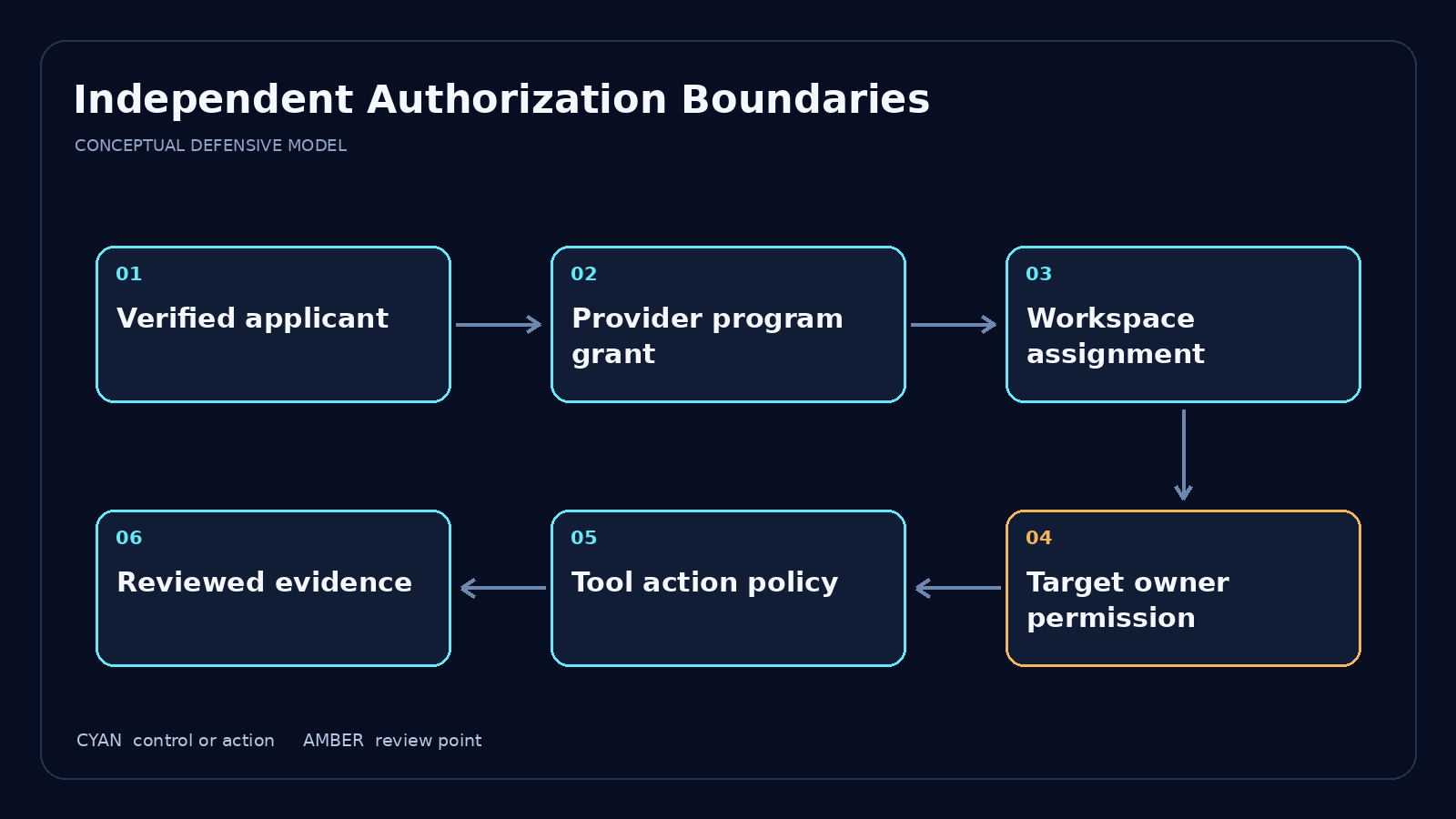
Four independent authorization decisions
The first decision is applicant identity. It connects a person or organization to a claimed identity through the provider’s verification process. That can support accountability, but it does not prove permission to test a customer’s system. A real company can still act outside a contract, and an experienced researcher can still exceed a bounty program’s rules.
The second is the provider grant. It describes what the provider permits under its program and policies. Record the approved organization, route, tier and use category in an internal register. Do not assume that an approval attached to one organizational context follows a user everywhere they can sign in.
The third is target-owner permission. It should identify the assets, methods, time window and constraints for the assessment. A customer may authorize testing an application while excluding a payment integration, shared infrastructure or destructive technique. Those exclusions need to reach the execution system, not remain in a statement of work nobody reads.
The fourth is execution policy. It determines whether a specific tool action may occur now, with these credentials, against this target. A broad project authorization can support many low-impact actions while still requiring a separate approval for a consequential step. The execution layer should make that distinction explicit.
| Decision | Responsible authority | Useful evidence |
|---|---|---|
| Applicant identity | Provider verification process | Current verified organizational context |
| Program access | Provider program decision | Approved route and use category |
| Target scope | Owner with authority over the system | Dated rules of engagement |
| Tool action | Assessment operator and execution policy | Allowed action, target and stop conditions |
These decisions form a chain without becoming interchangeable. If a customer changes the permitted scope, a provider grant does not override the change. If the provider narrows access, the customer’s authorization does not override the provider policy. If a tool lacks a safe way to constrain an action, the other approvals do not make that tool suitable.
This separation is especially useful during handoffs. A salesperson may know that the company has access, a project manager may know the customer scope and an engineer may control the runtime credentials. The workflow needs a common record that joins those facts without exposing secrets or allowing one role to silently expand another role’s authority.
Build an application evidence pack for an individual researcher
An individual should describe a narrow, credible security workflow and the environment in which it will run. Examples can include analysis of owned source, work within a published bounty scope or controlled reproduction in a local lab. The purpose of the description is to make the intended use understandable, not to claim unlimited authority through professional identity.
Use evidence that another person can verify. Public research, a maintained project or a documented disclosure history can help explain the work. Link to the relevant record rather than copying private correspondence or uploading an entire report that contains customer details. A shorter evidence pack can be stronger when every item has a clear purpose.
Separate evidence of identity from evidence of technical work. The former may require the provider’s private verification channel; the latter may be public. Do not post identity documents in a community discussion, send them to an unofficial support account or place them in a repository alongside application notes.
Explain the lab boundary in concrete terms. Name the type of environment, the synthetic data used and the actions that are excluded. If a demonstration is necessary, use an owned fixture with a clear success condition. A demonstration should show that the researcher understands the boundary rather than prove that they can affect an unrelated public target.
Treat the move from independent research to customer work as a deployment change. Revisit the provider use category, the customer’s authorization and the data path before sending the first client task. The earlier research application remains useful historical evidence, while the new service needs a decision describing its actual operator and audience. This makes the transition reviewable without discarding the work already completed.
Do not optimize the application by overstating credentials or results. Inconsistent names, ambiguous affiliations and unverifiable claims create review problems and can obscure otherwise legitimate work. Provide the strongest accurate description available, and identify gaps plainly. Only the provider can determine eligibility under its current requirements.
Retain a local decision record containing the application date, organizational context and approved purpose, with private materials stored under appropriate controls. The record is useful when an account changes, an integration is introduced or a reviewer asks why a particular workflow was enabled. It should not contain unnecessary copies of sensitive identity evidence.
Describe a security firm’s operating model accurately
A security firm should be able to explain who operates the model, who owns the target authorization and what a customer receives. These questions are more useful than a broad claim that the company “does pentesting.” They establish whether the proposed service has accountable staff, a bounded workflow and a meaningful review stage.
Use a representative engagement to make the description concrete. Describe an owned staging application, approved test accounts, the categories of actions allowed and the report review process. Remove customer identifiers and sensitive findings. The example should reveal how the process works without disclosing someone else’s confidential assessment.
Distinguish the people authorized to operate the service from everyone employed by the business. Sales, support and development roles may need different information and permissions. A company-wide grant should not automatically become a reason to give every user the same execution capability. Apply least privilege within the controls the product actually supports.
Write a responsibility map. The engagement owner confirms scope, the technical operator controls execution, the reviewer checks evidence and the customer contact approves any scope change. In a small firm one person may hold several roles, but the decisions still need to be visible. A small team benefits from explicit records because it has fewer opportunities for informal cross-checks.
Treat a report as a reviewed deliverable rather than a transcript export. Raw model output can contain uncertainty, irrelevant data or unsupported claims. The firm’s reviewer should identify what was actually observed, what is inferred and what remains unverified. This review is useful regardless of the model or access tier used.
The evidence pack should describe the process the firm can operate today. Planned controls, future certifications and intended hiring should not be presented as completed facts. Where a provider asks for a current control, an implementation plan is not the same evidence as a functioning configuration and its review record.
Reassess the model when the business changes. Moving from staff-operated consulting to a customer-directed product changes who supplies prompts, sees outputs and controls tools. That can alter both provider approval requirements and the firm’s own risk model. Treat the change as a new design decision, not a minor user-interface update.
Resolve customer use before building the integration
について current CVP help page distinguishes internal use from customer services and products, which need separate external-use approval. This is a material procurement boundary. An organization should resolve it before routing customer traffic through a program-enabled environment.
Create a data-flow diagram for the intended service. Identify who writes the prompt, who chooses the target, who can see raw output, who approves actions and who receives the final deliverable. A service description that omits those relationships can make a customer-directed product look like an internal analyst tool even when the actual behavior is different.
Consider three fictional operating models. In the first, an employee uses a model to analyze the company’s own application. In the second, a tester operates a service and delivers a reviewed report to a client. In the third, customers control the interaction through a product. The provider’s current application categories should be checked against the actual model, not the name chosen for it.
Do not solve an approval problem by hiding customer traffic behind an internal account. That removes the evidence needed to assess the service and can create an unsupported deployment. If the desired external use is not available, redesign around supported capabilities or defer that integration until the provider explicitly permits it.
A customer contract should also reflect what the service actually does. Describe relevant subprocessors and data handling through the organization’s normal procurement and legal process. Do not promise that a provider’s program automatically grants a particular retention arrangement, geographic location or liability allocation.
Keep internal and customer workflows distinguishable in the architecture. Separate identities, workspaces, data stores and logs where the supported platform and approved design require it. The exact implementation depends on the chosen surface. The design goal is to prevent a configuration intended for one purpose from silently changing the behavior of another.
Make customer claims traceable to documentation. An accurate description of AI-assisted assessment can explain the service without implying a provider certification. If the business wants to name a grant or entitlement, verify its scope, current status and disclosure conditions first. Customers still need evidence about the assessment method and deliverables; program access alone cannot answer those service-quality questions.
Effective access on the chosen product route
Provider approval and active product configuration can differ. The help page describes different activation paths for Console workspaces, Enterprise roles and other surfaces. Verify the route the team will actually use rather than assuming one account’s approval is effective everywhere.
Maintain a deployment record with the product surface, organization, workspace or role, approved users, use category and review date. Use identifiers that administrators can reconcile without including API secrets. The record should make it possible to explain why a user sees one behavior in an analyst interface and another in an application runtime.
Use a controlled acceptance task after configuration. Choose a permitted, low-impact analysis over synthetic data and observe the result through the intended route. This verifies the integration path and basic operation. It is not a challenge to defeat safeguards, and it does not certify that every advanced task will be accepted.
If the acceptance task fails, capture the non-sensitive error or status and ask the administrator to inspect configuration. Avoid copying entire customer prompts into a broad support ticket. A useful diagnostic record can often consist of the product route, request identifier, time, workspace and a sanitized description of the permitted task.
Test user removal as carefully as user addition. The team should know which identity controls access, how a role or workspace assignment is removed and how long-running work is handled. A grant that is easy to enable but difficult to revoke is an incomplete operational design.
Changes in organizational structure can invalidate assumptions. A new subsidiary, separate Console organization or cloud account may have a different program context. Before moving a workload, identify whether the provider’s existing approval applies. Do not infer continuity solely because the same employee manages both environments.
Use the product’s current administrative guidance as the source of truth for the exact controls. Documentation and user interfaces can evolve after a news announcement. The lasting principle is simple: record the effective configuration on the actual route, then preserve enough evidence to review it later.
Replace credential habits with workload identity design
Anthropic’s Workload Identity Federation documentation describes exchanging an identity-provider token for a short-lived service-account token under configured trust rules. The issuer, claim conditions, service account and workspace matter. Federation removes some static-secret handling, but it does not make an overbroad trust rule safe.
Start with the workload that needs access. Identify the environment, owner and allowed operations before choosing the service account. A shared identity for unrelated customers or pipelines makes it harder to attribute actions and revoke one workload without disrupting another. Use the smallest supported identity boundary that matches the operating model.
Review the trust rule as an authorization policy. Which issuer is trusted? Which subject, audience and other claims must match? Could an unrelated repository, branch, namespace or environment obtain a token with matching claims? These are design questions to test in a controlled environment, not details to accept because a wizard completed successfully.
A short token lifetime reduces the period in which a stolen token may remain usable, but it does not correct the actions allowed while that token is valid. Scope, workspace membership and execution policy remain necessary. Do not use short expiry as a reason to grant a workload broad privileges it does not need.
Plan failure behavior. If the identity provider is unavailable, the workload should stop or degrade according to an approved policy rather than fall back silently to a long-lived shared secret. A hidden fallback can undermine the very boundary the team believes it has deployed. Make credential precedence and failure paths visible during review.
について current program guidance announces a December 15, 2026 Defense Access transition to phishing-resistant MFA and away from static API keys; higher-tier Console requirements must be checked in the actual Programs status. Treat published future requirements and current effective controls as separate fields.
Prepare the transition early. Inventory workloads using static credentials, identify their owners and test the supported replacement in staging. Verify both successful exchange and rejection of an unapproved identity. A migration is complete when the intended workload works and the old credential path has been retired under the owner’s normal process.
Protect token and claim data during troubleshooting. A diagnostic example should show synthetic values and the expected relationship between them, not a live bearer token. Limit access to operational logs and redact credentials before sharing a support artifact. A federated workflow still handles security-sensitive material.
Verify identity rules with negative fixtures
A successful token exchange is only the positive half of identity acceptance. The organization also needs evidence that an unapproved workload cannot obtain the same access. Use synthetic identities in a controlled environment and write the expected denial before running each case.
Begin with an identity from the correct issuer but the wrong workload. This tests whether the rule binds access to the intended principal rather than merely trusting every subject signed by the identity provider. A broad issuer-level trust can make a carefully named service account less meaningful than administrators expect.
Next, vary the environment claim that the rule is intended to distinguish. A staging workload should not acquire a production identity simply because both run under the same cloud account or automation platform. Record which verified claim establishes the environment boundary and inspect whether the rule actually uses it.
Test an incorrect audience independently. An identity assertion issued for one recipient should not be assumed appropriate for another. The exact supported configuration comes from the provider’s federation documentation; the organization’s acceptance test should establish that its intended audience restriction is effective.
Then test workspace membership and scope. A service account can be the right principal while the requested workspace or capability is wrong. Verify that the surrounding policy rejects the mismatched request and that diagnostic output identifies the failed boundary without exposing a token.
Expiry tests should use a controlled clock or supported test mechanism. Do not manipulate a production system’s time to force a result. Record the observation time, credential lifetime and expected tolerance. A useful test makes the relationship explicit rather than treating an intermittent authentication failure as evidence of correct expiry enforcement.
Include the old credential path in migration testing. If a retired static key still works through a forgotten environment variable or secondary deployment, federation has not fully replaced that path. Inventory the supported credential sources and remove obsolete ones through the responsible owner’s approved process. Verify the intended denial afterward.
A denial can also fail through diagnostics. An error that prints the original bearer token or an entire sensitive assertion into a shared log creates a new handling problem. Inspect the actual error artifact, not only its status code. Preserve enough information to identify the failed rule while keeping live authentication material out of routine reports.
Assign independent reviewers to the positive and negative result set where practical. The person who configured the rule understands its intent, while another reviewer can challenge assumptions about claims and environment boundaries. In a small team, a written review against the original policy still provides a useful separation from simply accepting a green setup screen.
Keep the fixtures under version control with the policy they exercise, using only fictional values. When the issuer, service account, workspace or deployment method changes, rerun the relevant set. The expected result is a stable authorization boundary across change, not a one-time demonstration that an SDK can make a request.
This identity work supports a CVP deployment without pretending to replace provider verification. It establishes the organization’s own credential and execution boundary on the chosen route. The provider’s access decision, customer permission and model-output review remain separate parts of the operating record.
Decide what information may enter the model workflow
Data classification should precede a pilot. Identify source code, vulnerability details, customer records, authentication material and operational logs that might enter prompts or tool results. The fact that an analyst is authorized to view data internally does not automatically establish permission to send it to a model service.
Use synthetic inputs for initial evaluation. A fictional application can still exercise reasoning about authorization, parsing and evidence without exposing a production secret. Once the workflow is understood, the organization can decide which real data classes are permitted and what contractual and technical conditions apply.
Minimization should occur at the collection point. If a test only needs a response schema, do not capture the entire production response. If a finding needs an object identifier, use a controlled fixture rather than an unrelated customer’s record. Redaction after a large upload is weaker than avoiding the unnecessary collection in the first place.
Map tool outputs as well as prompts. An analyst may carefully sanitize the initial request while a browser, shell command or retrieval tool later returns sensitive data. Define output limits, filtering and review for those tools. The data-flow review should follow what the system can actually read, not only the text typed by a human.
Anthropic’s Enterprise Frontier Safeguards announcement describes a design combining customer-infrastructure retention with misuse safeguards. The program help documents retention requirements and qualified exceptions. Neither should be converted into a universal statement that every CVP route has the same privacy arrangement.
For a proposed deployment, ask which party stores each record, for how long, in which environment, under whose access controls and with what deletion process. Resolve the answers for the selected product and agreement. An architectural description in a public announcement is not a substitute for the arrangement actually approved for the organization.
Record unresolved data questions as blockers to the relevant data flow, not to every harmless evaluation task. The team can continue using synthetic fixtures while procurement or security owners resolve production-data handling. This keeps work moving without silently treating an unanswered question as permission.
Design a pilot around one owned application
A pilot should answer a concrete question about a workflow, not produce a dramatic demonstration. Choose one owned staging application, synthetic records and two or three defined roles. Identify a security property the owner expects, such as a user being unable to read another tenant’s record through an approved application path.
Write the success condition before running the task. A useful result contains the test preconditions, the action attempted, the observation and the reason it supports or contradicts the property. “The agent found something” is not an acceptance criterion. Neither is a long transcript without an independently reviewable result.
Set the allowed methods, rate limits, time window and excluded actions. Assign a human who can stop the task and a target owner who can resolve ambiguity. These details belong in the execution workflow so that they remain available when the model proposes a next step.
Define credentials specifically for the pilot. Test accounts should have the roles needed to evaluate the chosen boundary and no unrelated access. A production administrator account is a poor default for a staging exercise: it can hide authorization defects and increase the consequences of a mistaken action.
Start with a small observation budget. Limit the number of records, requests and files that a task may inspect. A successful authorized test usually needs enough evidence to establish the property, not a bulk export. The limits should be enforced by the surrounding tools where possible rather than left entirely to a prompt.
Include a deliberate denial case. Ask whether the system refuses an action outside the approved target or method. This tests the harness and authorization workflow, not the provider’s willingness to produce offensive content. A safe refusal by the execution layer is a useful pilot result.
Finish with a human evidence review. The reviewer should be able to repeat the relevant benign observation or inspect a deterministic fixture. If the result cannot be reproduced, classify the uncertainty. Do not promote a plausible explanation into a verified vulnerability because the model sounds confident.
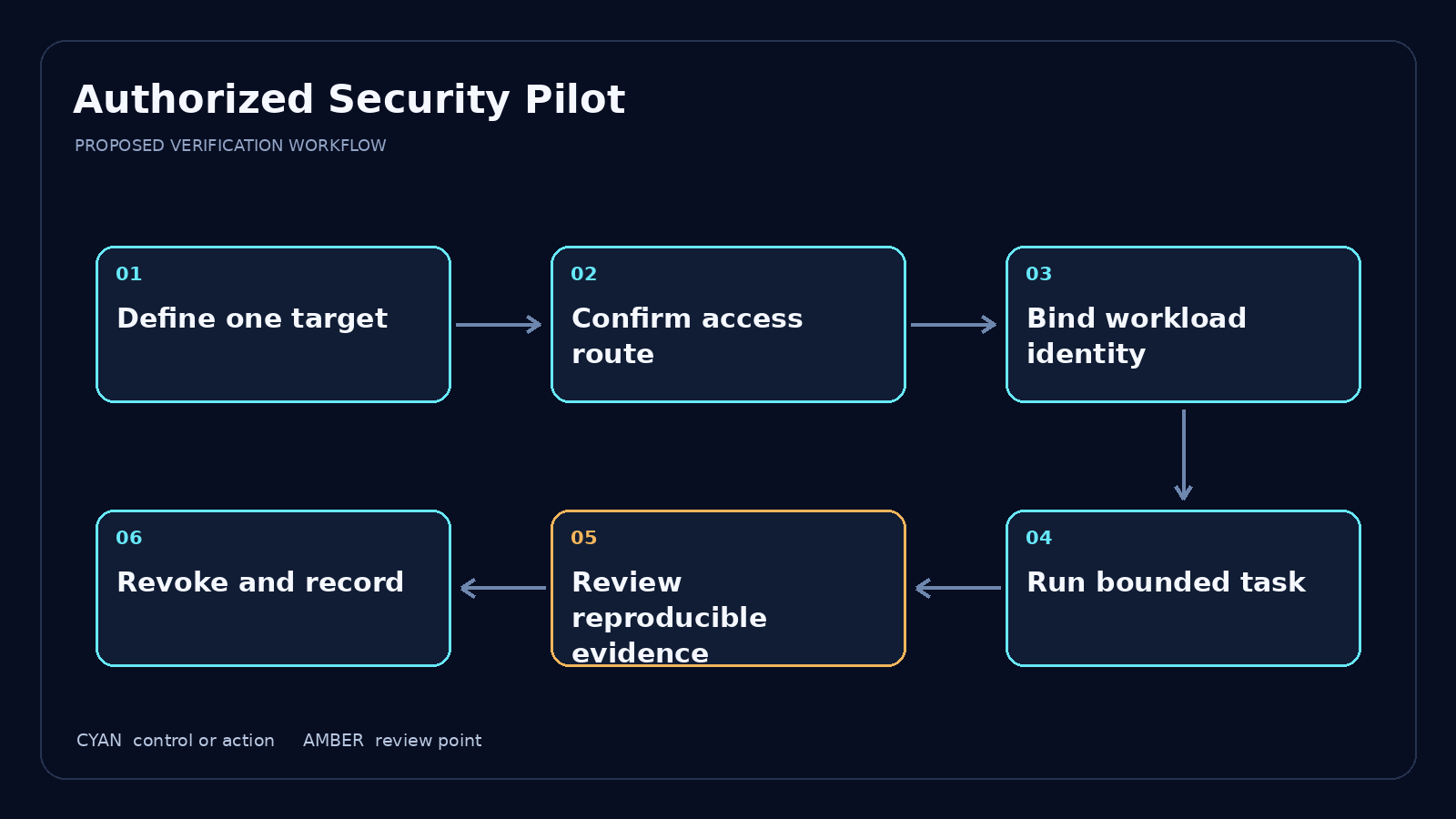
The pilot record should also identify who may accept residual uncertainty. A technical operator can describe a limitation, but a business owner may need to decide whether that limitation is acceptable for the proposed service. Keep the observation and the acceptance decision separate, with a review date. This prevents an engineer’s incomplete test from being mistaken for a broader procurement approval.
When the decision remains pending, preserve the completed synthetic evaluation and its configuration. The team can reuse that evidence once the missing approval is resolved instead of repeating the whole pilot or quietly expanding its scope.
Execution policy outside the model
A model can help interpret a request, but it should not be the sole authority deciding whether it may execute that request. Keep the target register, approved action types and credential scope in an independently controlled policy layer. The model’s own statement that permission exists is an input to inspect, not proof.
Use explicit action categories. Reading a supplied source file, sending a normal staging request, modifying a test record and changing a production permission have different consequences. The workflow should distinguish them before execution. A broad command tool with access to everything makes those distinctions harder to enforce.
Bind the policy to stable target identity. A hostname alone can be insufficient when redirects, shared services or environment changes are involved. Determine how the tool will establish that the actual destination remains within scope. If it cannot establish that relationship, stop the action and request an owner decision through the normal project process.
Apply the same principle to retrieved content. A web page, repository file or tool response may contain instructions, but those instructions do not grant authority. The operator should define how the system treats untrusted material and which actions require approval. A hostile document must not be able to expand the target scope merely by asking the model to do so.
Keep approval records specific. An approval should identify the proposed action, relevant target and data, expected impact and time. A stale blanket approval is difficult to interpret when the task changes. Reuse authorization when the action remains within its established scope, and obtain a new decision when the scope materially changes.
Build a stop path that works during partial failure. The operator should know how to suspend new actions, revoke the workload identity and preserve evidence without relying on the same model session that is misbehaving. Test that path in the pilot with synthetic work. A stop button that nobody has exercised is an assumption.
Separate policy failures from model-quality failures in the evaluation. A bad explanation is a model-output problem. A tool executing outside its allowed target is an execution-control problem. Both matter, but they need different owners and fixes. Combining them into one “AI safety score” can hide the practical remediation.
A safe toy example of independent scope enforcement
The following Python example runs entirely in memory. It does not contact Claude, authenticate to a provider, invoke a browser or test any real target. It models a proposed authorization check joining a program grant, a target scope and a requested action. The fictional values are deliberately small enough to inspect.
A grant identifies the route and workspace in which it may be used. A target scope identifies the owned fixture and permitted action. The request must satisfy both. This structure illustrates why “approved user” is not a sufficient execution decision: identity can be valid while the target, route or action is wrong.
from dataclasses import dataclass

@dataclass(frozen=True)
class ProgramGrant:
    route: str
    workspace: str
    expires_at: int

@dataclass(frozen=True)
class TargetScope:
    target: str
    actions: frozenset
    expires_at: int

def permitted(grant, scope, request, now):
    return (
        now < grant.expires_at
        and now < scope.expires_at
        and request["route"] == grant.route
        and request["workspace"] == grant.workspace
        and request["target"] == scope.target
        and request["action"] in scope.actions
    )

grant = ProgramGrant("demo-route", "review-lab", 1100)
scope = TargetScope(
    "owned-staging-fixture",
    frozenset({"read-synthetic-record"}),
    1050,
)
good = {
    "route": "demo-route",
    "workspace": "review-lab",
    "target": "owned-staging-fixture",
    "action": "read-synthetic-record",
}
assert permitted(grant, scope, good, 1000)

for field, value in [
    ("route", "different-route"),
    ("workspace", "customer-runtime"),
    ("target", "unapproved-fixture"),
    ("action", "change-permissions"),
]:
    altered = dict(good)
    altered[field] = value
    assert not permitted(grant, scope, altered, 1000)

assert not permitted(grant, scope, good, 1050)
print("Toy scope boundaries passed.")
The target-scope expiry is intentionally earlier than the program-grant expiry. At the later test time, the program grant is still current but the target permission is not. That is a useful failure case for a real workflow: one authorization can expire before another.
The example omits many production concerns, including cryptographic verification, identity-provider trust, policy administration, clocks, audit integrity and concurrent changes. Those omissions are limits, not implementation advice. A production system needs supported components and a security review appropriate to its environment.
Use the toy to test understanding. Ask a reviewer which condition should reject a moved workload or an out-of-scope action, then compare the actual decision. The reviewer should not change the allowed set merely to make a desired request pass. The policy expresses the owner’s decision, not the model’s preference.
A successful run proves only the behavior of these fictional objects. It does not establish that a provider grant is active, that an external service is approved or that a customer’s rules permit a test. Keep those real-world facts in their own evidence records.
Diagnose a blocked task without trying to evade controls
Begin by preserving a sanitized description of the task, product route and observed status. Determine whether the intended user is operating in the configured organizational context. A configuration problem can look like a capability problem when the user has several accounts or the workload points at a different environment.
Ask the administrator to compare the effective route with the approved deployment record. Check the workspace or role, the use category and any current requirements shown by the product. Use supported administration and support channels. Do not create alternate accounts or move traffic between organizations merely to obtain a different refusal outcome.
Next, examine the task itself. Is the requested action within the provider’s tier and policy, the customer’s scope and the tool’s allowed methods? A task can be legitimate in general while one proposed step is outside the current authorization. Narrow the step to the approved objective instead of treating every block as a false positive.
Separate a model’s refusal from a tool error. An expired workload token, unavailable endpoint, unsupported input or missing file is not necessarily a cyber safeguard decision. Record the actual status and investigate the appropriate layer. A vague “Claude is blocking us” ticket makes the diagnosis harder.
When the allowed task still appears blocked, submit a minimal reproducible description through the provider’s support process. Use synthetic inputs where possible and avoid exposing credentials, customer data or exploit material that is not needed for the question. The support record should help the provider understand the permitted task, not challenge its controls.
Document the outcome and any scope change. If the provider confirms that the task is unsupported, design a workflow within supported capabilities or choose another authorized method. A refusal is not permission to bypass the service’s safeguards. It is information that belongs in the operating decision.
Evaluate evidence quality independently of model fluency
A polished explanation is useful only when it connects to an observable property. For each pilot finding, ask what input produced the observation, which component was involved and why the result violates an agreed expectation. The reviewer should be able to separate the evidence from the model’s narrative.
Use a small evaluation set with known outcomes. Include one genuine defect in an owned fixture, one corrected case and one ambiguous case that should remain unresolved. The set tests whether the workflow can distinguish a finding, a pass and insufficient evidence. A system that labels everything vulnerable or everything safe has not demonstrated useful judgment.
Track false positives and false negatives separately. A false positive consumes review time and can lead to unnecessary changes. A false negative leaves exposure unaddressed. The relative cost depends on the task, so the evaluation should state its priorities rather than compress both into an unexplained score.
Measure reproducibility. Run the same bounded task under the same fixture and compare the material evidence, not exact wording. If the proposed explanation changes while the observation remains stable, the reviewer can resolve the interpretation. If the claimed observation itself changes without a fixture change, investigate the tool and evidence pipeline.
Assess the handling of uncertainty. A useful workflow names missing information and proposes a bounded next check. It does not invent an endpoint, patch version or exploit outcome to fill a gap. Include a case in which the correct result is to stop and request an owner decision.
Evaluate the whole system rather than the model in isolation. Tool permissions, data access, environment state and human review can determine the result. A benchmark from a provider’s controlled evaluation cannot establish the performance of a different harness against a different application. Retain the exact configuration used in the pilot.
Compare cost with reviewed outcomes. Count tasks that produced accepted evidence, tasks needing rework and tasks that were abandoned. Tokens, elapsed time and finding volume are useful supporting measures, but none establishes business value without the review result and a stable scope.
Build a report that preserves the evidence boundary
A security report should distinguish a directly observed behavior from a model’s interpretation. State the test environment, authorization context, relevant role and synthetic data. Include the minimum steps needed for an authorized reviewer to reproduce the result without turning the report into an unnecessary collection of sensitive material.
For a finding, identify the expected security property and the observed violation. A screenshot can support the observation, but it should not be the only explanation. Readers need to understand which record, response or action matters and why. Use redacted or synthetic values when the actual content is not essential.
For a pass, name the test performed and its limits. “No issues found” is too broad if the workflow examined one role and one path. A precise pass can still be valuable: the specified denied operation was blocked, the allowed operation succeeded and the relevant output contained no protected fixture data.
For an unresolved result, state the missing evidence and the next owner. Do not let uncertainty disappear because the final report template expects a severity. An unresolved configuration or permission question can block a reliable assessment without being a verified vulnerability.
A product-assisted workflow, including one evaluated through Penligent, should be held to the same evidence standard. Confirm the product’s current supported methods and deployment arrangement before use. A tool name cannot replace the test scope, reproduction record or human review, and this article does not certify a specific integration.
Keep provider program evidence separate from customer findings. A customer usually needs proof of the assessed behavior and the assessor’s authority, not private applicant documents or unrelated account configuration. Link the internal records only where appropriate for audit and governance.
Put budgets and concurrency around review capacity
Set a pilot budget before the first run and define what happens when it is reached. The budget should cover provider usage, tool execution, operator time and evidence review. A task that is cheap to generate can still be expensive to investigate if it produces many weak claims.
Use concurrency to match available reviewers and target capacity. More simultaneous tasks can make failures harder to attribute, increase duplicate work and complicate the stop procedure. Begin with a bounded number of independent tasks and expand when the team can review their results consistently.
Record the work unit. One “test” might mean an individual request, an analysis session or an entire assessment. Cost comparisons are meaningless if teams use different definitions. State the unit, target scope, environment and completion criterion alongside the measured usage.
Avoid promising a fixed cost from a model’s token price alone. Real workloads can retry, call tools, retrieve context and require human correction. Use observed pilot results to build a range appropriate to the intended task. Published prices and plan features should be checked through current official materials at procurement time.
Add a review queue limit. When unreviewed findings reach that limit, pause generation or redirect effort to validation. This makes the bottleneck visible and prevents a large transcript backlog from being mistaken for assessment progress. The goal is completed, defensible work.
Review spending anomalies together with technical behavior. A sudden increase can reflect an expanded scope, a looping task, repeated authentication failures or a model configuration change. Treat the usage signal as a prompt for investigation rather than assuming it is evidence of more productive testing.
Prepare for an out-of-scope action or data exposure
Define the incident procedure before enabling consequential tools. The operator should know how to halt new actions, identify the current workload, preserve relevant evidence and notify the responsible owner. That procedure should remain available if the model session or ordinary communication channel is unavailable.
If an out-of-scope action is proposed but blocked, retain the decision and relevant context for review. The block is useful evidence that the policy worked, but the proposed behavior can still reveal a configuration or instruction problem. Investigate the cause without treating a blocked proposal as a completed compromise.
If an action occurred, determine what actually happened before expanding the claim. Identify the destination, credentials, data and observable outcome. Stop further work under the owner’s process and preserve the minimum records needed for investigation. Do not let the agent continue exploring the result to “see how bad it is” without a new authorization decision.
For possible data exposure, identify which data crossed which boundary and which parties may hold it. Use the organization’s approved security, privacy and contractual processes to determine the response. Avoid issuing a public assurance or legal conclusion based solely on the model’s account of its own actions.
A provider account or credential problem may require a different owner from an application-testing problem. Keep the workstreams connected without conflating them. The model operator, target owner and platform administrator should each have a defined role in containment and recovery.
After the immediate response, repair the control that allowed the condition and rerun an appropriate synthetic regression. A revised prompt alone may be insufficient when the failure involved tool permissions or data handling. The corrective action should match the boundary that failed.
Revoke access and retire the workflow deliberately
An assessment has an end state. Remove temporary test credentials, close target access and revoke workload permissions through the supported processes. Preserve required evidence under the agreed retention policy. Do not leave a pilot’s broad access in place because the next project might need it.
Maintain an offboarding checklist tied to identities and environments. A person’s departure can affect provider roles, customer systems, source repositories, secret stores and report access. The checklist should name the relevant owners so that removing one account does not create a false sense that every path has been closed.
Test revocation with a harmless denied action in the controlled environment. The test should establish that the retired identity can no longer perform its former task. A completed administrative request is useful, but effective denial is stronger evidence of the intended access change.
Archive the deployment decision with its review date and scope. Record why the organization selected the route, what the pilot established and what limitations remain. A later team should not have to infer those decisions from old prompts or an invoice.
Changes to model routing, program terms, tool capabilities or data flows can require a new review. Identify which changes trigger reassessment and who monitors them. An approval from a previous deployment is historical evidence, not a permanent entitlement to run a materially different system.
The same discipline applies to a paused workflow. If the team is waiting for external-use approval or a data-handling decision, keep the affected path disabled and continue only the independent work that remains authorized. A pending application does not become approval through elapsed time.
Work through a fictional small-team decision
Consider a fictional three-person security company that wants to use a model for its own application and later for customer assessments. Its internal pilot uses synthetic records in a staging environment. The company records provider access, workspace configuration and target scope separately, then runs a bounded analysis task.
The pilot finds an authorization defect in the fixture and produces a reproducible result. That establishes something about the workflow under the tested conditions. It does not establish permission to route client traffic through the same environment or prove that every future application can be assessed with equal accuracy.
Before the first client engagement, the company reviews the provider’s external-use requirements and obtains the necessary decision through the proper channel. In parallel, it prepares a customer statement of work, defines who operates the tools and specifies what the customer receives. Those are complementary workstreams.
The team discovers that its planned product would allow customers to direct prompts and see raw outputs. That design differs from a staff-operated service delivering reviewed reports. It therefore pauses that integration until its provider use category and controls are resolved. The company can still continue supported internal work.
A month later, one tester leaves. The company removes the tester’s provider role, customer access and report permissions, then verifies the relevant denied paths. This is a stronger outcome than merely removing the person’s email account and assuming every dependent service followed automatically.
The example shows why access readiness is a collection of concrete states. Identity, provider approval, effective configuration, target authority, data handling and evidence review can each be complete or pending independently. Keeping those states visible lets a small team move quickly without turning an unanswered question into an operational assumption.
Frequently asked questions
What is Claude CVP?
- It is Anthropic’s program for verified security work with tier-dependent access.
- Treat it as one part of a permitted workflow, alongside target authorization and execution controls.
Can an individual researcher apply?
- The tier announcement includes individuals in Defense Access.
- Describe the actual research and controlled environment accurately; admission remains the provider’s decision.
Does a paid subscription automatically grant advanced cyber access?
- Payment and program approval are separate.
- Verify the effective account and product configuration before planning work that depends on a grant.
Does internal approval cover customer work?
- The current help page requires a separate external-use decision for customer services or products.
- Map who operates the model and who receives prompts or raw output before designing the integration.
Should a team keep static API keys in its testing pipeline?
- Review current program requirements and the announced transition date.
- Where supported and appropriate, evaluate workload federation with narrow trust rules and a tested revocation path.
What if a permitted task is still blocked?
- Diagnose the route, configuration and task category, then use the provider’s supported process with a sanitized example.
- Do not treat repeated rephrasing, alternate accounts or hidden routing as an access-control solution.
Can CVP replace an authorized pentesting workflow?
- No. It does not establish customer scope, safe tool permissions, reproducible findings or report quality.
- Evaluate those properties independently in a controlled pilot.
A useful deployment ends with a clear chain of authority and evidence: the right identity uses the approved route, tools stay within the target owner’s scope, data follows an approved path, and a human can review the result. Keep that chain intact as the service and the team change.
The following official Penligent video presents the general product workflow. It is separate from the source research and does not demonstrate or certify the specific findings discussed above.
 Japanese
 English
 German
 French
 Spanish
 Portuguese
 Korean
 Hindi
 Arabic
 Turkish
 Hebrew