
CVE-2026-129245 can turn a leaked GeoServer administrator password digest into an administrator login without the password. The other required ingredient is the remember-me signing key. The vulnerable design kept that key in the data directory and shipped a predictable default. A secret changed inside the same directory does not solve a disclosure that exposes both values. The project rates the issue Critical, with CVSS 4.0 9.2. Source: GeoServer’s advisory.
The operational task is to upgrade every serving node, review the related WFS exposure, and decide whether administrator credentials need recovery. GeoServer published its consolidated advisory on November 23, 2026; the fixed releases were already available on October 19, 2026. These are disclosure and release dates, respectively. Sources: November security update そして October release announcement.
Five CVEs, with different prerequisites
The project describes five separately fixed issues in one reported unauthenticated code-execution chain. That relationship does not make every stage independently unauthenticated RCE. The table below separates the boundary each flaw crosses from the conclusion a defender can reasonably draw. It is a review framework based on the individual advisories, not an exploit sequence to execute.
| Issue | Boundary affected | Condition or limit that matters |
|---|---|---|
| CVE-2026-129244 | WFS error response exposes the absolute data-directory path. | The path disclosure alone grants no access. It can identify where sensitive configuration resides. |
| CVE-2026-129243 | The dispatched service name and the name used for service authorization differ. | Operations protected only by service rules can lose that check. Layer and data permissions still apply. |
| CVE-2026-120705 | A built-in WFS query allows XML injection, local text-file reads and SSRF. | No custom stored query or CreateStoredQuery permission is required. Anonymous layer publication affects whether fetched contents are returned. |
| CVE-2026-129245 | Possession of the signing key and administrator digest can produce an accepted remember-me login. | Knowing a default key alone is not the complete condition; credential material is also needed. |
| CVE-2026-129242 | JDBC user/role property loading can deserialize objects. | Administrator control is required for this stage; resulting code runs with the GeoServer process’s OS privileges. |
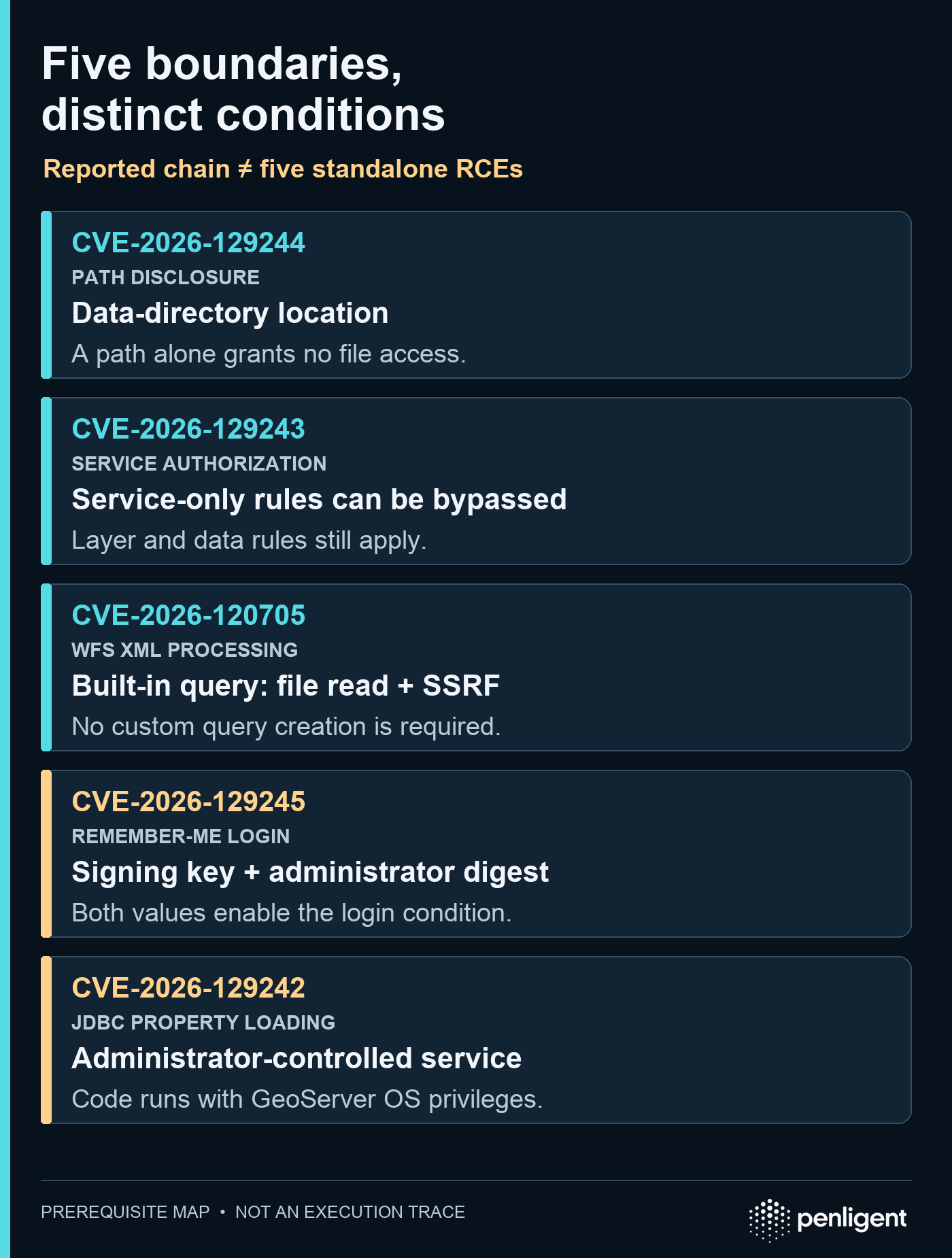
One distinction changes prioritization: disabling custom stored-query creation does not eliminate CVE-2026-120705. The WFS advisory identifies a built-in query as a separate entry point. It also distinguishes reading a file from returning its content: without an anonymously published layer, content may be read without being echoed. Therefore, an empty or unhelpful response is not a patch-verification result.
For CVE-2026-129243, review authorization rules together with service dispatch, rather than treating an existing deny rule as proof of protection. The service-security advisory recommends checking wfs/query そして workspaces/*/wfs/query for unexpected stored queries. Compare entries with the owner’s approved inventory; an unfamiliar file needs investigation, not an automatic compromise verdict.
Match the deployed branch to its fixed release
について November announcement identifies the following GeoServer releases as fixing this group. The affected ranges below come from the CVE-2026-129245 package advisory. A branch row is a package assessment, not proof that a particular host was attacked.
| GeoServer line | Affected range recorded for CVE-2026-129245 | Fixed release |
|---|---|---|
| 3.0 | 3.0.0–3.0.1 | 3.0.2 |
| 2.28 | 2.28.0–2.28.5 | 2.28.6 |
| 2.27 and older versions in the advisory | 2.27.6 and earlier | 2.27.7 |
For an older deployment, treat 2.27.7 as the advisory’s historical fix point, not a promise of ongoing support for every old branch. Select a supported migration destination and compatible extensions. For appliances or repackaged distributions, obtain the supplier’s mapping to the upstream fixes; a product version that resembles the table is not sufficient evidence.
Inventory each backend behind the load balancer. Record its running GeoServer build, deployment artifact and enabled extensions, then reconcile those records with the rollout. A successful check against the public hostname can repeatedly reach one healthy node while another remains outdated. This is deployment verification guidance, not a claim that GeoServer’s advisories observed that failure in your environment.
The key change also changes session behavior
について remember-me fix replaces the data-directory key with a configured property or a randomly generated value. Without an explicit property, the implementation generates a key for that process run. The accompanying code comments explain that a cookie then belongs to the issuing node and stops working after that node restarts. This is source-code analysis; no cookie-forgery test was performed for this article.
For clustered deployments, the current authentication documentation specifies GEOSERVER_REMEMBERME_KEY with the same long, complex value on every node. Treat it as a secret managed through the deployment’s approved configuration system. Record consistency and access controls without copying its value into a ticket, screenshot or monitoring output. An operator-selected shared key is a deliberate cluster setting; it is not permission to restore the old shipped default.
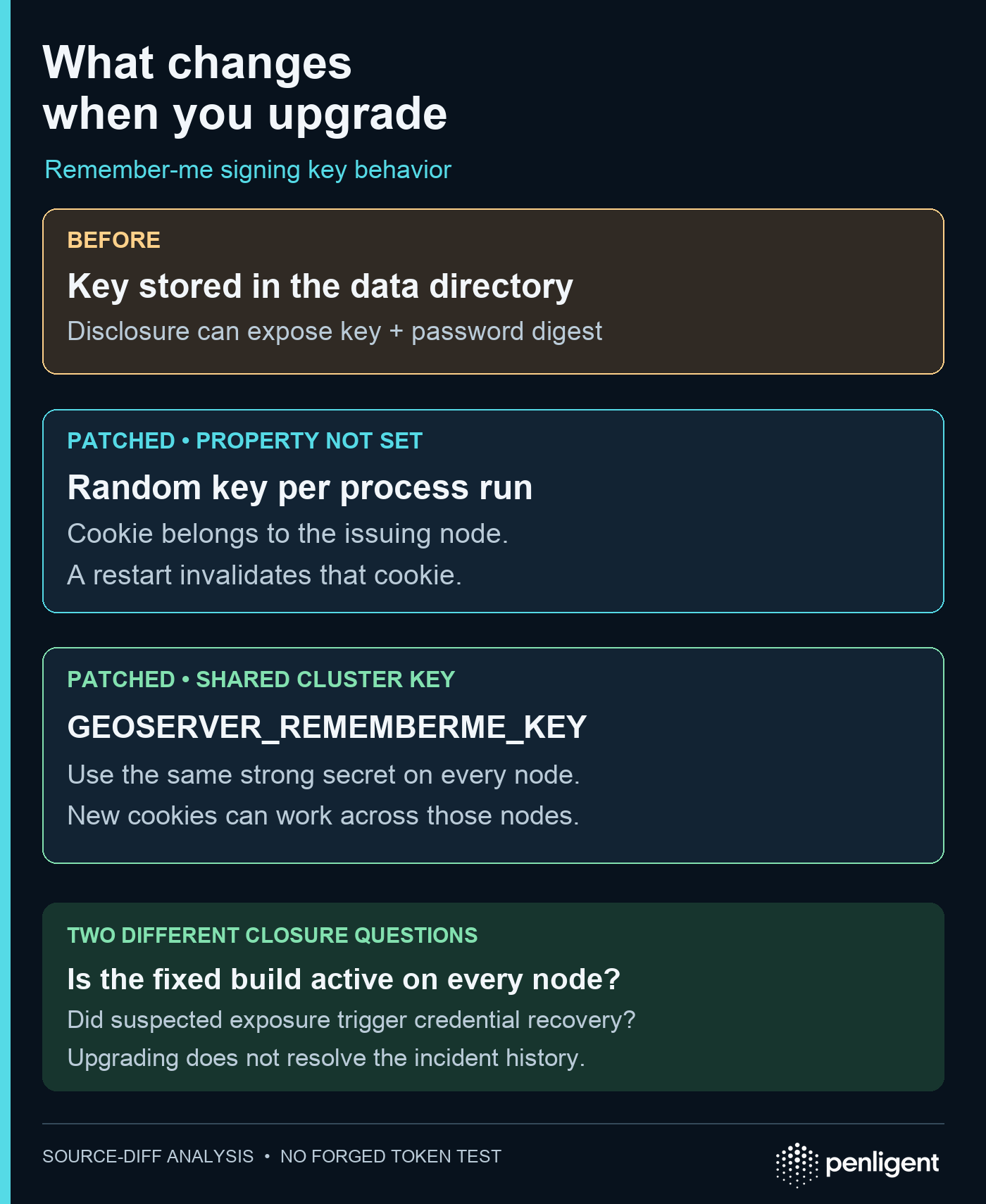
GeoServer’s CVE advisory states that upgrading invalidates existing remember-me cookies. Plan for users to sign in again. For acceptance testing, use an ordinary authorized test account: confirm a pre-upgrade remember-me cookie no longer authenticates, then verify new login behavior against the intended nodes. In a cluster configured to share the key, confirm expected cross-node behavior. These checks exercise legitimate authentication; they do not need an administrator digest or a forged token.
Keep the scope of that result precise. A rejected remember-me cookie is evidence about that authentication path. It does not establish that every session, API credential or prior attacker action has been removed. Record the old-cookie test and the deployment/version check separately so a passing login test cannot hide an unfinished rollout.
Temporary controls must cover the exposed paths
If an upgrade cannot be completed immediately, the remember-me advisory recommends removing the rememberme filter from the web authentication chain. Its alternative of changing the old key depends on preventing data-directory disclosure. Do not present key rotation inside that directory as an independent fix for a still-readable directory.
について WFS advisory recommends restricting anonymous WFS or disabling WFS when unnecessary. Read that alongside the service-rule bypass advisory: a rule inside the affected authorization layer cannot be the only assurance. Its proxy mitigation covers a slash in the service parameter in both query-string and XML forms. Have the service owner verify complete routing and expected legitimate requests before relying on a temporary restriction.
について JDBC advisory separately recommends limiting administrator access and restricting the resource and security REST interfaces to trusted networks. The JDBC security module and HSQLDB driver are included in the standard distribution, so do not dismiss that stage solely because an operator never intentionally configured a JDBC identity service. Network restrictions and trusted administrators reduce opportunity; upgrading repairs the unsafe property-loading behavior.
Separate patch closure from credential recovery
A useful incident record has two conclusions. The first is whether the deployed application has the fixes and intended service boundaries. The second is whether exposed credential material or earlier unauthorized changes require recovery. The following evidence checklist is an operational interpretation of the advisories, rather than a vendor-provided detection rule.
| Decision | Evidence to retain | What remains unresolved |
|---|---|---|
| Application fixed | Per-node build and rollout records; compatible extensions; intended WFS and administrator access. | Whether information was disclosed before the rollout. |
| Remember-me behavior correct | Old-cookie rejection; new ordinary login; intended key-sharing behavior across nodes. | Other authentication material and historical activity. |
| Suspected credential exposure addressed | Administrator password changes required by the incident plan; protected configuration; review of unexpected stored queries and administrator changes. | The complete incident scope without a separate investigation. |
If exposure is suspected, GeoServer explicitly advises changing administrator passwords. Preserve relevant access logs and configuration evidence under the organization’s incident procedure, then perform recovery from trusted administrative systems. Do not paste password digests, configuration secrets or session cookies into a public scanner to “confirm” the flaw. A repaired instance does not retrospectively prove those values stayed private.
The sources reviewed for this article do not establish exploitation in the wild. The official reported chain establishes a vulnerability relationship, and the fixed releases establish a remediation path. Neither statement should be promoted into an observed attack campaign or a claim that Penligent reproduced the chain.
For teams organizing authorized security validation and evidence collection, the following 寡黙 product demonstration provides general workflow context. It does not demonstrate exploitation or remediation of these GeoServer CVEs.
Method and scope: Prepared with AI assistance from GeoServer’s official advisories, release announcement, authentication documentation and published fix, checked November 26, 2026. The diagrams describe security boundaries and configuration behavior. No exploit, crafted WFS request, credential theft or live-instance test was executed.
 Japanese
 English
 German
 French
 Spanish
 Portuguese
 Korean
 Hindi
 Arabic
 Turkish
 Hebrew